The weekend artists, 2015

hermes.jpg

Fathomless Sounding (1932) by Gertrude Hermes.

This should have been the last post of the year but Ken Murphy’s film made a more fitting end. This is still the laziest post of the year, however, being a review of the artists/designers/photographers from 50 or so weekend posts. Scroll down to see what caught my attention over the past twelve months.

gourmelin.jpg

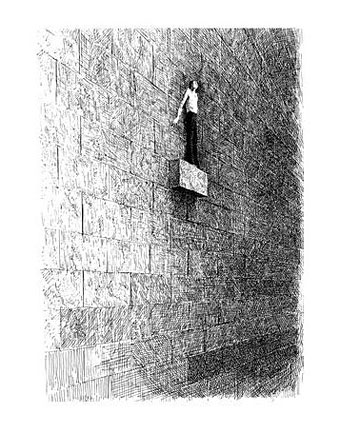
Untitled drawing by Jean Gourmelin.

hugo.jpg

Cover by Valentine Hugo for Contes Bizarres (1933) by Achim d’Arnim. See Hugo’s interior illustrations here.

Continue reading “The weekend artists, 2015”

Merlin

merlin06.jpg

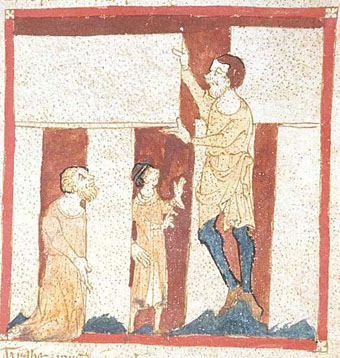
Merlin building Stonehenge (14th century) from Folio 30r of British Library, Egerton 3028.

The Arthurian magus in art and illustration. Despite the antiquity of the Arthur legend there doesn’t seem to be much early representation of Merlin outside a few drawings in old manuscripts. The British Library’s folio showing the raising of Stonehenge is the oldest known depiction of the ancient structure.

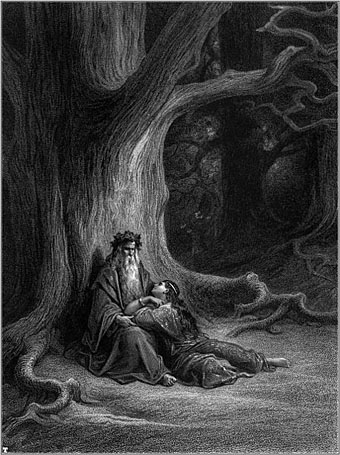
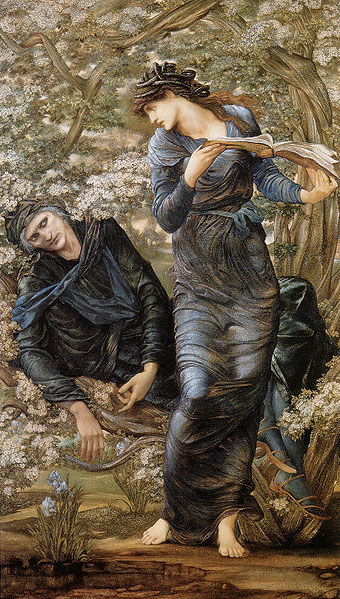
Most of the pictures here are illustrations for the Merlin and Vivien section of Tennyson’s Idylls of the King, the first book of which was published in 1859. Vivien (or Viviane, Nimue, etc) is the sorcerous Lady in the Lake who either imprisons Merlin underground or in a tree depending on whose account you read. Edward Burne-Jones’ The Beguiling of Merlin has long been my favourite of that artist’s paintings. This is only a very small selection of possible pictures, of course. A more complete catalogue would include Nicol Williamson in John Boorman’s Excalibur (1981), a performance that some find overly mannered but one that I’ve always enjoyed.

merlin03.jpg

Merlin and Vivien (1867) by Gustave Doré.

merlin02.jpg

The Beguiling of Merlin (1874) by Edward Burne-Jones.

Continue reading “Merlin”

Weekend links 288

gourmelin.jpg

Untitled drawing by Jean Gourmelin.

• Yet another book featuring my design work (interiors this time) has been published in the past week. Leena Krohn: Collected Fiction is an 850-page selection of novels, novel extracts and short works from a prolific Finnish author of the fantastic. Many of the selections are being published in English for the first time:

From cities of giant insects to a mysterious woman claiming to be the female Don Quixote, Leena Krohn’s fiction has fascinated and intrigued readers for over forty years. Within these covers you will discover a pelican that can talk and a city of gold. You will find yourself exploring a future of intelligence both artificial and biotech, along with a mysterious plant that induces strange visions. Krohn writes eloquently, passionately, about the nature of reality, the nature of Nature, and what it means to be human. One of Finland’s most iconic writers, translated into many languages, and winner of the prestigious Finlandia Prize, Krohn has had an incredibly distinguished career. Collected Fiction provides readers with a rich, thick omnibus of the best of her work—including novels, novellas, and short stories. Appreciations of Krohn’s work are also included.

• “Not only is the nature of Rollin’s choice of images close to [Clovis] Trouille’s, the director structures his movies in a similar fashion, crowding his movies with dreamy horror iconography. Rollin has specifically cited the influence of Trouille’s paintings on his work alongside that of other Surrealist painters working in a figurative style.” Tenebrous Kate explores the influences (and influence) of Jean Rollin’s erotic horror films.

• “[Morton] Subotnick might just have been the first person to get a club full of people—including the entire Kennedy family—dancing to purely electronic music when he played his Silver Apples Of The Moon at the opening night of New York’s legendary Electric Circus.” Robert Barry interviews the pioneering composer.

• “What I actually wanted to do was make music that contained all that was new in the 20th century,” says Irmin Schmidt in an interview with Bruce Tantum. Good to read that Rob Young is writing a biography of Can.

• “…gay mainstream culture was never really about expressing individuality, for me. It always seemed very conformist,” says Bruce LaBruce in conversation with Mike Miksche.

• At Dangerous Minds: Paul Gallagher on the making of Ken Russell’s The Devils, and Martin Schneider on the return of Paul Kirchner’s wordless comic strip, The Bus.

• Two years ago a group of Russian urban explorers climbed the Pyramid of Cheops at night. They’ve just returned from South America, and have a report here.

• In the wake of their new album, Kannon, Jason Roche asks “Are drone-metal icons Sunn O))) the loudest band on the planet?”

Junji Ito returns to horror with two new titles. Related: Fuck Yeah Junji Ito.

• Mix of the week: FACT mix 527 by Jóhann Jóhannsson.

Anna von Hausswolff‘s favourite albums.

Touch (Beginning) (1969) by Morton Subotnik | Rapido De Noir (1981) by Irmin Schmidt & Bruno Spoerri | The Gates of Ballard (2003) by Sunn O)))
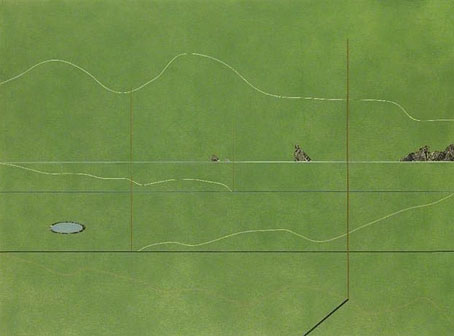
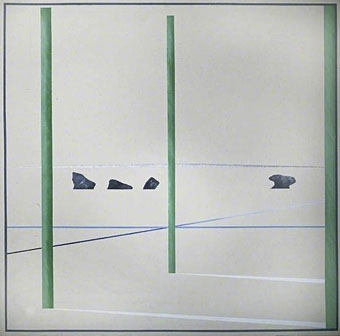
Derek Jarman’s landscapes

jarman01.jpg

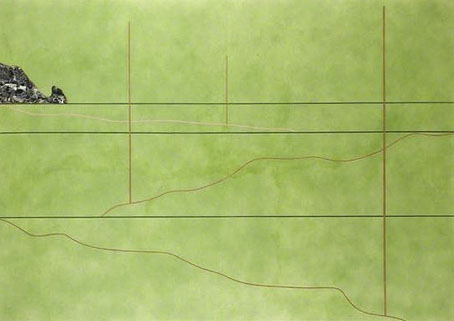
Landscape with Marble Mountain (1967).

1968 – The Lisson Gallery

I have been painting landscapes fairly consistently since I left school, and during that time they’ve changed a great deal. At first they were sparked off by holidays with Aunt Isobel at Kilve in North Somerset. I painted the red-brown earth and dark green of the Quantock Hills, which are at their brightest under the stormy grey skies which blow up over the Bristol Channel. In these paintings there are megaliths and standing stones and clumps of beech trees. By 1965 this has all changed. Oil paint is out. Aquatec, the new acrylic paint, in. The canvas is no longer rough brown flax, but a smooth white cotton duck. The use of rulers and masking tape produces a metrical precision, and replaces improvisation.

I began a series of landscapes which were larger—you have to paint large at the Slade or nobody notices. They have flat red grounds, blue skies, above eye-tricking imagery: Trompe l’oeil water, real taps, classical statues. The largest of these canvases, nine feet by seven, wins the Peter Stuyvesant award for painting at the Young Contemporaries show at the Tate in May 1967.

Since then things have changed again, and at my one-man show, my first one-man show at the Lisson, the canvases have become linear and perfectly balanced. There are no longer any figures or objects, and definitely no jokes. The canvases which are left raw resemble marble through which a grid of lines has been scored.

Derek Jarman, Dancing Ledge (1991)

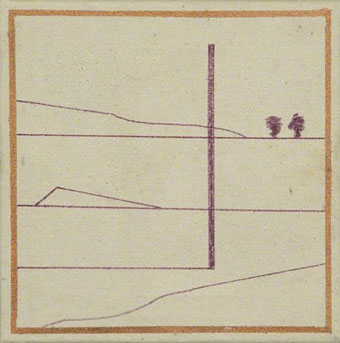
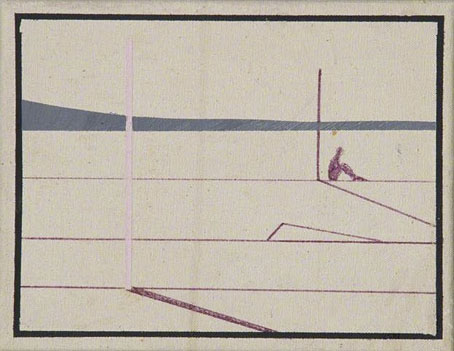
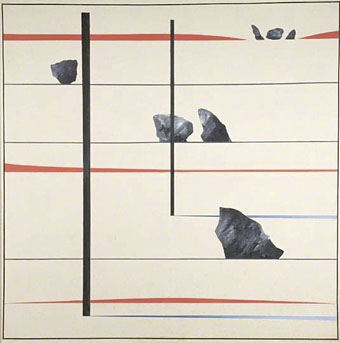
I don’t have a book of Derek Jarman’s paintings so the pictures featured here—taken from the BBC’s collection of public artworks in Britain—are the only examples I’ve seen of his landscapes. These are surprisingly minimal compared to the richly textured Super-8 films he started making in the early 1970s, but then his painting—which is only one facet of his artistic output—went through several distinct periods. It’s notable that he mentions painting standing stones from an early age given their presence in the Avebury series below, and in his beguiling short, A Journey to Avebury (1971).

(Note: Landscape with Marble Mountain is shown on the BBC site as a portrait picture which would appear to be an error. I’ve taken the liberty of rotating the image anti-clockwise.)

jarman02.jpg

Landscape with a Blue Pool (1967).

jarman04.jpg

Landscape (no date).

jarman03.jpg

Landscape II (no date).

jarman05.jpg

Avebury Series No.2 (1973).

jarman06.jpg

Avebury Series No.4 (1973).

Previously on { feuilleton }
Derek Jarman album covers
Ostia, a film by Julian Cole
Derek Jarman In The Key Of Blue
The Dream Machine
Jarman (all this maddening beauty)
Sebastiane by Derek Jarman
A Journey to Avebury by Derek Jarman
Derek Jarman’s music videos
Derek Jarman’s Neutron
Mister Jarman, Mister Moore and Doctor Dee
The Tempest illustrated
In the Shadow of the Sun by Derek Jarman
Derek Jarman at the Serpentine
The Angelic Conversation
The life and work of Derek Jarman