Weekend links 449

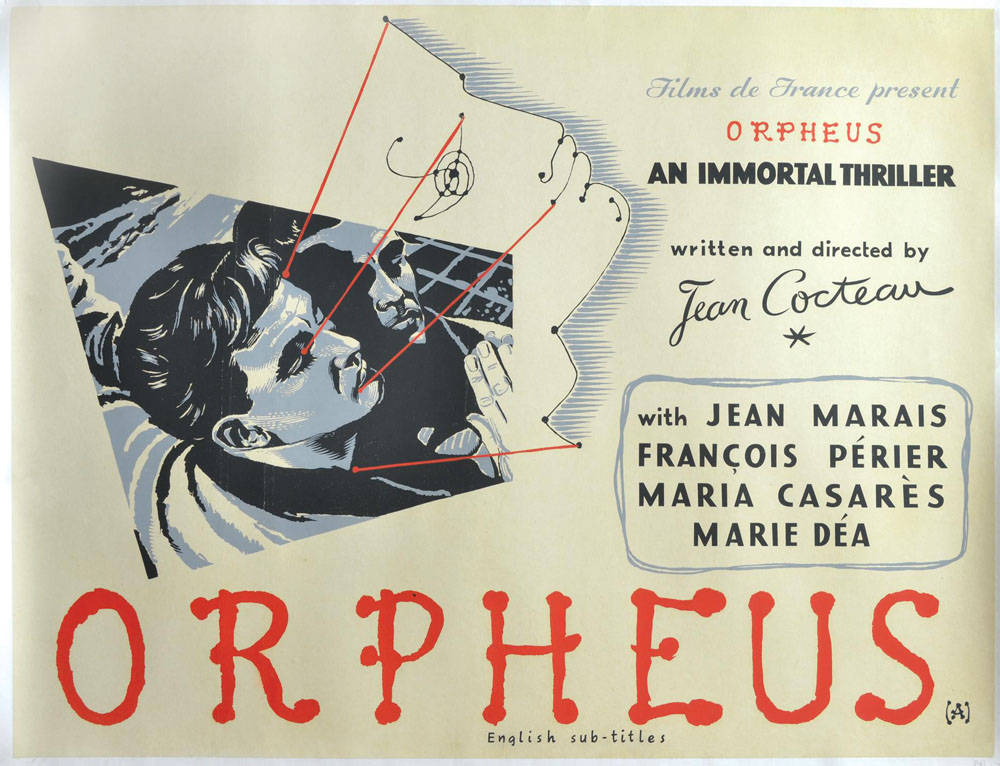
orpheus.jpg

UK poster, 1950. Cocteau’s film receives a UK blu-ray release this week.

• Into the Zone: 4 days inside Chernobyl’s secretive “stalker” subculture by Aram Balakjian. (Again. There’s an implication in Balakjian’s piece that illicit Chernobyl tourism is a new thing even though people have been doing this for a while now.) Related: Jonathan’s visit to the Chernobyl reactor control room, and photos of Soviet-era control rooms (plus a couple of stray American examples).

• “He’s a very interesting author: a disabled, gay writer during the Third Reich…who somehow survived only to be shot by a Red Army patrol days before the end of the war.” At the Edge of the Night (1933) by Friedo Lampe will receive its first English-language publication via Hesperus Press next month.

• “The tradition of the painted still life has been reinvented by contemporary photographers with pictures that pose a puzzle and slow the viewer down,” says Rick Poynor.

• Comic artist Matt Howarth has been writing short reviews of electronic music for many years. Sonic Curiosity is his archive site.

Bauhaus at 100: what it means to me by Norman Foster, Margaret Howell and others.

• RIP Jonas Mekas. Related: a conversation between Jonas Mekas and Jim Jarmusch.

• Beyond the Buzzcocks: Geeta Dayal remembers Pete Shelley‘s electronic side.

• Where to begin with Jean Cocteau: Alex Barrett goes through the mirror.

• Mix of the week: Secret Thirteen Mix 278 by Sarah Louise.

• At Dennis Cooper’s: Jud Yalkut Day.

• Undulating Terrain (1995) by Robert Rich & B. Lustmord | Darkstalker (2000) by Bohren & Der Club Of Gore | Stalker Dub (2012) by John Zorn


Weekend links 448

becher.jpg

Gas Tanks 1965–2009 by Bernd Becher and Hilla Becher.

• At Dangerous Minds: the drawings produced by Moebius for Maxwell House in 1989 are better than the coffee whose sales they were intended to assist.

Jarman Volume 2: 1987–1994, the BFI’s second collection of Derek Jarman films, is now available for pre-order.

• More Gorey: Cara Giaimo on Edward Gorey’s hoards and collections.

That movie [Susan Slade]—and I even have the paperback novelization of it—is a moment. That’s a perfect example. They would never release that image as a still of the movie. Come see a baby catch on fire! To me, I’m kind of rewriting the films as these scenes. That was a real shock to me as a teenager when I saw that. And I thought, Did that just happen? Her baby caught on fire? I remember in Serial Mom I had a big fight with a film executive who said that you can’t have her set her kid’s friend on fire. You can’t do that. And I said, “Why, it’s been in movies forever.” And I’m thinking of Susan Slade, but I’m thinking there’s no point using that in the argument.

John Waters talking to Gina Telaroli about his films but mostly about his works for the art gallery

Georgina Guthrie on how green became cinema’s loneliest colour.

• Tom Crewe reviews Edward Burne-Jones at Tate Britain.

• Mix of the week: FACT Mix 688 by Steve Hauschildt.

• At Strange Flowers: 19 books for 2019.

Jenzeits Cosmic Worlds by Jenzeits.

• Green Onions (1962) by Booker T. & The MGs | Green (1966) by Ken Nordine | Green Fuz (1969) by Randy Alvey And The Green Fuz

Weekend links 447

exercise.jpg

Physical Training for Business Men (1917).

• At Expanding Mind: Erik Davis concludes his discussion with religious scholar Diana Pasulka about anomalous cognition, 2001 monoliths, disclosure, future truths, absurd Christianity, and her book American Cosmic.

• This year the LRB wouldn’t let non-subscribers read Alan Bennett’s 2018 diary but they have a recording of Bennett reading entries here.

• “Glen thought it was very good PR for us to be heavily involved in the druids.” Tom Pinnock talks to the Third Ear Band.

• Rebecca Fasman on the forgotten legacy of gay photographer George Platt Lynes.

• Laura Leavitt on John Cleves Symmes Jr.‘s obsession with a hollow Earth.

• David Parkinson recommends 12 essential Laurel and Hardy films.

• Paul Grimstad on the beautiful mind-bending of Stanisław Lem.

• Mix of the week: Secret Thirteen Mix 277 by Sigillum S.

• The endlessly photogenic Chrysler Building.

Energy Flow by Ryuichi Sakamoto.

195 Gigapixel Shanghai

Solaris: Ocean (1972) by Edward Artemyev | The Sea Named Solaris (1977) by Isao Tomita | Simulacra II (2011) by Ben Frost & Daníel Bjarnason

Weekend links 446

pca.jpg

The Ghost Box label releases a new album by the excellent Pye Corner Audio in February (previews are here). The spectral design, as ever, is by Julian House.

• “In October 1966, Phyllis Willner arrived on motorcycle in San Francisco as a teenage Jewish runaway from Jamaica, Queens. She quickly fell in with the Hell’s Angels, the San Francisco Mime Troupe and, most crucially, the Diggers, who were just getting their street radical thing together in the Haight-Ashbury. The next two years would be eventful: many extraordinary highs, some really terrible lows.” Jay Babcock talks to Phyllis Willner about her involvement with “the executive branch of the hippie movement”, the Diggers.

• At Expanding Mind: Erik Davis talks with religious scholar Diana Pasulka about UFOs, scientific believers, book encounters, elite cabals, studying weirdness, and her new book American Cosmic: UFOs, Religion, Technology.

• Kenneth Anger is now 91 but he still appears hale, and looks even more magus-like than ever. This short film by Floria Sigismondi finds him reminiscing in the antiquated confines of the Chateau Marmont hotel on Sunset Boulevard.

David Wojnarowicz did not write dark fantasy. He wrote real life. In The Waterfront Journals he brilliantly captures electric tales from the mouths of strangers, those he described as “junkies, prostitutes, male hustlers, truck drivers, hobos, young outlaws, runaway kids, criminal types”, whose lives echo his own ostracized existence. He was thirteen when he was first paid for sex and sixteen when he started “turning tricks” regularly. His mother kicked him out of the house. By the time Wojnarowicz came out to friends in New York, he was in his early twenties. He was on the cusp of finding his voice as a writer and his confidence as an artist. It was the mid-1970s. AIDS was about to tear through the gay community.

Lara Pawson reviews three books by artist and writer David Wojnarowicz

John Banville reviews Kafka’s Last Trial by Benjamin Balint: “A scrupulous study of the squabble between Germany and Israel over Kafka’s papers, and the two women caught in the middle.”

• A sitting with the diva of the diode: electronic musician Suzanne Ciani in conversation with Christine Kakaire.

• Mixes of the week: Secret Thirteen Mix 076 by KK Null, and XLR8R Podcast 574 by SHXCXCHCXSH.

Cassie Packard on the colorful and clairvoyant history of aura photography.

Edward Gorey’s Children’s Books Illustrations, Revisited.

Alison Flood on the fascination of miniature books.

Magic Hollow (1967) by The Beau Brummels | Hollow Stone (1972) by Khan | Through Hollow Lands (For Harold Budd) (1977) by Brian Eno

Weekend links 437

watson.jpg

Rawmarsh Road, Rotherham, 1975 by Peter Watson.

Steel Cathedrals (1985), a composition by David Sylvian (with Ryuichi Sakamoto, Kenny Wheeler, Robert Fripp & others) was originally available only on the cassette release of Sylvian’s Alchemy: An Index Of Possibilities, and a video cassette where the music accompanied views of Japanese industry by Yasuyuki Yamaguchi. The video hasn’t been reissued since but may be viewed here.

• “If, as Arthur C Clarke famously observed, any sufficiently advanced technology is indistinguishable from magic, then can we accept that any sufficiently advanced magic is also indistinguishable from technology?” asks Mark Pilkington.

• “I didn’t like the idea of cartoons as just funny jokes, they had to have some relevant piece of observation in them to do with the society we are living in,” says Ralph Steadman.

I listen to music all the time, and I’ll often seek connections across quite disparate genres of that whatever I’m looking for. Sometimes it’s an aesthetic or a feeling, sometimes a pattern or structure, but it tends to cut across genres. The thing I liked about black metal and doom metal is the slowness and weightiness of it, it’s like deep time but in music. Sunn O))), Xasthur, and other bands captured this black gravity of sound. And they also tend to eschew the traditional vocal-lead guitar set-up, and everything is in the slow-moving wash and texture of sound.

I found that in other genres like noise music (especially Keiji Haino), the European avant-garde with composers like Ligeti, Scelsi, and Dumitrescu, dark ambient artists such as Lustmord or vidnaObmana, and contemporary works like Chihei Hatakeyama’s Too Much Sadness, Rafael Anton Irisarri’s A Fragile Geography, or Christina Vantzou’s No.4. There’s a lot to talk about in terms of music and forms of sorrow or grief, certainly every musical tradition has that—the funeral dirge, requiem, lamentation, or whatever.

Eugene Thacker listing a few favourite musicians and composers during a discussion with Michael Brooks about Thacker’s new book, Infinite Resignation

• The fourth edition of Wyrd Daze—”The multimedia zine of speculative fiction + extra-ordinary music, art & writing”—is out now.

• The Library of Congress has opened its National Screening Room, an online service for viewing films in the library’s collection.

The London Library discovered some of the books that Bram Stoker used for research when he was writing Dracula.

• “Oscar Wilde’s stock has never been higher,” says John Mullan, reviewing Oscar: A Life by Matthew Sturgis.

• Mixes of the week: RA Podcast 648 by Sarah Davachi, and Secret Thirteen Mix 269 by Sstrom.

• David Lynch directs a video for A Real Indication by Thought Gang.

• “Edward Gorey lived at the ballet,” says his biographer, Mark Dery.

• A new version of Blue Velvet Blues by Acid Mothers Temple.

• Photos of cooling-tower interiors by Reginald Van de Velde.

Aaron Worth on Arthur Machen: “the HG Wells of horror”.

• The Strange World of…Barry Adamson.

Glass And Steel No. 1 (1983) by Marc Barreca | Death Is The Beginning (1996) by Steel | Painless Steel (2000) by Bohren & Der Club Of Gore