Powell’s Bluebeard

bluebeard1.jpg

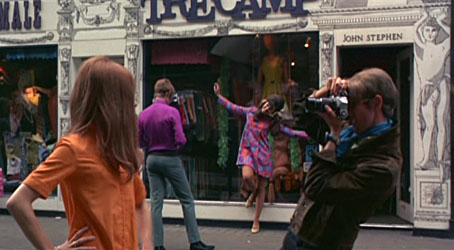
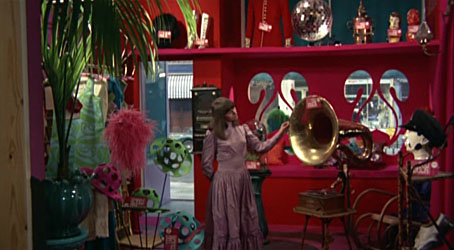
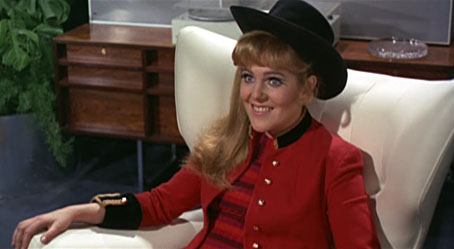
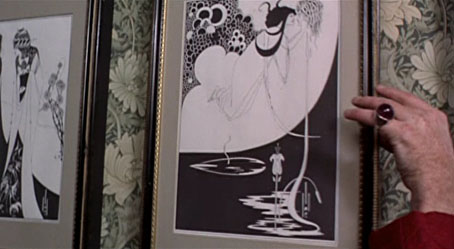
The subject of yesterday’s post, The Tales of Hoffmann, was the closest Michael Powell came to realising his concept of the “composed film”, a work intended to combine performance, music, lighting and set design thereby creating something which was unique to cinema. The central ballet sequence in The Red Shoes is another example of this, and Powell & Pressburger had plans to follow Hoffmann with similar works, including something based on The Odyssey that would have had contributions from Igor Stravinsky and Dylan Thomas. Their plans didn’t work out, unfortunately, Hoffmann was less successful than was hoped and the Archers partnership was eventually reduced to making dull films about the Second World War until P&P went their separate ways. The scandal of Peeping Tom in 1960 finished Powell’s career as a filmmaker in Britain, but he managed to return to the composed film concept in 1963 when production designer Hein Heckroth asked him to direct a production of the Bartók opera Bluebeard’s Castle for German television. Heckroth was responsible for the distinctive character of the later Archers films, including The Red Shoes and Tales of Hoffmann, but was working here with greatly reduced resources. Being a great Bartók enthusiast as well as a Powell aficionado it’s long been a source of frustration for me that this hour-long film is one of the least visible from Powell’s career. To date, the stills shown here are about the only visuals one can find.

bluebeard2.jpg

Bluebeard: Norman Foster.

Bluebeard’s Castle was Bartók’s only opera, a tremendous work and a lot easier to digest than some being a one-act piece for two singers: bass (Bluebeard) and soprano (Judith, his wife-to-be). The fairy tale of the murderous husband is turned into a psychodrama with Judith’s successive opening of the castle’s seven doors revealing more than she wants to know about her suitor’s personality. The libretto by Béla Balázs drops the last-minute rescue of the heroine by her brothers for a darker conclusion. The simple storyline and pronounced symbolism—the doors are often given different colours, while the rooms to which they lead each have a symbolic decor and import—lends itself to a variety of interpretations. Needless to say I’d love to see how Heckroth and Powell presented the drama. To whet the appetite further, one of the P&P sites has this account of a recent screening.

bluebeard3.jpg

Judith: Ana Raquel Sartre.

There are many other filmed versions of this opera, of course, and YouTube has the usual motley selection chopped into opus-ruining ten-minute segments. The BBC screened a fantastically gloomy version in 1988 by Leslie Megahey, director of many fine TV documentaries including the major Orson Welles edition of Arena in 1982 and a chilling adaptation of Sheridan Le Fanu’s Schalcken the Painter. His Bluebeard has been released on DVD in the US, and YouTube has an extract here.

Previously on { feuilleton }
The Tale of Giulietta
Diaghilev and the Ballets Russes
Béla Bartók caricatured

The Tale of Giulietta

hoffmann01

Watching Powell and Pressburger’s The Tales of Hoffmann (1951) again at the weekend it occurred to me that the second act, The Tale of Giulietta, is the closest British cinema gets to the extravagant weirdness of Fellini Satyricon. Or it was until Velvet Goldmine… Lavish costumes and artificial decor, feasts, orgies, lust, betrayal, sorcery, a duel…it’s all there, even a spot of androgyny if you count Pamela Brown’s role as Nicklaus.

• Ludmilla Tchérina as Giulietta
• Robert Helpmann as Dapertutto
• Robert Rounseville as Hoffmann
• Léonide Massine as Schlemil
• Pamela Brown as Nicklaus

If this is on YouTube I don’t want to know. Do the artists a favour, watch their work on DVD.

hoffmann02

Continue reading “The Tale of Giulietta”

Weekend links 40

peterloo.jpg

Manchester, August, 1819: yeomanry on horseback charge a crowd of demonstrators; London, November, 2010: Mounted police charge demonstrators; London, December, 2010: “…police horses have charged the crowd once and appear to be about to do so again.”

Rise like lions after slumber
In unvanquishable NUMBER!
Shake your chains to earth, like dew
Which in sleep had fall’n on you:
YE ARE MANY–THEY ARE FEW.

Percy Shelley, The Masque of Anarchy (1819).

• Amid the rest of the week’s tumult, discussion and activity around the censoring of David Wojnarowicz’s A Fire in My Belly film at the National Portrait Gallery, Washington DC, continues to rumble on. I’d missed this appraisal of the exhibition at The Smart Set. Hide/Seek: Too shocking for America features an interview with Jonathan Katz, co-creator of the exhibition in the eye of the storm:

“When,” Katz asks, “will the decent majority of Americans stand against a fringe that sees censorship as a replacement for debate?” Hide/Seek sought to conquer what Katz calls “the last acceptable prejudice in American political life” – but the conservative right, rampant after last month’s midterm elections, won’t relinquish their prejudices without a fight. And so, “an exhibition explicitly intended to break a 21-year blacklist against the representation of same-sex desire,” says a dispirited Katz, “now finds itself in the same boat.”

Related: Q&A with Hide/Seek curators Jonathan Katz and David C. Ward. The Smithsonian Institution issued a fatuous statement saying they stand by the exhibition despite having forced the removal of one of its works. One of the NPG commissioners resigned in protest at the gallery’s capitulation to political pressure. Other protestors were banned from the Smithsonian after playing a video of the work on an iPad. There’s video of the iPad protest here and the protestors have their own blog. In my earlier post on the subject I noted that the actions of censorious Catholics have given Wojnarowicz’s work far more public exposure than it would otherwise receive. The LATimes has details of some of the galleries throughout the US showing the video as a result of its removal in Washington.

• Related to the above, Bruce Sargeant and His Circle: Figure and Form, a book by artist Mark Beard about the work of his “Bruce Sargeant” alter ego. Homotography has a preview.

• “We focus most strongly at the margins, on the music that others may be blind to. We don’t care whether it is electronic, metal, jazz, folk, classical, noise, world music or whatever. We are as excited by the experimental, as we are exhausted by the ephemeral. We listen. We mosh. We think. We dance. We write words. We capture images. We hope to do justice to the art which inspires us. We are The Liminal”.

rotary.jpg

Rotary Signal Emitter, a vinyl zoetrope by audiovisual duo Sculpture.

Rest Easy Sleazy, a small mix dedicated to Peter Christopherson. Related: A Peter Christopherson tribute mix. Another mix: Mixhead was a 1997 promo CD by Portishead.

• Related to the above: What if we could touch our music again? (Hello? Some of us still play—and create—CDs and vinyl…) Is the mix tape as object-of-seduction a dead concept in a virtual world? “We traded connection for convenience,” says I Miss My Pencil. Their proposed solution, C60 Redux, is an RFID reader plus speakers, packaged in a smart 12-inch case.

• Iannis Xenakis: How an architect took music back to mathematical roots. Related: the Xenakis exhibition at MOCA, Los Angeles.

The Body Electric at Ikon, Birmingham, is the first retrospective exhibition in the UK of work by New Zealand artist Len Lye.

Hayley Campbell has a blog. This week you can read about her contribution to Jamie McCartney‘s Great Wall of Vagina.

More David Lynch: he really does love cherry pie but isn’t 100% sure how magnets work. I sympathise on both counts.

2019: A Future Imagined. Visual Futurist Syd Mead reflects on the nature of creativity and how it drives the future.

Quashed Quotatoes by Michael Wood, reviewing a new edition of Finnegans Wake.

New Weird Australia.

• Portishead’s 2008 performance for the Canal+ show Concert Privé is one of their best filmed concerts. YouTube has the whole thing.

Through the darkness of future pasts

peaks1.jpg

Having spent the past two weeks re-watching the whole run of Twin Peaks, and following that with David Lynch’s 1992 prequel, Fire Walk With Me, I feel I owe the producers of these works a note of apology. Being a long-time Lynchophile I eagerly watched every episode of Twin Peaks when it was first screened by the BBC in 1991, and while I thoroughly enjoyed the first fifteen episodes I grew increasingly dismayed with the series as the principal writer and director wandered off halfway through and the whole thing lost focus. There was a return to form with the very last episode, and Fire Walk With Me is great despite some flaws, a film I much prefer to the later Lost Highway, but that disappointment meant I’d never tried watching the whole series again until now, courtesy of a very reasonably-priced Gold Box Edition (thanks, Fopp).

peaks2.jpg

Kyle MacLachlan and Michael J. Anderson.

There were a number of surprises: first of all the main story hangs together better than I remembered, starting with the investigation into Laura Palmer’s death, grading to the cat-and-mouse game with rogue FBI agent Windom Earle, then looping back via the Black Lodge business in the final episode and Fire Walk With Me to Laura Palmer again. The sub-plots in season two are still a mix of the annoying (all the Dick Tremayne stuff) or the pointless (the unconvincing attempt to put James Hurley into a Black Widow ménage)—and the episode directed by Diane Keaton is positively amateurish—but if you stick with Agent Cooper all is well. Aside from the content lapses the quality of the whole thing was a delight, having watched the series originally with mono sound on a TV with a fuzzy picture. There are many great performances which benefit from the DVD mastering, among which I’d choose Kyle MacLachlan, Sherilyn Fenn, and especially Ray Wise as Leland Palmer whose role is by turns comic, terrifying, and ultimately tragic when he comes to terms with the horror of his predicament.

The best episodes are all Lynch-directed, of course, and I hadn’t realised before that the climax of the first story arc, the murder of Maddy Ferguson, is episode 15, right in the middle of the run. And I had the opportunity this time to do something I’m sure many Lynch-heads have done already, namely watch Fire Walk With Me after the final episode as though it’s episode 31. Seeing the film this way deepens the whole experience despite obvious disjunctions such as the slightly older cast and Donna Hayward being played by a different actor altogether. (In a David Lynch film this perhaps doesn’t matter too much.) What’s most thrilling is the realisation that Lynch has done something here which seems almost unique by joining the end of his otherwise unfinished story to its beginning; Laura Palmer’s life and death becomes a Möbius strip in which questions of ends or beginnings are negated. And why not when the Red Room is an apparently timeless space?

peaks3.jpg

Sheryl Lee.

I could enthuse at length about the musical moments which are always a high spot in Lynchland—Julee Cruise’s appearances, Audrey’s dance, Little Jimmy Scott (!) in The Black Lodge—but if you’ve seen these you’ll know to what I refer. If you haven’t, well…your life is a hollow sham. Now that we’re in the month of the Gift Apocalypse I’d thoroughly recommend the Twin Peaks box as a purchase for anyone who likes the weird stuff. A feast of garmonbozia awaits.

Previously on { feuilleton }
David Lynch window displays
Patrick McGoohan and The Prisoner
David Lynch in Paris
Inland Empire

Weekend links 39

galas.jpg

The Divine Punishment (1986) by Diamanda Galás. Design by Paul White/Me Company.

What the Catholic League and certain members of the House presumably wish to remove from their consciousness is thirty years of death sentences handed down to their parishioners and citizenry, who were told not to wear condoms, and the mistreatment of those stigmatized as miscreants and sinners by their viral status and/or homosexuality and/or status as drug addicts.

• Diamanda Galás responds in her usual forthright manner to the censoring of David Wojnarowicz’s film (and her music which accompanied it) by the Catholic League and members of the House of Representatives earlier this week. Related: Demonstrators gather to protest removal of Wojnarowicz art from NPG | Is the censored David Wojnarowicz video really ‘anti-Christian’? | Vengeance is hers: a conversation with Diamanda Galás.

Update: Hide/Seek: Too shocking for America. One of the exhibition curators speaks out against the censorship.

“Their attitude is: ‘Next time you think of writing about sex, don’t,'” said Susie Bright, who was the editor of the Best American Erotica anthology series for 15 years. “I can’t think of any other fundamental human experience that writers would be encouraged to keep to themselves.” Melissa Katsoulis, a literary reviewer for the Times of London, certainly seemed to conform to Bright’s impression when asked to comment on the award by the BBC: “Sex is a subject best avoided altogether,” she said. “If I was writing a novel, I wouldn’t attempt to write it except in the most Victorian and prim way, because it’s awful. It’s a cliché, but the moments of genuine frisson in books are when hardly anything happens.” Speak for yourself, missy.

Laura Miller dissing the Literary Review‘s annual Bad Sex Award. Good to find more voices being raised against this drivel and the admission of failure which it implies.

The latest offbeat experiment from filmmaker David Lynch: pop singles. He gets crazy with the vocoder here. Related: David Lynch talks new music projects.

scenaillustrata.jpg

Scena Illustrata (1914). Cover by Ezio Anichini (?). Via this set of magazine covers from 1880–1920.

• Tumblrs of the week: Heart Killer and Pretty Pictures from the Paleo-Future Blog.

The Big Picture’s 2010 Hubble Space Telescope Advent Calendar.

National Geographic‘s Best Underwater Views of 2010.

A seasonal gift from a famous Northampton resident.

Paris versus New York: A Tally of Two Cities.

This is your browser on drugs.

Double-Barrel Prayer (1988) by Diamanda Galás, with a video directed by the late Peter Christopherson.