Uncharted islands and lost souls

lostsouls1.jpg

The pulp fiction of the early 20th century favoured remote or uncharted islands as locations for the bizarre and the fantastic; in isolated jungles all manner of savage and grotesque behaviour could take place out of sight of the civilised world. Islands are secure from interference; they can be visited by accident or intention, and later fled from when everything goes wrong. The Island of Doctor Moreau is an early example of the type although Jules Verne’s The Mysterious Island (1874) pre-dates it by twenty-two years. The Island of Lost Souls (1932), the first film adaptation of the Wells novel, is one of a crop of mysterious islands that appeared in the 1930s following the success of the Universal adaptations of Dracula (1931) and Frankenstein (1931). The recent Eureka DVD/Blu-ray edition of the film is the first UK release to present the film in its original, uncensored form. I watched it this weekend.

lostsouls3.jpg

Moreau (Charles Laughton) and Montgomery (Arthur Hohl) at work.

HG Wells famously hated the film, and his vociferous complaints helped to ensure it was banned in Britain until 1958. Even without Wells’ complaints there was enough there to bait the censors who declared it to be “against nature”: writers Philip Wylie and Waldemar Young push the erotic implications of Wells’ story to a degree that would have been impossible in 1896, and would be equally impossible two years later when the Hays Code clamped down on cinematic salaciousness. Charles Laughton’s Moreau is eager to discover whether Lota, the Panther Woman (Kathleen Burke), will show any sexual interest in the marooned Edward Parker (Richard Arlen). The bestiality theme continues when Parker’s fiancée arrives on the island and finds one of Moreau’s Beast People at her bedroom window. Add to this Moreau’s declaration that he feels like God (a similar line was cut from James Whale’s Frankenstein), a traditional British squeamishness towards maltreating animals (unless they’re foxes), and the Panther Woman’s skimpy outfit, and it’s no surprise that the authorities collapsed with the vapours.

lostsouls4.jpg

Sensationalism aside, this is one of the greatest horror films of the early 1930s, and one which follows its source material with much more fidelity than Universal’s Dracula and Frankenstein. The production had been commissioned by Paramount to capitalise on the success of the Universal films, hence the presence of a very hirsute Bela Lugosi as the Sayer of the Law. Cinematographer Karl Struss had worked the year before on Rouben Mamoulian’s excellent Dr. Jekyll and Mr. Hyde; prior to this he photographed Sunrise (1927) for Friedrich Murnau. The combination of Struss’s chiaroscuro compositions, some adept direction from Erle C. Kenton (including crane shots), and a tremendous performance by Charles Laughton puts The Island of Lost Souls in a different league entirely to Tod Browning’s stagey and over-rated Dracula. Laughton’s cherub-faced Mephistopheles is a performance that runs counter to the cod theatricals of the period: he’s sly, confident and completely authoritative even if he looks nothing like Wells’ white-haired doctor.

Continue reading “Uncharted islands and lost souls”

Weekend links 191

strongowski.jpg

Two cover designs from Eliash Strongowski’s 30 Days—30 Covers project.

My thanks once again to Dennis Cooper for placing this blog on his end-of-year lists. Meanwhile. one of the albums I designed earlier this year, Cold Mission by Logos, made the 30 Best Album Covers of 2013 list at FACT.

• “Many of their more outlandish ideas never saw fruition: an organ powered by an entire factory, an electro-acoustic orchestra mounted on a fleet of airplanes.” Colin McSwiggen reviews Sound in Z: Experiments in Sound and Electronic Music in Early 20th Century Russia by Andrey Smirnov.

Queer Pagan Punk, a major film retrospective of the work of Derek Jarman, will take place in February and March 2014 at the BFI Southbank, London.

• “For over forty years, Iain Sinclair’s work has combined obsessive myth-making with urban despair. But what do we know about him?” asks Fatema Ahmed.

• “Rather than trying to intercept alien communications, perhaps we should go looking for alien artefacts.”

• Mix of the week: Radio Belbury Programme 12, and Winter Hours, the Cafe Kaput 2013 winter mix.

BEEP BEEP. BLOOP BLEEP: Road Runner cartoons soundtracked by a Eurorack synthesizer.

Historia Discordia: Documenting the Origins, History & Chaos of the Discordian Society.

gebbie.jpg

Pink Boy by Melinda Gebbie.

Suffered From The Night: Queering Stoker’s Dracula edited by Steve Berman.

• At Dangerous Minds: An interview with soundtrack composer Cliff Martinez.

Sarah Schoenfeld puts recreational drugs under the microscope.

• Powerplant Art-déco, a set of photos by Romain Veillon.

Adrian Curry chooses the best film posters of 2013.

Portent’s Content Idea Generator

Tarkovsky at Pinterest

The Sea Named Solaris (1977) by Tomita | Is That What Everybody Wants? (2002) by Cliff Martinez | Reyja (2011) by Ben Frost & Daníel Bjarnason

Nigel Kneale’s Woman in Black

wib1.jpg

The British television tradition of screening a ghost story at Christmas was filled in 1989 with Nigel Kneale’s adaptation of Susan Hill’s novel The Woman in Black. This isn’t one of the best contributions to the annual ghost drama but at 100 minutes it’s one of the longest, and it has its supporters, some of whom value it above the recent Hammer film production. Seeing as I’d re-watched Nigel Kneale’s major film and TV works earlier this year I thought I’d give The Woman in Black another look. It was better than I remembered although it still left me feeling unsatisfied.

I’ve not read Susan Hill’s book so can’t say how it compares to the television version in any detail. (Wikipedia has a spoiler-heavy list of the differences.) I did see Stephen Mallatratt’s play in 1988, however, the first adaptation of the book which has since become one of London’s most popular theatre productions. The play conjures an effective sense of dread but relies a little too much on loud noises to shock the audience at crucial moments. This is a cheap trick in bad horror films (Wes Craven does it a lot), and it’s just as cheap a trick on a stage. Nigel Kneale may have altered Hill’s story to a degree which apparently displeased her but he didn’t resort to any Craven tricks.

wib2.jpg

The BBC’s Christmas ghost stories have tended to be MR James stories, and The Woman in Black is very much a James pastiche which no doubt helped make it attractive to ITV. All the James hallmarks are there: a man of letters (solicitor rather than a scholar) visiting an isolated part of the English countryside; a lonely house; fearful locals; mysterious deaths; documentary evidence that requires examination; a haunting.

Adrian Rawlins is the young solicitor, Arthur Kidd, given the task of putting the estate of a dead woman in order. Rawlins would have been fine in a smaller role but he wasn’t a good choice for a central character, not when Kidd is on screen every minute of the running time. Far better is the always excellent Bernard Hepton as a genial landowner, a very different role to his sinister Fisher in Robin Redbreast. There’s a lot of solid period detail—Kneale’s dialogue fixes the date at around 1925—and the writing and direction manages to avoid insulting the intelligence. In place of the usual voiceover reading of letters we have Kidd listening to a succession of recording cylinders, an unlikely thing for an elderly woman to be using but it does give the film a connection back to Van Helsing’s device in Dracula. There’s even a surreptitious reference to Kneale’s “stone tape” theory when Kidd says that the ghostly sounds he keeps hearing are like a recording of a terrible event. Director Herbert Wise does some clever hide-and-seek business with the spectral woman, only fumbling things near the end when he makes the mistake of trying to imitate Jack Clayton’s The Innocents. So why does this version still remain unsatisfying?

Continue reading “Nigel Kneale’s Woman in Black”

The Island of Doctor Moreau

moreau2.jpg

Painting by Paul Lehr for the Berkley Highland paperback (1970).

The Island of Doctor Moreau is one of those Victorian novels everyone thinks they know well enough from various film or television adaptations, even when those adaptations have accreted a layer of misconception around the story. In the case of HG Wells’ novel we have The Island of Lost Souls (1932), which the author loathed for its vulgarisations, and which he helped get banned in Britain for many years; the 1977 film directed by Don Taylor which nobody seems to have a good word for; and Richard Stanley’s 1996 adaptation which might have been worthwhile if he hadn’t been kicked off his own film shortly after shooting began. These films may not distort Wells’ novel as much as the numerous adaptations of Dracula, and Dr Jekyll and Mr Hyde, but they still present a skewed impression of a book which is stranger and more disturbing than any screen version.

Wells’ story purports to be the written account of one Edward Prendick who finds himself on Moreau’s remote island after a shipwreck. The bare bones of the story are familiar: Prendick is rescued by Moreau’s alcoholic assistant, Montgomery, and ends up on the island against the doctor’s wishes. The story deviates from the films very quickly by introducing a setting that’s commonplace in Victorian literature but which Hollywood abhors: the all-male enclave. The Island of Lost Souls put “Edward Parker” on the island with his fiancée but went further (to the outrage of Wells and the British censors) by adding a sexy Panther Woman to the menagerie with whom Moreau encourages Parker to mate. There are women among the “Beast People” in Wells’ novel but we’re assured that they’re as grotesque as their male counterparts.

moreau3.jpg

Illustration by Lawrence Sterne Stevens (aka Lawrence) for Famous Fantastic Mysteries, October 1946.

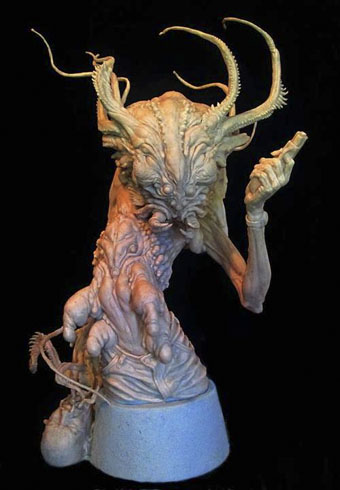
And here we have the second major difference between novel and films: given the limitations of makeup effects—not to say the limitations of the human body—it’s no surprise that the Beast People in the films tend to be like Star Trek aliens, mostly humanoid with a variety of different facial features. Stan Winston’s effects in the 1996 film were the most successful, and were aided considerably by casting a range of actors of different sizes and shapes. All the films tend to present single types, however: wolf-man, cat-woman, bear-man, etc. Wells was writing in 1896 yet his imagination had already brought him this far:

The two most formidable Animal Men were my Leopard-man and a creature made of hyena and swine. Larger than these were the three bull-creatures who pulled in the boat. Then came the silvery-hairy-man, who was also the Sayer of the Law, M’ling, and a satyr-like creature of ape and goat. There were three Swine-men and a Swine-woman, a mare-rhinoceros-creature, and several other females whose sources I did not ascertain. There were several wolf-creatures, a bear-bull, and a Saint-Bernard-man. I have already described the Ape-man, and there was a particularly hateful (and evil-smelling) old woman made of vixen and bear, whom I hated from the beginning. She was said to be a passionate votary of the Law. Smaller creatures were certain dappled youths and my little sloth-creature. But enough of this catalogue.

Later on Moreau has this to say:

“The fact is, after I had made a number of human creatures I made a Thing—” He hesitated.

“Yes?” said I.

“It was killed.”

“I don’t understand,” said I; “do you mean to say—”

“It killed the Kanaka—yes. It killed several other things that it caught. We chased it for a couple of days. It only got loose by accident—I never meant it to get away. It wasn’t finished. It was purely an experiment. It was a limbless thing, with a horrible face, that writhed along the ground in a serpentine fashion. It was immensely strong, and in infuriating pain. It lurked in the woods for some days, until we hunted it; and then it wriggled into the northern part of the island, and we divided the party to close in upon it. Montgomery insisted upon coming with me. The man had a rifle; and when his body was found, one of the barrels was curved into the shape of an S and very nearly bitten through. Montgomery shot the thing. After that I stuck to the ideal of humanity—except for little things.”

Continue reading “The Island of Doctor Moreau”

Weekend links 190

lipton.jpg

Seam Stress (1987) by Laurie LiptonThe Drawings of Laurie Lipton is out now from Last Gasp.

• The Quietus continues to be essential reading: John Doran talks to Richard H Kirk about Cabaret Voltaire | Sarah Angliss, musician and inventor of music machines, talks to Stuart Huggett | “…the most overt literary lodestar for The Art Of Falling Apart is John Rechy, trailblazing chronicler of the gay underbelly of hustlers and queens zig-zagging across America, and author of Numbers, the book from which Soft Cell’s song takes its name.” Matthew Lindsay looks back at Soft Cell’s second (and best) album.

• “The English have something of a tradition where they like to scare you out of your mind at Christmas, a kind of sobering up of the senses by forces that seem to be beyond them.” Colin Fleming on The Signal-Man by Charles Dickens. More ghosts: Lisa Kerrigan explains why she loves Nigel Kneale’s 1989 TV adaptation of The Woman in Black by Susan Hill, and the BFI resurrects The Mistletoe Bough (1904), “the oldest film version of a classic Christmas ghost story”.

• “…the story is filled with a whole mess of embarrassed and embarrassing euphemisms for (ahem) big dick—stiff language, so to speak, like ‘bludgeon,’ like ‘giant concupiscence’ and ‘ostentatious organ.'” Steven Cordova on A Visit to Priapus and Other Stories by Glenway Wescott.

• “Never produced, the screenplay for The Way to Santiago is credited to Orson Welles. A quick look at the text leaves no doubt it was the work of the Citizen Kane filmmaker when he was at the peak of his arrogant brilliance. The script begins: ‘My face fills the frame.'”

• If you’re at all interested in the current state of the British musical underground, the end-of-year lists at Ears For Eyes are worth your attention.

Pee-wee’s (Remastered) Christmas Adventure: An interview with Paul Reubens. Related: Grace Jones sings Little Drummer Boy for Pee-wee.

• “I’m like a drag queen at Halloween.” John Waters on his favourite time of year: Christmas.

• Mix of the week: Secret Thirteen Mix 099, an “(anti)Christmas mix” by Robert Curgenven.

• The British Library makes over a million free-to-use images available at Flickr Commons.

• Lost in Translation: Notes on adapting Ballard by Calum Marsh.

MR James at Pinterest.

Book Map by Dorothy.

Martin (1983) by Soft Cell | Ghost Talk (1985) by Cabaret Voltaire | For Laika (2011) by Spacedog