Weekend links 90

varo.jpg

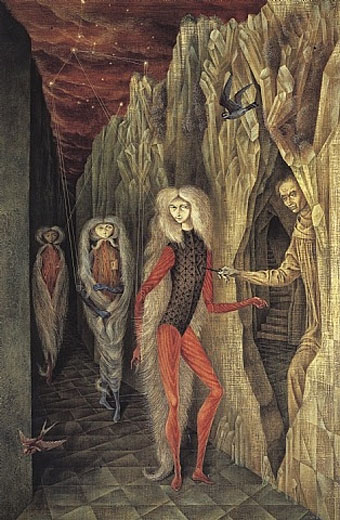
Portrait of Dr. Ignacio Chavez (1957) by Remedios Varo (1908–1963) some of whose Surrealist paintings can be seen at Frey Norris, San Francisco, from 19th January. There’s also In Wonderland: The Surrealist Adventures of Women Artists in Mexico and the United States at the Los Angeles County Museum of Art from 29th January.

The current crop of Republicans jostling for the Presidential nomination have reminded me of the Downunder people in Harlan Ellison’s post-apocalypse novella A Boy and His Dog (1969): a retrograde, fear-ridden community who send troublesome individuals to be exterminated at “the farm”. Rick Santorum (unforgettably pictured here with family in 2006 after losing an election) almost received the majority of Iowa’s votes for his nomination last week, prompting renewed scrutiny of his negative views about gay people, sexually active people, foreign people (especially Arabs and Mexicans), and anyone generally who isn’t a white, Catholic, Downunder person. Santorum is against gay marriage, of course—it’s hard to find a Republican who isn’t—but he also wants to ban abortion even in cases of rape and incest, and given the opportunity would allow US states to prevent any use of contraception. Add to this his pro-torture stance (which offends current Catholic church policy), and his willingness to wage war with Iran, and it’s easy to see why his name prompts reactions such as this:

I have a history with Rick Santorum. In 2003, when Santorum, in an interview with the Associated Press, first compared gay relationships to child rape and dog fucking (have I mentioned that Santorum has compared gay relationships to child rape and dog fucking?), I held a contest to redefine Santorum‘s last name. The winning definition: “the frothy mix of lube and fecal matter that is sometimes the byproduct of anal sex.” (“Sometimes” is the most important word in the new definition of santorum; if you’re doing anal sex correctly, there won’t be any santorum – lower- or upper-case.) And since 2003, the new definition has been the No. 1 Google return when you search “santorum“.

Rick Santorum’s homophobic frothing by Dan Savage

Related: Santorum was named one of the three “most corrupt” Senators in 2006 | “Homohater fosser fram” which is how Dagbladet, Norway’s second largest tabloid newspaper, introduces Santorum to its readers | “Rick Santorum channels Saint Augustine” an article at Slate exploring the Handmaid’s Tale extent of Santorum‘s attitudes towards sex and morality | Rick Santorum quotes as New Yorker cartoons.

marlin.jpg

The Rod (1973) by Brigid Marlin.

• Ballardian posts a long-overdue interview with Brigid Marlin, famous now for having brought two lost Paul Delvaux paintings back to life for JG Ballard, but also a woman with an extensive career as a fantastic artist using Ernst Fuchs‘s laborious mische painting technique.

Quentin Blake on Ronald Searle, in which Blake notes that his hero was given a full-scale exhibition of his work at the Bibliothèque Nationale, France, in 1973 whilst being ignored throughout his life by the major institutions in Britain.

Alfred Jarry: A Pataphysical Life by Alastair Brotchie is reviewed by Michael Moorcock who tells me the Guardian cut out his references to Boris Vian, Maurice Richardson and David Britton.

Ian McKellen stirs things up by suggesting (not for the first time) that Shakespeare was bisexual.

• Ten posters by Only More Never Less inspired by Pink Floyd’s Dark Side of the Moon.

An end to bad heir days: The posthumous power of the literary estate.

Peace Eye! Fug! A Long Talk With Ed Sanders.

• Sand sculptures by Carl Jara.

Letterheady

• Skylab: These Are The Blues (1995) | Beyond The Breeze (1995) | Red Light, Blue Light (1995) | Indigo (Sabres of Paradise remix, 1995) | Seashell (Nobukazu Takemura mix, 1995).
Albert Bierstadt in Yosemite

bierstadt1.jpg

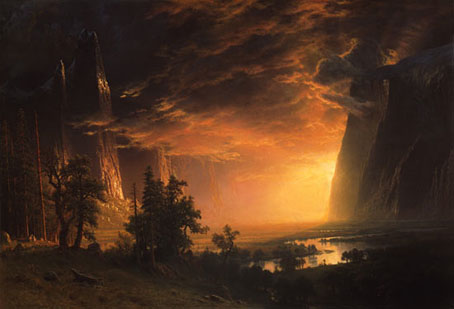
Sunset in the Yosemite Valley (c. 1868).

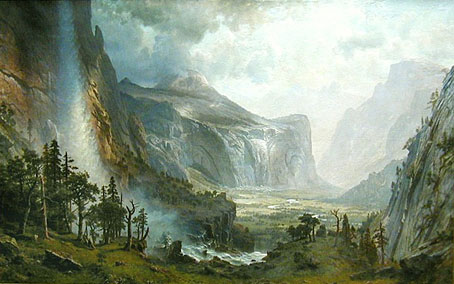
After yesterday’s photos of the Yosemite Valley I have to follow up with paintings of the region by Albert Bierstadt (1830–1902), a German immigrant whose landscape art is connected to the Hudson River School although much of his work concerned views of California and the Rocky Mountains. Some of the paintings apparently received criticism for their deliberately Romantic approach to landscape, especially the John Martin-like blazing sunsets. All the pictures here date from the same period that Carelton Watkins was taking his celebrated photos of the area (which makes me wonder whether artist and photographer ever met) so complaints about lack of realism would seem somewhat redundant.

Wikimedia Commons has a substantial collection of Bierstadt’s paintings.

bierstadt2.jpg

Looking Down Yosemite Valley, California (1865).

bierstadt3.jpg

The Domes of the Yosemite (1867).

bierstadt4.jpg

Cathedral Rocks, A Yosemite View (1872).

Previously on { feuilleton }
Carleton Watkins in Yosemite
Two American paintings

Lunation: Art on the Moon

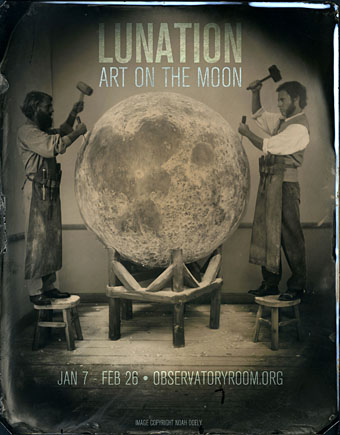
lunation.jpg

Image by Noah Doely.

Steve Moore’s lunarian occult novel Somnium was published a couple of months ago, and now we have an art exhibition exploring similar themes. Lunation: Art on the Moon is a group show at Observatory, Brooklyn, NYC which opens on January 7th:

Artists portray the moon as a source of danger and power, and latter-day sorceresses and men of magic call up to that heavenly lamp, seeking to transcend the ordinary night. For them, the old myths have not changed so much: the moon is still a secret mirror, showing in pale light how the familiar contains always an element of the unexpected…

Participants include Grace Baxter, Jesse Bransford, Susan Crawford, Noah Doely, Joanna Ebenstein, Theo Ellsworth, Michelle Enemark, Ted Enik, Jesse Gelaznik, Ethan Gould, Dr. Gary Greenberg, Pam Grossman, Maria Liebana, Gerald Marks, Chad Merritt, Heidi Neilson, G.F. Newland, Rebeca Olguín, Kathryn Pierce, Lado Pochkhua, Dylan Thuras, Binky Walker, James Walsh and Julianne Zaleta.

Lunation: Art on the Moon runs to the end of February, 2012.

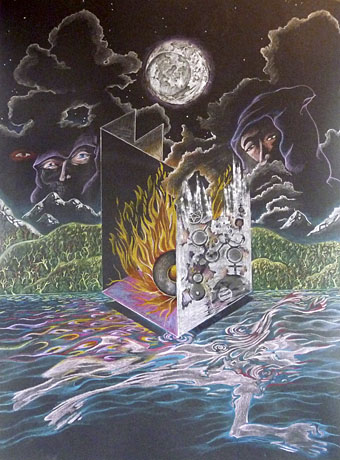
gelaznik.jpg

The Lake at Night by Jesse Gelaznik (2011).

merritt.jpg

Salvio Hexia by Chad Merritt (2011).

ellsworth.jpg

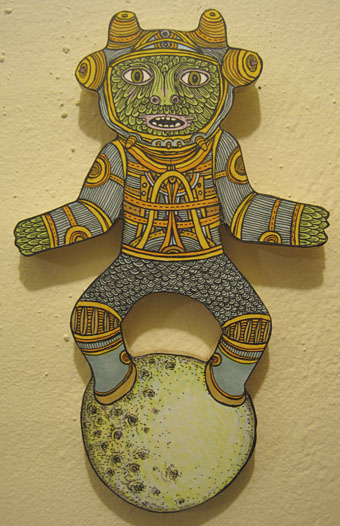
A gigantic space-man has landed on the moon, but why?! by Theo Ellsworth (2011).

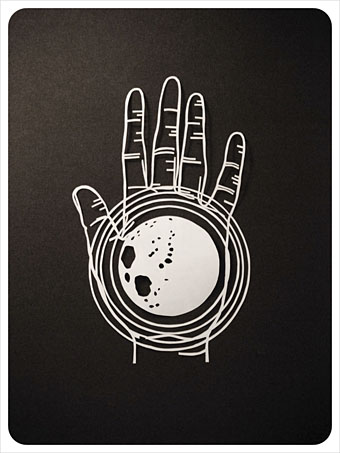
bransford.jpg

Luna by Jesse Bransford (2009).

Previously on { feuilleton }
Somnium by Steve Moore
Blood on the Moon
Filippo Morghen’s Voyage to the Moon

The weekend artists

olofsdotter1.jpg

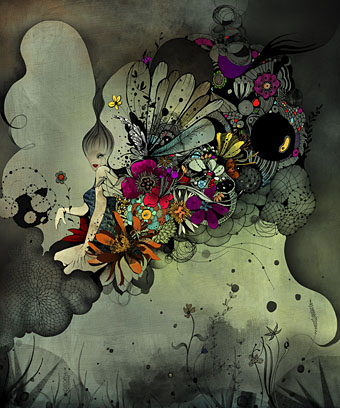
Flower Me Gently (2010) by Linn Olofsdotter.

Yes, this is one of those lazy end-of-year retrospectives, a look back at all the artists whose work was highlighted in the weekend posts for 2011. Thanks to BibliOdyssey, Form is Void and 50 Watts for so often pointing the way.

martin.jpg

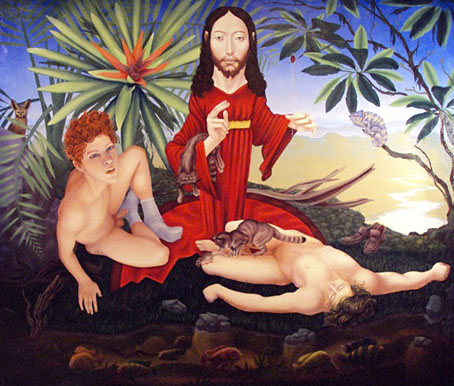
Blasphemous Rumours (2009/2010) by Ryan Martin. The artist now has a dedicated site for his paintings.

beksinski1.jpg

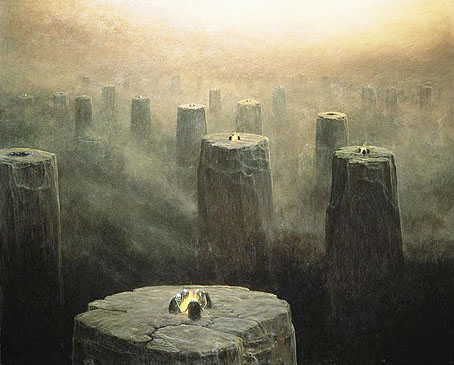
DG-2499 (1975) by the fantastic (in every sense of the word) Zdzisław Beksiński (1929–2005). See the Dmochowski Gallery for a comprehensive collection of the artist’s work.

Continue reading “The weekend artists”

Tom Phillips album covers

phillips00.jpg

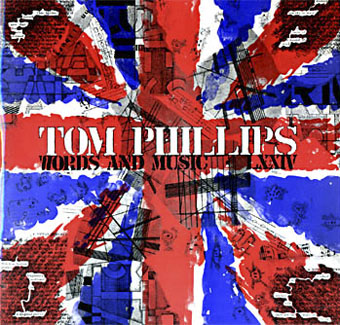
Words and Music (1975) by Tom Phillips.

Two related posts is coincidence, three is a series. Earlier posts from the past couple of weeks looked at album covers created by designers better known for their work in other areas. Tom Phillips is a British artist, writer and composer who I continue to insist is one of our greatest living artists, a figure of singular intelligence, invention and versatility whose lack of grandstanding has never raised his profile to, say, the Hockney level. Phillips’ involvement with the music world, both as composer/librettist, and his oft-cited position as Brian Eno’s art teacher in the 1960s, have led to the creation of a handful of record and CD covers from the mid-70s on. Before we get onto those I’ll note that Phillips has a piece in the latest edition of Eye magazine where he reviews a book of postcards from the Wiener Werkstätte. I happen to have a review in the same issue looking at a republished Kenneth Anger study.

Words and Music above has a January 1975 release date although the cover clearly states “LXXIV” in Phillips’ customary stencil lettering. The pressing was limited to 500 copies and doesn’t seem to have been reissued since which means that copies for sale command excessive prices. Side A comprises recordings of Phillips’ compositions while on the flip the artist/author reads extracts from A Humument, the treated book/experimental novel which is not only his most celebrated work but a project whose influence permeates all of the Phillips oeuvre, including the sleeve art.

phillips01.jpg

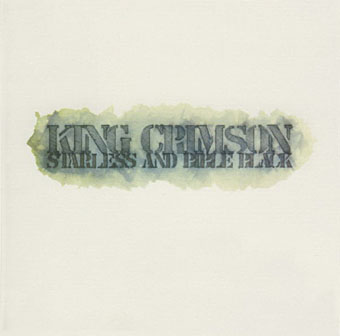
Starless and Bible Black (1974) by King Crimson.

phillips02.jpg

A year before Words and Music, Phillips created the cover art for this King Crimson album, and he’s also credited with the design. The fractured stencil lettering on the gatefold interior resembles similar effects in some of Phillips’ paintings while on the back cover there’s a tiny extract from A Humument bearing the enigmatic phrase “this night wounds time”. I’ve wondered for years how this cover came about: Robert Fripp often selects the art for King Crimson’s covers so was Phillips his choice as artist/designer? Or was it a result of the Fripp and Eno connection? If anyone knows the answer, please leave a comment.

Continue reading “Tom Phillips album covers”