Pádraig Ó Méalóid talks to Steve Moore

somnium.jpg

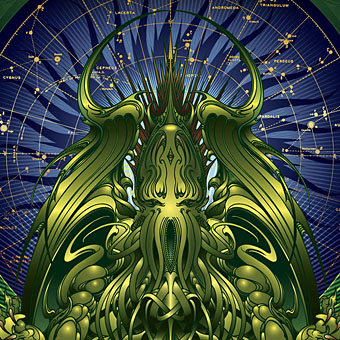
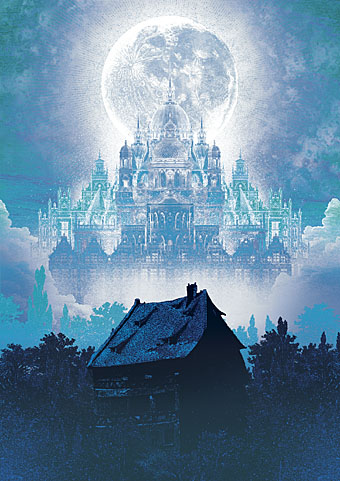
Author Steve Moore discusses Somnium, his occult novel for which I provided a cover illustration, with Pádraig Ó Méalóid at the Forbidden Planet site. In addition to examining his comics work and long friendship with Alan Moore, Steve also tells us something about his novel and his lunar obsession:

Without giving away too much of the plot, it’s a historical fantasy about a young man called Kit Morley in 1803 who, fleeing an impossible romance, arrives at an inn on Shooters Hill, where he’s intent on writing a story set in Elizabethan times, titled Somnium, which means ‘a dream’. In that story, a courtier named Sir Endimion Lee arrives on Shooters Hill and finds a lunar dream-palace called Somnium, where he encounters someone who appears to be a moon-goddess. Then there are various other stories embedded within these, set at various times, written in various styles and providing a number of layers, while Morley himself starts to question the nature of the world he’s living in. So it’s a fantasy, but a long way away from the sort of Tolkien-type adventure that a lot of people think of as fantasy.

As to what it’s about … myth (particularly that of the moon-goddess Selene and her mortal lover Endymion) and dream and the fluid nature of reality … lost love and redemption … the psychogeography and psychohistory of Shooters Hill, where I’ve lived all my life … about writing, and real and imaginary books … and goddesses, and Romantic Idealism. It’s poetic, and it’s very, very pagan …

Somnium, as mentioned before, is available direct from that splendid cabinet of curiosities, Strange Attractor.

Previously on { feuilleton }
Somnium by Steve Moore

A Picture to Dream Over: The Isle of the Dead

iod_basle.jpg

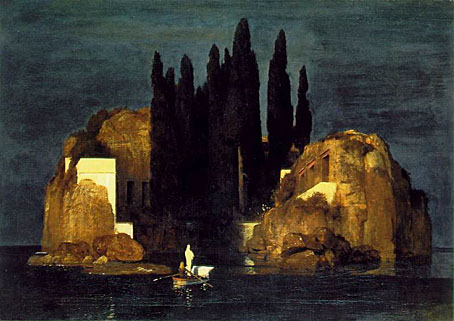
The Isle of the Dead (second version, 1880), Kunstmuseum, Basel.

In the sudden flares of light over the water, reflected off the sharp points of his cheeks and jaw, a harder profile for a moment showed itself. Conscious of Sanders’s critical eye, Father Balthus added as an afterthought, to reassure the doctor: “The light at Port Matarre is always like this, very heavy and penumbral – do you know Böcklin’s painting, ‘Island of the Dead’, where the cypresses stand guard above a cliff pierced by a hypogeum, while a storm hovers over the sea? It’s in the Kunstmuseum in my native Basel –”

The Crystal World (1966) by JG Ballard.

rachmaninov.jpg

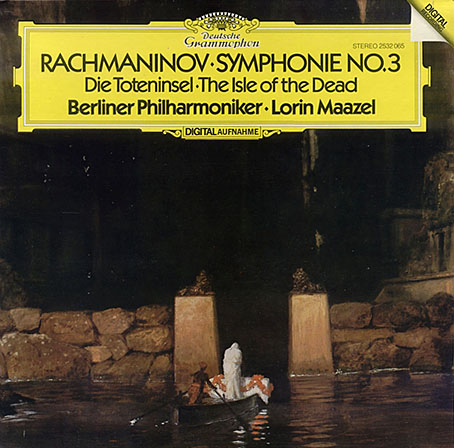
A 1982 recording.

Today’s post is another guest piece over at Tor.com where I run through a history of some of the works in different media inspired by Arnold Böcklin’s The Isle of the Dead (1880–1886). The four versions of Böcklin’s painting are favourites of mine so I’ve touched on this subject a couple of times before but this is the first time I’ve gone into any detail examining their influence. Many artworks have become highly visible in the past century via copies, parodies and imitations: think of Leonardo’s Mona Lisa and The Last Supper, or Michelangelo’s David and The Creation of Adam. What’s fascinating about The Isle of the Dead is that it’s not one picture but four versions of the same scene, and they’ve all been very influential not as parodies but as direct inspirations for other artworks—musical compositions, feature films, a novel—yet few people would recognise the artist’s name. My post only scratches the surface by running through some of the more well-known works but there’s a whole website devoted to the subject for anyone wishing to investigate further.

coc.jpg

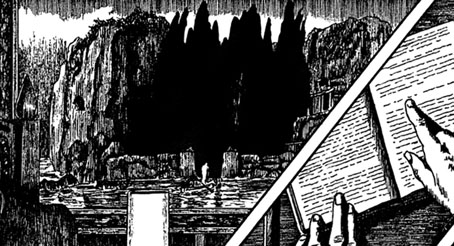
The Call of Cthulhu (1988).

Modesty prevented me from mentioning my own work in the Tor post but I’ll do so here. Among the many references ladled into my adaptation of The Call of Cthulhu there’s the 1886 Leipzig version of Böcklin’s painting in the background of a panel. A prefiguring of the end of the story and also an excuse to add to the list of works acknowledging one of the great Symbolist paintings.

Previously on { feuilleton }
The Isle of the Dead in detail
Arnold Böcklin and The Isle of the Dead

Coulthart calendars for 2012

2012calendar1.jpg

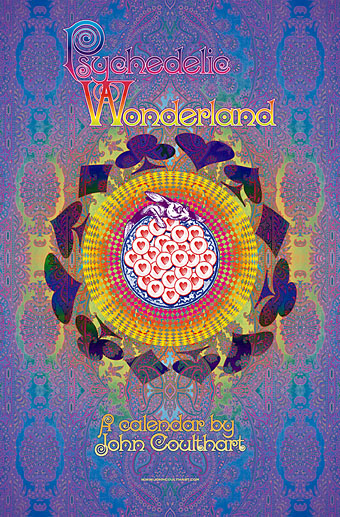
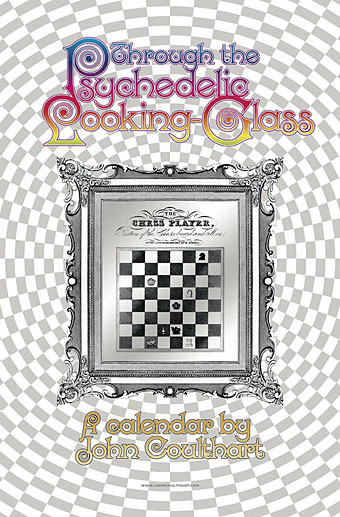
I did have vague plans earlier this year for doing a new calendar but when work gets as busy as it has been you really need to plan these things weeks in advance and in the end I didn’t have the time. Since I created my psychedelic Alice in Wonderland calendar in 2009 I’ve had a number of requests to make it available again. It’s still the most popular thing I’ve sold at CafePress so this year I decided to reissue it along with last year’s equally psychedelic take on Through the Looking-Glass. Here they are:

Psychedelic Wonderland wall calendar at CafePress | A full preview of the pages

Psychedelic Looking-Glass wall calendar at CafePress | A full preview of the pages

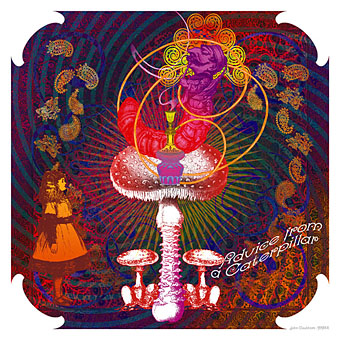
pw05.jpg

Advice from a Caterpillar.

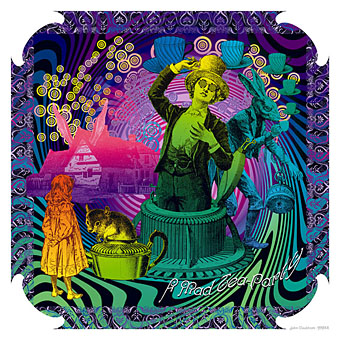
pw07.jpg

A Mad Tea-Party.

2012calendar2.jpg

ttlg02

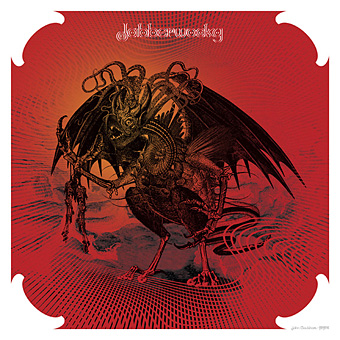
Jabberwocky.

ttlg10.jpg

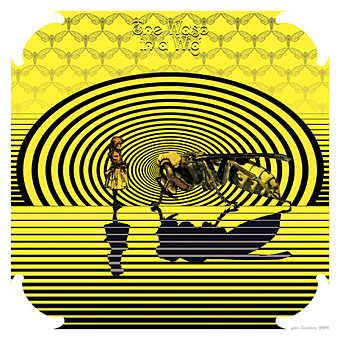
The Wasp in a Wig.

Previously on { feuilleton }
Scenes from a carriage
Through the Psychedelic Looking-Glass: the 2011 calendar
Jabberwocky
Alice in Acidland
Return to Wonderland
Dalí in Wonderland
Virtual Alice
Psychedelic Wonderland: the 2010 calendar
Charles Robinson’s Alice’s Adventures in Wonderland
Humpty Dumpty variations
Alice in Wonderland by Jonathan Miller
The Illustrators of Alice

Somnium by Steve Moore

somnium.jpg

Another new piece of illustration and design. Somnium is an occult novel by Steve Moore being published this month by Strange Attractor. Some readers here may know Steve’s work as a comics writer, ex-editor of Fortean Times and also the subject of Alan Moore’s recent Unearthing text and recording. I’ve not seen the book yet but it comes laden with praise from Michael Moorcock and Iain Sinclair, and features an afterword by Alan Moore:

Written in the early years of the 21st century, when the author was engaged in dream-explorations and mystical practices centred on the Greek moon-goddess Selene, Somnium is an intensely personal and highly-embroidered fictional tapestry that weaves together numerous historical and stylistic variations on the enduring myth of Selene and Endymion. Ranging through the 16th to 21st centuries, it combines mediæval, Elizabethan, Gothic and Decadent elements in a fantastic romance of rare imagination.

With its delirious and heartbroken text spiralling out from the classical myth of Endymion and the Greek lunar goddess Selene, Somnium is an extraordinary odyssey through love and loss and lunacy, illuminated by the silvery moonlight of its exquisite language.

The printed version should incorporate metallic silver ink on the title and border, something you can never quite replicate on a web image, hence the gradient on the title lettering. Somnium is available in a range of signed or unsigned editions and can be purchased direct from the Strange Attractor Shoppe.

Previously on { feuilleton }
Dodgem Logic again
Of Moons and Serpents

Seminal art and design

fountain.jpg

Fountain (2011) by John Coulthart.

seminal, a. and n.

A. adj. Of or pertaining to seed; of the nature of seed.

1. a. Of or pertaining to the seed or semen of men and animals (applied Phys. and Anat. to structures adapted to contain or convey semen); of the nature of semen.

Oxford English Dictionary

The Dirty Comics exhibition curated by Jon Macy opens today in San Francisco so here at last is my non-comics contribution to Jon’s erotic art show. This is something I’d had in mind for a while so it was good to have the opportunity to actually tackle the thing, and also have an outlet for it outside this website. Below I explore some of the intent and inspiration which led to the piece.

Creating some sort of gay erotica was an idea I’d had in mind for a while but it suffered from the usual syndrome whereby work with no immediate outlet gets shunted aside by the pressure of paid commissions and ongoing personal projects. It’s also the case that pieces of work I create for myself I tend to want to sell or see reproduced via a service such as CafePress. The trouble is that most of those services are based in the US which means they’re subject to that tiresome puritan attitude towards sexual content: anything other than “artistic” nudity is forbidden at CafePress, and the same applies to many other self-publishing services. There are outlets for gay erotica but I’ve not had chance to explore the best options. If anyone has any tips then please leave a comment.

closeup.jpg

This angel figure was something I’d drawn back to 2008 when I’d made a start on a similar work which fell by the wayside. One of the great things about computer graphics is being able to work on part of something which can then be picked up later and dropped into a new composition.

figures.jpg

So the intention was to produce a follow-up to the Dodgem Logic cover I created last year which presented a same-sex take on various Art Nouveau stylisations. The figures above are from one of the early drafts which takes a border design from Alphonse Mucha’s Documents Decoratifs (below), a series of sample borders and frames Mucha produced for the use of artists and designers.

Continue reading “Seminal art and design”