Moorcock: Faith, Hope and Anxiety

moorcock.jpg

Photo of the author by Linda Moorcock.

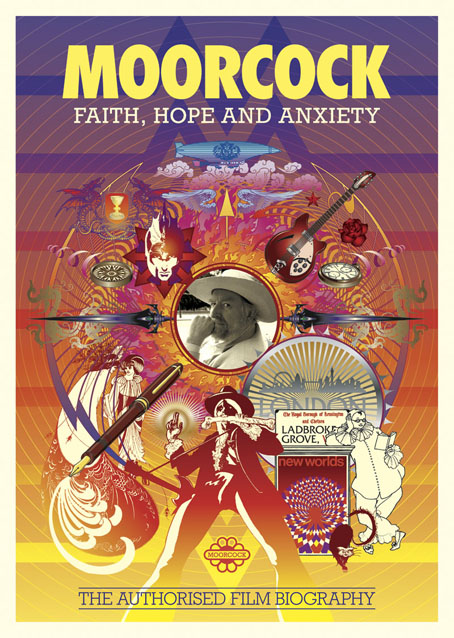
I mentioned a few days ago that I had another new piece of work to reveal, and this is it, a poster/promotional piece for Russell Wall’s forthcoming documentary about Michael Moorcock. The main challenge with one was to create something that would give a sense of Moorcock’s extensive career and the genre-spanning content of his many books.

mm1.jpg

I took the 1970s as the starting point, since this was the period when his reputation as a writer was established worldwide. The decade began with Britain’s bookshelves being colonised by Moorcock’s SF and fantasy novels published by Mayflower with vivid covers; it saw a cult feature film—The Final Programme—made from his first Jerry Cornelius novel, and it ended with the fourth Jerry Cornelius novel, The Condition of Muzak, winning a serious literary award, the Guardian Fiction Prize.

mm2.jpg

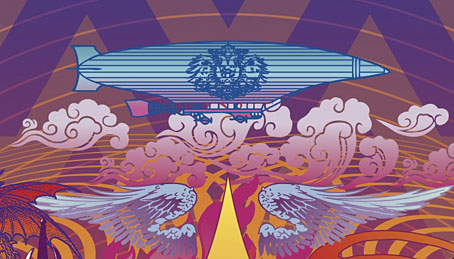
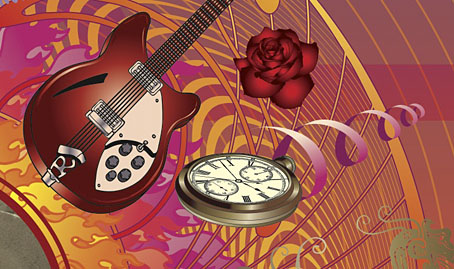
So the general appearance of the design, the headline typography, and the colour scheme are a nod to the Mayflower covers and especially to Bob Haberfield’s artwork which often used a similar style of Tibetan flames and clouds. The rest of the type is set in Rockwell, a preferred typeface of the Hipgnosis design team for much of the 1970s. Early on I had the idea of filling the design with stylised graphics like those used by some of the Hipgnosis illustrators, chiefly George Hardie, but that idea receded once the composition began to arrange itself. The fountain pen is the main hangover from this, a hard-edged graphic tilted at an angle like many of Hardie’s illustrations. The pen is a little inappropriate given that Moorcock is famous for knocking out novels at speed on a typewriter but it made a good visual rhyme with the guitar, a Rickenbacker like the one the author played in his Deep Fix band.

mm3.jpg

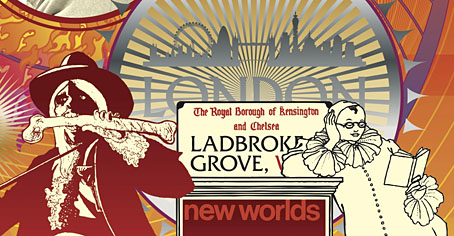
Elsewhere there are many specific references competing for attention: the Elric head is Jim Cawthorn’s illustration from the first edition of Stormbringer (1965); the Jerry Cornelius figure (straddling a repurposed Mayflower logo) is one of Mal Dean’s best, as seen on the cover of issue 191 of New Worlds magazine; the sorcerous blades are my own designs from 1985 as seen on the sleeve of Hawkwind’s Chronicle of the Black Sword album; the Beardsley figures from Salomé were a vague gesture to the 1890s but the Pierrot figure happens to be one Moorcock used for a while as a bookplate, something I didn’t know until I’d placed it in the design; the cat at Pierrot’s feet is another Beardsley from one of the Bon-Mots books; the London skyline is a contemporary one, London past and present having been a continual feature of Moorcock’s writing throughout his career. Lastly, all these details are contained by a graphic based on Abram Games’ BBC TV ident from the 1950s. When Russell and I began talking about this project the words “television biography” were being used so this would have connected to that idea, and to the decade when Moorcock’s career began.

mm4.jpg

I don’t know when the documentary will be released but any news will be posted here in due course. There’s also talk of making copies of the poster available for purchase but nothing concrete has been decided yet.

Previously on { feuilleton }
Eduardo Paolozzi at New Worlds
Elric 1: Le trône de rubis
Into the Media Web by Michael Moorcock
The Best of Michael Moorcock
Revenant volumes: Bob Haberfield, New Worlds and others

Enki by Melechesh

enki.jpg

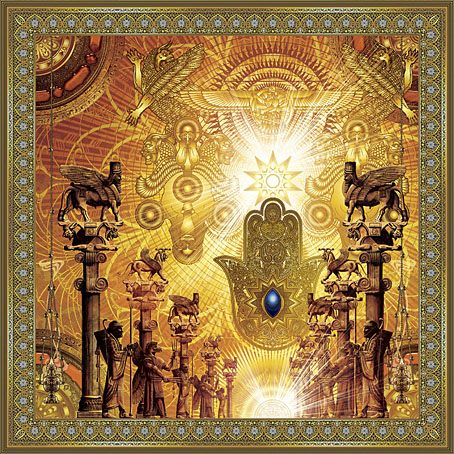
Another album cover, and this time the artwork is my own, being my third cover for metal band Melechesh. The album won’t be released until February but the record label, Nuclear Blast, revealed the cover earlier this week so I thought I may as well post it myself. See a larger copy here. Note that other copies in circulation at the moment show a temporary title design (not my doing) which will probably be changed by release time.

This is my third cover for the band whose songs are preoccupied with Sumerian mythology, as should be evident from the symbolism. The artwork was also one of two elaborate (unconnected) designs I’d been working on over the autumn. The other one may be revealed next week so watch this space.

Elsewhere on { feuilleton }
The album covers archive

Previously on { feuilleton }
The Epigenesis by Melechesh

Homosurrealism

oldham.jpg

Untitled (2012) by Brian Oldham.

Jack Sanders was in touch recently about his online art showcase Homosurrealism, a gallery of homoerotics, the surreal and the occult. The fourth issue has just gone live, and the contents could just as well be described as Homo-occultism given the predominance of esoterica. Jean Cocteau and Kenneth Anger are in there, also William Burroughs via Gus Van Sant’s film of the Thanksgiving Prayer which receives a lot of exposure at this time of year.

waiblinger.jpg

La Petite Mort by John Waiblinger.

Also featured is my Sephiroth of the Great Old Ones from the Haunter of the Dark collection. Credit should be given there to Alan Moore who was responsible for the attribution of the various gods to the different spheres. In the book the chart is followed by my renderings of the sinister pantheon together with Alan’s description of each god and sphere.

sephiroth.jpg

The Great Old Ones: Sephiroth (1999) by John Coulthart & Alan Moore.

Elsewhere on { feuilleton }
The gay artists archive

Previously on { feuilleton }
The Salivation Army, a film by Scott Treleaven

The Art of Gothic by Natasha Scharf

goth01.jpg

This weekend I was at the Louder Than Words music conference in Manchester to meet Peter Bebergal, author of Season of the Witch: How the Occult Saved Rock and Roll, and Mark Pilkington of Strange Attractor. By coincidence the event was hosting a discussion about goth music and culture based around The Art of Gothic, a new art book by Natasha Scharf. As mentioned last month, this book features some of my work but I hadn’t seen a copy until now.

goth02.jpg

I’ve been fortunate recently to have my work appear in some impressive volumes but this outsize hardback takes some beating. It’s a very lavish production, 224 colour pages on heavy paper with gorgeous design by Paul Palmer-Edwards. Goth has been subject from the outset to mocking stereotypes, to a degree that many people would imagine they know exactly what a study such as this would contain. A recurrent theme of the Louder Than Words discussion was the growth of the goth subculture beyond its clichéd boundaries which is one reason my work is featured in the book. When Natasha was first in touch I thought it might be for the Cradle of Filth album covers but I’m in the chapter that examines the increasingly tangled goth/steampunk crossover. This is one development that’s come to seem almost inevitable given the roots of so much of the goth aesthetic in Victorian nightmares. Many steampunk novels tend towards the dark in their blend of science fiction and horror so the traffic goes in both directions.

goth03.jpg

Elsewhere in the book there are chapters on Futuristic Goth, Japanese Goth, and Cybergoth, all of which maintain the requisite darkness while evolving away from the top hats, lace and veils (the latter are all present and correct elsewhere, of course). It’s a beautiful book, out now in the UK from Omnibus Press, and in the US from Backbeat Books. A few more page samples follow. There’s more at Amazon UK.

• See also: 13 Things That Prove Gothic Art Is Enchanting And Beautiful

goth04.jpg

left: The Amazing Screw-On Head by Mike Mignola (2002); centre: the full-colour version of the ever-popular Steampunk Equation (2009), words by Jeff VanderMeer, graphics by John Coulthart; right: Dr Geof’s Medicine Lady, aka Steampunk Pinup #2.

goth05.jpg

The mighty Giger again. I’ve got a framed print of that picture on the wall, a fact that will surprise nobody.

Continue reading “The Art of Gothic by Natasha Scharf”

Steampunk in the Tank

tank00.jpg

Plague doctor mask by Tom Banwell.

Last month I wrote a little about the Steampunk: Art of Victorian Futurism exhibition that’s been running since the beginning of October in Beijing, this being the same event that was staged in Seoul earlier in the year. Five of my book cover designs have been featured in these shows, together with some very impressive artworks, designs and constructions by international artists. This week the organisers of the show, Artcenter IDA, sent their own photos of the event.

tank01.jpg

Locomotive Square.

As mentioned before, the venue is an exhibition space in 751 D-Park outside central Beijing, an area I’ve been told was formerly an industrial complex manufacturing armaments during the Cold War. If we occasionally find that life these days imitates the fictions of JG Ballard or Philip K Dick, 751 D-Park strikes me as a very William Gibson kind of place: Cold War industrial complex transmuted into an international art space—Beijing Design Week is hosted here each year—that on this occasion is showcasing antique science fiction. The 751 website has a map of the area with links to photos and other information. I’m rather taken with “Crached Furnace Square” and “Locomotive Square“.

tank02.jpg

Continue reading “Steampunk in the Tank”