Beardsley’s Salomé

salome1.jpg

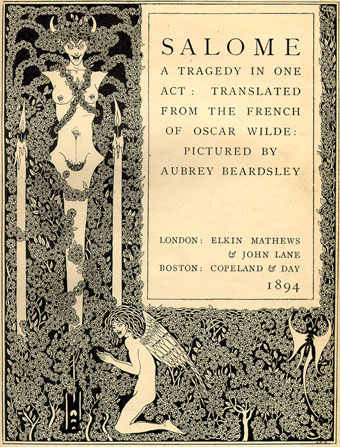
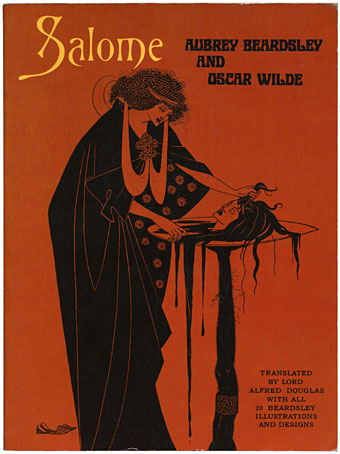
So the first book purchase of the year turns out to be the original Dover edition of Beardsley and Wilde’s Salomé. This appeared in 1967, a year after the major V&A exhibition which introduced Beardsley’s work to a new generation and commenced the Beardsley craze that lasted into the Seventies. Not that I’m in desperate need of these drawings, having most of them several times already in different Beardsley books, but this volume is worth having since the reproductions are large size, very sharp and they took enough care to ensure that the uncensored versions of the drawings were used. The book also includes the complete text of Wilde’s play and Robert Ross’s Note on Salomé from 1930 which I don’t have elsewhere.

salome2.jpg

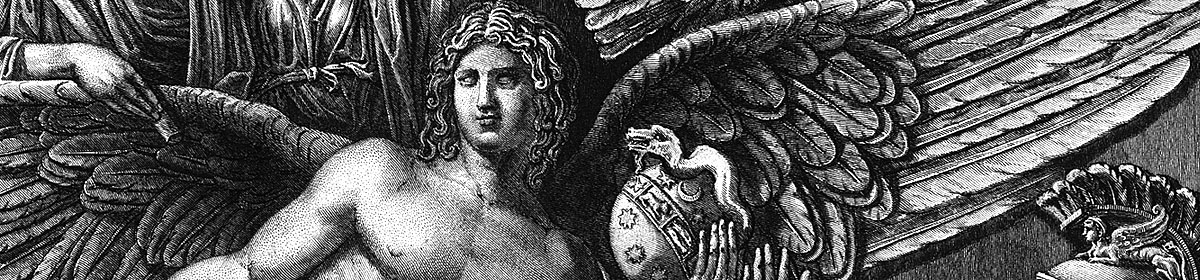
Beardsley’s work was subject to many censorship actions during his career but the Salomé book caused the most trouble (his later erotic works were private editions so don’t really count). The original title page shown here had the semi-erect penis of the winged boy and the pendulous genitals of the herma removed while one drawing, The Toilette of Salomé, was deemed too much and had to be redrawn entirely. That picture did contain a masturbating page boy so it’s perhaps not so surprising. There was such a lot to offend Victorian sensibilities in Beardsley’s work at this time, whether overt or surreptitious, that it’s remarkable the book was printed at all. His art was so radically different from anything else being done in 1894 that many people had difficulty accepting these pictures as illustrations at all, regardless of the content. As a result they missed salacious details that would have finished the career of a lesser artist. Wilde’s play was equally scandalous and could only be performed in France, having been banished from the London stage. As Robert Ross says in his Note:

Wilde used to say that Salomé was a mirror in which everyone could see himself. The artist, art; the dull, dullness; the vulgar, vulgarity.

salome3.jpg

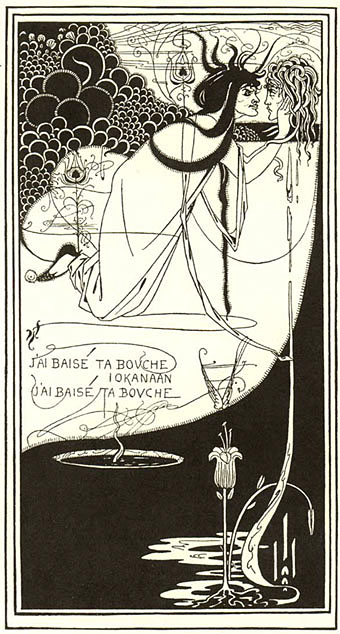
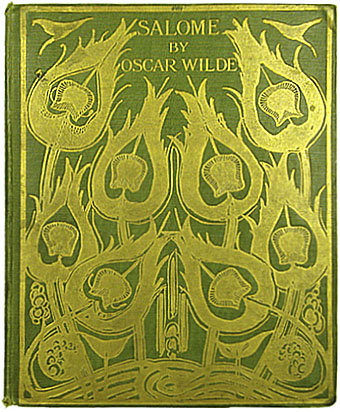
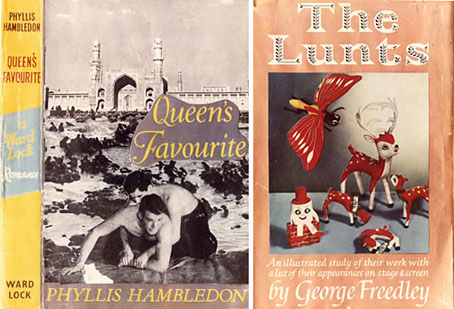
The sense of shock extended back to Beardley’s original Salomé drawing (also included in the Dover volume) which appeared in the first number of The Studio in 1893, some of the readers of that magazine finding the detail of the spilled blood nourishing a phallic lily a grotesque detail too far. The Studio drawing was reworked and simplified as The Climax for Salomé. You can see the complete set of illustrations here. Neither that collection nor the Dover book include a picture of the original cover, however, whose splendid gold-on-green peacock feathers look a lot more impressive than Beardley’s rough design. So here it is.

salome4.jpg

• Download the 1906 US edition of Salomé free at the Internet Archive

Elsewhere on { feuilleton }
• The book covers archive
• The illustrators archive
• The Salomé archive

Joe Orton Online

orton2.jpg

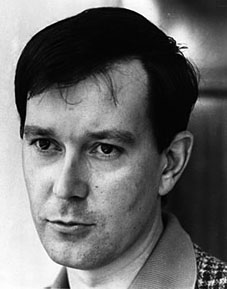
Joe Orton by John Haynes.

Last April I wrote that pioneering gay playwright Joe Orton was poorly represented on the web, unaware at the time that an official Orton site was being planned. Now web designer Alison Forsythe has written to say that the site was launched yesterday on what would have been Orton’s 75th birthday.

Joe Orton Online is exactly the resource I’d been looking for, with detailed information about the writer and a wealth of biographical material, reminiscences from collaborators and enthusiasts and a collection of ephemera. It’s especially good to be able to see the library books which Orton and his partner Kenneth Halliwell defaced (I’d say improved) for their own amusement, and which led to them receiving short prison sentences for vandalism.

orton1.jpg

Two of the defaced library books.

Also present are a number of manuscript extracts, including samples of his very early works, and some of the “Edna Welthorpe” letters, another Joe and Ken wheeze which adopted the persona of a priggish middle-aged woman to poke fun at the Welthorpes of the world by agreeing with their petty outrages.

For those impatient with the written word, there’s a fair amount of Orton-related material on YouTube, including what appears to be all of Prick Up Your Ears. (Buy the DVD you cheapskates!) Most fascinating and valuable for Ortonites is a section of a documentary about Kenneth Williams which discusses the actor’s association with Orton and features a rare TV appearance by the man himself.

Previously on { feuilleton }
• The lost boys: Brian Epstein, Joe Orton and Joe Meek
• Joe Orton

The night that panicked America

mercury.jpg

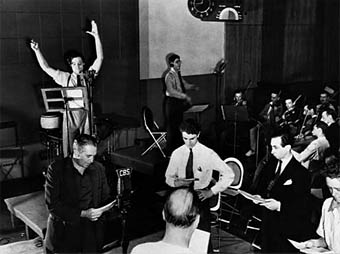
The Mercury Theatre on the air.

Being a long-time fan of both HG Wells and Orson Welles, the latter’s radio production of War of the Worlds with the Mercury Theatre group has always held a special fascination. This was staged sixty-nine years ago today, October 30th, 1938, and famously caused panic among listeners who missed the opening and believed they were hearing genuine news reports of an alien invasion. I’ve often listened to the rather crude recording of the play around this time of year, having owned that recording on vinyl, cassette tape and CD. These days you don’t have to buy it, you can head over to the Internet Archive or this Mercury Theatre page and grab an mp3 to discover what all the fuss was about. The recording may be crude but the presentation still strikes me as decades ahead of its time, with a very astute sense of how ordinary people behave when faced with the news media. I’ve always loved the attention to detail, such as the moment when the man who’s been interviewed at the crash site wants to carry on talking and the interviewer has to shut him up. That same verisimilitude was carried over to the newsreel footage in Citizen Kane (which was pretty much a Mercury production for cinema) and it was those moments in the radio play which helped encourage people to think that what they were hearing was real, not drama.

Screenwriter Howard Koch, who later polished the rudimentary draft script that became Casablanca, is credited as writer of the play but the adaptation was a group effort according to Koch in his book The Panic Broadcast (1970). The idea of presenting Wells’s story as a series of news bulletins came from Orson Welles and producer John Houseman, with Koch scripting the scenes and dialogue. Most of the other Mercury adaptations took a more traditional approach and if you want some spooky listening for Halloween I’d suggest you try their version of Dracula, also from 1938. The story is severely truncated, of course, but Agnes Moorehead is very impressive as Mina, there’s some remarkable music from Bernard Herrmann and Welles plays both Arthur Seward and the sinister Count.

Previously on { feuilleton }
• Alexandre Alexeieff and Claire Parker
• The Door in the Wall
• Voodoo Macbeth
• War of the Worlds book covers

Paradise Now: The Living Theatre in Amerika DVD

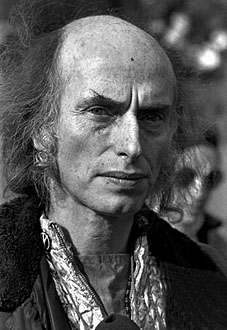
julian_beck.jpgMost people today know Julian Beck, if at all, for a small but unforgettable film role at the end of his career. In Poltergeist 2 (1986) Beck plays the nightmarishly sinister Reverend Henry Kane and his one full scene in that film is far more unnerving than the rest of its rubber monsters and special effects. Beck, a bisexual radical who makes most contemporary theatre directors seem as challenging as civil servants, started out as a painter but moved into theatre in the late Forties, founding the legendary Artaud-inspired Living Theatre in 1947. The Living Theatre was to the stage what the Beats were to literature, intent on shaking up the medium, the audience’s complacency and—by implication—society itself, to the fullest extent possible.

It’s the tragedy of theatre that its nature as a medium dependent on performance leaves so little record of its works behind. But there is one major film of the Living Theatre at its most provocative and it’s fitting that this should appear on a new DVD from Arthur Magazine in the year of the company’s sixtieth anniversary.

NEW FROM ARTHUR: PARADISE NOW: THE LIVING THEATRE IN AMERIKA DVD. LIMITED EDITION OF 1,000 – PRE-ORDER NOW – SHIPS OCT 1ST, 2007!

the screams
the unchained soarings of a sincerity which is on its way
to this revolution of the whole body without which nothing can
be changed. – Antonin Artaud
paradise.jpg

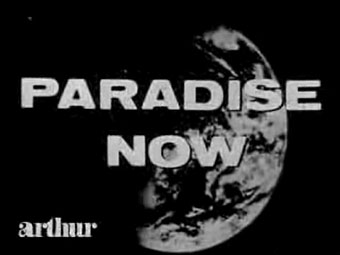
Arthur Magazine proudly presents our newest release PARADISE NOW: The Living Theatre in Amerika DVD featuring rare, never-before-distributed films and a bacchanal of revolutionary multimedia documents from The Living Theatre’s historic and influential ’68–’69 American tour. A fulminating art-meets-life installation brought to you in collaboration with The Living Theatre, The Ira Cohen Akashic Project and Saturnalia Media Rites of the Dreamweapon.

DVD INCLUDES – PARADISE NOW: The Living Theatre in Amerika (1969) a film by Marty Topp, produced by Ira Cohen for Universal Mutant

• EMERGENCY (1968) a film by Gwen Brown, featuring precious footage of Living Theatre productions Mysteries and smaller pieces, Paradise Now, and Frankenstein

• RARE PHOTOGRAPHS of Paradise Now at Brooklyn Academy of Music by Don Snyder

• THE MAP OF PARADISE NOW, a 14″ x 19″ double-sided, commemorative poster + ‘zine including texts by Antonin Artaud, Julian Beck, Judith Malina, Ira Cohen and Don Snyder

ADDITIONAL SPECIAL FEATURES

• Slideshow / Installation, The full theatrical script

• Paradise Now: A Collective Creation of The Living Theatre as written down by Julian Beck and Judith Malina

• Video Interviews with director Judith Malina, Hanon Reznikov, Steve Ben Israel, and producer Ira Cohen

• The Spinning Wheel by Steve Ben Israel, soundtrack to EMERGENCY sourced from agit-prop radio broadcasts

• Akashic Video Gallery of excerpts from current and forthcoming Arthur DVD releases

WHAT IS PARADISE NOW?

In 1968 The Living Theatre, led by Julian Beck and Judith Malina, triumphantly returned to America from years of self-imposed exile in Europe with their theatrical breakthrough Paradise Now. The play introduces the practice of collective creation, dissolving the boundaries of human interactions and forging a harmony between the actors and audience. Of this process, Julian Beck writes, “Collective creation is the secret weapon of the people… This play is a voyage from the many to the one and from the one to the many. It’s a spiritual voyage and a political voyage, a voyage for the actors and the spectators. The play is a vertical ascent toward permanent revolution, leading to revolutionary action here and now. The revolution of which the play speaks is the beautiful, non-violent, anarchist revolution.The purpose of the play is to lead to a state of being in which non-violent revolutionary action is possible.”

The result of this shared voyage is the spontaneous creation of a temporary anarchist collective – free from the enslavements of war, violence, the State, money and the self.

CRITICAL PRAISE FOR PARADISE NOW

“Marty Topp’s beautiful film of Paradise Now reveals how the theories of revolutionary change and the experience of sexual liberation are not separate paths to the beautiful nonviolent anarchist revolution. Practiced together they are a single thrust, encompassing both political action and sensual joy, leading to the dreamed-of terrestrial paradise.” Judith Malina

“Paradise Now is possibly The Living Theatre’s greatest achievement – unsurpassable!” Ira Cohen

“This past spring, in a group art show at New York?s Swiss Institute, an old black-and-white television played a grainy print of bodies writhing to the tune of distant drumming. “As long as you have people working for money and not love, there will be violence,” intoned a tall, angular man on the screen. The bodies – women in scant bikinis and men in what looked like loincloths-piled together in an orgiastic tribal dance, some simulating (or perhaps actually having) sex as the voice continued: “Psycho-sexual repression is impeding the revolution.” What looked like an underworld-of the 1960’s counter-cultural variety, in this case- is the Living Theatre?s Paradise Now, as documented in the 1969 Ira Cohen-produced film Paradise Now: The Living Theatre in Amerika ? soon to be released on DVD from Arthur Magazine.” CAN THEATER STAGE A REVOLUTION – Traci Parks, Fall ’07 Preview, V MAGAZINE

“Joyous, brutal, exploding with the kinetic energies of psychic catharsis… Marty Topp’s PARADISE NOW: The Living Theatre in Amerika has captured the essence of this extraordinary theatrical experiment. It is unquestionably one of the finest artistic documentaries to come out of the United States cinema. Its heartfelt sincerity should be sheer inspiration to the many young people throughout the country who are struggling to make meaningful and influential work. It is the reverberation of a crucially important message that must not be neglected, for the consequences are too terrible to endure.

“Marty Topp’s achievement is not just in the making of a great film, but in making us remember again, Paradise as a reality.” PARADISE ON FILM – Don Snyder, July 1970, East Village Other

“Like an astonishing portion of the country’s popular music, the spectacles of The Living Theater proved to be in content and form outside the social system – not structured by it nor, except as outlet, implementing it: liberated territory.” Revolution at the Brooklyn Academy – Stefan Brecht, The Drama Review number 43: Spring 1969, The Living Theater Issue
Previously on { feuilleton }
• William Burroughs by Ira Cohen, 1967
• The Invasion of Thunderbolt Pagoda