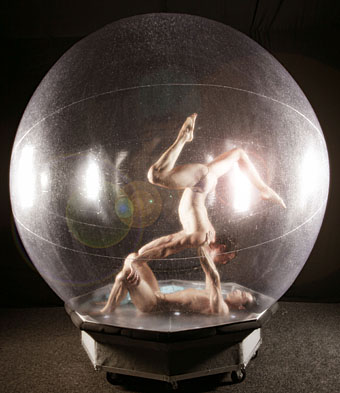
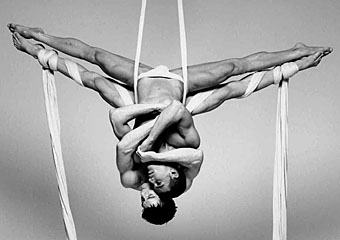
Some of the talented (and sexy) acrobats from Les Farfadais circus troupe. YouTube has several clips of their performances.
Elsewhere on { feuilleton }
• The gay artists archive
A journal by artist and designer John Coulthart.
Theatre
Some of the talented (and sexy) acrobats from Les Farfadais circus troupe. YouTube has several clips of their performances.
Elsewhere on { feuilleton }
• The gay artists archive
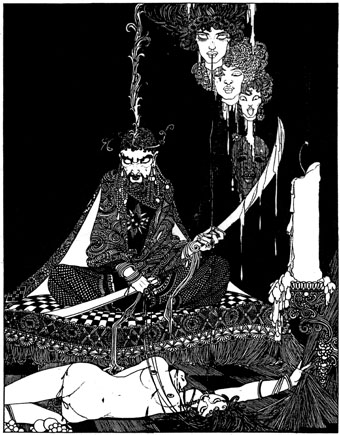
A few drawings by British illustrator John Austen (1886–1948), like Patten Wilson another artist whose work is hard to come by today. Austen was one of the many young illustrators over whom Aubrey Beardsley’s etiolated shadow fell from 1900 onwards and it’s the first ten years of Austen’s work I find most interesting, mainly because of the Beardsley stylings. He’s not as original or as elegant as Harry Clarke but he’s a lot better than the frequently overrated (yet interesting for other reasons) Hans Henning Voigt, or Alastair as he preferred to be known.
Powell & Pressburger reworked for the stage
A Matter of Life and Death and theatre.
The Maids murder mystery
Neil Bartlett’s new production of Genet.
 We tend to think of cinema as a modern medium, quintessentially 20th century, but the modern medium was born in the 19th century, and the heyday of the Silent Age (the 1920s) was closer to the Decadence of the fin de siècle (mid-1880s to the late-1890s) than we are now to the 1970s. This is one reason why so much silent cinema seems infected with a Decadent or Symbolist spirit: that period wasn’t so remote and many of its more notorious products cast a long shadow. Even an early science fiction film like Fritz Lang’s Metropolis has scenes redolent of late Victorian fever dreams: the vision of Moloch, Maria’s parable of the tower of Babel, the coming to life of statues of the Seven Deadly Sins, and—most notably—the vision of the Evil Maria as the Whore of Babylon. Woman as vamp or femme fatale was an idea that gripped the Decadent imagination, and it found a living expression in the vamps of the silent era, beautiful women with exotic names such as Pola Negri, Musidora (Irma Vep in Feuillade’s Les Vampires) and the woman the studios and press named simply “the Vamp”, Theda Bara (real name Theodosia Burr Goodman).
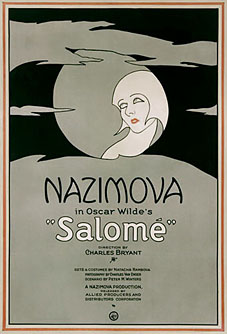
Alla Nazimova was another of these exotic creatures, and rather more exotic than most since she was at least a genuine Russian, even if she also had to amend her given name (Mariam Edez Adelaida Leventon) to exaggerate the effect. Like an opera diva or a great ballerina she dropped her forename as her career progressed, and is billed as Nazimova only in her 1923 screen adaptation of Oscar Wilde’s play, Salomé. Nazimova inaugurated the project, produced it and even part-financed it since the studios, increasingly worried by pressure from moral campaigners, regarded it as a dangerously decadent work. Nazimova had a rather colourful off-screen life and the stories of orgiastic revels at her mansion, the Garden of Allah, probably didn’t help matters.
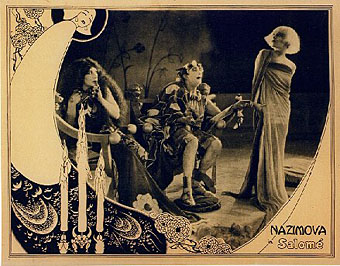
Salomé lobby card (1923).