Brothers Quay scarcities

quays7.jpg

Igor: The Paris Years (1982).

More animation, and scarce in the sense that some of these films were omitted from the core Quay Brothers canon released in the UK by the BFI as Quay Brothers: The Short Films 1979-2003. Quay obsessives such as myself would have been happy to pay for an extra disc featuring more of their oeuvre but we can at least turn to YouTube to fill in some gaps. This is by no means everything so I may add more discoveries at a later date. Some of the DVD-issued films can be seen on the BFI’s official Daily Motion channel.

I was eager to see the Stravinsky film again having watched it one time only in a Channel 4 screening some 25 years ago. After a fresh viewing it’s not as impressive as I remembered, in part because the Quay’s distinctive approach to animation—and filmmaking generally—developed a great deal following the unforgettable Street of Crocodiles (1986). Igor: The Paris Years concerns the composer’s relationship with Jean Cocteau and Vladimir Mayakovsky, all of whom are animated as cut-out figures in a Modernist cityscape with The Rite of Spring playing on a piano.

quays6.jpg

Leos Janácek: Intimate Excursions (1983). Part 2 is here.

In a similar vein, but more successful, is this portrait of Czech composer Leos Janácek. This uses the same cut-out character style but places the composer in Eastern European settings similar (down to the floating tram pantographs) to those seen in the very first Quay film, Nocturna Artificialia (1979). Among the other puppet characters there’s one figure singing an aria who later appears as Enkidu in This Unnameable Little Broom (1985).

quays1.jpg

Old Piano (1988).

A very short (and poor quality) ident for MTV.

Continue reading “Brothers Quay scarcities”

The Secret Life of Edward James

james1.jpg

From the earliest days of YouTube there were two films about Surrealist art that I’d been hoping would one day be posted somewhere so I could watch them again. One was José Montes-Baquer’s collaboration with Salvador Dalí, Impressions de la Haute Mongolie – Hommage á Raymond Roussel (1976), which eventually turned up at Ubuweb; the other was Patrick Boyle’s The Secret Life of Edward James, a 50-minute documentary about the wealthy poet and Surrealist art patron that was screened once, and once only, on the UK’s ITV network in 1978. Boyle’s film, which was narrated by James’ friend and fellow Surrealism enthusiast, George Melly, was my first introduction to a fascinating figure who was one of the last—if not the last—of the many eccentric aristocrats that these islands have produced. I knew James’ name from Surrealist art books where the Edward James Foundation was credited as the owner of paintings by Magritte and Dalí, but had no idea that James was the model for three of Magritte’s paintings, including La reproduction interdite (1937); or that he’d abandoned his huge ancestral home to create a Surrealist house at nearby Monkton, and had also commenced the construction of a concrete fantasia, Las Pozas, in the heart of the Mexican jungle at Xilitla. Boyle’s film explores all of this in the calm and uncondescending manner that used to be a staple of UK TV documentaries. I’ve been telling people about this film for years, hoping that somebody might have taped it (unlikely in 1978) but no-one ever seemed to have seen it.

james2.jpg

In 1986, two years after James’ death, Monkton was up for sale so Central TV sent George Melly and director Patrick Boyle to revisit the place. Monkton, A Surrealist Dream, was the result, a 26-minute documentary which relied heavily on the earlier film to fill out the details of James’ life. The original resurfaced for me again, albeit briefly, in Brighton in 1998. A Surreal Life: Edward James (1907–1984) was an exhibition at the Brighton Museum & Art Gallery that featured many works from the James art collection, including major pieces by Leonora Carrington (who appears in Boyle’s film), Dalí, Leonor Fini, Magritte, Picasso, Dorothea Tanning, Pavel Tchelitchew and others. A tape of the 1978 documentary was showing on a TV in one part of the exhibition but the people I was with were reluctant to stand around for an hour so all I got to see was a minute or so of Edward in his jungle paradise. Happily we’re all now able to watch this gem of a film since it was uploaded to YouTube earlier this month (my thanks to James at Strange Flowers for finding it!).

james3.jpg

For anyone whose interest is piqued by all of this, two books are worth searching for: Swans Reflecting Elephants, My Early Years (1982) is an autobiography which George Melly compiled from conversations with its subject (and which apparently finished their friendship). James’ propensity for invention means it can’t always be trusted but then that’s the case with many memoirs. A Surreal Life: Edward James (1998) is the 160-page exhibition catalogue which explores James’ life and aesthetic obsessions in a series of copiously-illustrated essays. Both books can be found relatively cheaply via used book dealers.

Previously on { feuilleton }
Las Pozas panoramas
René Magritte by David Wheatley
Soft Self-Portrait of Salvador Dalí
Mongolian impressions
Hello Dali!
Return to Las Pozas
Dirty Dalí
Impressions de la Haute Mongolie revisited
Las Pozas and Edward James

Le Grand Macabre

topor1.jpg

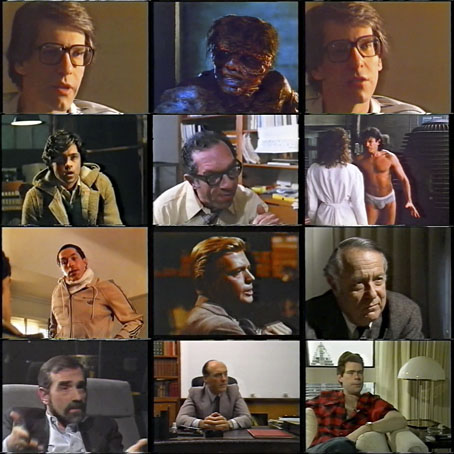
Yesterday I mentioned Leslie Megahey’s Ligeti film, All Clouds Are Clocks, an hour-long documentary based around an interview with György Ligeti filmed in 1976. A unique feature of that film was that Megahey returned to film Ligeti in the same room in 1991 where they discussed the composer’s work during the intervening period. Of these, Le Grand Macabre, written in the late 1970s, was the most ambitious piece.

topor2.jpg

Bartók and Ligeti share some attributes: both were Hungarian, and both were forced to flee their native country. Both composers also wrote only one opera apiece. Le Grand Macabre is Ligeti’s opus, an absurdist drama based on Michel de Ghelderode‘s 1934 play, La Balade du grand macabre. In the film Ligeti explains that he didn’t want to repeat the mid-century concept of the anti-opera but was also dissatisfied with the traditional variety, hence Le Grand Macabre‘s description as an “anti-anti-opera”, a work that combines the tradition and its reaction.

topor3.jpg

Continue reading “Le Grand Macabre”

Leslie Megahey’s Bluebeard

bluebeard01.jpg

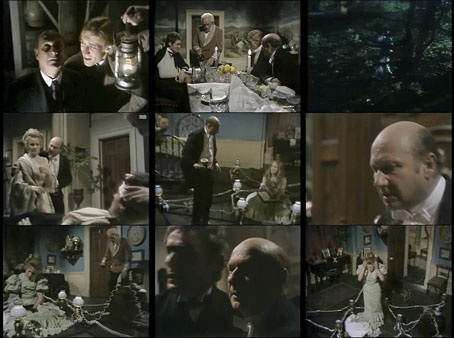
Back in the days when the BBC’s television output challenged its audience rather than pandered to it, Leslie Megahey was a name I always looked out for. During the 1970s and 80s, Megahey was one of the corporation’s outstanding producers and directors, and since his tastes often ran very close to mine seeing his name in a magazine listing was an alert for some essential viewing. Favourite Megahey documentaries would include his Omnibus film about (and interview with) György Ligeti in 1976, and the two-part Arena special about Orson Welles in 1982 that persuaded the director to talk at length for the first time about his career. Megahey’s arts films included drama documentaries about the French painters David and Gericault, and two dramas with painting themes, Cariani and the Courtesans (1987), and Schalcken the Painter (1979), the latter being an exceptional adaptation of the Sheridan Le Fanu ghost story. Duke Bluebeard’s Castle was one of the last of his BBC films, an adaptation of the Bartók opera that had this Bartók obsessive hopping with delight when it was screened in 1988.

bluebeard02.jpg

Bluebeard and Judith.

Bartók’s only opera was written in 1911, and is easier to adapt than most, being a single act of an hour or so in length with only two performers, Bluebeard (bass) and Judith (soprano). Given this it’s surprising there haven’t been more filmed versions. I wrote something a while back about the seldom-seen Michael Powell version; then there’s a version from 1981 by Miklos Szinetár scored by the London Philharmonic Orchestra with Georg Solti conducting. Megahey’s film also features the London Philharmonic with Adam Fischer conducting. Robert Lloyd and Elizabeth Laurence are the performers.

bluebeard03.jpg

The libretto by Béla Balázs turns the old fairy tale into a psychodrama that’s also one of the first post-Freud operas, with the audience being asked in the prologue “Where is the stage? Is it outside, or inside?” Judith is ushered into the castle by Bluebeard to find seven locked doors: her curiosity and her demands to discover what lies behind the doors (or inside the mind of her husband-to-be) seals her fate. In some of the fairy tale versions the brothers of the bride arrive at the last moment to rescue their sister; not so here.

Continue reading “Leslie Megahey’s Bluebeard”

Weekend links 94

walpoth.jpg

Mateo (2011), carved wood sculpture by Bruno Walpoth.

“Dennis Potter’s [The Singing Detective] is 25 years old but still feels avant garde,” says Stephen Armstrong. No fucking kidding, I watched the DVDs again last weekend. Potter’s drama featured non-linear flashbacks, song-and-dance hallucination sequences, an intertextual sub-plot, and a central character who was vitriolic, misanthropic, misogynist and covered from head-to-toe in flaking skin. This wasn’t exiled to an arts channel ghetto but was primetime viewing, Sunday evenings on BBC 1. • Related: “Is Dennis Potter’s singalong noir miniseries the all-time pinnacle of television drama? Graham Fuller thinks it is.”

• American band Earth are using Kickstarter to fund their next project, Wonders from the House of Albion, an LP/CD/DVD/book combining their music with “field recordings from various megalithic and other sites of human/fairy encounters across the UK, also the use of ritual and folkloric magical practices”. Dylan Carlson & Adrienne Davies discuss their work here.

…sort of like Nabokov’s objection to Our Lady of the Flowers, which he saw as a masterpiece but thought, “Why isn’t this book about women?” Nabokov hated homosexuality and was very edgy around it, partly because his own brother was homosexual and his uncle. And he believed that it was hereditary, so he was always nervous about it.

Edmund White chooses five favourite gay novels. Related: a dance adaptation by Earthfall of Jamie O’Neill’s At Swim, Two Boys.

• “The Belbury Tales is the kind of record you feel should have come out on Vertigo around ’73, but never actually did.” Belbury Poly‘s Jim Jupp on ploughman’s lunches, prog rock and avoiding “Clarkson/Wakeman territory”.

Morbid Curiosity: The Richard Harris Collection, an exhibition at the Chicago Cultural Center exploring “the iconography of death across cultures and traditions spanning nearly six thousand years”.

Geoff Dyer’s Zona, an exegesis of Andrei Tarkovsky’s Stalker, is officially out at the end of this month. The book is reviewed here and here.

• “Through a blurry electronic prism“: MetaFilter traces a history of analogue video synthesis.

Dylan Ricci‘s wonderful photography of the male body has moved to a new location.

Infinite Forest by Studio a+i, a design for an AIDS memorial in New York City.

Susan Cain discussing “the power of introverts” at Scientific American.

• Strange Flowers on that icon of Middle Eastern music, Umm Kulthum.

Ewan Morrison on “The self-epublishing bubble”.

Winter Sleep (2007) by Valgeir Sigurdsson feat. Dawn McCarthy | Black (2008) by Ben Frost with Valgeir Sigurdsson, Sam Amidon & Sigrídur Sunna Reynisdóttir | Unbreakable Silence (2011) by Ben Frost & Daníel Bjarnason