Night’s black agents

dulac.jpg

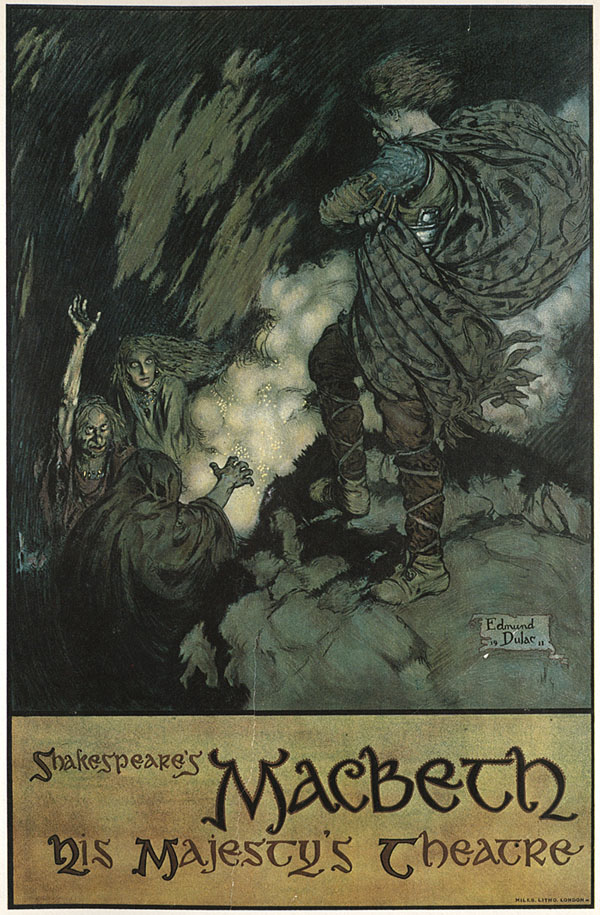
Poster by Edmund Dulac (1911).

This month sees a profusion of events marking the 400th anniversary of Shakespeare’s death so here’s my contribution, a rundown of Macbeths-I-have-seen on screen and stage. I’ve mentioned before that Macbeth and The Tempest are my favourite Shakespeare plays, two dramas concerned with magic of very different kinds. Macbeth is the more popular play, not least for being the more easily adaptable: the supernatural dimension may not suit every circumstance but the themes of treachery, fear, paranoia and a murderous struggle for power are universal. This list contains a wide range of adaptations but there are many film versions I’ve yet to see, including the most recent directed by Justin Kurzel.
welles.jpg

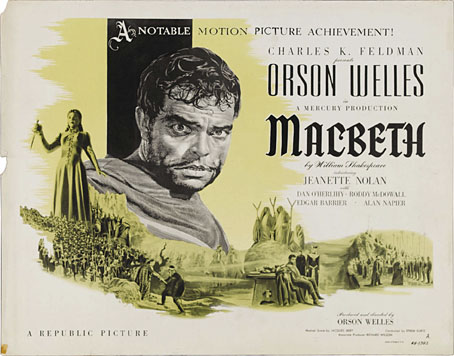
Macbeth (1948), directed by Orson Welles
Orson Welles as Macbeth
Jeanette Nolan as Lady Macbeth

I think the Welles adaptation was the first Macbeth of any kind that I saw so it’s fitting that it begins this chronological list. Famously shot over three hectic weeks on the sound stages of Republic Studios, and with sets made from props previously used in cheap westerns, the result is often eccentric. I’ve a lot of time for Welles as a director but this is one film of his that I’ve never enjoyed very much. His theatre performances (and productions) of Shakespeare began at school, and he was seldom precious with the texts: Chimes at Midnight is a fusion of several different plays while this version of Macbeth uses the same doctored script that he directed for the Voodoo Macbeth in Harlem in 1936. I don’t mind some editing—short scenes such as the witches’ meeting with Hecate are often excised—but some of Welles’ changes are made to support his belief that the witches are directly responsible for Macbeth’s actions, a theory I don’t agree with, and which I’ve never seen given credence elsewhere. This explains oddities such as the appearance of the witches at the very end of the film delivering words from the beginning of the play: “Peace! The charm’s wound up.”

Worse than this is the decision to have most of the cast speaking with vague Scottish accents (a “burr” Welles called it), something that would work with a Scottish cast but which courts disaster with a group of Americans working in haste. The accents may be warranted by the setting but the words of the play are English ones, free of common Scottish colloquialisms such as “ken”, “bairn” and the like. On the plus side, it’s good to see Harry Lime-era Welles performing Shakespeare, and the mist-shrouded production has a barbaric quality that Jean Cocteau appreciated. The forked staff that each witch carries is a detail that I’ve borrowed for drawings on a number of occasions.
joemacbeth.jpg

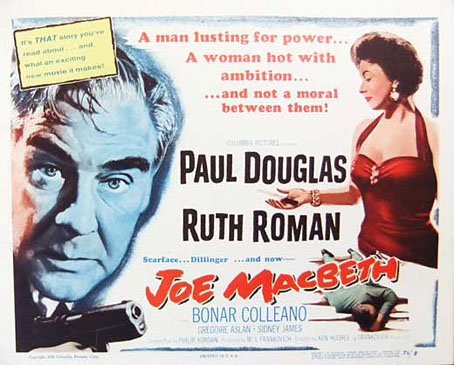
Joe MacBeth (1955), directed by Ken Hughes
Paul Douglas as Joe MacBeth
Ruth Roman as Lily MacBeth

The play reworked as a cheap gangster picture set in the Chicago of the 1930s but made in Britain with a partly American cast. I’ve only seen this once (and many years ago) but I recall it being pretty ludicrous, not least for another accent problem with the English actors doing bad impersonations of Chicago hoodlums. Anyone who grew up watching the Carry On comedy films has a hard time taking Sid James seriously in heavy roles, and here he plays the Banquo character, “Banky”. Joe MacBeth is chiefly notable today for being the first entry in the Macbeth-as-gangster sub-genre; after this there was Men of Respect (1990), Maqbool (2003, an Indian film set in Mumbai), and Macbeth (2006, an Australian film set in Melbourne), none of which I’ve yet seen.
Continue reading “Night’s black agents”

Weekend links 301

ruscha.jpg

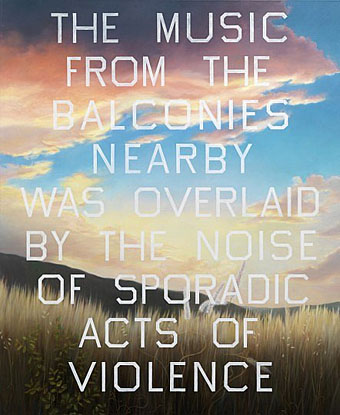
The Music from the Balconies (1984) by Edward Ruscha.

• At The Quietus: High-Rise director Ben Wheatley runs through his favourite films. Kudos for mentioning Elem Klimov’s Come and See (1985) among the more familiar fare, a nightmarish masterwork that everyone should watch at least once. On the same site, author Joe R. Lansdale also lists some favourite films while discussing the new TV series of his Hap and Leonard books.

Electric Hintermass (Sound Apart) by Hintermass, a track from The Apple Tree, their debut album on the Ghost Box label.

Michael Mann’s Heat: “A complex, stylistically supreme candidate for one of the most impressive films of the Nineties”.

• Despair Fatigue: David Graeber on how [political] hopelessness grew boring, and what happens next.

• Mix of the week: FACT Mix 541 by Tortoise, and Blowing Up The Workshop 56 by Eric Lanham.

• At Dennis Cooper’s: “Some books (1961–1975) that either faked ingesting LSD or did”.

• David Litvinoff again: “Was he only an opportunistic hustler?” asks David Collard.

John Carpenter’s The Thing rescored with one of the director’s Lost Themes.

Overlooked: a book by Marina Willer about the manhole covers of London.

• Pam Grossman (words) and Tin Can Forest (art) ask What is a Witch?

• A long way down: Oliver Wainwright on JG Ballard and High-Rise.

• A conversation with designer and typographer Erik Spiekermann.

• The BFI compiles a list of “The 30 Best LGBT Films of All Time“.

• Decoding the spiritual symbolism of artist Hilma af Klint.

Sabat Magazine

Heat (1983) by Soft Cell | The Heat (1985) by Peter Gabriel | Heat Miser (1994) by Massive Attack

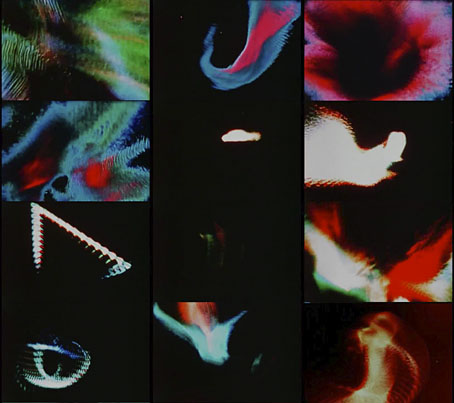
Heavy-Light, a film by Adam K. Beckett

beckett.jpg

In the early 1990s the UK’s Channel 4 still operated as an avant-garde television channel, broadcasting films, dramas and documentaries that the other channels would be unlikely to show. Late nights were often filled out with resolutely uncommercial fare, as was the case when Abstract Cinema was shown in 1993, a 50-minute documentary by Keith Griffiths that traced the history of abstract cinematic experimentation from the animations of Oskar Fischinger to the growing field of computer graphics. The documentary was followed by an additional 25 minutes of abstract shorts, one of which, Heavy-Light (1973) by Adam K. Beckett, is a particular favourite.

Most of Beckett’s films are free-form doodles, hand-drawn and dreamlike in their endlessly shifting and often erotic metamorphoses. Heavy-Light is different for being the product of some optical process that sends billowing waves of vivid colour blooming out of darkness. The effect is very similar to Jordan Belson’s films where the realisation is equally mysterious and the result equally (that word again) psychedelic; a bonus in Beckett’s film is the excellent score by Barry Schrader. Beckett died young at the age of 29 so there isn’t much of his work to see although a few of the animated films are also on YouTube at the moment (see here, here, here and here). They may not remain there for long so watch them while you can.

Elsewhere on { feuilleton }
The abstract cinema archive

Weekend links 299

blanco.jpg

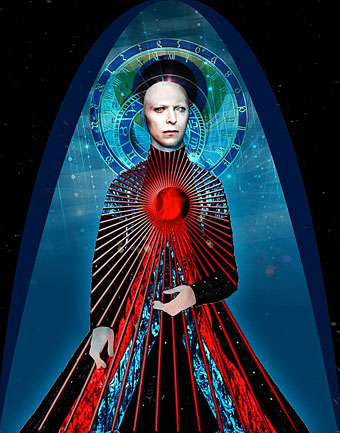
Starman (2016) by Nyahzul Blanco. From the Saint Bowie exhibition at Stephen Romano Gallery, NY.

• “…[Dashiel] Hammett’s first-hand experience of political sleaze, industrial violence and the everyday routine of an agent allowed for a realism that brought hard-boiled fiction to new heights.” Oliver Harris reviews a new life of Hammett, a history of the American detective, and a study of film noir.

• Mixes of the week: Secret Thirteen Mix 177 by Vladislav Dobrovolski, The After-School Club by Melmoth The Wanderer, and Perfect Monolake by Rich Ears.

Inside High-Rise: product designs by Michael Eaton and Felicity Hickson for Ben Wheatley’s feature film.

Yeats is not the only respected writer to make use of the tarot: Italo Calvino, Salvador Dalí, and even Charles Williams, a novelist and theologian who belonged to the Inklings literary circle, also drew on the cards. Still, the cards remain firmly associated with the occult—and, while [Jessa] Crispin is sympathetic to that tradition, she aims to bring tarot to those who may be skeptical of that way of thinking. Her references are more literary than arcane.

Peter Bebergal talks to Jessa Crispin about making the Tarot literary again

Legowelt’s best free paranormal synth samples, occult instruments and lo-fi effects.

• At Dangerous Minds: a smorgasbord of sorcerous bad taste via Vintage Occult.

• Free download: Cavern of Anti-Matter live at Acad, Berlin, 2015.

• Conversing with your Subconscious: The Art of Adrian Cherry.

Diagonal Science is the debut album from Black Helicopters.

111 Photographs of 111 Westminster Street in Providence, RI.

• More magick: occult documentaries of the 1970s.

• A Bosch-themed fashion feature by Tim Walker.

Cycloid Drawing Machine

Dark Star (1984) by Harold Budd | Dark Start (1994) by ELpH vs Coil | Dark Star Blues (2004) by Acid Mothers Temple & The Melting Paraiso U.F.O.

Jan Švankmajer, Director

svankmajer.jpg

As I have always said, my aim is to make Surrealist documentaries. I want to show that our world is imaginative by nature, that you can look at it imaginatively. It has something that escapes the quotidian gaze. And it is possible to reveal it through the technique of animation. Animation thus becomes a sort of new alchemy.

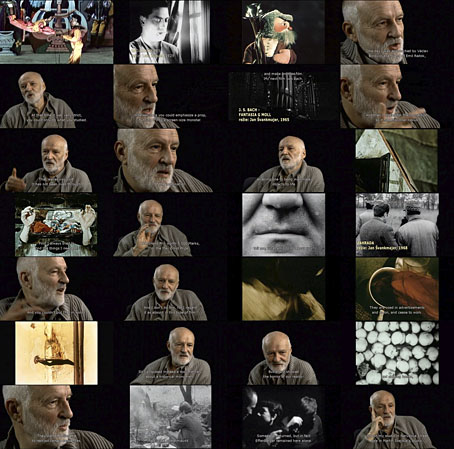
Thus Jan Švankmajer whose production company, Athanor, is named after the furnace used by medieval alchemists. Jan Švankmajer, Director (2009) is an hour-long documentary by Martin Sulík, one of several films from Golden Sixties, a Czech television series about film directors. Švankmajer has been the subject of several documentaries following his rise to international prominence, one of which, Les Chimeres des Švankmajer (2001), may be found on the BFI’s DVD set of the complete short films. Martin Sulík’s documentary doesn’t cover as much ground as the French film—the focus is on the 1960s—but has an advantage by allowing Švankmajer to talk at length about his work. Topics include his discovery of the usefulness of animation, his approach to filmmaking (and art in general), and peripheral subjects such as the soundtrack music of Zdeněk Liška, and the activities of the Prague Surrealist group. (Via MetaFilter.)

Jan Švankmajer, Director: Part one | Part two | Part three | Part four

Previously on { feuilleton }
Don Juan, a film by Jan Švankmajer
The Pendulum, the Pit and Hope
Two sides of Liška
The Torchbearer by Václav Švankmajer