Weekend links 465

palladini.jpg

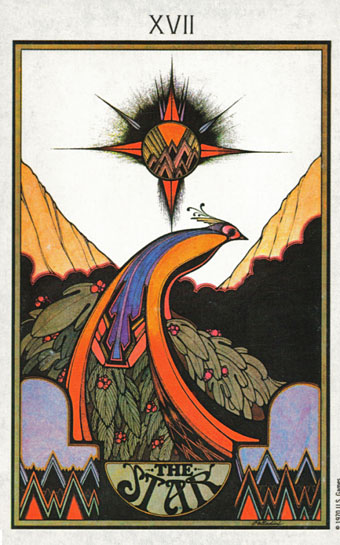
The Star (1970) from The Aquarian Tarot by David Palladini.

• Artist David Palladini died in March but I only heard the news this week. His poster for Werner Herzog’s Nosferatu has been a favourite of mine ever since the film’s release, while some of his other works have featured here in the past. Still popular among Tarot users is the Aquarian Tarot (1970), a deck published a few years after Palladini had helped with the production of the Linweave Tarot. From the same period as the Aquarian deck is a set of Zodiac posters, all of which exhibit Palladini’s distinctive blend of Art Nouveau and Deco stylings. In addition to posters, Palladini produced book covers and illustrations, and even a few record covers. A book collecting all of this work would be very welcome.

Erotikus: A History of the Gay Movies (1974? 75? 78?): Fred Halsted presents a 90-minute history of American gay porn, from the earliest beefcake films to the hardcore of the 1970s, some of which Halsted also helped create. Related: Centurians of Rome [sic]: Ashley West and April Hall on the bank robber who made the most expensive gay porno of all time.

Peter Bradshaw reviews Too Old to Die Young, a Nicolas Winding Refn TV series described as “a supernatural noir”. Sign me up.

Naomi Wolf’s Outrages establishes the context for [John Addington] Symonds’s desperate efforts to justify his own sexual feelings. Since he was born in 1840, he was 15 when the first edition of Walt Whitman’s Leaves of Grass appeared, the same year that legislation in Britain streamlined the laws against sodomy and ensured that men found guilty of it served long prison sentences. With intelligence and flair, Wolf uses the various responses to Whitman to show the levels of intense need in the decades after the publication of Leaves of Grass for images and books that would rescue homosexuality from increasing public disapproval.

Colm Tóibín reviews Outrages: Sex, Censorship and the Criminalisation of Love by Naomi Wolf

• Record label Dark Entries has discovered 40 more reels (!) of music by Patrick Cowley dating from 1974 to 1979.

• “Is Stockhausen’s Licht the most bonkers operatic spectacle ever?” asks Robert Barry.

• Sex, Spunk, Shoes and Sweet Satisfaction: A Q&A with artist Cary Kwok.

• Tripping his brains out: Eric Bulson on Michel Foucault and LSD.

• Paul O’Callaghan chooses 10 best Dennis Hopper performances.

• “More obscene than De Sade.” Luc Sante on the fotonovela.

• Karl Blossfeldt’s Urformen der Kunst (1928).

• The Strange World of…Gong

Neonlicht (1978) by Kraftwerk | Brüder Des Schattens, Söhne Des Lichtes (1978) by Popol Vuh | Lichtfest (2017) by ToiToiToi
Weekend links 462

chanctonbury.jpg

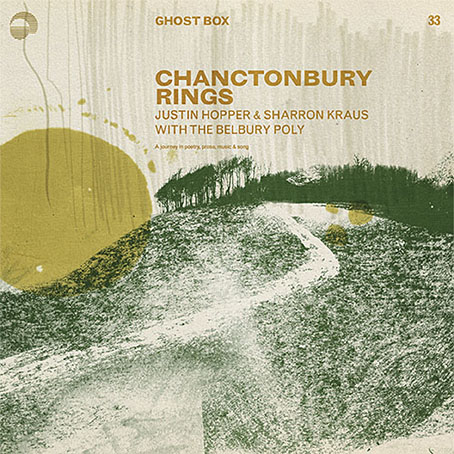
The next release on the Ghost Box label, Chanctonbury Rings is “a blend of folk, electronic music, poetry, prose and environmental sound” by Justin Hopper & Sharron Kraus with The Belbury Poly. The album will be available in June. Design, as always, is by Julian House.

• Clumsy and insensitive translations can ruin the enjoyment of a foreign-language film. Don’t blame us, say the subtitlers pressing film-makers for more appreciation of their art. Anne Billson on the difficulties of translating for a medium of moving images.

• At Expanding Mind: Hypermedia researcher and author Konrad Becker talks with Erik Davis about algorithms from hell, the madness of rationality, media seances, and the martial art of freedom.

The HP Lovecraft Cat Book: a limited collection of Lovecraft’s writings about cats edited by ST Joshi and illustrated by Jason C. Eckhardt.

Amacher was also inspired by a short story she found in the 1986 cyberpunk anthology Mirrorshades, edited by Bruce Sterling—a tale called Petra by Greg Bear, about a grand cathedral, possibly Notre Dame in Paris, in a ravaged, postapocalyptic landscape. Stone gargoyles and other statues mate with humans, creating new hybrids who wander the labyrinthine chambers of the battered house of worship.

Geeta Dayal on composer Maryanne Amacher

• The novel that wouldn’t leave Anthony Burgess alone: Alison Flood on the discovery of a non-fiction continuation of the themes in A Clockwork Orange.

Kristina Foster on photographs of Central Asia’s Striking Soviet Architecture.

Adrian Shaughnessy‘s ten favourite design and visual culture books.

William Joel on the process behind Helvetica’s 21st century facelift.

• The Stupid Classics Book Club by Elisa Gabbert.

The Haunted Generation by Bob Fischer.

Haunted Cocktails (1983) by Intro | Haunted Gate (1997) by David Toop | The Universe Is A Haunted House (2002) by Coil

Weekend links 461

meryon.jpg

Le Stryge (The Vampire) (1853) by Charles Méryon.

Notre-Dame-de-Paris in art and photography. Related: Chris Knapp on the Notre-Dame fire, and John Boardley on the print shops that used to cluster around the cathedral. Tangentially related: Mapping Gothic France.

The Bodies Beneath: The Flipside of British Film & Television by William Fowler and Vic Pratt will be published next month by Strange Attractor. With a foreword by Nicolas Winding Refn.

• “In his new biweekly column, Pinakothek, Luc Sante excavates and examines miscellaneous visual strata of the past.”

I also gathered underland stories, from Aeneas’s descent into Hades, through the sunken necropolises of Italo Calvino’s Invisible Cities and the Wind Cave cosmogony of the Dakota Sioux, to accounts of the many cavers, cave-divers and free-divers who have died seeking what Cormac McCarthy calls “the awful darkness inside the world”—often unable to communicate to themselves, let alone others, what metaphysical gravity drew them down to death. Why go low? Obsession, incomprehension, compulsion and revelation were among the recurrent echoes of these stories—and they became part of my underland experiences, too.

Robert Macfarlane on underworlds real and imagined, past, present and future

• Mixes of the week: FACT Mix 703 by Mary Lattimore, and The Colour Of Spring by cafekaput.

• A witty appraisal by Anna Aslanyan of a lipogrammatic classic and its smart translation.

• “Unseen Kafka works may soon be revealed after Kafkaesque trial.”

• “Why do cats love bookstores?” asks Jason Diamond.

Sunn O))) pick their Bandcamp favourites.

Le Grand Nuage de Magellan

Cathedral In Flames (1984) by Coil | The Cathedral of Tears (1995) by Robert Fripp | Cathedral Et Chartres (2005) by Jack Rose

Weekend links 460

treister.jpg

Black Hole (1987) by Suzanne Treister.

• “Most people who are considered heroes are always to be found messing about in someone else’s affairs, and I don’t think that’s very heroic.” Robert Altman talking in 1974 to Jan Dawson about The Long Goodbye.

• “Tea is calming, but alerting at the same time.” Natasha Gilbert on the science of tea’s mood-altering magic.

• Alien spaceship, Hammer horror? Philip Hoare on the pulsating visions of Harry Clarke.

“…world cinema, particularly European cinema…hasn’t shied away from sex and, in fact, has often found ways of using sex to tell a story. Movies like The Duke of Burgundy or Sauvage or BPM gracefully integrate eroticism into the narrative—even when the sex itself is far from graceful. Even the American films that have focused on sex tend to do it with a leer and luridness, regarding sex with a certain narrative fetishism, as opposed to matter-of-factly.”

Rich Juzwiak talking to Catherine Shoard about the current state of sex in the cinema

• Chernobyl again: photographs by David McMillan from inside the exclusion zone.

Lasting Marks: the 16 men put on trial for sadomasochism in Thatcher’s Britain.

• Before Tarkovsky: Michael Brooke on the Russian TV adaptation of Solaris.

• Mix of the week: XLR8R Podcast 588 by Rouge Mécanique.

• Dustin Krcatovich on The Strange World of Mark Stewart.

• Your Surrealist literature starter kit by Emily Temple.

John Peel’s Archive Things (1970)

5fathom: Things rich and strange

Hole In The Sky (1975) by Black Sabbath | Thru The Black Hole (1979) by Metabolist | Black Hole (1993) by Total Eclipse

Sundial and Mile End Purgatorio

blacktower.jpg

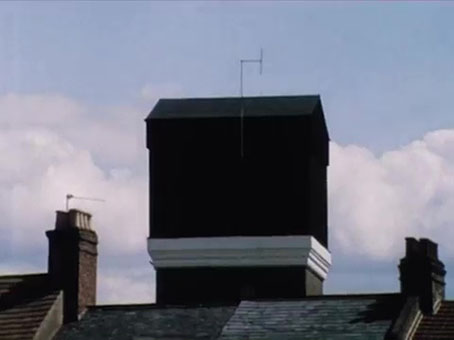
The Black Tower.

I ought to have devoted this post to The Black Tower (1987), John Smith’s short and sinister film which I linked to at the weekend. It was good to watch it again after seeing a TV screening (no doubt the only one) on the UK’s Channel 4 in 1988. It also reminded me of the two shorter films linked here, both of which were also shown on Channel 4 a few years later in Benjamin Woolley’s excellent Midnight Underground series. All three films are linked by their London locations and their different solutions to the perennial problem of the micro-budget filmmaker looking to make the most of limited resources.

sundial.jpg

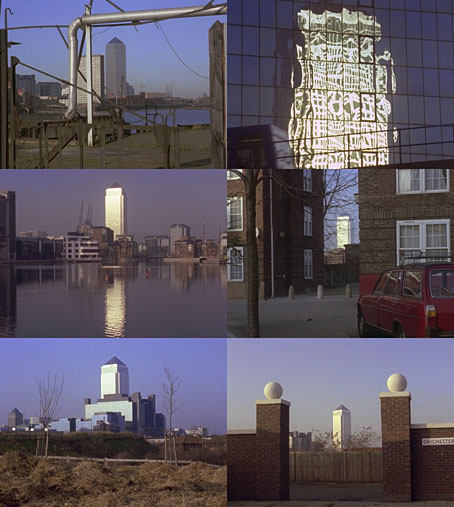
Sundial.

Smith’s film is the more substantial work, and of particular interest to those looking for examples of weird (or horror) cinema that avoids Hollywood cliches. The Black Tower combines static views of an unusual building with voiceover and sound effects to turn a mundane piece of architecture into a growing menace. Using a voiceover to craft a narrative from unrelated shots has always been a useful and flexible technique, especially if money is limited; Peter Greenaway did this with all of his early films, and it’s an approach also favoured by Patrick Keiller and Terrence Malick.

mileend.jpg

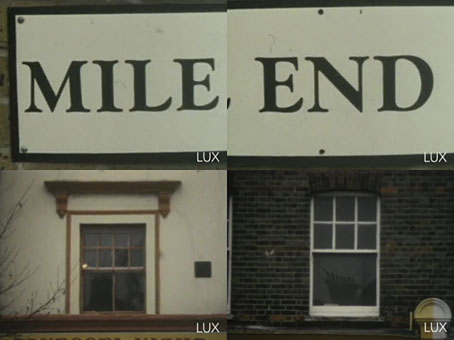
Mile End Purgatorio.

Guy Sherwin uses the same technique for Mile End Purgatorio (1991), an East-End riff on Dante, Hamlet and the Bible, with words by Martin Doyle. William Raban’s Sundial (1993) has no voiceover but it follows The Black Tower in making the Canary Wharf tower the centre of its attention, the fixed point in the passing of a single day. Sherwin and Raban also show how much can be done with a single minute of film.