Weekend links 317

mucha.jpg

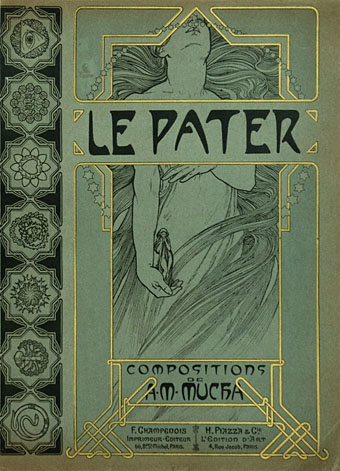
Alphonse Mucha’s Le Pater, a book of mystical Symbolism written, designed and illustrated by the artist, was published in a limited edition in 1899. The book has been out of print ever since but Thomas Negovan at Century Guild will be reprinting it later this year.

• “Five axioms to define Europe: the coffee house; the landscape on a traversable and human scale; these streets and squares named after the statesmen, scientists, artists, writers of the past; our twofold descent from Athens and Jerusalem; and, lastly, that apprehension of a closing chapter, of that famous Hegelian sunset, which shadowed the idea and substance of Europe even in their noon hours.” George Steiner explores his idea of Europe.

Journey To The Edge Of The Universe by Upper Astral, 43 minutes of cosmic ambience, is a cassette-only release from 1983. The album has never been reissued so secondhand copies command excessive prices but it may be downloaded here.

• Mixes of the week: Three hours of ambience by Gregg Hermetech, XLR8R Podcast 446 by [Adrian] Sherwood x Nisennenmondai, and Secret Thirteen Mix 190 by Shxcxchcxsh.

Today [Angela] Carter is well known, widely taught in schools and universities, and much of what she presaged—in terms of recycling and updating (“old wine in new bottles”, she called it), or gender role play and reversal—has become commonplace in the culture. Despite this, many critics find it difficult to situate her work properly. This is partly because Carter is so sui generis (she has literary offspring but few antecedents), and partly because many struggle with the relationship of politics and aesthetics in her writing.

Kate Webb reviews two new books about Angela Carter

• Words that will forever pursue us: Tim Page on the late Michael Herr, “rock’n’roll voice of the Vietnam War”.

• From 2015: Luigi Serafini on how and why he created an encyclopedia of an imaginary world.

James Campbell on Ginsberg, Kerouac and Burroughs: celebrating the Beats in Paris.

Fragile Beasts, an exhibition of grotesque print ornaments at Cooper Hewitt, NYC.

• Not before time, Guy Gavriel Kay wants to see an end to the plague of writing tips.

• David Bowie and Buster Keaton by Steve Schapiro.

Tom Charity on the films of Michael Cimino.

Alison Goldfrapp: photographer.

Golem Mecanique

European Man (1981) by Landscape | Europe After The Rain (1981) by John Foxx | Trans Europe Express (1994) by The One You Love

The art of Frantisek Kobliha, 1877–1962

kobliha05.jpg

Untitled.

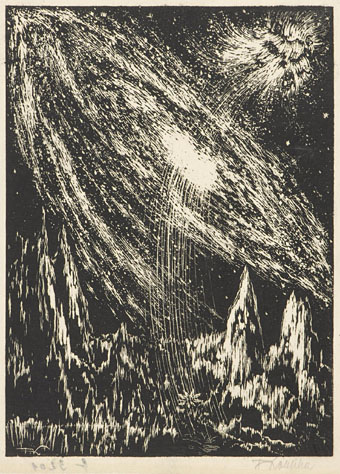
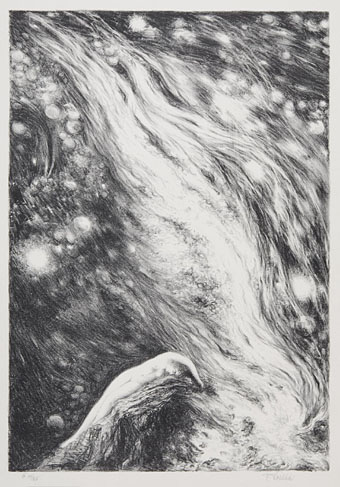
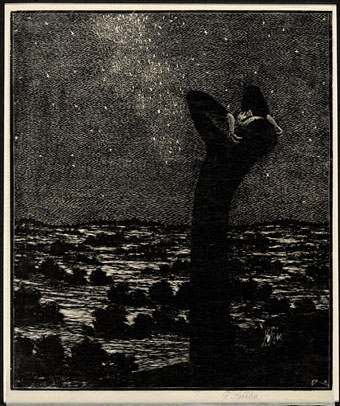
Another unfamiliar name, Frantisek Kobliha was a Czech Symbolist whose output includes a great deal of monochrome work in a variety of media: woodcuts, lithographs and the like. This may explain why he doesn’t make the larger Symbolist studies despite the quality of his work. Among his series of prints there’s that Symbolist perennial, the Temptation of St Anthony.

These examples may be found at larger size here (slow to load but many pages) and here. Thanks to Thom for the tip!

kobliha06.jpg

Untitled.

kobliha09.jpg

May (1911).

Continue reading “The art of Frantisek Kobliha, 1877–1962”

Ernst Fuchs, 1930–2015

fuchs6.jpg

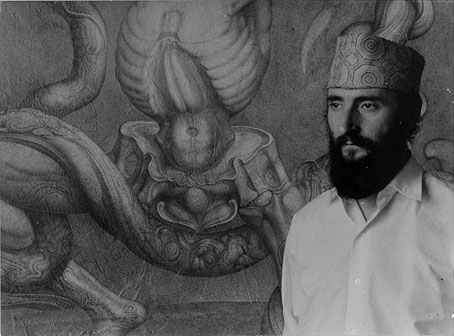
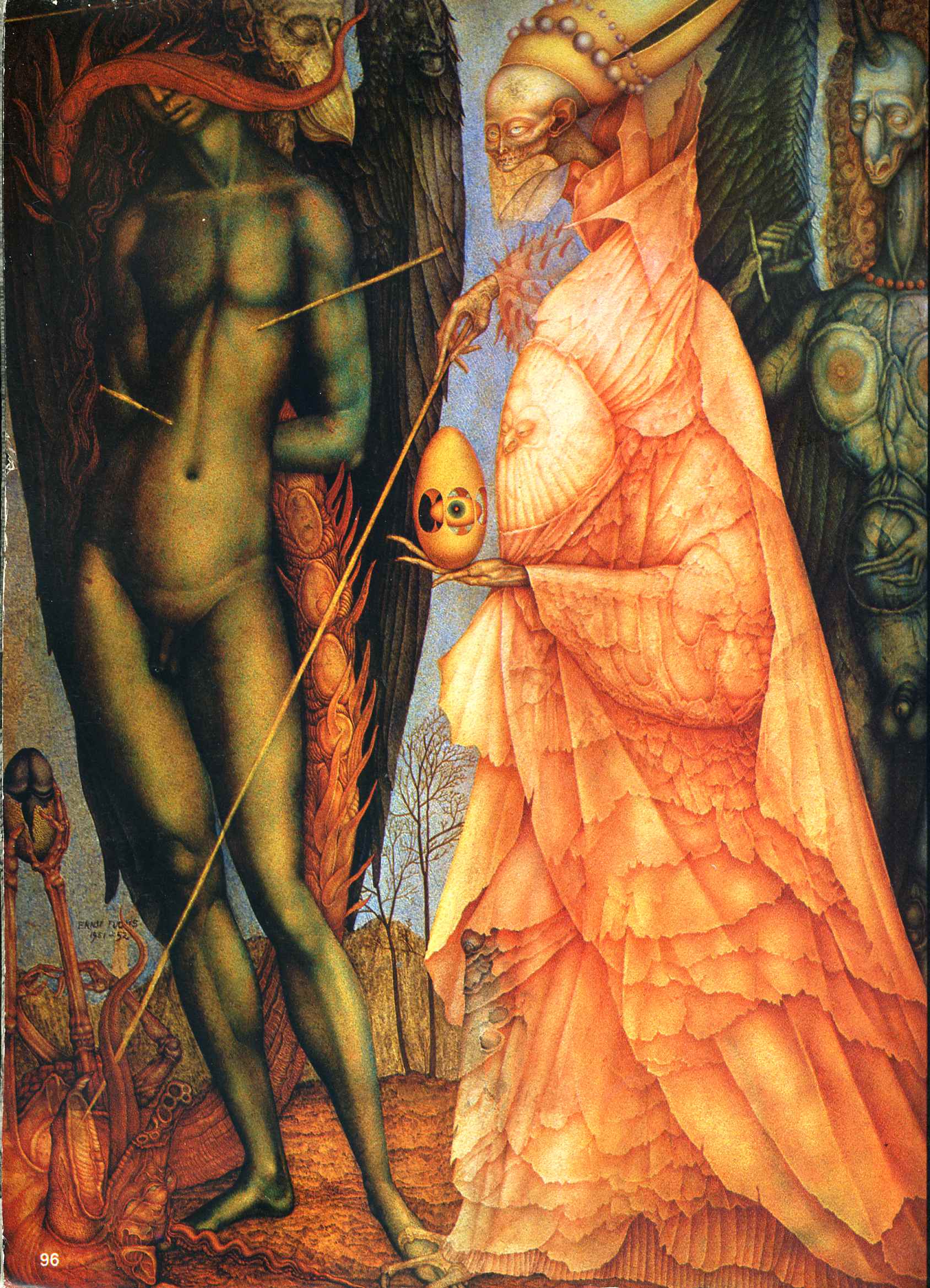
It was a surprise to see the death of Austrian artist Ernst Fuchs mentioned on the BBC website since I’d never seen him mentioned in the British media during his lifetime. Fuchs was one of those artists who would have been a natural Surrealist if he’d been born a few years earlier, and his work does occasionally receive a mention in the more comprehensive guides to Surrealism. The first place I saw any of his paintings was in the pages of Omni magazine when it was launched in the late 1970s. As well as providing a high-profile showcase to science-fiction writers, Omni in its early days avoided generic SF art in favour of the living practitioners of Fantastic Realism: Fuchs, HR Giger, Mati Klarwein, Robert Venosa, Rudolf Hausner, De Es Schwertberger and many others. Fuchs was often seen as the figurehead of this loose movement as a result of founding the Vienna School of Fantastic Realism in the 1940s, but Fantastic Realism as it’s generally applied is an umbrella term used to connect a generation of artists who were using hyper-real techniques to explore their obsessions. Fuchs’ obsessions often concern spirituality of one kind or another but he could be erotic as well, something you can’t always say about his many imitators in the current Visionary Art world. At his best his paintings seem caught midway between the Max Ernst style of the late 40s and Gustave Moreau’s more hieratic moments, with human figures or inhuman creatures emerging from (or melting into) mineral forms.

Official site
Fuchs at Wikiart
Fuchs pages at Fantastic Visions
360-degree panorama of the Apocalypse Chapel, Klagenfurt

fuchs2.jpg

Battle of the Gods that have been Transformed (1952).

fuchs1.jpg

The Spirit of Mercury (1954).

Continue reading “Ernst Fuchs, 1930–2015”

The nocturnes of William Degouve de Nuncques

nuncques04.jpg

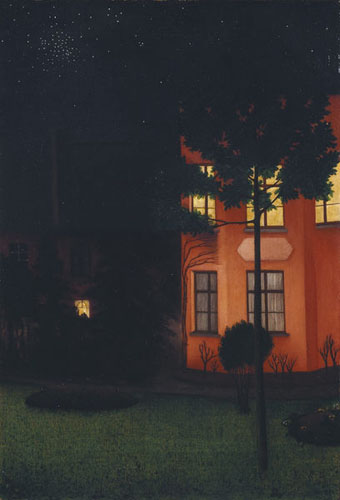
The Blind House (1892).

William Degouve de Nuncques (1867–1935) is one of the less well-known Belgian Symbolists but one with a place in art history for the picture above. The mysterious atmosphere of The Blind House (often labelled as The Shuttered House, The Pink House or even The House of Mysteries) was admired by René Magritte who inverted the apparent conjunction of night and day in his own Empire of Lights series. Degouve de Nuncques’ other pictures from this period possess a similar quality of nocturnal mystery, a predilection he shared with other Belgian artists such as Léon Spilliaert and Paul Delvaux. Many of these pictures are pastels, a popular medium among the Symbolists for its nebulous effects.

nuncques09.jpg

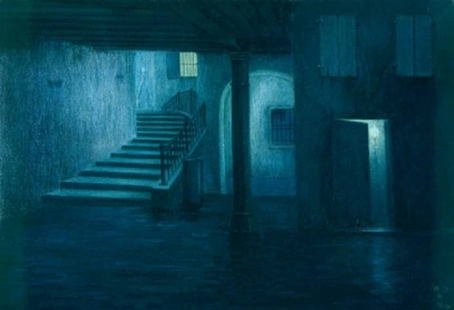
In Venice (1895).

nuncques03.jpg

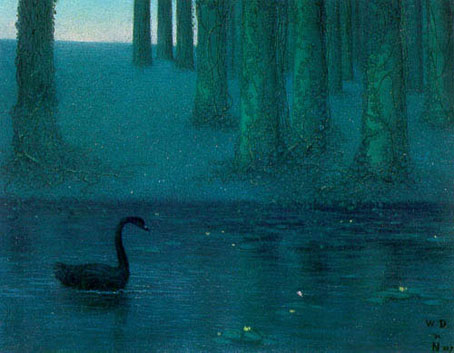
The Black Swan (1896).

Continue reading “The nocturnes of William Degouve de Nuncques”

Tooropia

toorop1.jpg

The Sphinx (1895).

The Dutch Symbolist isn’t a stranger to these pages but every so often a drawing or painting by Jan Toorop draws attention to itself. The Sphinx above is oft-reproduced but you don’t always see it in colour or at a size that does justice to its detail. De Staatskas (below) is a caricature I hadn’t seen before, an unusual piece whose background is filled with stringed instruments that are also smoking chimneys.

toorop2.jpg

Desire and Satisfaction (1893).

toorop4.jpg

De Staatskas (1895).

Continue reading “Tooropia”