Jan Parker’s witches

parker01.jpg

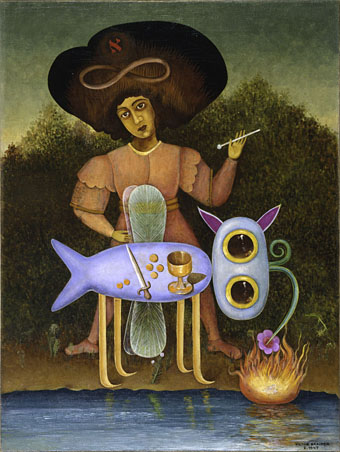
Also witch-finders, demons, magi, and a skeletal Adolf Hitler clutching a glowing crystal ball… Jan Parker is a British artist who was working as an illustrator in the early 1970s, during which time he produced a small number of covers for SF and fantasy titles. One of these, The Worlds of Frank Herbert, is a book I used to see a lot on the secondhand shelves although I never owned a copy. As with Victor Valla’s cover art, the 70s was a decade when idiosyncratic imagery of the type created by Parker and co. was a more common sight on genre covers than it is today. Witchcraft and Black Magic, published by Hamlyn in 1971, brought Parker’s brand of naïve weirdness to a Peter Haining history of the more lurid forms of occultism. This is a book that I did own for a while until someone borrowed it and never returned it, a persistent hazard for the books in my not-very-extensive occult library. Haining’s study is the kind of thing that publishers often call a pocket guide, although this suggests something you’d carry around to be used as an identification tool during chance encounters; you wouldn’t want to encounter most of the people (never mind the creatures) in these paintings.

parker02.jpg

A handful of Parker’s illustrations turned up some years ago at the now-defunct Front Free Endpaper, then were reblogged at Monster Brains and elsewhere. The copies here are from another recent upload at the Internet Archive where the book is part of a sub-archive of titles scanned from Indian libraries. The very tight binding evidently presented difficulties for the scanner, hence the appearance of fingers holding open most of the pages. It’s good to see this one again; I always valued the book more for the artwork than the text which isn’t bad but was simply another commission for the very prolific Haining, a writer who was a better anthologist than a historian. If you want a general history of the occult there are more authoritative options elsewhere.

parker03.jpg

As for the artwork, I wonder now how long it took Parker to paint all these pictures. There are about 80 original illustrations plus a number of others taken from antique books or from artists such as Frans Hals and Goya; that’s a lot of original art for a book of only 160 pages. Many of Parker’s pieces are copies of pre-existing portraits or of familiar illustrations like the perennially popular demons from de Plancy’s Dictionnaire Infernal. This makes me wonder why Hamlyn commissioned copies from Parker rather than simply paying a picture library for the original images as Marshall Cavendish were doing in 1971 with their multi-part encyclopedia, Man, Myth and Magic. Whatever the reason I’m pleased they gave Parker so much free reign. His depictions of historical figures wouldn’t be out of place in the portrait gallery in Dance of the Vampires, while some of his other pieces stray into outright Surrealism; the picture of people being menaced by flying eyeballs was used for the cover art of the US reprint from Bantam.

parker04.jpg

Haining’s book had at least one reprint in the UK before going out of print. The early 1970s saw the peak of the occult revival which had begun in the previous decade, and which made room in publishers’ lists for odd little books like this one. Secondhand copies are still floating around although they’re seldom cheap. If you do find one just be careful who you lend it to.

parker05.jpg

Continue reading “Jan Parker’s witches”

Dreyer’s dark dreams

vampyr00.jpg

“Almost every time one takes a closer look at a film that is world-famous one has to face the sad fact that the film does not really exist in a form that seems acceptable.” Martin Koerber discussing the physical condition of Vampyr. Carl Dreyer’s film is now 90 years old, and has suffered more than most from the ravages of time and censorship, but after several years of restoration (or should that be resurrection?) by Koerber and others it looks as good today as it’s likely to get; not perfect, when many excisions remain lost, but still the best print I’ve seen.

vampyr01.jpg

Watching this again I’d forgotten how deeply strange it all is, a sketch of conventional horror motifs borrowed from Sheridan Le Fanu’s In a Glass Darkly, overlaid with inexplicable events from the imaginations of Dreyer and screenwriter Christen Jul. “Surreal” is the word that comes to mind, not least because the film was being shot in locations around Paris while the Surrealists were busy creating their aesthetic scandals inside the city; the Surrealist quest for “the marvellous” and the iconography of dreams is fully realised in Dreyer’s revenants and ambulatory shadows. Vampyr manages to look as primitive as an early silent film—the diffuse photography and stilted acting—while also being sophisticated in its visual style and directorial technique; something else I’d forgotten was the restlessness of Rudolph Maté’s camera, continually moving about the actors or roaming the rooms and corridors. Dreyer’s shoot was almost finished when the Tod Browning version of Dracula was going into production, a film which is equally stilted but with few redeeming features. Where Browning’s film is inert and devoid of atmosphere Vampyr is thoroughly cinematic, with a startling, original score by Wolfgang Zeller that’s nothing like the classical pastiches of Hollywood in the 1930s.

vampyr02.jpg

Kim Newman compares Dreyer’s actors to the hypnotised cast of Werner Herzog’s Heart of Glass, an astute observation. I’ve never regarded the somnolent performances as a flaw, not when they suit the mood so well. More of a deficiency is Vampyr‘s title which raises expectations of a traditional tale of the undead that Dreyer never delivers. The English and French versions were originally titled The Strange Adventure of David Gray but it’s the German version that provides most of the materials for the restored print, and this was retitled Vampyr: The Strange Dream of Allan Gray. (The dual name of the central character is another complication.) The distributors held over the release in Germany until Universal’s Dracula and Frankenstein had opened there which must have pressured them to present the film (unsuccessfully as it turned out) as a conventional horror story. “Strange Dream” is evasive but also more accurate. It reminds me of the only description that David Lynch would provide when asked what Eraserhead was all about: “A dream of dark and troubling things”.

vampyr03.jpg

vampyr04.jpg

vampyr05.jpg

vampyr06.jpg

vampyr07.jpg

vampyr08.jpg

Previously on { feuilleton }
Universal horror
Undead visions
David Rudkin on Carl Dreyer’s Vampyr

Weekend links 620

varo

Premonition (1953) by Remedios Varo.

• “Classical mythology, Arcadian idylls, occult speculation, and an interest in cultural curiosities coexisted in the grotto, allowing for the playful exploration of a new tension emerging between Nature and Artifice.” Laura Tradii explores the artificial grottoes of the Renaissance and beyond.

• “Some of the symbols and signs seem like bridges to nowhere, and perhaps Nabokov was lovingly teasing our endless quest to find patterns and generate meaning.” David M. Rubin on writing a response to a Nabokov short story.

• New music: “KMRU & Aho Ssan erupt in post-apocalyptic extremity with Resurgence“. I did the layout for this latest release on the Subtext label but I still haven’t got round to updating my web pages so you’ll have to take my word for it.

• Powell & Pressburger’s Black Narcissus “unleashes a level of eroticism that’s surprising for 1940s British cinema,” says Adam Scovell.

• “Premonitions are impossible, and they come true all the time.” Fiona Sturges reviews The Premonitions Bureau by Sam Knight.

• Between Hell and Paradise: paintings by Hieronymus Bosch and his followers at the Museum of Fine Arts, Budapest.

• At The Collector: Olivia Barrett on the Voodoo Queens of New Orleans.

• Steven Heller’s font of the month is Astronef Super.

• Mix of the week: Isolatedmix 118 by Pan American.

TMP-01 Vintage Synth TV Series from Benge.

• Vale, A Year In The Country.

Premonition (1979) by Simple Minds | Premonition (1980) by Cabaret Voltaire | Premonition (Giant Empty Iron Vessel) (1987) by David Sylvian & Holger Czukay

Michel Henricot, 1936–2022

henricot1.jpg

Deux Personnages (1974).

Jan of JKK Fine Arts was in touch this week to inform me that the French artist Michel Henricot died in February, a month before the opening of an exhibition of his work organised by JKK Fine Arts for the International Cultural Centre in Cracow, Poland.

henricot2.jpg

Le Voyageur IV (1996).

I first encountered Henricot’s work in the pages of OMNI magazine where he was one of several featured artists who can be grouped together as “fantastic realists”—Ernst Fuchs, Mati Klarwein, HR Giger, Robert Venosa, Rudolf Hausner, De Es Schwertberger—although the label wouldn’t have necessarily been agreed to by any of them apart from Fuchs and Hausner, both of whom were members of the Vienna School of Fantastic Realism in the 1960s. Henricot’s sombre and obsessive figure studies were a good fit for the magazine, with the science fiction context lending his paintings suggestions of the futuristic or alien that might otherwise be absent in the empty space of an art gallery.

henricot3.jpg

The artist photographed by Jan K. Kapera.

Despite such a high-profile showcase Henricot’s work has never been as visible as his more famous contemporaries so I’m grateful to Jan for supplying additional information, including the artist’s actual birth date, 8th July, 1936, rather than the erroneous dates found all over the internet. Henricot was friends with Leonor Fini, an artist whose work was also preoccupied with the human figure, often just as stylised and set against featureless monochrome backgrounds. Like Henricot, Fini’s art gets tagged as Surrealist even though her own obsessive paintings evolved away from any particular school. Henricot’s Les Promeneuses (1954) was definitely reaching for a Dalínean/Delvaux-like quality, but if his mature work belongs anywhere it’s with that small collection of French artists who don’t comprise any defined movement but who share a taste for the fantastic, the strange and the inexplicable: Sibylle Ruppert, Jean-Marie Poumeyrol, Jean-Pierre Ugarte, Gérard Trignac, Erik Desmazières, Jean-Paul Faccon, Pierre Clayette, Raymond Bertrand, Roland Cat, Gilles Rimbault, Jean-Michel Mathieux-Marie, and others. If I was given the opportunity to put together an art show for a French gallery (or even the Pompidou Centre…), these are some of the artists I’d choose.

henricot4.jpg

Le Silence (1979).

Henricot will be running at the International Cultural Centre, Cracow, until the end of April.

Elsewhere on { feuilleton }
The fantastic art archive

Previously on { feuilleton }
Saint Sebastian in NYC
The art of Michel Henricot

Weekend links 615

tesla.jpg

Tesla does the Astro. Hunter Dukes at Public Domain Review examines the promotion of Nikola Tesla’s ideas via this famous photograph.

• Coming soon from Side Real Press: Kokain—The Modern Revue, a magazine produced in Vienna that ran for five issues during 1925. “Original copies are so rare that it scarcely appears in any of the literature relating to the Weimar period and its contents have remained almost entirely ignored and certainly untranslated. Until now.”

• “Magritte had gotten this far in life by refusing to obey anyone, and in a way his disobedience proved that he understood Surrealism better than the leader of the Surrealists.” Jackson Arn reviewing Magritte: A Life by Alex Danchev.

• “Go as far into your dream as possible and find your own unique voice.” Meredith Monk (again) talking to Elizabeth Aubrey.

• Coming soon from Strange Attractor: City of the Beast: The London of Aleister Crowley by Phil Baker.

• At Spoon & Tamago: The natural world springs to life in kirie paintings by Tamami Kubota.

Antonia Mufarech on why sunflowers are Ukraine’s national flower.

• At Dennis Cooper’s: Etienne-Louis Boullée’s unbuildable tombs.

• Mix of the week: I Can’t Go For That by The Ephemeral Man.

• New music: Triumph Of The Oak by The Lord.

• RIP Philip Jeck.

Tesla (1997) by Jimi Tenor | Tesla (2011) by They Might Be Giants | Tesla Coil (2016) by Xhei