Klapheck versus Ballard

klaphek.jpg

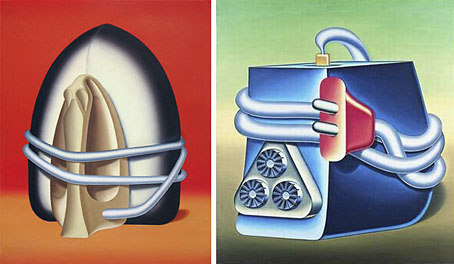
left: The Hostage (1966); right: The Female Terrorist (1971). Both by Konrad Klapheck.

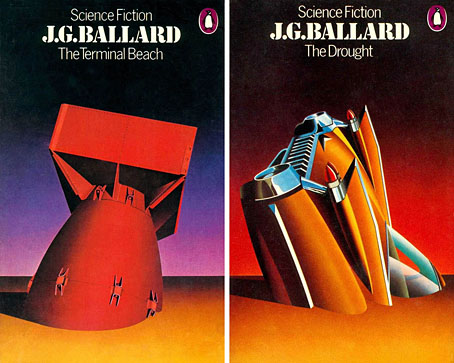
No, I’m not suggesting that David Pelham’s paintings for the Ballard covers he designed in the 1970s are inspired by the earlier work of German artist Konrad Klapheck. But it’s tempting to think of Klapheck’s isolated objects as being intended for Ballard collections that never saw the light of day. Klapheck has connections with late Surrealism, and some of his paintings prefigure the styles and concerns of Pop Art, so I’m sure Ballard would have approved.

pelham.jpg

Three of Pelham’s memorable Ballard paintings were made available as signed and numbered prints earlier this year, together with his design for A Clockwork Orange. For more about the covers see Landscapes From a Dream: How the Art of David Pelham Captured the Essence of JG Ballard’s Early Fiction, an essay at Ballardian. The designer discussed his career at some length in 2007. Then there’s the complete set of covers at the Penguin Science Fiction site, and let’s not forget Konrad Klapheck who’s still painting and who has a website here.

Elsewhere on { feuilleton }
The book covers archive

Weekend links 82

morris.jpg

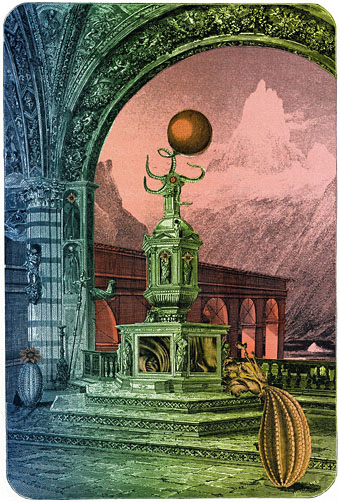
At the Mountains of Madness (1979) from Halloween in Arkham by Harry O. Morris.

• Golden Age Comic Book Stories always pulls out the stops in the run up to Halloween. In addition to a wonderful collection of Harry O. Morris collages, Mr Door Tree has also been posting Virgil Finlay’s illustrations for Edgar Allan Poe, Lynd Ward’s tremendous illustrations for a collection of weird tales entitled The Haunted Omnibus, Barry Moser’s woodcuts for an edition of Frankenstein, and Virgil Finlay’s illustrations for stories and poems by HP Lovecraft.

• “Eugene Thacker suggests that we look to the genre of horror as offering a way of thinking about the unthinkable world. To confront this idea is to confront the limit of our ability to understand the world in which we live – a central motif of the horror genre. In the Dust of This Planet explores these relationships between philosophy and horror.”

• “…the reader […] becomes a conscious participant in the process of imposing a linear sequence, while at the same time remaining aware that all narrative is an act of memory, and that memory is necessarily random.” Jonathan Coe reviews Marc Saporta’s book-in-a-box, Composition No.1, recently republished by Visual Editions.

• Nearly fifty years after its first performance, Peter Weiss’s Marat/Sade is still disturbing playgoers. And nearly ninety years after its release, Alla Nazimova’s silent film production of Oscar Wilde’s Salomé is touring the UK with live musical accompaniment.

Tom of Sinland at Homotography, in which illustrator Bendix Bauer portrays some of the fashion world’s notable male designers as Tom of Finland-style characters for Horst magazine.

Neil Gaiman Presents is a new audiobook imprint which launches with works by Jonathan Carroll, Alina Simone, Keith Roberts, M. John Harrison and Steven Sherrill.

• The Weird Wild West: Paul Kirchner has put all his Dope Rider comic strips online.

Leonora Carrington prints at Viktor Wynd Fine Art, London, from November 5th.

The Fall to Earth: David Bowie, Cocaine and the Occult.

Photos of New York City, 1978–1985.

Kathy Acker recordings at Ubuweb.

The Occupied Times of London.

The Golden Age of Dirty Talk.

Pushkin silhouettes.

• This week I’ve been lost in the Velvet Goldmine (again): John, I’m Only Dancing (1972) by David Bowie | The Jean Genie (1972) by David Bowie | Drive-In Saturday (1973) by David Bowie.

John Holmes, 1935–2011

holmes4.jpg

(1974).

Artist John Holmes, whose obituary was published this week, had a style that was immediately recognisable from the many paintings featured on book covers (and a few record sleeves) in the 1970s and 1980s. His painting for The Female Eunuch is by far the most well-known, of course, although I often used to wonder how many people who knew the picture could have named the artist responsible. Holmes’ art brought a touch of Magritte-like Surrealism to cover illustration (at times the debt to Magritte was quite overt), and his images are familiar to anyone in the UK who was reading science fiction or horror during the 70s. He also has the distinction of being the first artist to provide a cover for an M. John Harrison book with the painting for Harrison’s debut novel, The Committed Men, in 1971. (Or not quite… See comments.)

The McNeill Gallery has some original work for sale while the artist himself talked about some of his cover art at All Things Horror.

holmes2.jpg

(1974).

holmes3.jpg

(1981).

Elsewhere on { feuilleton }
The album covers archive
The book covers archive

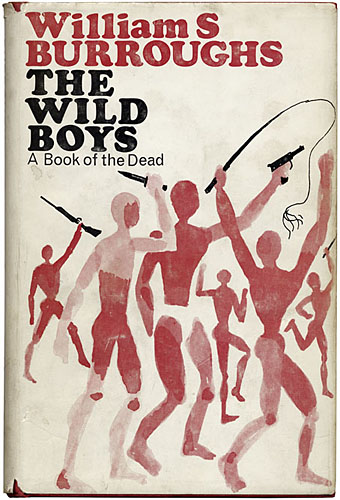
Looking for the Wild Boys

wildboys-calder.jpg

Calder & Boyars, 1972. Design by John Sewell.

This must be the first space novel, the first serious piece of science fiction—the others are entertainment.

Mary McCarthy defending The Naked Lunch in the New York Review of Books, June, 1963.

Mary McCarthy’s view—echoed a year later by Michael Moorcock and JG Ballard in the pages of New Worlds magazine—has never been popular or even particularly acceptable. William Burroughs gets touted as an sf writer by other writers, and John Clute gives him an entry in the Encyclopedia of Science Fiction, but Burroughs’ sf scenarios are guaranteed to offend those readers who prefer their narratives presented in a neat, linear form with detailed explanations of How The Future Would Actually Work, or the physics behind some piece of imaginary technology. The books which immediately follow The Naked LunchThe Soft Machine, The Ticket that Exploded, and Nova Express—all feature sf scenes or ideas. The latter was deemed sufficiently generic to prompt Panther Books in the UK to publish it three times as “Panther Science Fiction” although given the severe criticism that Moorcock sustained for trying to broaden the horizons of readers in the late 60s I don’t expect sales were encouraging.

The Wild Boys, published in 1971 (1972 in the UK), was Burroughs’ first novel after Nova Express, and his first book of fresh material after mining the stack of writing that birthed The Naked Lunch and the titles which followed. The novel is subtitled A Book of the Dead (as in the Egyptian or Tibetan Books of the Dead), and is certainly science fiction although I’ve never seen it marketed as such or noticed any sf reader include it in a list of notable genre novels of the period. My Calder & Boyers hardback offers a précis of the fractured narrative:

The year is 1988. The Wild Boys, adolescent guerilla armies of specialized humanoids, are destroying the armies of the civilized nations and ravaging the earth. The wild boys, who began in the pre-present past as petrol gangs, dousing their victims with petrol and setting them on fire for kicks, have grown to an army, dedicated to violence. One of them is used in a cigarette commercial. He becomes a new cult figure, a demi-god responsible for great destruction, and it is left to strong man Arachnid Ben Driss to exterminate the wild boys. He slaughters them, but the battle continues underground until all civilization collapses, revealing a future of horrifying dimensions. The originality of the theme and the very special Burroughs style together make this one of the most unusual science fiction novels ever, a prophetic exploration of the future, that should quickly establish itself as one of the classics of the present time.

That’s accurate, up to a point, although like many book blurbs it misrepresents the content somewhat. It also neglects to say how funny the book is. For anyone with a black sense of humour Burroughs has always been a great comic writer, and The Wild Boys has some prime examples, not least the opening chapter, Tío Mate Smiles, which is best appreciated in the author’s own reading.

Having gone through the novel in the past week, and going through its follow-up/appendix/remix Port of Saints at the moment, a couple of things occurred to me. The first was the way The Wild Boys strongly prefigures later works like Cities of the Red Night and The Place of Dead Roads. This is a fairly obvious point but it’s one that hadn’t fully clicked until now. The Wild Boys takes the problems of repressive control systems posed in the first few novels and offers a possible solution: a homoerotic utopia/dystopia where gangs of teenage boys hide out in depopulated regions, waging war against the rest of humanity with sex, magic and a mastery of weapons, including biological and viral varieties. While doing this they are steadily mutating so they can leave behind all human concerns with nation, family, laws and written language. Cities of the Red Night was Burroughs first novel after The Wild Boys and presents a less radical proposal, ranging through time with its anarchist pirate colonies and the six cities of the title. In The Place of Dead Roads Kim Carsons has his band of outlaw cowboys, The Wild Fruits, and the book gives us the conflict between the Johnsons—those who “mind their own business”—and the Shits: lawmen, politicians, tycoons, all the usual agents of Control.

Continue reading “Looking for the Wild Boys”

Die Farbe and The Colour Out of Space

farbe2.jpg

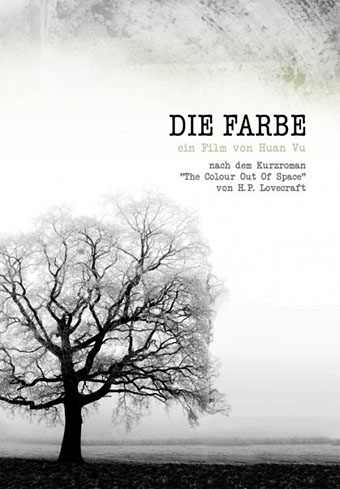
Die Farbe (2010).

The colour, which resembled some of the bands in the meteor’s strange spectrum, was almost impossible to describe; and it was only by analogy that they called it colour at all. Its texture was glossy, and upon tapping it appeared to promise both brittleness and hollowness.

The Colour Out of Space (1927).

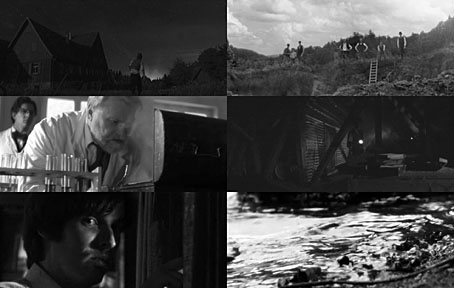
Die Farbe (The Colour) is a German feature film by Huan Vu based on HP Lovecraft’s tremendous short story The Colour Out of Space. Vu’s film was completed last year, and has been well-received at film festivals and by Lovecraft aficionados but I’ve been rather tardy in hearing about it. Better late than never.

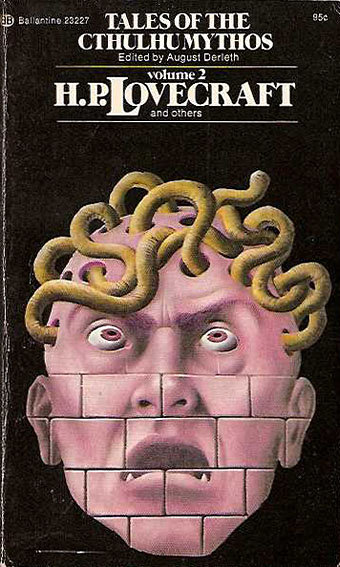
Having adapted two-and-a-half stories, I tend to take a more than cursory interest in works based on Lovecraft’s fiction. One of the reasons I tackled his works in the first place was out of frustration at the apparent inability of film producers and comic artists to treat the stories as they’d been written. The Colour Out of Space is one of the masterpieces of Lovecraft’s mature period, and was the favourite of his own stories, a skilful blending of horror and science fiction in the tale of a fallen meteorite infecting a farm with an inexplicable process of decay and physical mutation. The mysterious colour is the product of some unearthly substance inside the meteorite which corresponds to no known part of the visible spectrum. This wasn’t the first story of Lovecraft’s that I read—I’d earlier found The Moon-Bog in a ghost story anthology—but it was the first that made a serious impression when I came across it in another anthology at age 12 or 13. Since then, whenever people ask me which Lovecraft stories to read first The Colour Out of Space is always one I recommend.

farbe1.jpg

Continue reading “Die Farbe and The Colour Out of Space”