Weekend links 211

shau.jpg

Secret Bloom (2014) by Natalie Shau.

Bloomsday approachs. “Reading Ulysses changed everything I thought about language, and everything I understood about what a book could do,” says Eimear McBride whose debut novel, A Girl Is a Half-formed Thing, recently won the first Bailey’s women’s prize for fiction. McBride was interviewed by Susanna Rustin last month, shortly before the award was announced, and her novel has now become one of those minor causes célèbres for being rejected so often it was eventually published by a new imprint set up by a bookseller. “If the publishing industry doesn’t take a risk then who will?” asks Henry Layte, the bookseller in question.

Speaking of risk, David Hebblethwaite coincidentally wrote a post earlier this week asking where the formal challenge has gone in science-fiction writing. (He mentions McBride in passing.) Nina Allen followed up with a post of her own. I suspect the books are still being written but they’re no longer being accepted by editors and publishers who want even more adventure stories, “sympathetic” characters, and easy reads. Novels that only aspire to be written equivalents of action films or computer games are doomed to be less exciting than their more kinetic competitors. The struggle between the values of art and the values of entertainment is an old one but it shouldn’t be an either/or proposition. “Difficulty is subjective,” says Eimear McBride, “the demands a writer makes on a reader can be perceived as a compliment.”

Related: the following from Geoffrey Hill on “difficulty”:

We are difficult. Human beings are difficult. We’re difficult to ourselves, we’re difficult to each other. And we are mysteries to ourselves, we are mysteries to each other. One encounters in any ordinary day far more real difficulty than one confronts in the most “intellectual” piece of work.

• The Quietus pulled out all the stops this week, interviewing Annette Peacock, Iain Sinclair (again), Alan Moore (again), and asking Peter Strickland, the director of Berberian Sound Studio, for a list of his favourite albums. Given the above, it’s worth noting that all those people have produced challenging work of their own in different media.

• “The Satyrs Motorcycle Club was founded in 1954 with seven members, but little did anyone know it would become the oldest running LGBT organization (and oldest gay motorcycle club) in the world.”

Trunk TV posted another great selection of television title sequences. The previous selection has been taken down for the usual tiresome copyright reasons so watch this one while you can.

• “Detroit techno and black metal have so much in common,” say Wolves In The Throne Room whose new album, Celestite, is predominantly a product of synthesizer technology.

• “Houghton Library’s copy of Arsène Houssaye’s Des destinées de l’ame (FC8.H8177.879dc) is without a doubt bound in human skin.”

• The secret of Nabokov’s sexual style: David Lodge reviews Nabokov’s Eros and the Poetics of Desire by Maurice Couturier.

• How long can you hold your breath? 2 models, 7 divers in an underwater shipwreck by photographer Von Wong.

• At Dangerous Minds: Paul Gallagher on The fantastic world of Sharmanka Kinetic Theatre.

• Wizards of the Coast: Benjamin Breen on John Dee and the occult in California.

• More photography: Peter Guenzel captures strange lights in forests.

• Mix of the week: Bleep podcast 121 presented by Margot Didsbury.

I’m The One (1972) by Annette Peacock | Eros Arriving (1982) by Bill Nelson | The Dire And Ever Circling Wolves (2005) by Earth
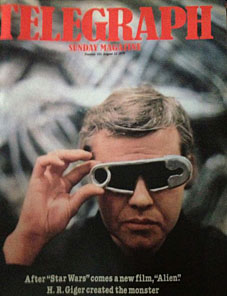
The Man Who Paints Monsters In The Night

giger.jpg

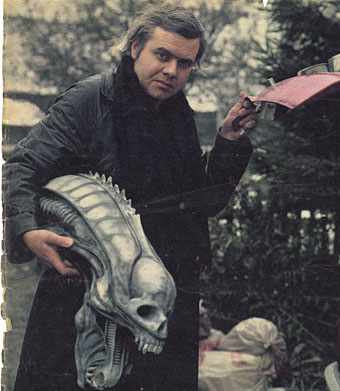
HR Giger. Photo by Eve Arnold, 1979.

The news of HR Giger’s death was prominently featured in UK papers, something that wouldn’t have happened without his connection to the Alien films. Artists like Giger seldom make the front-page news even though he was well-established before the call from Ridley Scott. He’d already worked on Jodorowsky’s aborted Dune project alongside Moebius (who also did some work on Alien; people forget that), and his work had even appeared in a major feature film before Alien with a blink-and-you-miss-it appearance from his portrait of Li Tobler in Alain Resnais’s Providence (1977). Alien may have made him world-famous but I’ve always felt that Ridley Scott needed Giger far more than Giger needed either Scott or Hollywood. Paul Scanlon and Michael Gross’s The Book of Alien (1979) shows the production designs for the alien components before Giger’s involvement, none of which had the requisite strangeness that made the film such a success. That success would have made many artists decamp to Los Angeles in the hope of repeating the trick but Giger kept his distance. You can’t blame him when his work was diluted by James Cameron in Aliens while a unique project like Clair Noto’s The Tourist—which had heavy Giger involvement—never got made. (See here and here.)

The following is the first interview I read with Giger, a feature in the Sunday Telegraph magazine from August 1979, shortly before Alien was released in the UK. I wasn’t sure whether I still had this since I’d chopped up some of the other pages in the 1980s when I was making collages. The Sunday Telegraph then was even more of a stuffily conservative title than it is now so it’s a surprise to see Giger given such treatment; he was also the cover star although the cover on my copy is lost. I was given this by a friend whose parents read the paper; the only time I’ve ever bought the Sunday Telegraph was when I appeared in it in the early 1990s for a piece about Savoy Books. The interviewer on that occasion was Byron Rogers who I’m surprised to find wrote one of the other pieces in this magazine. (Thanks to Joe for sending me a picture of the missing cover!)

* * *

THE MAN WHO PAINTS MONSTERS IN THE NIGHT by Robin Stringer

giger4.jpgThe man in black is talking about his monster. “It is elegant, fast and terrible. It exists to destroy—and destroys to exist. Once seen it will never be forgotten. It will remain with people who have seen it, perhaps in their dreams or nightmares, for a long, long time. Perhaps for all time.”
The speaker is H. R. Giger, a Swiss-German surrealist painter, who designed the monster for Alien, the latest screen shocker, made in British studios under British direction to meet the apparently insatiable twin public cravings for space and horror films. Alien has already persuaded Americans to queue in record-breaking numbers outside their cinemas. It is said to have recouped its £15 million cost within 26 days of opening, and it comes to Britain on September 6.

The crew of a space tug on a fuelfinding mission answer a distress signal from an unknown planet. They land and discover an alien spacecraft in which, unknown to them, an awful creature has been spawned and waits seething, but with infinite patience, for a chance of life. Taken on board the space tug, clinging to one of the crew, the creature parasitically reproduces itself in him and bursts out into life in a welter of blood. It proceeds to make itself at home on board by hiding in dark places and jumping out at passers-by. It gobbles up the space crew one by one and grows prodigiously. Being unfamiliar with the monster’s lifestyle, the crew understandably panic.

That in brief the story of Alien, which, of course, has actually been spawned by the movie makers to scare us just a little bit and, in the process. to make them a lot of money.

The man who designed the monster will make some money, too—though not a lot, he says. He is not on a percentage. H. R. Giger, who calls himself H.R., because “the other things are too long and complicated”, is a chunky 39-year-old who lives with his girlfriend/secretary Mia, two cats, 12 skeletons and some books on magic in the middle of a rickety row of terraced houses in the industrial outskirts of Zurich. He always wears black.

Continue reading “The Man Who Paints Monsters In The Night”

Steampunk catalogued

steampunk1.jpg

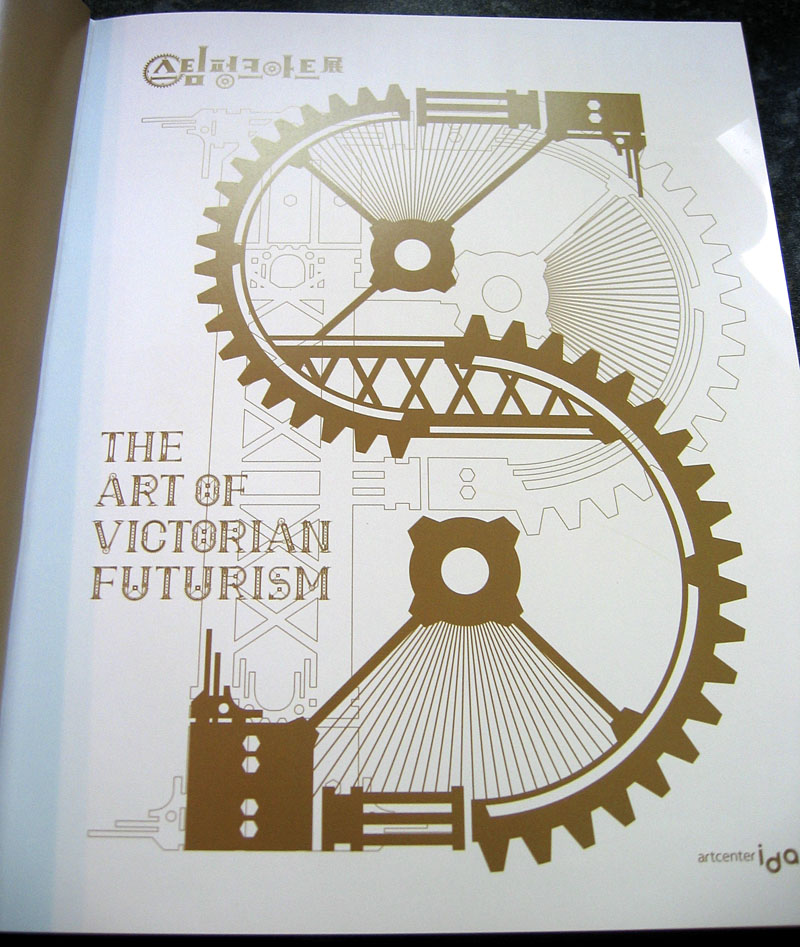
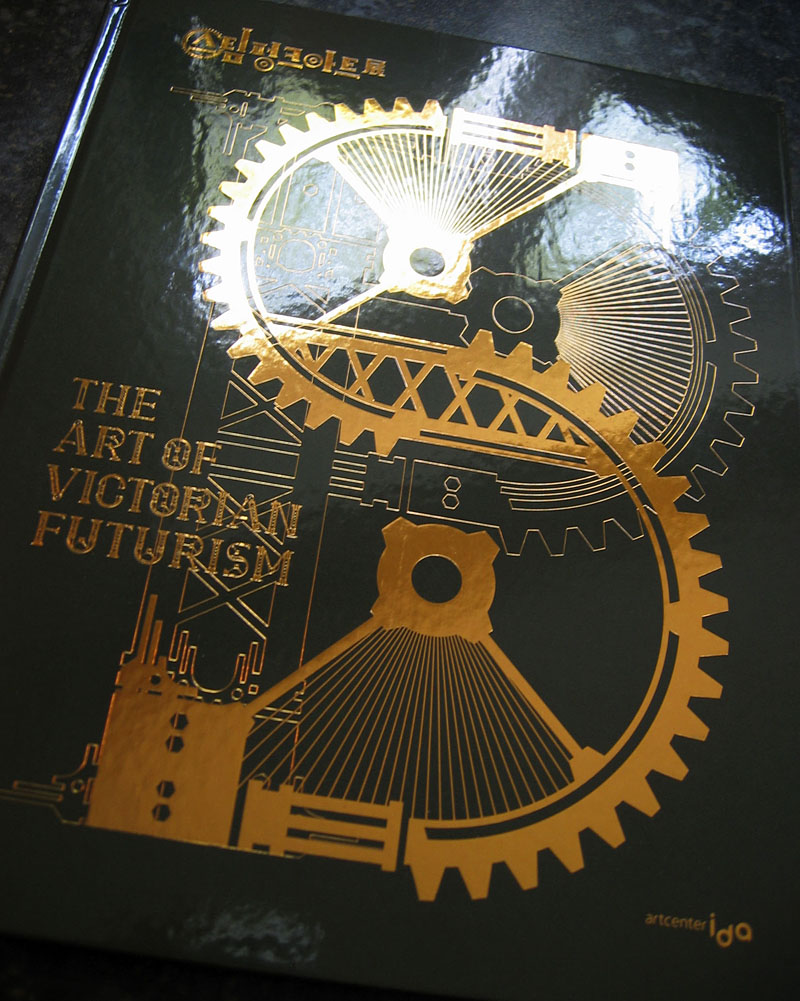
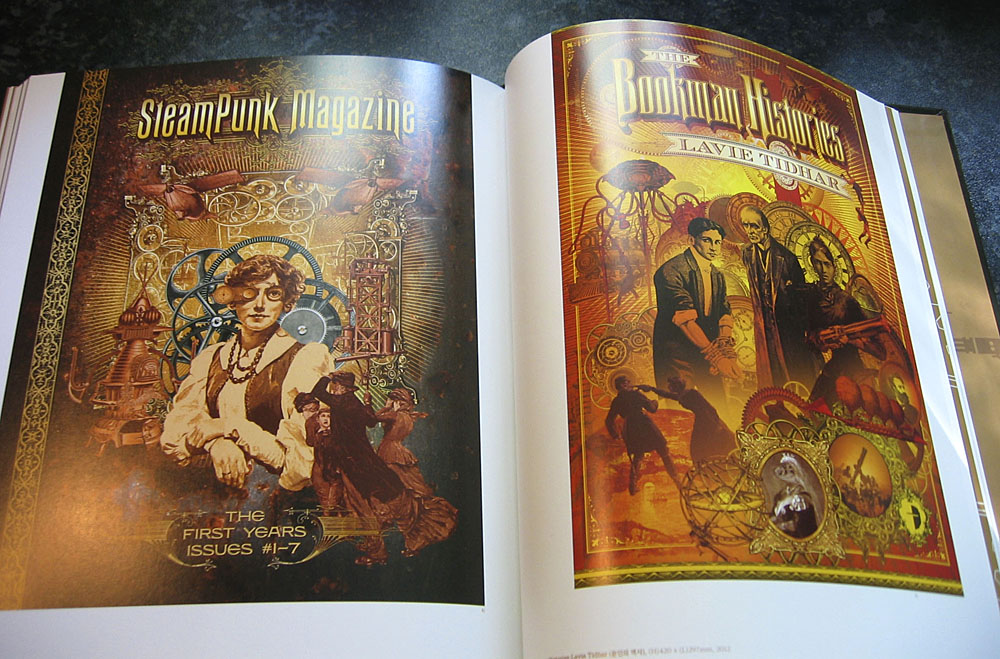
Another month, another exhibition catalogue. Steampunk: The Art of Victorian Futurism is still running at Artcenter IDA in Seoul with a selection of my book covers on display among a great variety of mechanical sculptures, costumes and other creations. The catalogue is a suitably lavish affair, so much so that it puts to shame many of the bandwagon-jumping coffee-table books that have been appearing recently. Excellent printing with lots of gold-ink embellishment, and all the exhibits are given substantial space. I especially like the mechanical type designs, and can now credit them to designers Se Byeol Moon and Han Woong Yoon. Korean TV news has run a couple of reports about the exhibition, the best of which may be seen here. The exhibition itself continues until May 18th.

steampunk2.jpg

steampunk3.jpg

steampunk4.jpg

Previously on { feuilleton }
Steampunk: The Art of Victorian Futurism
Steampunk Calendar
Words and pictures
Nathanial Krill at the Time Node
Fiendish Schemes
Ghosts in Gaslight, Monsters in Steam
Steampunk Revolution
The Bookman Histories
Aether Cola
Crafting steampunk illustrations
SteamPunk Magazine
Morlocks, airships and curious cabinets
The Steampunk Bible
Steampunk Reloaded
Steampunk overloaded!
More Steampunk and the Crawling Chaos
Steampunk Redux
Steampunk framed
Steampunk Horror Shortcuts

Weekend links 206

komoda.jpg

Nova Express (2014) by Paul Komoda.

• Last week it was Kraftwerk, this week it’s Can in another astonishing 70-minute TV performance from 1970. For those who know where to look in the torrent world there are copies of these recordings circulating there.

JG Ballard: five years on. Extracts from introductions by John Gray, Hari Kunzru, Robert Macfarlane, Deborah Levy, James Lever, China Miéville and Michel Faber for a new series of Ballard editions.

• Mix of the week: Needle Exchange 147 by Inventions. Also at Self-Titled Mag: Suzanne Ciani on her Buchla beginnings, talking dishwashers, and why no one got electronic music in the ’70s.

• At Dangerous Minds: It’s So Far Out It’s Straight Down, a Granada TV documentary from 1967 featuring Paul McCartney, Allen Ginsberg, International Times, Pink Floyd et al.

The Wonderful World of Witches: Portraits of English Pagans. A photo-special from the 1960s at LIFE. Related: From 1974, the US TV ad for Man, Myth and Magic.

• Suspicious Minds: Adam Curtis on Stephen Knight, Jack the Ripper, squatters, heists, From Hell, and why people no longer trust those in authority.

• Here be men with beards and syntezators: Andy Votel‘s Top 10 Early Patch-Bay Polymaths From Eastern Europe.

The New York Public Library has made 20,000 maps available as free, high-res downloads.

• An oscilloscope video by Vincent Oliver & Steve Bliss for Riff Through The Fog by Clark.

Anne Billson interviewed Alejandro Jodorowsky in 1990.

• At BLDGBLOG: When Hills Hide Arches.

Do gay people still need gay bars?

Pixelord Dreams

I’m So Green (1972) by Can | Nova Feedback (1978) by Chrome | Gay Bar (2003) by Electric Six

The world of the future

century21-01.jpg

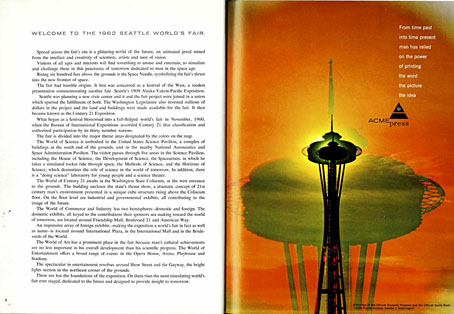
Pages from the Official Souvenir Program for the Seattle World’s Fair, 1962. Very typical corporate design by RT Matthiesen and Associates but not bad for all that. The pages give an overview of the exposition, punctuated by ads from its sponsors, while the text sets forth the purpose of the event which was intended to give a taste of life in the new Space Age. NASA’s Project Mercury missions were ongoing during the time the fair was being planned so the ethos of the event was very much tied to the obsessions of the time, obsessions fuelled by Cold War competition and a desire for an automated future. The technocratic side of things is to the fore in the booklet which trots out the usual utopian vision of life in “Century 21” as being one of short working-hours, a great deal of leisure, personal air-cars, and revolving houses. My childhood encyclopaedias were filled with this sort of thing which has only given me a lifelong suspicion of any kind of wild futurology, positive or negative. Those books were also filled with pictures of monorails, and the Seattle exposition had a monorail all of its own which I’m pleased to see is still running today.

century21-02.jpg

century21-03.jpg

century21-04.jpg

Continue reading “The world of the future”