Willy Pogány’s Children of Odin

pogany01.jpg

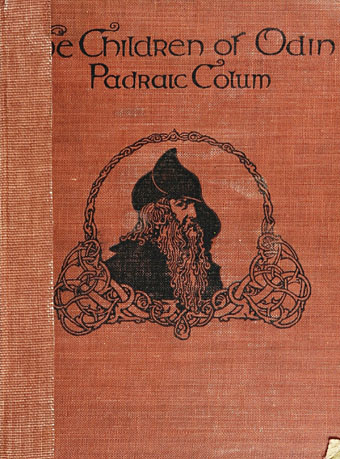
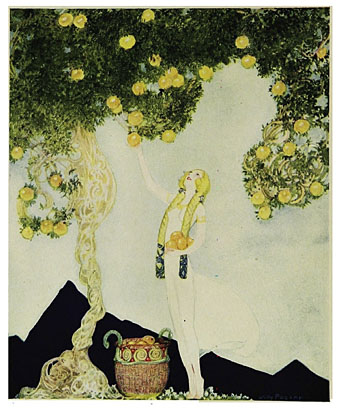
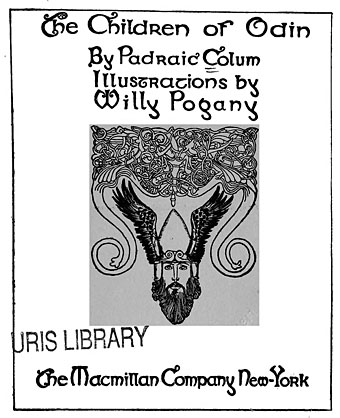
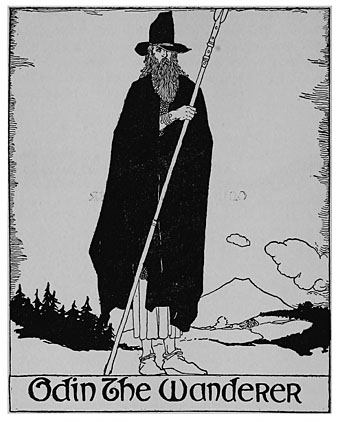
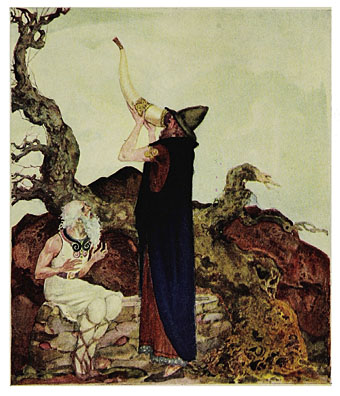
I ought to have waited until Wotan’s Day to post this one. The title may suggest a black metal album but these are illustrations by the versatile Willy Pogány for a retelling of Norse myths by Padraic Colum. Pogány illustrated several of Colum’s books, including retellings of Greek myths for which the illustrations resemble the figures found on Grecian ceramics. Children of Odin was published in 1920 with illustrations and page designs closer to Pogány’s drawings and paintings for Colum’s novel, The King of Ireland’s Son. The four colour plates shown here aren’t always present in the editions available online.

pogany02.jpg

Iduna picking the Apples of Life for the Gods.

Jason and the Argonauts was one of my favourite films when I was 10 years old (and the story of the Golden Fleece happens to be the subject of a later Colum/Pogány volume) but I was never very interested in the written accounts of Greek mythology. The world of the Norse gods was darker and more mysterious, and I read Roger Lancelyn Green’s Myths of the Norsemen many times. I’m sure I would have done the same with Colum’s book, especially in this edition which contains over 40 illustrations. These days, any mention of Odin and Thor is blighted by association with the steroidal junk of “The Marvel Universe” and neopagan numbskullery. Feed them all to Fenrir and the Midgard Serpent, say I, and let the old gods rest in peace.

pogany03.jpg

pogany04.jpg

pogany05.jpg

Odin at Mimir’s Well.

Continue reading “Willy Pogány’s Children of Odin”

Weekend links 594

klinger.jpg

Eva und die Zukunft (1898) by Max Klinger.

• “It is no exaggeration to say that MAD invented the modern, postwar American takedown.” Thomas Larson reviews Seeing MAD: Essays on Mad Magazine’s Humor and Legacy.

• At the Internet Archive: Cartoon Modern: Style And Design In Fifties Animation (2006) by Amid Amidi, a book which has been made available as a free download by its author.

• New music: A preview of Metta, Benevolence by Sunn O))), recorded live in the Mary Anne Hobbs’ radio show in 2019; Veils by Víz; The Mountain (Blakkat Dub) by Ladytron.

• At Public Domain Review: Claude Mellan’s The Sudarium of Saint Veronica (1649), an engraving made with a single continuous line.

• “For Harry Houdini, séances and Spiritualism were just an illusion,” says Bryan Greene.

TheStencil is Steven Heller’s font of the month.

• At Dennis Cooper’s: Derek Jarman Day.

Nicky Mao’s favourite music.

Mad Man Blues (1951) by John Lee Hooker | Mad Pierrot (1978) by Yellow Magic Orchestra | Mad Keys (2002) by Al-Pha-X

Crank book covers

kolosimo2.jpg

Cover art by Tony Roberts, 1974. A book I received as a present for Christmas, 1974. Also the first place I encountered the words “Popol Vuh”, before discovering the music of Florian Fricke and co. a few years later.

Yes, “crank” is a pejorative word but it’s used with some degree of affection, as in “harmless crank”. It’s also a convenient umbrella term for the books referred to in the weekend post which embrace diverse subjects, from lost continents and “Earth energy” to ancient astronauts and flying saucers.

The prime crank decade was the 1970s, a period when publishers were falling over themselves to cash-in on the massive popularity of Erich von Däniken’s dubious investigations, while also catering to the by-products of the hippy era and the occult revival. Books by Charles Fort, Immanuel Velikovsky and James Churchward (the Mu series) all received reprints, with some appearing in paperback for the first time. The British editions of these books were published by imprints like Corgi, Panther and Sphere who were also publishing large quantities of science fiction, a situation that led to many crank titles being packaged as though they were fiction or fantasy. Sphere was in the vanguard, presenting a wide range of books with the same cover designs, cover artists and Novel Gothic typeface as their SF titles. A cynical move, no doubt, but it also makes the crank books seem more like fiction than their authors might have intended.

This post presents a selection of crank titles with cover art by SF artists but there are many more examples out there. (Watch the skies!) I’ve limited the selection to British publishers but the same syndrome was evident in American publishing, as documented at Absolute Elsewhere. And I’ve included a couple of books by sceptics John Sladek and Dr. Christopher Evans. These were intended to dismantle the claims of L. Ron Hubbard, Erich von Däniken and co. but were still packaged in paperback to resemble the books they were attacking. The major demolition of Von Däniken is Ronald Story’s The Space Gods Revealed but covers for that one have always been relatively restrained.

Missing from this list are three paintings by SF artist Peter Jones for books by Dr. Celia Green. The art may be seen in Jones’s Solar Wind collection but I couldn’t find any of the printed covers, which suggests they had a limited run if they were printed at all. These are odd for being typical fantasy imagery attached to serious studies of lucid dreaming and out-of-body experiences. Dr. Green is a philosopher and science researcher (she coined the term “out-of-body experience”) so she doesn’t belong on a crank list in any case. Also absent is the most popular British cover illustrator of the decade, Chris Foss, who would have been too busy working through his fiction commissions and creating designs for feature films.

kolosimo1.jpg

Cover art by Tony Roberts (?), 1974.

evans.jpg

Cover art by Bruce Pennington, 1974.

Evans was a computer scientist, an occasional contributor to New Worlds magazine, and also the model for the deranged Vaughan in JG Ballard’s Crash. Cults of Unreason investigates crank sects such as the flying-saucer worshippers of the Aetherius Society (hence the cover art), and the Scientologists who caused a stir in Britain in the 1960s when L. Ron Hubbard set up an outpost at East Grinstead.

fort2.jpg

Cover art by Colin Hay, 1974.

fort1.jpg

Cover art by Angus McKie, 1979.

Continue reading “Crank book covers”

Weekend links 587

jetpac.jpg

Jetpac (1983) by Ultimate Play The Game. Lunar Jetman was the superior sequel but Jetpac had the better loading screen.

• RIP Clive Sinclair. Products made by Sinclair Research Ltd. were among the first electronic gadgets I owned: the Sinclair Scientific calculator which compelled you to learn Reverse Polish notation before you could use it; the ZX Spectrum computer, of course; and the pocket TV that came bundled with the computer, a machine with such feeble reception that it only ever worked outdoors. I’ve still got my Spectrum computer, and it still worked the last time I plugged it in although it’s hardly worth keeping when emulators proliferate. Spectacol for Android is a good example of the latter. Related: World of Spectrum; the early stages of the Spectrum design process by Sinclair designer Rick Dickinson; XL-1 by Pete Shelley, electro-pop with Spectrum-generated lyrics and graphics.

• Mixes of the week: A Lee “Scratch” Perry tribute mix by Dennis Bovell, and Blood Tide Station 1: Breakaway plus Blood Tide Station 2: Force of Life by The Ephemeral Man.

• “It’s not an easy time to be daring,” says Dennis Cooper, talking to Barry Pierce about his new novel, I Wished.

• London under London: Adam Zamecnik interviews Tom Chivers about searching for London’s lost rivers.

• New music: Ode To The Blue by Grouper, and A Shadow No Light Could Make by Nathan Moody.

• At Public Domain Review: 700 years of Dante’s Divine Comedy in art.

• At Wormwoodiana: The Mushroom Man—A Note on EC Large.

DJ Food trips out with a collection of psychedelic drug posters.

Nodnol (1969) by The Spectrum | Spectrum (1969) by The Tony Williams Lifetime | Spectrum (1973) by Billy Cobham

London churches of the XVIIth and XVIIIth centuries

birch01.jpg

This is another of those books that I’ve been led to by the requirements of the current workload, in this case the need to find pictures of a particular London church. George H. Birch’s book was published in 1896, and while it’s possible to find contemporary photographs of these buildings, I like the exterior views for showing the churches in a different time to our own.

birch02.jpg

The photographs were by Charles Latham who avoids the usual street-level portraits in favour of views of each steeple from the highest floors of surrounding offices and warehouses. The buildings of London in the 1890s didn’t reach very far, St Paul’s Cathedral still dominated the City skyline, but Latham’s pictures have the additional attraction of showing us that skyline as it was over a century ago, before it was radically reconfigured by the bombs of the Luftwaffe and several generations of planners and architects. George H. Birch was the curator at the time of one of my favourite places in London, the Sir John Soane Museum. Browse or download the rest of his book here.

birch03.jpg

birch04.jpg

birch05.jpg

Continue reading “London churches of the XVIIth and XVIIIth centuries”