Drone Mass

johannsson.jpg

Design by Florian Karg.

You’d think someone would have used the title Drone Mass prior to this new release but it seems not. The album is the premiere recording of a late composition by Jóhann Jóhannsson, performed by the composer’s regular collaborators in the American Contemporary Music Ensemble, together with Theatre of Voices and their conductor Paul Hillier. The album title and the presence of a choral group raises expectations of a religious Mass but John Schaefer’s notes draw attention to the title’s ambiguities, Jóhannsson having said that he was thinking as much about airborne drones as sustained sounds. (The Khephri scarab on the cover has a rather drone-like appearance.) Schaefer also notes that the word “mass” can refer to physical substance as well as religious ritual.

As to the substance of the music, there is a superficially religious quality to the first two pieces, a feature deceptive enough to make the album the kind of thing I’d like to play to the unsuspecting. Without knowing what to expect you could easily imagine the rest of the suite developing like an Arvo Pärt composition (and Theatre of Voices/Paul Hillier have performed Pärt on several occasions) until you reach the dissonant waves of the third piece, Triptych In Mass, after which various electronic rumbles and distortions arrive to take the album into a very different sphere. One of the pleasures of Jóhannsson’s compositions was this juxtaposition between the familiar structures and instruments of classical composition with sounds processed by computer software. The combination isn’t exactly new, Edgard Varèse was doing the same as far back as the 1930s (he also discussed his music in terms of “sound masses”), but in 20th-century examples the orchestral component is always striving to seem as fresh and as different as the electronics genuinely were. What you didn’t get then—because any such music would have been deemed old-fashioned or even reactionary—is this blending of traditional chords and harmonies with sounds that originate in the latest digital processes. After the release of Last And First Men I hadn’t been expecting any new Jóhannsson compositions (although previously unreleased soundtracks keep turning up) so this is all very welcome.

If you’ve looked at Florian Karg’s cover and are wondering what any of the above has to do with Ancient Egypt, an explanation may be found inside the album where a photo shows the 2015 premiere performance of Drone Mass taking place outside the Temple of Dendur at the Metropolitan Museum of Art, New York. That bright yellow Deutsche Grammophon logo has become something to watch for in recent years. The DG cartouche has always been a trademark of quality where classical recordings are concerned but the label has a somewhat broader remit today, releasing many more soundtrack albums than they would have done in the past, in addition to non-soundtrack works by Jóhann Jóhannsson, Max Richter and others. Oddly enough (considering the news last week), the new direction was begun by Vangelis in 1985 when his Invisible Connections album was released on DG instead of its pop sibling, Polydor. This was very surprising at the time even though the label had been releasing avant-garde compositions for many years; the first Stockhausen album I bought in 1981 was a secondhand DG release of Mikrophonie I & II. Some of the recent remixes of old Berlin Philharmonic recordings will have set Herbert von Karajan spinning in his sarcophagus but the label hasn’t pushed things too far in that direction, and if the poppier works pay for new recordings such as this one then I’m not complaining.

Previously on { feuilleton }
Jóhannssonia
Last and First Men

Weekend links 622

balbi.jpg

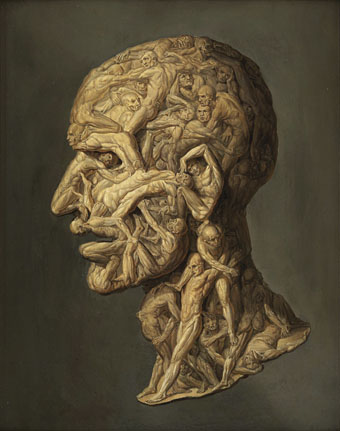
Testa Anatomica (1854) by Filippo Balbi.

The New School of the Anthropocene is “…an experiment. But it is also an act of repair. In partnership with October Gallery in London, we seek to reinstate the intellectual adventure and creative risk that formerly characterised arts education before the university system capitulated to market principles and managerial bureaucracy… (more)”

• “Every once in a while, you come across old music that generates a shock of new excitement.” Geeta Dayal on Oksana Linde whose electronic compositions are being released in a retrospective collection next month.

• More Walerian Borowczyk: Anatomy of the Devil, a collection of Borowczyk’s short stories, newly translated into English by Michael Levy, and with a cover design by the Quay Brothers.

• Washing machines, garden snails, and plastic surgery: A stroll through the Matmos catalogue. Related: “Why scientists are turning molecules into music.”

• Coming soon from Strange Attractor: Boogie Down Predictions, Hip Hop, Time and Afrofuturism, edited by Roy Christopher.

• At Spoon & Tamago: Exploring Japan’s historical landmarks and shrines in the middle of streets.

• New music: Adrian Sherwood Presents: Dub No Frontiers, music by female dub artists.

Winners of the 2022 Milky Way Photographer of the Year.

• A Vision In Many Voices: The art of Leo and Diane Dillon.

Molecular Delusion (1971) by Ramases | DNA Music (Molecular Meditation) (1985) by Riley McLaughlin | Pop Molecule (Molecular Pop 1) (2008) by Stereolab

Weekend links 620

varo

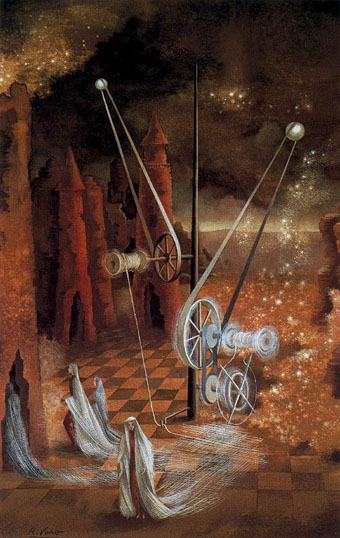
Premonition (1953) by Remedios Varo.

• “Classical mythology, Arcadian idylls, occult speculation, and an interest in cultural curiosities coexisted in the grotto, allowing for the playful exploration of a new tension emerging between Nature and Artifice.” Laura Tradii explores the artificial grottoes of the Renaissance and beyond.

• “Some of the symbols and signs seem like bridges to nowhere, and perhaps Nabokov was lovingly teasing our endless quest to find patterns and generate meaning.” David M. Rubin on writing a response to a Nabokov short story.

• New music: “KMRU & Aho Ssan erupt in post-apocalyptic extremity with Resurgence“. I did the layout for this latest release on the Subtext label but I still haven’t got round to updating my web pages so you’ll have to take my word for it.

• Powell & Pressburger’s Black Narcissus “unleashes a level of eroticism that’s surprising for 1940s British cinema,” says Adam Scovell.

• “Premonitions are impossible, and they come true all the time.” Fiona Sturges reviews The Premonitions Bureau by Sam Knight.

• Between Hell and Paradise: paintings by Hieronymus Bosch and his followers at the Museum of Fine Arts, Budapest.

• At The Collector: Olivia Barrett on the Voodoo Queens of New Orleans.

• Steven Heller’s font of the month is Astronef Super.

• Mix of the week: Isolatedmix 118 by Pan American.

TMP-01 Vintage Synth TV Series from Benge.

• Vale, A Year In The Country.

Premonition (1979) by Simple Minds | Premonition (1980) by Cabaret Voltaire | Premonition (Giant Empty Iron Vessel) (1987) by David Sylvian & Holger Czukay

Weekend links 618

anderson.jpg

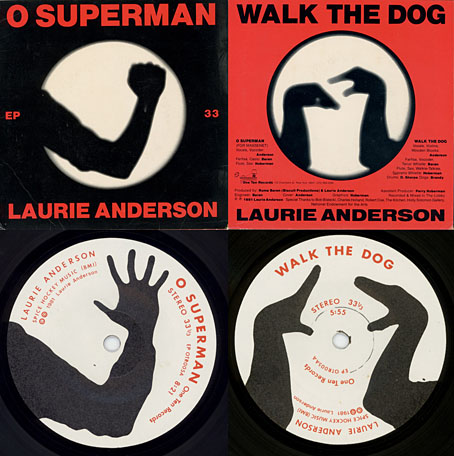
O Superman (1981), a seven-inch single on One Ten Records. Design by Laurie Anderson and Perry Hoberman.

• “…I was painting a picture of a garden at night. It had a lot of black and this green kind of coming out of the black, and I sat back, probably to take a smoke, looking at this painting, and I suddenly heard a wind coming from the painting, and the green started to move. And I thought, ‘Oh, a moving painting.’ And that experience led to cinema.” David Lynch talking to Josh Hitchens about living in Philadelphia.

• “This is the time and this is the record of the time.” Big Science, the album that propelled Laurie Anderson from performance artist to pop star, is 40 years old this month. Mat Colegate recalls his confused impression that the album was the work of a West Country folk singer, while Studs Terkel talked to Laurie Anderson about the album shortly after its release.

• At Public Domain Review: Kensy Cooperrider explores a millennium of “hand mnemonics”, “the variety of techniques practised by Buddhist monks, Latin linguists, and Renaissance musicians for remembering what might otherwise elude the mind.”

Ghosts in the Machine is an exhibition being hosted by Bower Ashton Library, Bristol, for World Book Night, 2022. 93 participants contributed ghost-related images for an accompanying artist’s book [PDF].

• “Sixty years after Seattle’s Century 21 Exposition, world’s fairs have largely fallen out of fashion in the US.” Grant Wong charts the rise and fall of world’s fairs.

• A trailer for Ennio: The Maestro, a feature-length documentary about Ennio Morricone by Giuseppe Tornatore.

• “The film Putin doesn’t want the world to see: Firebird, a gay love story about fighter pilots.”

• At Dennis Cooper’s: Andrei Tarkovsky Day.

• New music: Intersections by Specimens.

Schöne Hände (1977) by Cluster & Eno | Hands 2 Take (1981) by The Flying Lizards | Red Hand (1996) by Paul Schütze

Weekend links 617

parent.jpg

Diane (1977) by Mimi Parent.

Richard Pinhas expounds upon his favourite musical choices for Warren Hatter. The influence of Robert Fripp has always been to the fore in the Pinhas oeuvre—an early track by Heldon is titled In The Wake Of King Fripp—so there was bound to be a King Crimson album on the list. But which one? Click through the selections to find out.

• Vinyl is the product of a toxic manufacturing process, as well as being difficult to recycle without releasing yet more toxins, but you seldom see these issues discussed by today’s quality-conscious vinyl fetishists. Jono Podmore talks to some of the people trying to create an eco-friendly disc.

• “…these Renaissance images shock us because they are so frequently ithyphallic: Christ has risen, but not in the way we have come to expect.” Hunter Dukes on ostentatio genitalium in Renaissance art.

• At Wormwoodiana: Mark Valentine on those music projects that used to be described as “hauntological”, with an emphasis on The Machinery of the Moment, a new release from The British Space Group.

• “Like Delia Derbyshire jamming with This Heat.” Jesse Locke tours the Broadcast discography.

• 50 Watts announces the birth of 50 Watts Books, a publisher of strange and/or unusual art books.

• “Black lights turn this North Carolina mine into a psychedelic wonderland.”

• At Dennis Cooper’s: Bill Morrison Day.

Black Lightening Light (1968) by The Shy Guys | Black Light (1994) by Material | Transmission Nine: Black Light (2013) by Pye Corner Audio