The art of Ephraim Moses Lilien, 1874–1925

lilien1.jpg

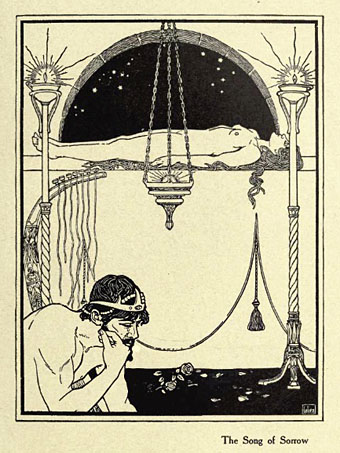
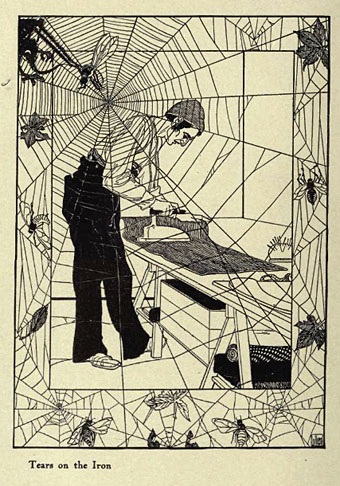
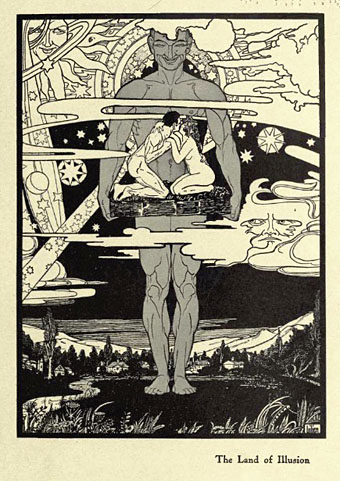
Marvellous black-and-white work from a Galician artist whose drawings were predominately concerned with Jewish and Zionist themes. These are from a small monograph about the artist, The New Art of an Ancient People; The Work of Ephraim Mose Lilien (1906) which can be downloaded at the Internet Archive. Elsewhere there’s a page here about the artist with further examples and links, a gallery site with a catalogue of his drawings of Palestine, and some of his illustrations can also be found in back issues of Jugend magazine.

lilien2.jpg

lilien3.jpg

Elsewhere on { feuilleton }
The illustrators archive

Previously on { feuilleton }
Jugend, 1900

Weekend links 27

wang.jpg

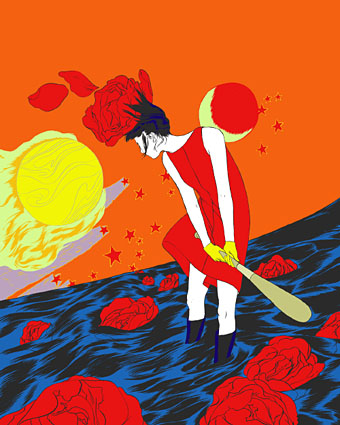
Annie Duels The Sun (2010) by Angie Wang.

I’m interviewed again, this time by James at Cardboard Cutout Sundown. Covering familiar subjects for {feuilleton} readers: art history, design, Lovecraft, the genre/mainstream seesaw, etc. Related: Jeff VanderMeer previewed my design for the forthcoming Steampunk Reloaded.

Battle over legacy of father of Art Nouveau. Prague authorities are demanding the paintings which comprise Alphonse Mucha’s Slav Epic be moved to the capital.

The films that time forgot. David Thomson on ten neglected works including a cult favourite of mine, Jerzy Skolimowski’s Deep End (1970).

The Viatorium Press: “Fine letterpress printing, digital typography, and hand painted illumination.” Among their recent productions is a poem by Clark Ashton Smith.

verne.jpg

À la conquête du pôle (1912); Georges Méliès vs. Jules Verne.

Taxandria, a feature-length collaboration between Raoul Servais, François Schuiten and, er, Alain Robbe-Grillet, is on YouTube. My earlier post about the film is here.

Salvagepunk, or (maybe) Post-post-modernism: “How a music micro-trend heralds an emerging, internet-enabled, aesthetic movement.” See also the latest issue of The Wire.

Drainspotting with Remo Camerota: documenting Japan’s creative manhole covers.

• Yo-ho-ho, and a bottle of squid: a book devoted to Kraken Black Spiced Rum.

After Stanley Kubrick. Christiane Kubrick on life without Stanley K.

• Pills and penises and kissing boys: Tara Sinn’s Kaleidoscopes.

Found Objects: a hauntological dumping ground.

• Sandow Birk’s American Qur’an.

• RIP Frank Kermode.

Feuerland (1968) by Theo Schumann Combo; Feuerland (1977) by Michael Rother; Feuerland (2007) by Justus Köhnke.

Constantinople, 1900

constantinople1.jpg

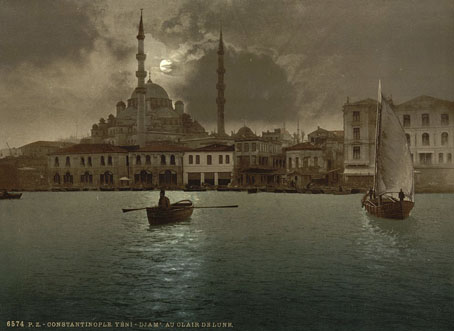
Yeni-Djama (ie, Yeni Cami) by moonlight, Constantinople.

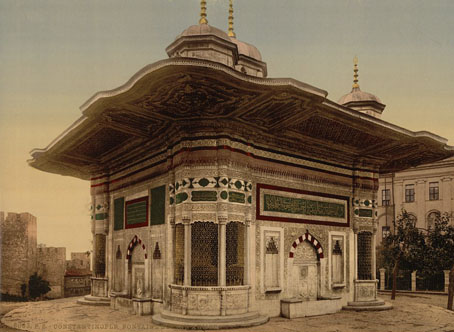
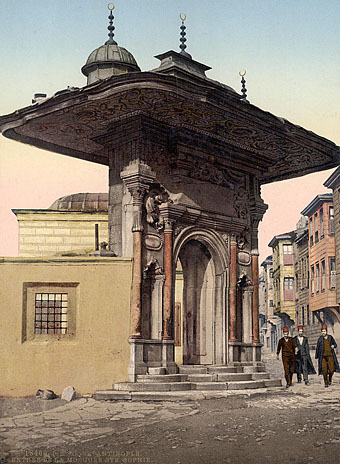
Fascinating views of the Turkish city circa 1890–1900 from the Photochrom collection of the Library of Congress. These are from the LoC Flickr selection; the library website has a lot more.

Published primarily from the 1890s to 1910s, these prints were created by the Photoglob Company in Zürich, Switzerland, and the Detroit Publishing Company in Michigan. The richly colored images look like photographs but are actually ink-based photolithographs, usually 6.5 x 9 inches.

constantinople2.jpg

The fountain of Sultan Ahmed, Constantinople.

constantinople3.jpg

Entrée de la Mosque Ste. Sophie, Constantinople.

Previously on { feuilleton }
Albert Kahn’s Autochromes
The Dawn of the Autochrome

Weekend links 25

borgespesos

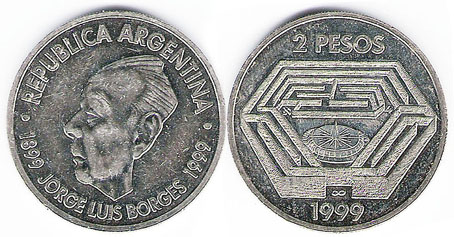
A commemorative Borges coin.

He says, “Two aesthetics exist: the passive aesthetic of mirrors and the active aesthetic of prisms. Guided by the former, art turns into a copy of the environment’s objectivity or the individual’s psychic history.” There, of course, he sums up all of realism, no? “Guided by the latter, art is redeemed, makes the world into its instrument and forges, beyond spatial and temporal prisons, a personal vision.” That’s Borges.

The Borges Behind the Fiction: Colin Marshall talks to translator Suzanne Jill Levine. Related: The Garden of Forking Paths.

• From The Quietus: Blondie in Conversation with William S. Burroughs by Victor Bockris, 1979; An Interview with Laurie Anderson by Robert Barry, 2010.

In 962 Abd-er Rahman III was succeeded by his son Al-Hakim. Owing to the peace which the Christians of Cordova then enjoyed […] the citizens of Cordova, Arabs, Christians, and Jews, enjoyed so high a degree of literary culture that the city was known as the New Athens. From all quarters came students eager to drink at its founts of knowledge. Among the men afterwards famous who studied at Cordova were the scholarly monk Gerbert, destined to sit on the Chair of Peter as Sylvester II (999–1003), the Jewish rabbis Moses and Maimonides, and the famous Spanish-Arabian commentator on Aristotle, Averroes.

Entry for The Diocese of Cordova from The Catholic Encyclopedia (1917).

Professor Newt’s Distorted History Lesson. A riposte to the ignorance of the wretched Gingrich. Related: the Mezquita de Córdoba.
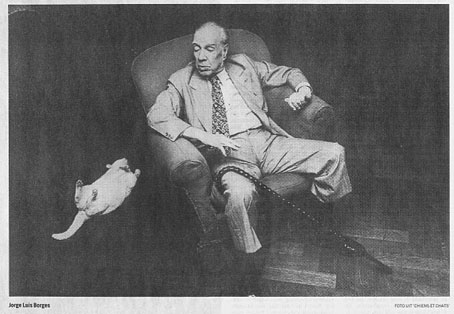
borgeskat

Jorge Luis Borges and a cat. Via.

Joseph and His Friend—A Story of Pennsylvania (1870) by Bayard Taylor, America’s first (?) gay novel. Related: 20 classic works of gay literature.

Elegies For Angels, Punks and Raging Queens at the Shaw Theatre, London, from 10–28 August 2010.

• Tristan Perich’s 1-Bit Symphony is released later this month. Café Kaput’s first release, Electronic Music in the Classroom by DD Denham, appears in September.

• “Just relax and enjoy it.” k-punk on the ambition and vision of David Rudkin’s Artemis 81.

• Chris Watson explores Alan Lamb’s The Wires: three audio recordings to download.

• Jonathan Barnbrook: Tuxedomoon fan, 1988, and Tuxedomoon designer, 2007.

• Rob Young’s Electric Eden reviewed by Michel Faber.

Brian Eno gets the Warp factor.

No Tears (1978) by Tuxedomoon; Atomic (1979) by Blondie; Everything You Want (1980) by Tuxedomoon; Next One Is Real (1984) by Minimal Compact; Hologram (2010) by These New Puritans.

Dalí’s Elephant

burman.jpg

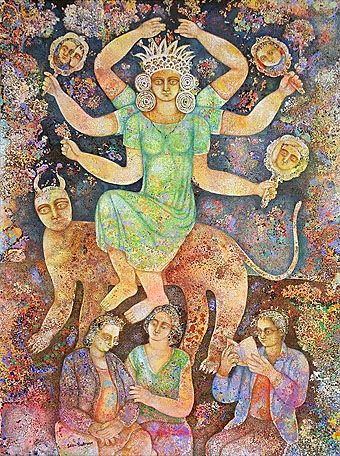
Madhav Reading Stories of Devi (2007) by Sakti Burman.

Dalí’s Elephant is a group exhibition at London’s Aicon Gallery that “traces the echoes of Surrealism in modern and contemporary art from the Indian Subcontinent.” The exhibition title refers to the gift ashtray which Salvador Dalí designed for Air India in 1967:

In 1967 Air India commissioned Salvador Dali to produce a limited edition ashtray which was to be given to a select group of lucky first-class passengers. Dali produced a small unglazed porcelain ashtray composed of a shell-shaped centre with a serpent around its perimeter. This was supported by three stands, two of which point in the same direction and resemble an elephant’s head. The third stand was inverted so that it resembled swan’s head. Dali was initially paid no more than a few hundred dollars for his design but when they received the design the airline bosses were so delighted that they made Dali the surprise gift of an elephant. Dali lived with the elephant for a few days at his Portligat home before donating the beast to the local zoo. (More.)

The Surrealist element is very much a trace in some of the works which seems surprising given the distinctive heritage of India’s religious imagery, as was demonstrated recently at A Journey Round My Skull. But I like the Sakti Burman paintings, especially the example shown here. Dalí’s Elephant runs to September 4th, 2010.

Previously on { feuilleton }
Marsi Paribatra: the Royal Surrealist
Dalí in Wonderland
Bollywood posters
Impressions de la Haute Mongolie revisited
Dalí and Film
The persistence of DNA
Salvador Dalí’s apocalyptic happening
Dalí Atomicus
Impressions de la Haute Mongolie