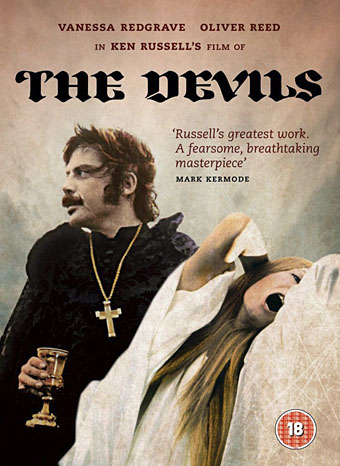
The Devils on DVD

devils01.jpg

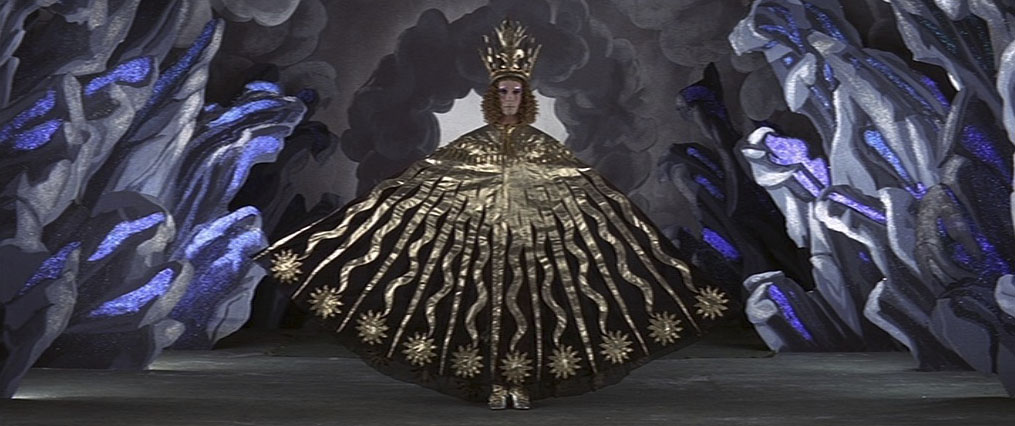
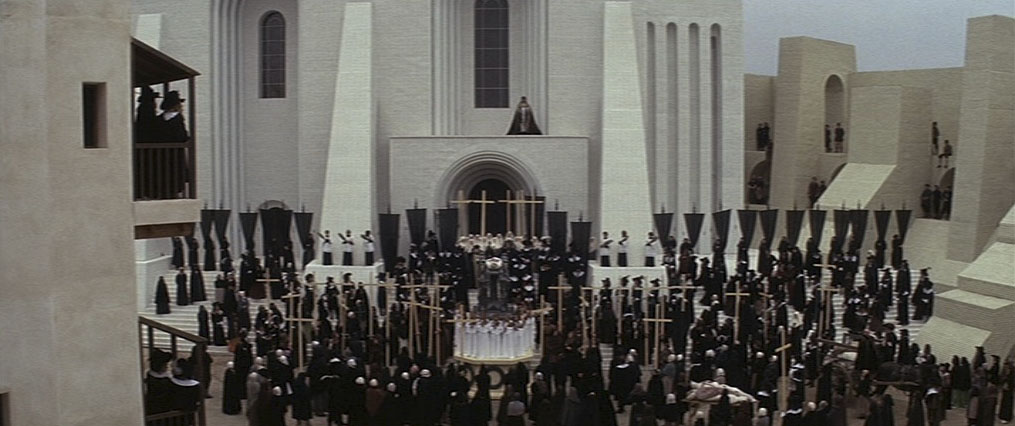
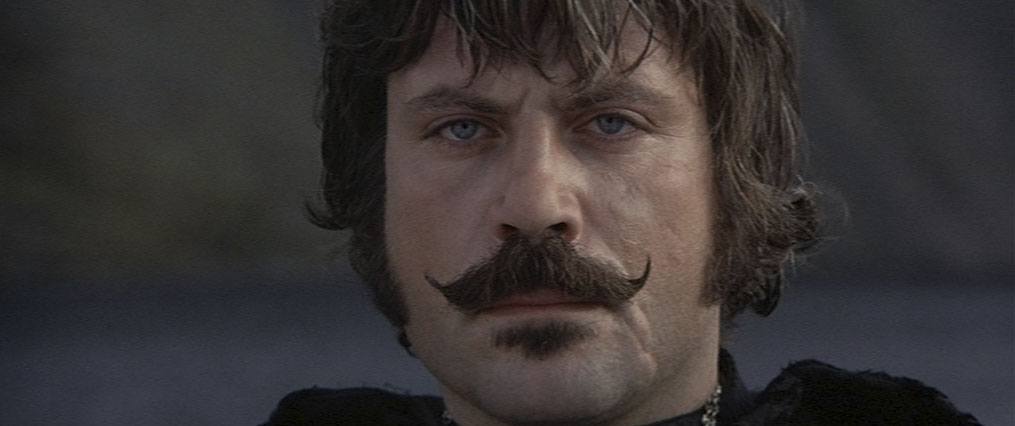
No Blu-ray as yet but this is another excellent BFI release so it looks and sounds fantastic. There’s been some grumbling that the 1971 director’s cut is still being embargoed by Warner Brothers but when the rest of the film looks so pristine I find it difficult to get worked up over a few missing shots of writhing nuns. Among the extras there’s an early Ken Russell short, Amelia and the Angel (1958), and a second disc of supplementary material, including Paul Joyce’s 48-minute documentary about the making of the film, Hell on Earth. Inside the booklet there’s a photo of set designer Derek Jarman looking very young and sweet. A few screen grabs follow to make Russell enthusiasts in Region 1 jealous. (Hi Thom!)

devils02.jpg

devils03.jpg

devils04.jpg

Continue reading “The Devils on DVD”

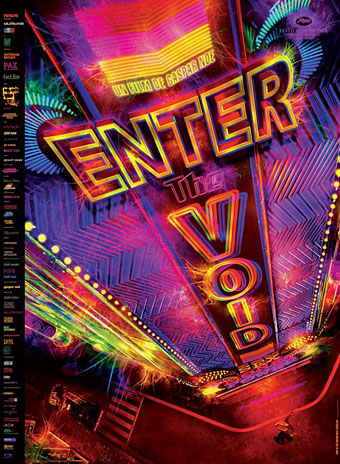
Enter the Void

etv01.jpg

It’s taken me a while to see this but the long search for a genuinely psychedelic feature film is over. That’s genuinely psychedelic not in the debased sense of a handful of garish or trippy visuals, but in the full-spectrum expanded-consciousness sense for which Humphrey Osmond invented the term in 1956:

I have tried to find an appropriate name for the agents [psilocybin, mescaline, LSD, etc] under discussion: a name that will include the concepts of enriching the mind and enlarging the vision. My choice, because it is clear, euphonious, and uncontaminated by other associations, is psychedelic, mind-manifesting.

Other films have given us flashes of this kind of unfiltered experience—Chas’s mushroom trip in Performance (1970), for example—or attempted to relay LSD states through Hollywood conventions: The Trip (1967) and Altered States (1980). Then there are inadvertently psychedelic moments such as the Star Gate sequence in 2001: A Space Odyssey (1968). Some of the most successful works from a psychedelic perspective have almost always been abstract, micro-budget films such as those made by James Whitney, Jordan Belson, Ira Cohen and others. But until very recently no-one had attempted to combine the narrative-free intensity of abstract cinema with a film narrative that would warrant placing psychedelic experience at the heart of the story. I was hoping A Scanner Darkly (2006) might do it but, good as it was, it didn’t really get there. Gaspar Noé’s Enter the Void is the film that gets everything right.

etv02.jpg

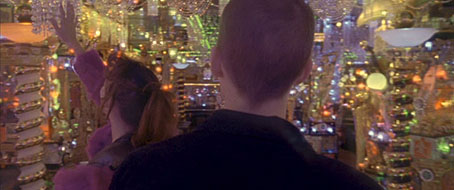
Linda and Oscar.

The narrative is a simple one (Noé calls his story a “psychedelic melodrama”): Oscar, a young American drug-dealer living in Tokyo smokes DMT, trips out for a while then goes to exchange some goods with a customer in a small club called The Void. While there he’s shot and killed in a police raid. His disembodied consciousness leaves his body, and for the next two hours wanders the streets and buildings following his beloved sister, Linda, and his friends while they cope with the aftermath. Later on he starts to re-experience memorable (and traumatic) moments from his life. The Big Signifying Text in all of this is introduced in the opening scene: The Tibetan Book of the Dead. Oscar hasn’t read much of it so his friend Alex quickly relates (for the benefit of the audience) the book’s description of what happens to the soul between the time of death and rebirth into a fresh human body. A few minutes later we’re with Oscar experiencing this very process in dizzying, miraculously-filmed detail. Flicking through my own copy of The Tibetan Book of the Dead (OUP, 1960) one paragraph in the introduction had particular relevance:

The deceased human being becomes the sole spectator of a marvellous panorama of hallucinatory visions; each seed of thought in his consciousness-content karmically revives; and he, like a wonder-struck child watching moving pictures cast upon a screen, looks on, unaware, unless previously an adept in yoga, of the non-reality of what he sees dawn and set.

WY Evans-Wentz

etv07.jpg

This is your brain on drugs: the DMT trip.

Continue reading “Enter the Void”

Studies in the Horror Film: The Exorcist edited by Danel Olson

exorcist2.jpg

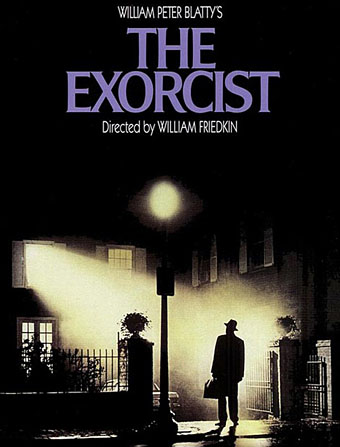
Growing up in the 1970s put cinema-going kids of my generation in a frustrating position: we knew that the censorship of decades past was over but we weren’t old enough to see any of the films benefiting from the relaxed strictures. Consequently some notorious releases grew larger in the imagination than they might have otherwise, especially when their cryptic titles—A Clockwork Orange, Straw Dogs—gave no clue as to their content. Looming larger and darker than all of these was William Friedkin’s The Exorcist whose content was at least clear despite that vague poster design. The film arrived in Britain in March 1974 bearing a ferocious reputation thanks to tabloid reports of a cursed production and hysteria at US screenings. The film’s power has been significantly reduced since its release, not least because of its enormous success which gave us two sequels, a prequel that went through three directors (and ended up as two separate films), a reworked version of the original in 2001, and all the endless parodyings of Linda Blair’s torment.
exorcist3.jpg

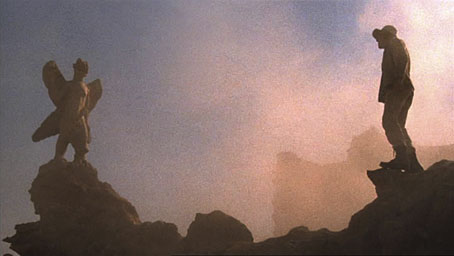
Pazuzu and Father Merrin face off in the desert.

The film and its sequels are explored in a new book from Centipede Press which turned up before Christmas but which has taken me a while to get round to since I wanted to re-watch the film first. I hadn’t seen The Exorcist for many years, the last viewing being a shoddy VHS copy so it was good to see it again in a decent DVD print. I still find the film more admirable on a technical level than as a work of cinematic art: the story has always been a piece of Catholic propaganda—something that author William Peter Blatty freely admits—and even if I set aside my lapsed-Catholic prejudices I have a hard time taking seriously Blatty’s religious narrative. Friedkin is a very good thriller director but the tension sags in the first half of the film when the possessed (or is she?) Regan is being hauled around various hospitals while Father Karras frets about his dying mother and his lapsed faith. A sub-plot with police detective Lee J. Cobb—a pared-down thread from the novel—is completely superfluous. On the plus side, the acting is first-class, the almost wordless sequence in Iraq makes a tremendous opening, and the exorcism itself still packs a considerable punch not least because of Dick Smith’s remarkable makeup effects.
exorcist1.jpg

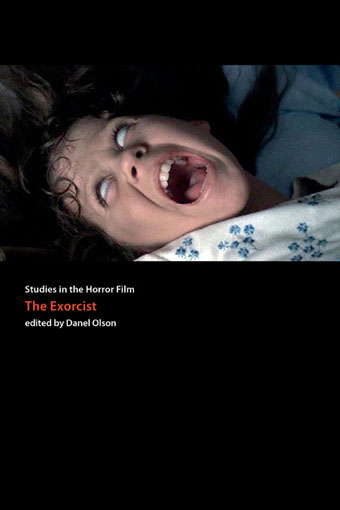
The Centipede volume is a substantial collection (516 pages) of interviews and essays edited by Danel Olson, part of the publisher’s Studies in the Horror Film series. The interviews are especially worthwhile being taken in part from back issues of Cinefantastique magazine: Friedkin and Blatty appear twice, there are talks with Dick Smith and Friedkin’s editor Bud Smith (no relation), and Paul Schrader discusses his troubled prequel, Dominion (2005).

Among the essay highlights Thomas Ligotti juxtaposes Blatty’s moral and theological universe with the amoral pessimism of HP Lovecraft while Blatty recounts the factual origin of his novel in a piece taken from The Exorcist: From Novel to Film (1974). Successful films that spawn sequels often present challenges for critics when the later installments begin to deviate from the premise of the original. Part of the interest in Olson’s collection is seeing how the writers delve into the imperatives of Hollywood sequelitis for moments of value. The critical essays are thought-provoking without wandering into the quicksands of jargon-ridden academicism: Kendall Phillips examines the influence of The Exorcist on The Texas Chainsaw Massacre (1974), there’s a spirited attempt by James Kloda to defend John Boorman’s much-vilified The Exorcist II: The Heretic (1977), and James Marriott points out that horror films are a continuing source (however debased) of metaphysical speculation.

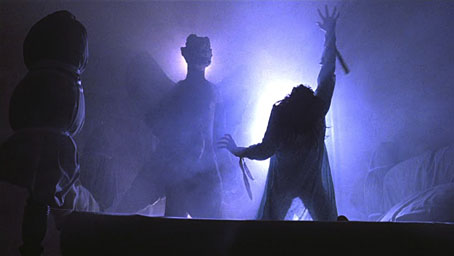
This last notion is an intriguing one: people always take The Exorcist at face value—God and Satan are real; it’s a spiritual battle—yet the demon we see in the film is the Assyro-Babylonian god Pazuzu, a spirit never mentioned by name in the Bible, or in the film for that matter. I’d suggest there’s an argument to be made that it’s only Pazuzu that actually exists as a supernatural force in the film’s world, and that the prayers of the priests confound it but temporarily.
exorcist4.jpg

Pazuzu has entered the building.

The aura of metaphysical threat may have diminished but The Exorcist still wasn’t allowed a UK TV screening until 2001. Something about the idea of people confronting supernatural evil continues to compel, however antiquated the scenario may seem. This isn’t too surprising when we have nominees for the US Presidential elections talking in hyperbolic terms about God and Satan without being widely ridiculed. Then there’s news stories like this recent one in the UK: “Boy ‘tortured and drowned’ over witchcraft claims, court told“. Blatty and Friedkin’s devil child was one of the most influential films of the 1970s, and may well be the most influential despite the continued popularity of the wretched Star Wars cycle. In the past couple of years alone we’ve had The Last Exorcism (2010) and The Rite (2011), with The Devil Inside due to appear on UK cinema screens in March; possessed girls appear in all three films. Danel Olson could easily fill another volume tracing this influence through the decades.

Studies in the Horror Film: The Exorcist isn’t published until March 2012 but can be pre-ordered at Amazon (US) and Barnes & Noble.

Previously on { feuilleton }
A playlist for Halloween: Orchestral and electro-acoustic
Dead on the Dancefloor
The monstrous tome

Weekend links 90

varo.jpg

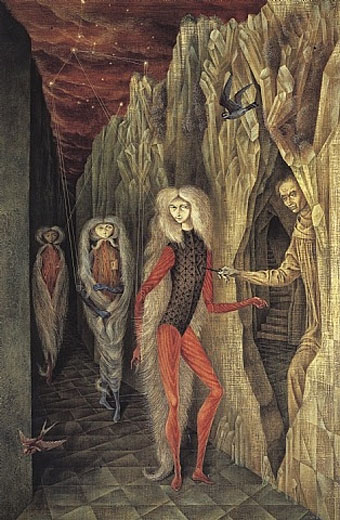
Portrait of Dr. Ignacio Chavez (1957) by Remedios Varo (1908–1963) some of whose Surrealist paintings can be seen at Frey Norris, San Francisco, from 19th January. There’s also In Wonderland: The Surrealist Adventures of Women Artists in Mexico and the United States at the Los Angeles County Museum of Art from 29th January.

The current crop of Republicans jostling for the Presidential nomination have reminded me of the Downunder people in Harlan Ellison’s post-apocalypse novella A Boy and His Dog (1969): a retrograde, fear-ridden community who send troublesome individuals to be exterminated at “the farm”. Rick Santorum (unforgettably pictured here with family in 2006 after losing an election) almost received the majority of Iowa’s votes for his nomination last week, prompting renewed scrutiny of his negative views about gay people, sexually active people, foreign people (especially Arabs and Mexicans), and anyone generally who isn’t a white, Catholic, Downunder person. Santorum is against gay marriage, of course—it’s hard to find a Republican who isn’t—but he also wants to ban abortion even in cases of rape and incest, and given the opportunity would allow US states to prevent any use of contraception. Add to this his pro-torture stance (which offends current Catholic church policy), and his willingness to wage war with Iran, and it’s easy to see why his name prompts reactions such as this:

I have a history with Rick Santorum. In 2003, when Santorum, in an interview with the Associated Press, first compared gay relationships to child rape and dog fucking (have I mentioned that Santorum has compared gay relationships to child rape and dog fucking?), I held a contest to redefine Santorum‘s last name. The winning definition: “the frothy mix of lube and fecal matter that is sometimes the byproduct of anal sex.” (“Sometimes” is the most important word in the new definition of santorum; if you’re doing anal sex correctly, there won’t be any santorum – lower- or upper-case.) And since 2003, the new definition has been the No. 1 Google return when you search “santorum“.

Rick Santorum’s homophobic frothing by Dan Savage

Related: Santorum was named one of the three “most corrupt” Senators in 2006 | “Homohater fosser fram” which is how Dagbladet, Norway’s second largest tabloid newspaper, introduces Santorum to its readers | “Rick Santorum channels Saint Augustine” an article at Slate exploring the Handmaid’s Tale extent of Santorum‘s attitudes towards sex and morality | Rick Santorum quotes as New Yorker cartoons.

marlin.jpg

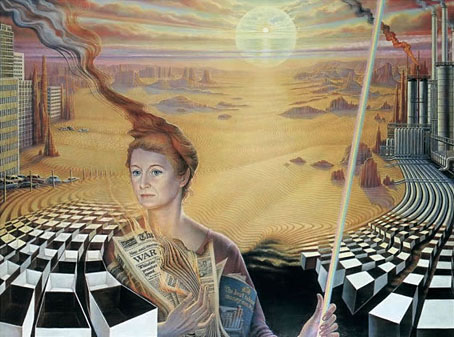
The Rod (1973) by Brigid Marlin.

• Ballardian posts a long-overdue interview with Brigid Marlin, famous now for having brought two lost Paul Delvaux paintings back to life for JG Ballard, but also a woman with an extensive career as a fantastic artist using Ernst Fuchs‘s laborious mische painting technique.

Quentin Blake on Ronald Searle, in which Blake notes that his hero was given a full-scale exhibition of his work at the Bibliothèque Nationale, France, in 1973 whilst being ignored throughout his life by the major institutions in Britain.

Alfred Jarry: A Pataphysical Life by Alastair Brotchie is reviewed by Michael Moorcock who tells me the Guardian cut out his references to Boris Vian, Maurice Richardson and David Britton.

Ian McKellen stirs things up by suggesting (not for the first time) that Shakespeare was bisexual.

• Ten posters by Only More Never Less inspired by Pink Floyd’s Dark Side of the Moon.

An end to bad heir days: The posthumous power of the literary estate.

Peace Eye! Fug! A Long Talk With Ed Sanders.

• Sand sculptures by Carl Jara.

Letterheady

• Skylab: These Are The Blues (1995) | Beyond The Breeze (1995) | Red Light, Blue Light (1995) | Indigo (Sabres of Paradise remix, 1995) | Seashell (Nobukazu Takemura mix, 1995).

Athanasius Kircher’s Tower of Babel

babel1.jpg

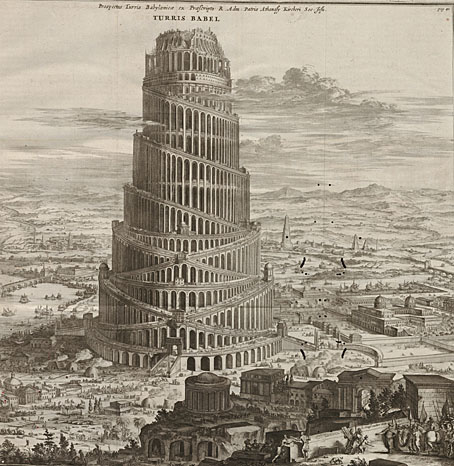
Here’s a picture whose myriad details I’ve wanted to scrutinise for many years. Lieven Cruyl was the draughtsman and Coenraet Decker the etcher while the picture itself appears as an illustration in Athanasius Kircher’s (deep breath) Turris Babel, Sive Archontologia Qua Primo Priscorum post diluvium hominum vita, mores rerumque gestarum magnitudo, Secundo Turris fabrica civitatumque exstructio, confusio linguarum, & inde gentium transmigrationis, cum principalium inde enatorum idiomatum historia, multiplici eruditione describuntur & explicantur. The book was published in 1679 and, among other speculations, features Kircher’s eye-popping illustration (below) showing how tall the Tower of Babel would have to be in order to reach the Moon. I used part of the big illustration in a cover design for metal band Melechesh in 2006.

babel6.jpg

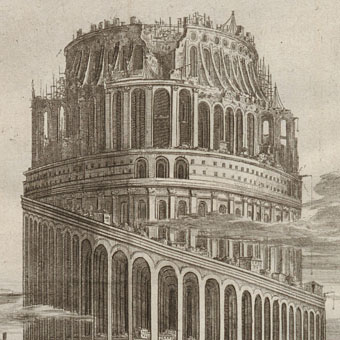
The copies here are from a scanned volume at the University of Heidelberg where the pages have suffered slightly from bookworm. But the resolution is high enough to explore a picture crawling with tiny details, from the bristling scaffolding at the top of the structure, and the houses (for the workers?) built on the ramps lower down, to a procession of camels and other beasts being led towards the main entrance. In the background there are smaller towers and a few pyramids (Kircher explored the latter elsewhere in the book), and also a harbour with beast-headed sailing ships. The full-size picture may be explored here.

babel2.jpg

Continue reading “Athanasius Kircher’s Tower of Babel”