Weekend links 555

demuth.jpg

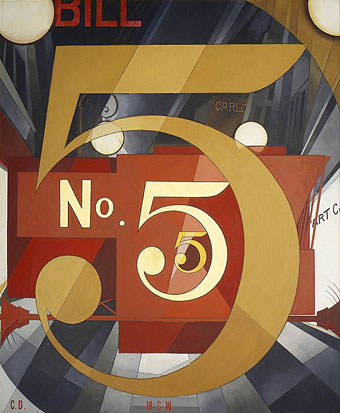
I Saw the Figure 5 in Gold (1928) by Charles Demuth.

• “Reading the new edition in 2021, I’m struck by his dismissal of CD-ROMs, of VR, of interactivity; how he anticipates contemporary debates about algorithmic bias…his prescient exhaustion.” Sukhdev Sandhu reviews Brian Eno’s diary for 1995, A Year with Swollen Appendices. Meanwhile, Eno himself says “Artists like me are being censored in Germany—because we support Palestinian rights.”

• “Kink is often pathologized in popular culture: it’s shamed, used as a punchline, and, on the whole, relegated to the margins of desire.” Greg Mania interviews R.O. Kwon and Garth Greenwell about Kink a collection of new stories about unorthodox desires.

• “This album is the king of hauntology. From where I’m sitting, I’m going back to the past, listening to an album imagining the future, imagining the past.” Tom Herdman on the fabulous Time (1981), a science-fiction concept album by the Electric Light Orchestra.

Cavafy, the ultimate Alexandrian, gave us an Alexandria that was already not quite there in his own lifetime. It kept threatening to disappear before his eyes. The apartment where he had made love as a young man had become a business office when he went to revisit it years later; and the days of 1896, of 1901, 1903, 1908, 1909, once filled with so much eros and forbidden love, were already gone and had become distant, elegiac moments that he remembered in poetry alone. The barbarians, like time itself, were at the gates, and everything would be swept in their wake. The barbarians always win, and time is hardly less ruthless. The barbarians may come now or in a century or two, or in a thousand years, as indeed they had come more than once centuries earlier, but come they will, and many more times after that as well, while here was Cavafy, landlocked in this city that is both the transitional home he wishes to flee and the permanent demon that can’t be driven out. He and the city are one and the same, and soon neither will exist. Cavafy’s Alexandria appears in antiquity, in late antiquity, and in modern times. Then it disappears. Cavafy’s city is permanently locked away in a past that refuses to go away.

André Aciman on the poetry of Cavafy and the Alexandrias of memory

DJ Food on the package design for The Superceded Sounds of…The New Obsolescents, which uses a similar foil card to the “Héliophore” stock used by Philips in their cult series of electroacoustic compositions, Prospective 21e Siècle.

Onlyou by Can, is “A relaxed studio session, recorded on a mono taperecorder in 1976 at the Innerspace”. Released in 1982 on a 34-minute cassette sealed inside a can (geddit?), and limited to 100 copies.

Olivia Rutigliano ranks 45 films containing prison escapes. I’d put the Bresson at number one but otherwise, yes.

• “…some kind of future unrealised time…” Mix of the week is a mix for The Wire by Muqata’a.

• RIP Christopher Plummer. Never mind the musical, watch him in The Silent Partner (1978).

• At Ubuweb: short films by Erkki Kurenniemi soundtracked by his own electronic music.

• New music: Neurogenesis by Robert Rich.

Kinky Boots (1964) by Patrick McNee & Honor Blackman | David Watts (1967) by The Kinks | The Dominatrix Sleeps Tonight (Dominant Mix) (1984) by Dominatrix
Weekend links 554

yokoo.jpg

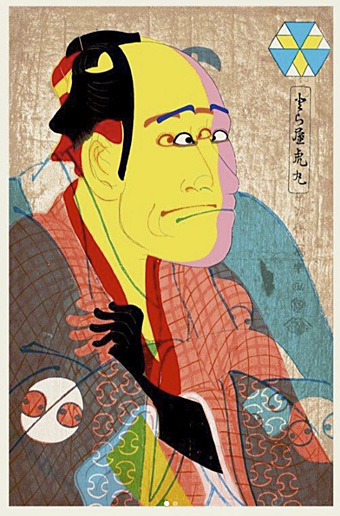
Tadanori Yokoo Emphasizes Deliberate Misalignment in Contemporary Woodblock Series.

• Another week, another Paris Review essay on Leonora Carrington. This time it’s Olga Tokarczuk exploring eccentricity as feminism. At the same publication there’s more eccentricity in Lucy Scholes‘ feature about the neglected novels of Irene Handl, a woman best known for the characters she played in many British films and TV dramas. I’ve long been curious about Handl’s writing career so this was good to see.

• “The denial of our participation in the world, [Fisher] implies—the disavowal of our desire for iPhones even as we diligently think anti-capitalist thoughts—is incapacitating. It leads to a regressive utopianism that cannot envision going through capitalism, but only retreating or escaping from it, into a primitive past or fictional future.” Lola Seaton on the ghosts of Mark Fisher.

• More ghosts: Paranormal is the latest collection of spooky, atmospheric electronica from Grey Frequency, “an audio document exploring extraordinary phenomena which have challenged orthodox science, but which have also grown and evolved as part of contemporary culture and a wider folkloric landscape.”

• “Items billed as THE BEST EVER can stop us cold, and even cause us to take them for granted, never reassessing them, as we instead gesture, often without thought, to where they sit in the corner, under a halo and backdrop of blue ribbons.” Colin Fleming on Miles Davis and Kind Of Blue.

• “Diaboliques and Psycho both achieve something very rare: a perfect plot twist but an unspoilable movie,” says Milan Terlunen.

• Richard Kirk returns once more as “Cabaret Voltaire” with a new recording, Billion Dollar.

• Even more Leonora Carrington: some of the cards from her Tarot deck.

DJ Food on Zodiac Posters by Simboli Design, 1969.

Kodak Ghosts (1970) by Michael Chapman | Plight (The Spiralling Of Winter Ghosts) (1988) by David Sylvian & Holger Czukay | The Ghosts Of Animals (1995) by Paul Schütze

Weekend links 550

moebius

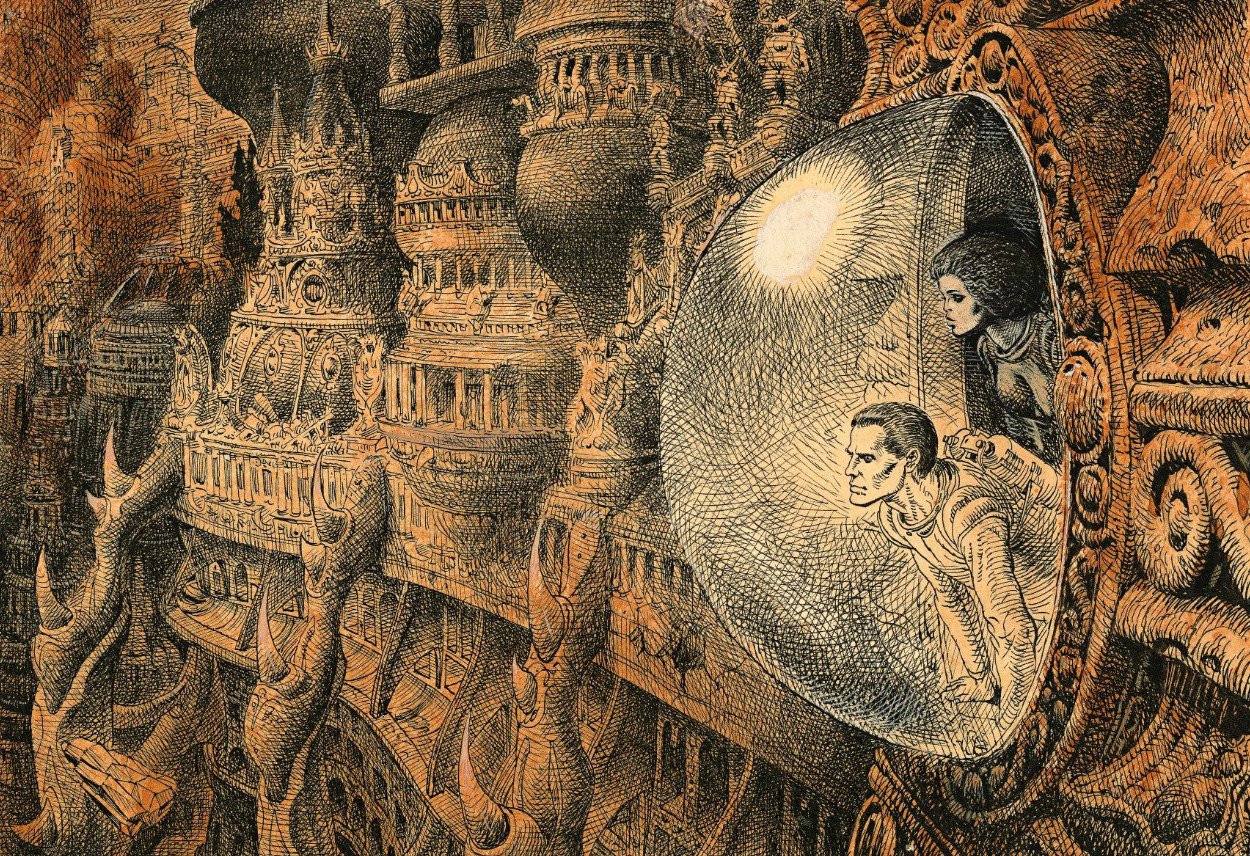
Illustration by Moebius for Les Robinsons du Cosmos (1970) by Francis Carsac.

Notre Dame des Fleurs is a collection of art based on or inspired by the Jean Genet novel. The book, which includes some new work of mine, will be published in February. Editor Jan van Rijn has a trailer for it here. It’s limited to 150 copies so anyone interested is advised to pre-order.

• Books that made me: William Gibson‘s influential reading. Good to see him mention Suttree by Cormac McCarthy, an outstanding novel that might be better known if it wasn’t for the gravitational pull of McCarthy’s other works.

• Zagava have announced a paperback reprint of The Art of Ilna Ewers-Wunderwald, a collection of neglected Art Nouveau drawings and designs compiled by Sven Brömsel.

• At Dennis Cooper’s: Black_Acrylic presents…He Stood In The Bath And He Stamped On The Floor: A Joe Meek Day.

• More yearly roundups: Our Haunted Year 2020 by Swan River Press, and The Year That Never Was by blissblog.

• New music: Spaceman Mystery Of The Terror Triangle by The Night Monitor.

Ralph Steadman’s guided tour through six decades of irrepressible art.

• At Greydogtales: Valentine Dyall: Mystery and Mesmerism.

• At Wormwoodiana: The Esoteric in Britain, 1921.

• At Strange Flowers: Marie Menken’s Lights.

I Want To See The Bright Lights Tonight (1974) by Richard and Linda Thompson | Neon Lights (1978) by Kraftwerk | Lights (1980) by Metabolist

Weekend links 542

gysbrechts.jpg

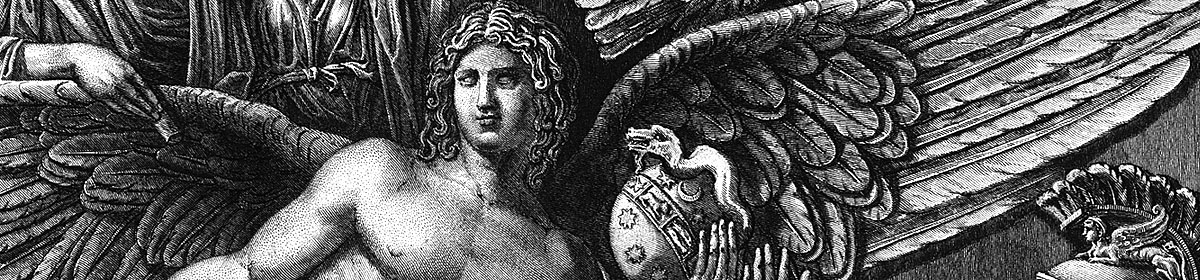
The Reverse of a Framed Painting (between 1668 and 1672) by Cornelis Norbertus Gysbrechts.

• New music with a cinematic flavour: Disciples Of The Scorpion (Main Theme) Heavy Mix by The Rowan Amber Mill is a taster for the group’s forthcoming imaginary soundtrack, Disciples Of The Scorpion (also a sequel of sorts to The Book Of The Lost); The Quietened Dream Palace is this year’s final themed compilation from A Year In The Country. The subject this time is abandoned cinemas, past and present.

San Francisco Moog: 1968–72 by Doug McKechnie, a collection of early synthesizer music using a modular instrument that was later bought by Tangerine Dream. “The quiescent, meditative pulse of the music has much more in common with what would come to be known as the Berlin school of German electronic music than anything coming out of the US at the time,” says Geeta Dayal.

• Sarah Davachi released a new album recently, Cantus, Descant, so The Quietus asked her to discuss her favourite albums. Related: XLR8R has a mix of the music that Davachi regards as influences. Kudos for the choice of Why Do I Still Sleep by Popol Vuh, an overlooked piece from the end of the group’s career.

When I use relevance as a filter for determining what books to read, I’m failing to make myself available for an authentic encounter with otherness, something genuine art always offers. I’m presuming that I can guess, from the barest plot summary, whether a book will be useful in my life. But how can I know what I will find relevant about a work before I have submitted myself to the experience? I don’t think we are likely to be transformed by art if we try to determine that encounter in advance. Part of the vulnerability necessary for transformation is the recognition that I am, to a great extent, a mystery to myself. How could I know what I need?

Garth Greenwell on the idea that a novel is only worthwhile if it is somehow “relevant”

• “For a long time I had been encouraged by the world of fine art to remove references to the spiritual from my work,” says Penny Slinger in a piece by Hettie Judah exploring the resurgence of interest in occult art. Good to see S. Elizabeth and her book on the subject receiving a mention.

• Arriving on Region B blu-ray later this month is Spring (2014) by Justin Benson & Aaron Moorhead, which 101 Films describes as Richard Linklater channeling HP Lovecraft. I enjoyed Benson & Moorhead’s Resolution (2012) and The Endless (2017) so this one is on pre-order.

• Topical books dept: The Man in the High Chair and Other Tyrannies by Kurt Fawver, a benefit publication for the California Coalition for Women Prisoners.

• We never know exactly where we’re going in outer space: Caleb Scharf on the difficulties of aiming for distant objects in an ever-changing universe.

• Submissions open soon for the contemporary Dada journal Maintenant 15, with a theme of “Humanity: The Reboot”. Details here.

• At Dennis Cooper’s: Harry Smith, Filmmaker Day.

Pandemonium – Spring (1985) by Peter Principle | Silent Spring (2006) by Massive Attack feat. Elizabeth Fraser | Spring Stars (2009) by Simon Scott

Weekend links 539

earle.jpg

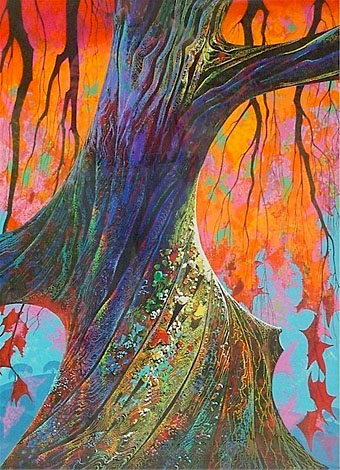
Fire, Red and Gold (1990) by Eyvind Earle.

Roger Penrose won a Nobel Prize recently for his work in physics. I read one of his books a few years ago, and was intimidated by the “simple” equations, but I always like to hear his ideas. This 2017 article by Philip Ball is an illuminating overview of Penrose’s life and work.

• At Dangerous Minds: Joe Banks on the incidents that led to Lemmy’s dismissal from Hawkwind in 1975, an extract from Hawkwind: Days of the Underground. The book is available from Strange Attractor in Europe and via MIT Press in the USA.

• “Not married but willing to be!”: men in love (with each other) from the 1850s on. It’s always advisable to take photos like these with a pinch of salt but several of the examples are unavoidably what they appear to be.

Most of all, this resolutely collaborative production stood against the vanity and careerism of individual authorship; Breton called it the first attempt to “adapt a moral attitude, and the only one possible, to a writing process.” The text itself is peppered with readymade phrases, advertising slogans, twisted proverbs, and pastiches of such admired predecessors as Rimbaud, Apollinaire, and Lautréamont, whose pluralistic credo, “Poetry must be made by all. Not by one,” anticipates the sampling aesthetic by a century. But the intensity was draining, and as the book moves toward its final pages and the writing becomes increasingly frenetic, you can almost feel the burnout taking hold. After eight days, fearing for his and Soupault’s sanity, Breton terminated the experiment.

Mark Polizzotti reviews a new translation by Charlotte Mandell of The Magnetic Fields by André Breton and Philippe Soupault

• The hide that binds: Mike Jay reviews Dark Archives: A Librarian’s Investigation into the Science and History of Books Bound in Human Skin by Megan Rosenbloom.

• “A photographer ventures deeper into Chernobyl than any before him.” Pictures from Chernobyl: A Stalker’s Guide by Darmon Richter.

John Van Stan’s reading of Frankenstein by Mary Shelley uses my illustrations (with my permission) for each of its chapters.

Susan Jamison, one of the artists in The Art of the Occult by S. Elizabeth, talks to the latter about her work.

William Hope Hodgson: The Secret Index. A collection of Hodgson-related posts at Greydogtales.

Gee Vaucher talks to Savage Pencil about her cover art for anarchist punk band, Crass.

Weird, wacky and utterly wonderful: the world’s greatest unsung museums.

Tom Cardamone chooses the best books about Oscar Wilde.

• At Dennis Cooper’s: Jean-Pierre Melville Day.

You by The Bug ft. Dis Fig.

Magnetic Dwarf Reptile (1978) by Chrome | Magnetic Fields, Part 1 (1981) by Jean-Michel Jarre | Magnetic North (1998) by Skyray