Witkinesque

supervert.jpg

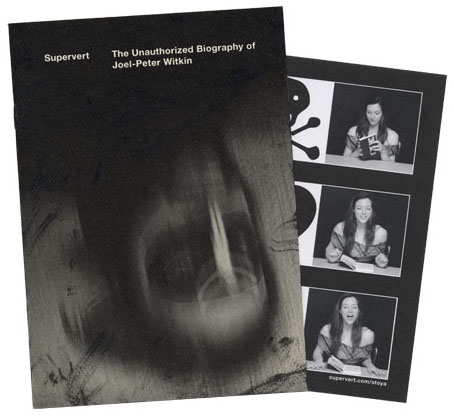
Arriving in the post this week, a Christmas gift from Supervert, a chapbook featuring a new piece of writing that purports to be the unauthorised biography of American artist/photographer Joel-Peter Witkin. The premise is that the facts of the real Witkin’s life are far too mundane to account for his extraordinary photo tableaux so Supervert supplies details such as “Mary Witkin [his mother] worked as a bookkeeper in a DDT plant, slowly saving to enrich the unfathomable reservoirs of the absurd.” A metaphysical portrait of the artist, then, with echoes of David Lynch or Bruno Schulz. Inside the chapbook was a promo postcard bearing pictures of the delightful Ms. Stoya whose reading of Necrophilia Variations has now gained over four million YouTube views.

The Witkin book isn’t for sale but copies are available to those who enter the Supervert contest which is running throughout December. All you need do is enter an email address here then keep your fingers crossed.

witkin.jpg

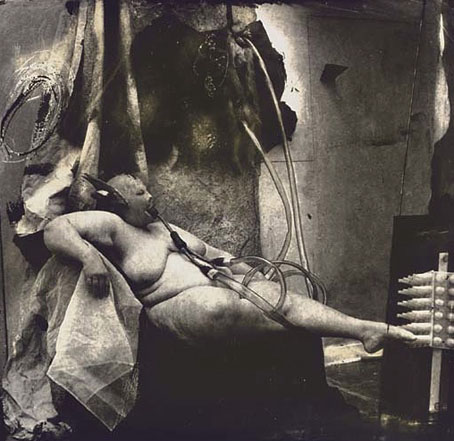
Sanitarium, New Mexico (1983) by Joel-Peter Witkin.

Witkin’s tableaux made an immediate impression circa 1993 when I bought a copy of PhotoVision, a Spanish photography journal which had devoted an entire issue to his work. This arrived at a point when I was halfway through drawing the Reverbstorm comic series, and Witkin’s parade of unorthodox humanity, crucified apes and sundry body parts seemed an ideal complement for the parade of similar grotesqueries (and sundry body parts) we were putting into the comic pages. I also liked the way Witkin worked his own variation on familiar scenes from art history, something we were doing throughout Reverbstorm (Witkin’s Vase: Study For the Base of the Crucifix just happens to combine a partly dissected human skull with Picasso’s Guernica, a recurrent motif throughout the series).

reverbstorm1.jpg

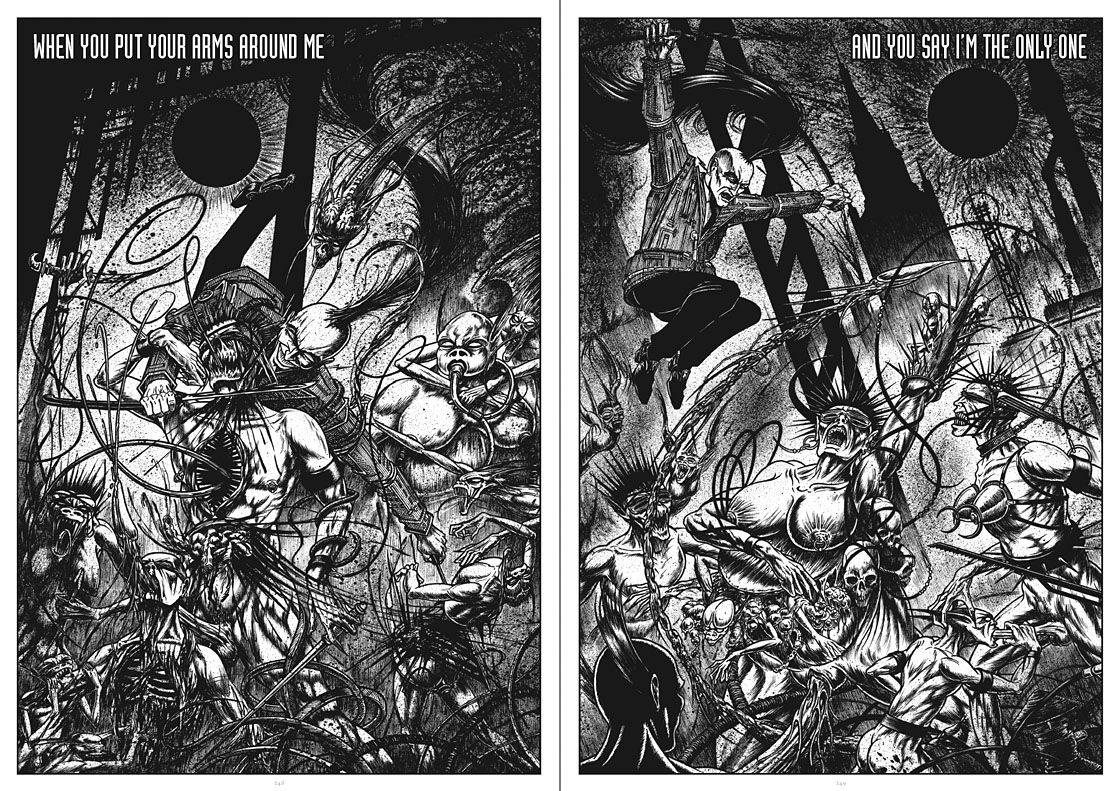
Above and below, some of the more Witkinesque details from part seven of Reverbstorm. The main figure above was a direct reference to Witkin’s Sanitarium, New Mexico. Many figures in other drawings are given Witkin-like blindfolds.

Continue reading “Witkinesque”

Weekend links 137

jacobsen.jpg

Self-portrait by Jon Jacobsen from his Home series.

Steven Arnold: Cabinet of Curiosities is “a retrospective exhibition of this groundbreaking yet under-recognized queer artist at the ONE Archives Gallery & Museum in West Hollywood. The exhibition celebrates Arnold’s radical imagination, presenting many of his tableaux vivant photographs alongside never before exhibited drawings, sketchbooks, paintings and original poster art. In conjunction with the exhibition, ONE will screen Arnold’s four films, including Luminous Procuress (1970), which featured The Cockettes and was lauded by Salvador Dalí.” The exhibition runs to  January 12, 2013.

• “The boundary-pushing techno/sound design duo Emptyset will transform London’s cavernous industrial space Ambika P3 into an immersive sound installation for one night only—and here’s how they’re going to do it”.

• “At one time he was a well-known figure in Montparnasse, where he had a reputation as a master of the occult sciences.” Aleister Crowley is interviewed about his expulsion from France in 1929.

Our normal waking consciousness, rational consciousness as we call it, is but one special type of consciousness, whilst all about it, parted from it by the filmiest of screens, there lie potential forms of consciousness entirely different. We may go through life without suspecting their existence; but apply the requisite stimulus, and at a touch they are there in all their completeness… No account of the universe in its totality can be final which leaves these other forms of consciousness quite disregarded… [T]hey forbid our premature closing of accounts with reality.

William James (1842–1910) quoted in What Should We Do With Our Visions of Heaven—and Hell? by John Horgan at Scientific American.

Screws is an album of piano music by Nils Frahm that’s currently available as a free download (inc. aiffs).

• At Pinterest: Art Visonnaire. Related: Ain’t We Got Fun: The magical surrealism of Jen Ray.

Rowan Somerville “challenges the purpose and legitimacy” of the Bad Sex Awards.

Jimmy’s End: the website for the film by Alan Moore & Mitch Jenkins.

Douglas Rushkoff in conversation with Genesis Breyer P-Orridge.

• Linda Rodriguez McRobbie explores The History of Boredom.

• Recreating the sounds of the BBC Radiophonic Workshop.

Alchemical Emblems, Occult Diagrams, and Memory Arts.

Rocaille: A Blog about Decadence, Kitsch and Godliness.

• A new video for Goddess Eyes II by Julia Holter.

• The complete audio recordings of Jean Cocteau.

The Rumpus interview with Russ Kick.

Forgotten Bookmarks

• RIP Spain Rodriguez

Astradyne (1980) by Ultravox (produced by Conny Plank) | Biomutanten (1981) by Les Vampyrettes (Conny Plank & Holger Czukay) | Never Gonna Cry Again (1981) by Eurythmics (feat. Holger Czukay, produced by Conny Plank).

Hill figures

whitehorse.jpg

Last year I was searching out various works of American land art via Google Maps. This is a similar post looking for some of Britain’s hillside figures, all of which are far older than any 20th-century artworks even if some of them aren’t as old as people hope. The antiquity of the Uffington White Horse in Oxfordshire has been established, however, the figure being estimated to be at least three thousand years old. The debate in this case is whether it represents a horse, a dragon or some other creature. What’s most fascinating about the figure is that it can’t be seen from any of the surrounding area, it’s only visible at the top of the hill; all other hill figures are intended to be viewed from a distance. There are other white horse figures carved into southern England’s chalky hillsides but the rest look like distinctly modern creatures. The Uffington carving resembles the kind of animals seen in cave paintings.

longman.jpg

The Long Man of Wilmington in East Sussex provokes endless speculation as to its age and purpose. In the case of this figure and the Cerne Abbas Giant (below) there are no written records of them earlier than the 16th century whereas the Uffington horse is mentioned in medieval texts. This doesn’t rule out their being far older but it implies that their origin may be more recent and more mundane than some would like to believe. The satellite view of the Long Man currently on Google Maps shows that local wags have given the figure a smiley face.

cerneabbas.jpg

The most famous erect penis in Britain can be found near the village of Cerne Abbas in Dorset. In the 1930s the Bishop of Salisbury petitioned the Home Office to have the giant phallus covered over, to no avail.

cropcircle.jpg

Not a hill figure, this is the remains of a crop circle I noticed when looking at Avebury from the air. There are no doubt more to be found, Wiltshire is apparently a popular area for circle makers.

uno.jpg

Uno (1974) by Uno.

Given the usual subjects of concern here I have to mention these two album covers which make use of hill figures. The Uno sleeve is a design by Hipgnosis which is a lot more well-known than the album it decorates. The original XTC vinyl sleeve designed by Ken Ansell was textured card with the horse and lettering embossed into the surface. I’ve not been able to find a cover featuring the Cerne Abbas Giant although that doesn’t mean to say there isn’t one.

xtc.jpg

English Settlement (1982) by XTC.

Elsewhere on { feuilleton }
The album covers archive

Previously on { feuilleton }
Land art
How to make crop circles

Painting the Henge

stonehenge1.jpg

Wiltonia sive Comitatus Wiltoniensis; Anglice Wilshire (1649) by Atlas van Loon.

Avebury doth as much exceed Stonehenge in grandeur as a Cathedral doth an ordinary Parish Church.

John Aubrey

John Aubrey (1626–1697) was the pioneering antiquarian and archaeologist whose interest in the ancient sites of southern England made him the first person to subject Avebury to any serious study. As a consequence his comparison between Avebury and Stonehenge may contain some bias—Stonehenge’s site on the desolate Salisbury Plain made its presence well-known even if it was little understood—but it should be noted that in Aubrey’s time there were more stones at Avebury than there are today, and the long avenues leading to and from the outer circle were still intact. The stones of Avebury were unfortunately small enough to be broken up by the locals for building materials.

stonehenge2.jpg

Stonehenge (1835) by John Constable.

The size of the stones, and the isolation of the site explains why Stonehenge has proved more attractive to the arts than other Neolithic monuments. William Macready in the 19th century added Stonehenge-like trilithons to his stage designs for King Lear, an addition that persisted for decades; Thomas Hardy’s Tess of the d’Urbervilles (1891) famously ends with a scene at the stones, while in the 20th century Stonehenge was shoehorned into Night of the Demon (1957), Jacques Tourneur and Charles Bennett’s film adaptation of Casting the Runes by MR James. James was an antiquarian himself so may well have approved of the inclusion, especially the way the stones are used in the opening scene.

stonehenge3.jpg

Stonehenge at Sunset (1835) by John Constable.

Painted renderings of the stones tend to be a mixture of archaeological studies and depictions like those featured here. The site had an understandable attraction to the Romantics, and drew both Constable and Turner there. (See Turner’s paintings and sketches here.) Constable’s watercolour of the stones against a turbulent sky is oft-reproduced. Some of the stones seen in 19th paintings and drawings lean more than they do today, having been restored to the vertical in the 20th century.

stonehenge4.jpg

Stonehenge – Twilight (c. 1840) by William Turner of Oxford (not to be confused with his more famous namesake).

Closer to our own time there’s Henry Moore’s marvellous series of lithograph prints from 1973 which study the stones from a variety of angles. These include close views, something few other artists seem to attempt. The photo print below shows the site as it was in the 1890s with cart tracks passing nearer to the stones than visitors today are allowed to venture.

stonehenge5.jpg

Previously on { feuilleton }
Stonehenge
Stonehenge panorama

The art of Gregorio Prieto, 1897–1992

prieto01.jpg

Predicadors del be i del mal (c. 1928–1930).

My thanks to Will at 50 Watts for sending these experimental photos by Spanish artists Eduardo Chicharro (1873–1949) and Gregorio Prieto, neither of whose work I’d looked at before. Prieto is of most interest here (that’s him in photo five with the metalwork wrapped around his head) for the homoerotic quality of his other work, a quality which no doubt explains why some of these pictures set the gaydar bells ringing. I thought that Javier at Bajo el Signo de Libra might have featured Prieto already but it seems not.

prieto02.jpg

Iluita (c. 1928–1930).

The photos are from Les avantguardes fotografiques a espanya, 1925–1945. The superimposed images are reminiscent of those that Emil Cadoo was producing in the 1950s albeit with more of a deliberate Surrealist flavour; the ruins and Classical references are also a feature of Prieto’s paintings, some of which can be seen here. (Also a coloured print of the first photo above.) The homoerotics is most evident in his line drawings, some of which can be seen here. His reclining youths and embracing sailors look rather Cocteau-like but they probably owe more to the etchings of Picasso’s Vollard Suite which were being produced around the same period. There’s more Picasso-esque Prieto at Flickr including a drawing dedicated to Lorca.

prieto03.jpg

Metamorfosi (c. 1928–1930).

Continue reading “The art of Gregorio Prieto, 1897–1992”