Infrared California

highsmith3.jpg

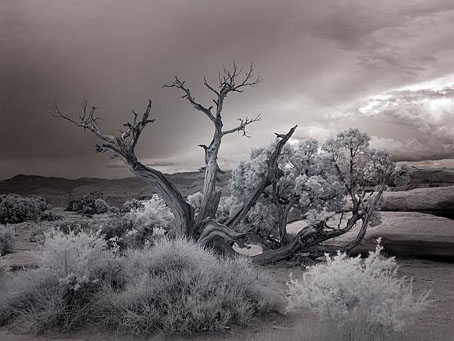
Bare tree in the desert near the Salton Sea, California.

Work-related searches this week led me to an archive of photographs by Carol M. Highsmith at the Library of Congress. There are 22531 photos in all (!), not all of which have been digitised. The ones that are available are all recent pictures which have been freed of copyright, something Highsmith is allowing with her entire digital archive.

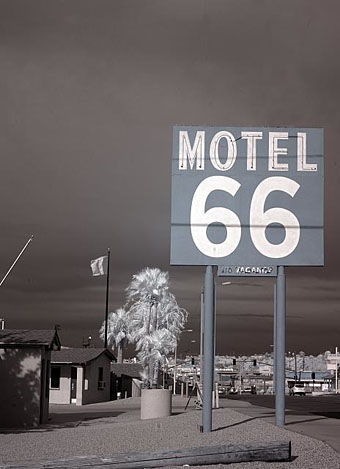
The examples here are from a small set of infrared shots of the California desert. I’ve always liked the ghostly quality of infrared photography so it’s fitting that some of the shots are of Bodie, a ghost town in Mono County. Browse them here.

highsmith1.jpg

Motel 66 sign in Barstow, Calfornia.

highsmith2.jpg

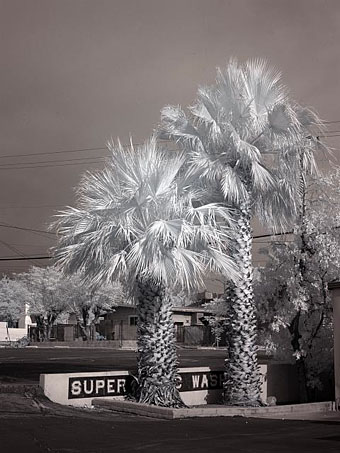
Palm trees in Barstow, Calfornia.

Tornadoes

tornado1.jpg

A gust, a storme, a spoute, a loume gaile, an eddy wind, a flake of wind, a Turnado.

Captain John Smith from An Accidence, or the Pathway to Experience Necessary for all Young Seamen (1626).

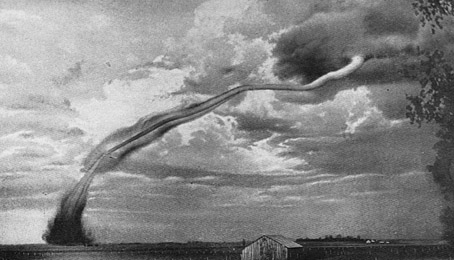
In an age of storm chasers and increasingly spectacular photos, Lucille Handberg’s celebrated picture may seem undramatic, but for the moment this is still the most celebrated tornado photo to date. I knew the picture from an early age thanks to its appearance in a children’s encyclopedia. When Deep Purple’s Stormbringer album appeared in 1974 (below) that imperilled barn, and the shape of the twister, was immediately recognisable.

tornado4.jpg

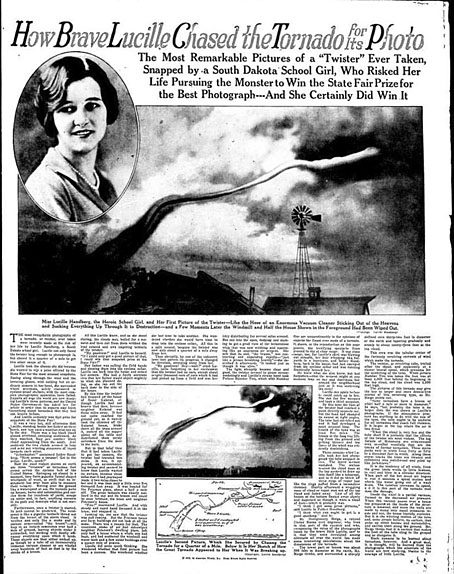
Lucille Handberg took her famous photo on 8th July, 1927 as the tornado passed by Jasper, Minnesota. It’s a surprise to see from the account in The Milwaukee Sentinel that there’s at least one other picture. I tried searching for a larger image of the second photo but photo libraries still control its reproduction. The copy above is from an account of the tornado here.

Continue reading “Tornadoes”

Weekend links 185

rondelli.jpg

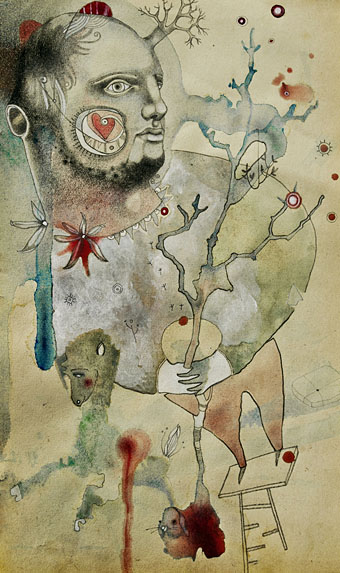
L’uomo che piantava gli alberi (2013) by Sofia Rondelli. Via Form Is Void.

• I’m looking forward to hearing the new album by Chrome Hoof, a band whose ambition and attitude makes many of their contemporaries seem lukewarm at best. Mick Middles gets to grips with Chrome Black Gold here. John Doran interviewed the group in 2010, a piece which includes a Chrome Hoof mix of tracks by other artists.

Jay Roberts: “I was a young Marine scout sniper, definitely his type. And for a single, unforgettable afternoon, Orange County’s most notorious serial killer coaxed me into a place from which many didn’t escape.”

Jonathan Meades: “Why I went postal … and turned my snaps into postcards.” “Meades isn’t your average architectural fanboy,” says Rachel Cooke who went to talk to him at his home in Marseille.

“Faced with a Nabokov novel,” Zadie Smith writes, “it’s impossible to rid yourself of the feeling that you’ve been set a problem, as a chess master sets a problem in a newspaper.” Certainly, while Humbert asks the reader “not to mock me and my mental daze”, the suspicion is that the power dynamic in his tale is a little different.

Tim Groenland on the difficulties of writing, publishing and reading Lolita.

Cosmic Machine is a double-disc collection of French electronic music from the 1970s & 1980s. Justice enthuse about the music here where you can also preview the tracks.

The Midnight Channel, Evan J. Peterson’s horror-poetry homage to the VHS era, is available now from Babel/Salvage. There’s a trailer here.

• “Our age reveres the specialist but humans are natural polymaths, at our best when we turn our minds to many things,” says Robert Twigger.

• Another musical Chrome: Richard Metzger on newly resurrected recordings by one of my long-time cult bands.

• Hermes Trismegistus and Hermeticism: An interview with Gary Lachman.

• A stunning set of photos of London in the sweltering summer of 1976.

Pye Corner Audio live at The Outer Church, Madrid, November 2013.

Judee Sill, the shockingly talented occult folk singer time forgot.

• Designer Jonathan Barnbrook answers twenty questions.

• Don’t trust the painting: Morgan Meis on René Magritte.

Laurie Anderson’s farewell to Lou Reed.

Philippe Druillet at Pinterest.

• The Chrome Plated Megaphone Of Destiny (1968) by The Mothers of Invention | March Of The Chrome Police (1979) by Chrome | Chrome (1981) by Debbie Harry

Belgian Autochromists

autochrome2.jpg

Misty wood (c. 1910) by Charles Corbet.

A perfect autumnal scene from Charles Corbet, one of many woodland views at the Belgian Autochromists site. As usual with autochromes it’s hard to believe that almost all these images are over a century old, the colours are so subtle. Some of the lighting is also remarkable, especially the self-portraits by Ernest van Zuylen which are lit with a single candle. Paul Sano’s lady sitting in the garden gives a foretaste of Magritte-like Surrealism, its inset eclipse appearing at first glance to be a large black sphere hovering unnoticed or ignored beside the seated woman.

Via Wood s Lot.

autochrome1.jpg

Melancholia (c. 1910) by Charles Corbet.

autochrome3.jpg

Sunset on the heath (c. 1910) by Paul Sano.

autochrome4.jpg

Lady and inset of solar eclipse (c. 1910) by Paul Sano.

Previously on { feuilleton }
Colour photography, 1908
Fred Holland Day revisited
Constantinople, 1900
Albert Kahn’s Autochromes
Gertrude Käsebier’s crystal gazer
The Dawn of the Autochrome

Witches

witches02.jpg

Scene of Witchcraft (1510) by Hans Baldung Grien.

Earlier this year Pam Grossman declared 2013 to be the Year of the Witch, so in honour of that (and the season) here’s a handful of sorceresses through the ages. Most can be found in higher quality at the Google Art Project but a couple are from other sources. I’ve taken the liberty of attributing the drawing below to Hans Baldung Grien, not Albrecht Dürer as Google has it. Not only is this the attribution I’ve always seen for this picture but Baldung’s “HBG” monogram is clearly visible beneath the sprawling woman.

witches01.jpg

New Year’s Greeting with Three Witches (1514) by Hans Baldung Grien.

witches03.jpg

The Witches’ Sabbath (c.1640–1649) by Salvator Rosa.

Salvator Rosa specialised in lurid depictions of bandits, executions and—as here—witches. The excessive imagery appealed to later generations, especially the Romantics. This painting is even more grotesque than usual with its flayed-bird abominations (below) looming out of the shadows.

witches04.jpg

Continue reading “Witches”