Weekend links 437

watson.jpg

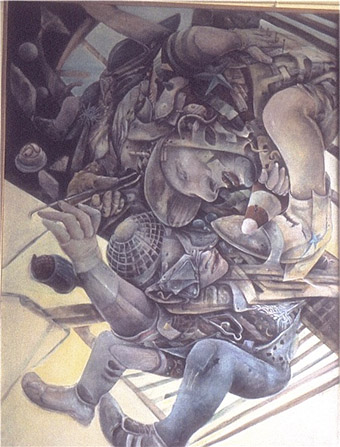
Rawmarsh Road, Rotherham, 1975 by Peter Watson.

Steel Cathedrals (1985), a composition by David Sylvian (with Ryuichi Sakamoto, Kenny Wheeler, Robert Fripp & others) was originally available only on the cassette release of Sylvian’s Alchemy: An Index Of Possibilities, and a video cassette where the music accompanied views of Japanese industry by Yasuyuki Yamaguchi. The video hasn’t been reissued since but may be viewed here.

• “If, as Arthur C Clarke famously observed, any sufficiently advanced technology is indistinguishable from magic, then can we accept that any sufficiently advanced magic is also indistinguishable from technology?” asks Mark Pilkington.

• “I didn’t like the idea of cartoons as just funny jokes, they had to have some relevant piece of observation in them to do with the society we are living in,” says Ralph Steadman.

I listen to music all the time, and I’ll often seek connections across quite disparate genres of that whatever I’m looking for. Sometimes it’s an aesthetic or a feeling, sometimes a pattern or structure, but it tends to cut across genres. The thing I liked about black metal and doom metal is the slowness and weightiness of it, it’s like deep time but in music. Sunn O))), Xasthur, and other bands captured this black gravity of sound. And they also tend to eschew the traditional vocal-lead guitar set-up, and everything is in the slow-moving wash and texture of sound.

I found that in other genres like noise music (especially Keiji Haino), the European avant-garde with composers like Ligeti, Scelsi, and Dumitrescu, dark ambient artists such as Lustmord or vidnaObmana, and contemporary works like Chihei Hatakeyama’s Too Much Sadness, Rafael Anton Irisarri’s A Fragile Geography, or Christina Vantzou’s No.4. There’s a lot to talk about in terms of music and forms of sorrow or grief, certainly every musical tradition has that—the funeral dirge, requiem, lamentation, or whatever.

Eugene Thacker listing a few favourite musicians and composers during a discussion with Michael Brooks about Thacker’s new book, Infinite Resignation

• The fourth edition of Wyrd Daze—”The multimedia zine of speculative fiction + extra-ordinary music, art & writing”—is out now.

• The Library of Congress has opened its National Screening Room, an online service for viewing films in the library’s collection.

The London Library discovered some of the books that Bram Stoker used for research when he was writing Dracula.

• “Oscar Wilde’s stock has never been higher,” says John Mullan, reviewing Oscar: A Life by Matthew Sturgis.

• Mixes of the week: RA Podcast 648 by Sarah Davachi, and Secret Thirteen Mix 269 by Sstrom.

• David Lynch directs a video for A Real Indication by Thought Gang.

• “Edward Gorey lived at the ballet,” says his biographer, Mark Dery.

• A new version of Blue Velvet Blues by Acid Mothers Temple.

• Photos of cooling-tower interiors by Reginald Van de Velde.

Aaron Worth on Arthur Machen: “the HG Wells of horror”.

• The Strange World of…Barry Adamson.

Glass And Steel No. 1 (1983) by Marc Barreca | Death Is The Beginning (1996) by Steel | Painless Steel (2000) by Bohren & Der Club Of Gore

The art of Henricus Jansen, 1867–1921

henricus0.jpg

This week’s post is another by Sander Bink about a neglected artist of the Dutch fin de siècle. Once again, this is an artist whose work was new to me. The Mucha-like style of the later pictures (and the one above from the same series) are especially good. My thanks again to Sander for the post.

* * *

Henricus Jansen (1867–1921) was a Dutch painter, graphic artist and illustrator who used ‘Henricus’ as his artist’s name, ‘Jansen’ being a very common and decidedly unsexy surname. He originated from The Hague where Art Nouveau and symbolism flourished in the 1890s more than any other Dutch city.

In the little that has been written about Henricus he is usually considered not to be avant-garde or progressive enough to be an ‘important artist’ (whatever that may mean). He is, however, mentioned in the standard reference work Symbolism in Dutch Art by Polak from 1955. Extensive studies have never been published about him and my main source of information about his life and work is an unpublished university thesis from 1988 by Louis Baeten of which I happen to have a copy. Baeten had spoken to Henricus’s daughter who was then still alive. According to the thesis Henricus must have made hundreds of drawings and paintings but they seem to be quite rare nowadays and seldom come to auction.

henricus1.jpg

For example, Henricus visited Tunisia in 1901 where Baeten says he produced more than 67 pastels and drawings of which “only seven survive”. These were exhibited in The Hague in 1901, and Leiden in 1907. One of these is depicted here from a private collection: a charming, somewhat cartoon-like ink drawing of three Tunisian male figures.

henricus2.jpg

From 1887 till 1892 Henricus lived in Paris where he mingled in the bohemian and artistic circles around Le Chat Noir, and knew people like Rodolphe Salis and Paul Verlaine. The drawings and illustrations he produced from around 1890 are strongly influenced by Parisian graphic artists like Steinlen, Grasset and Willette, uncommon models in Dutch art of the 1890s. Examples like the drawing of a lady in an antique market (above) are to be found in his illustrations for a book by Johan Gram, ‘s-Gravenhage in onzen tijd (The Hague nowadays) from 1893.

henricus3.jpg

More Symbolist in style, and therefore probably more of interest to { feuilleton } readers, are his illustrations for the popular magazine Elsevier’s. The picture shown here is a lithograph he made for the poem ‘Paulinus van Nola’ by the Flemish poet Pol de Mont, published in 1895.

henricus4.jpg

But his chef d’oeuvre is a series of lithographs inspired by the medieval folk song Heer Halewijn (Lord Halewijn), published in 1904 and exhibited in The Hague the same year, of which three are depicted here (from the collection Van der Peppel.) The most famous of the series is plate number sixteen in which Lord Halewijn’s head is decapitated by a charming lady. It is obviously inspired by Beardsley’s Salomé but is made with an entirely different technique and in colours. There is also a touch of Puvis de Chavannes and Carlos Schwabe to them. They are among the finest examples of Dutch fin de siècle graphic art.

Sander Bink

henricus5.jpg

henricus6.jpg

Previously on { feuilleton }
The art of Antoon van Welie, 1866–1956
The art of Simon Moulijn, 1866–1948
René Gockinga revisited
Gockinga’s Bacchanal and an unknown portrait of Fritz Klein
More from the Decadent Dutch

Weekend links 434

klint.jpg

Group X, No. 1, Altarpiece (1915) by Hilma af Klint.

“Like Kandinsky, and other pioneers of abstract art, af Klint was deeply immersed in theosophy and anthroposophy. But she seems to have taken that interest much further than her male counterparts, participating in (and later leading) séances with a group of women friends. Whatever the spirits said, af Klint did.” Nana Asfour on pioneering abstract painter, Hilma af Klint.

• Four electronic artists reflect on the influence of composer Laurie Spiegel. Spiegel’s The Expanding Universe (1980) is reissued by Unseen Worlds next month. Related: Laurie Spiegel in 1977 playing the Bell Labs Digital Synthesizer.

• At Expanding Mind: Gurdjieffean writer and DuVersity director Anthony Blake talks with Erik Davis about dialogue, synergy, mind between brains, the trouble with teachers, and the gymnasium of beliefs in higher intelligence.

• Mixes of the week: Flashing Noise Mix by Tim Gane, Secret Thirteen Mix 268 by Bérangère Maximin, and Samhain Séance Seven: A Very Dark Place – Prologue by The Ephemeral Man.

Geeta Dayal on Broken Music (1989), a book about sound art edited by Ursula Block and Michael Glasmeier which is now available in a new edition from Primary Information.

• The Sainsbury Archive showcases the graphic design of several decades of the supermarket chain’s products.

• More of the usual suspects: Michael Moorcock and Alan Moore in 2006 discussing Moorcock’s career.

• “Karloff the Uncanny”: Joe Dante talks to Stephanie Sporn about the attraction of old film posters.

Mexico City, another preview (and a psychedelic one) of Randall Dunn’s forthcoming solo album.

• At Haute Macabre: Timeless Phantom Interludes: The Photography of Jason Blake.

Mark Valentine on the current state of Britain’s secondhand book shops.

• At I Love Typography: Unicorns, Frogs and the Sausage Supper Affair.

• “I never wanted to be a cult film-maker,” says John Waters.

• Artist Arik Roper chooses some favourite album covers.

Broken Head (1978) by Eno, Moebius, Roedelius | Broken Horse (1984) by Rain Parade | Broken Aura (2000) by Coil

Leonor Fini

fini1.jpg

I’ve been hoping for years that a proper documentary about the enigmatic Argentinian artist might surface, and here one is at last. Leonor Fini (1987) was directed by Chris Vermorcken, and as a portrait of an artist it’s almost as good as the films the BBC used to produce for the Arena arts strand. I say “almost” because the Arena template tended to blend a biographical sketch with the life of the artist or writer at the present moment. Vermorcken encourages Fini to tell us about her early years in Trieste up to her meeting with the Surrealists in Paris, after which the discussion meanders to her vast company of Persian cats and the various forms of her painting and drawing.

fini2.jpg

Unlike most other films about Fini, this one is subtitled throughout so we can enjoy her reading from some of the stories that accompany her drawings, and also find out which films she liked. (Fellini’s Casanova was a favourite.) There’s also an appearance by Konstanty Jelenski, one of the points of the bisexual ménage à trois formed by Jelenski, Fini and Count Stanislas Lepri, all of whom lived together in the cat-infested house. Essential viewing here.

Previously on { feuilleton }
Leonor Fini: comment vivre sans chat
Angels of Anarchy: Women Artists and Surrealism
The art of Leonor Fini, 1907–1996
Surrealist women

Weekend links 432

urbanowicz.jpg

Tokyo at night, one of a series of watercolours depicting the back streets of the city by Mateusz Urbanowicz.

• “The experience of reading the book is something like watching Dr. Strangelove on one screen, Apocalypse Now on a second screen, and having both feeds interrupted by explicit gay erotica.” Bad Books For Bad People examines William Burroughs’ celebrated YA novel, The Wild Boys. The subject is a perennial one here, explored at length in this post.

• Lindsay Anderson’s The White Bus (1967), a surreal precursor to If…. and O Lucky Man!, will receive the high-quality BFI reissue treatment as part of the Woodfall Films portmanteau feature, Red, White and Zero.

• The Radiophonic Workshop have composed the score for Possum, a horror film by Matthew Holness. The main title theme is here. The film is released later next month.

Might I have written a sober affair, had I not been under the influence? Perhaps not—I have never needed tramadol to be attended by angels, or to feel demons pricking my feet. But I think of Vincent van Gogh, who looked at the world through the yellowish haze conveyed by digitalis, and grew enraptured by sunflowers and straw chairs, and I think of a glass prism through which a beam of white light passes and is split into a rainbow. What had been a single lucid idea had passed through the drugs I took and been dispersed into a spectrum of colours I had only half foreseen.

Sarah Perry on trying to write while besieged by bodily pain and prescription drugs

• Jacques Tourneur’s masterful MR James adaptation, Night of the Demon (1957), is released on region-free Blu-ray next month by Powerhouse Films.

• Mixes of the week: FACT mix 673 is The Bug presents PRESSURE, and XLR8R Podcast 561 by Zendid.

• The Space Shifters exhibition at the Hayward Gallery, London, messes with Adrian Searle‘s mind.

Gregory Wells on queers, faeries and revolutionaries in the psychedelic movement.

Wide Boys (1977) by Ultravox! | On Demon Wings (2000) by Bohren & Der Club Of Gore | Spoonful (2013) by Robert Plant and the Sensational Space Shifters