Weekend links 451

smith.jpg

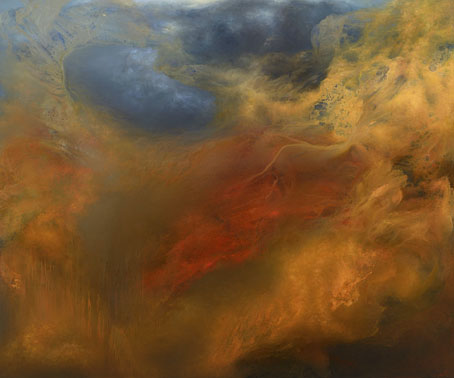
Manifold (2015), a painting by Samantha Keely Smith which will appear in April on the cover of Life Metal, a new album by Sunn O))).

• At Expanding Mind: Professor and queer historian Heather Lukes talks with Erik Davis about Silver Lake riots, gay bikers, house ball scenes, the nostalgia for repression, and the joys and challenges of working on the online archive The Grit and Glamour of Queer LA Subculture.

A Stroke of Ingenious: Chatting Fear and Fantasy with Darius Hinks.  Also this week, Darius Hinks’ The Ingenious (for which I created the cover art) was featured in a Barnes & Noble list of seven attractive (if hazardous) fantastic cities.

• “From the late ’60s and through the ’70s broadcasters invested in home-grown kids’ television, and much of it was decidedly weird.” Paul Walsh on the vanished, thought-provoking strangeness of British TV.

That late surrealism still needs rescuing by curators and critics is perhaps not a sign of its defeat but of the breadth and pervasiveness of its triumph. Could we have Pablo Picasso or Jackson Pollock without surrealism? What about David Lynch, JG Ballard or Angela Carter? As an influence, it’s easy to give [Dorothy Tanning] a crucial place in the canon of feminist art. Louise Bourgeois was born just a year later than Tanning but only started to sew after Tanning had exhibited her first sculptures.

Lara Fiegel on the weird, wild world of Dorothea Tanning

After its own death / Walking in a spiral towards the house by Nivhek, a new album from Liz Harris (Grouper) “recorded using Mellotron, guitar, field recordings, tapes, and broken FX pedals”.

• At Dangerous Minds: Michael Rother (Neu!/Harmonia) on the forthcoming reissue of his solo albums from the 1970s.

Clesse by Clesse, another pseudonymous musical project by Jon Brooks (The Advisory Council et al).

• After Dark: The art of life at night—and in new lights by Francine Prose.

Elena Lazic on where to begin with Gaspar Noé.

• Mix of the week: Headlands by David Colohan.

Steven Heller‘s confessions of a letterhead.

• RIP Albert Finney.

• Void (2009) by Monolake | Void (2013) by Emptyset | Void (2014) by The Bug feat. Liz Harris

Weekend links 448

becher.jpg

Gas Tanks 1965–2009 by Bernd Becher and Hilla Becher.

• At Dangerous Minds: the drawings produced by Moebius for Maxwell House in 1989 are better than the coffee whose sales they were intended to assist.

Jarman Volume 2: 1987–1994, the BFI’s second collection of Derek Jarman films, is now available for pre-order.

• More Gorey: Cara Giaimo on Edward Gorey’s hoards and collections.

That movie [Susan Slade]—and I even have the paperback novelization of it—is a moment. That’s a perfect example. They would never release that image as a still of the movie. Come see a baby catch on fire! To me, I’m kind of rewriting the films as these scenes. That was a real shock to me as a teenager when I saw that. And I thought, Did that just happen? Her baby caught on fire? I remember in Serial Mom I had a big fight with a film executive who said that you can’t have her set her kid’s friend on fire. You can’t do that. And I said, “Why, it’s been in movies forever.” And I’m thinking of Susan Slade, but I’m thinking there’s no point using that in the argument.

John Waters talking to Gina Telaroli about his films but mostly about his works for the art gallery

Georgina Guthrie on how green became cinema’s loneliest colour.

• Tom Crewe reviews Edward Burne-Jones at Tate Britain.

• Mix of the week: FACT Mix 688 by Steve Hauschildt.

• At Strange Flowers: 19 books for 2019.

Jenzeits Cosmic Worlds by Jenzeits.

• Green Onions (1962) by Booker T. & The MGs | Green (1966) by Ken Nordine | Green Fuz (1969) by Randy Alvey And The Green Fuz

The art of Nick Hyde, 1943–2018

hyde05.jpg

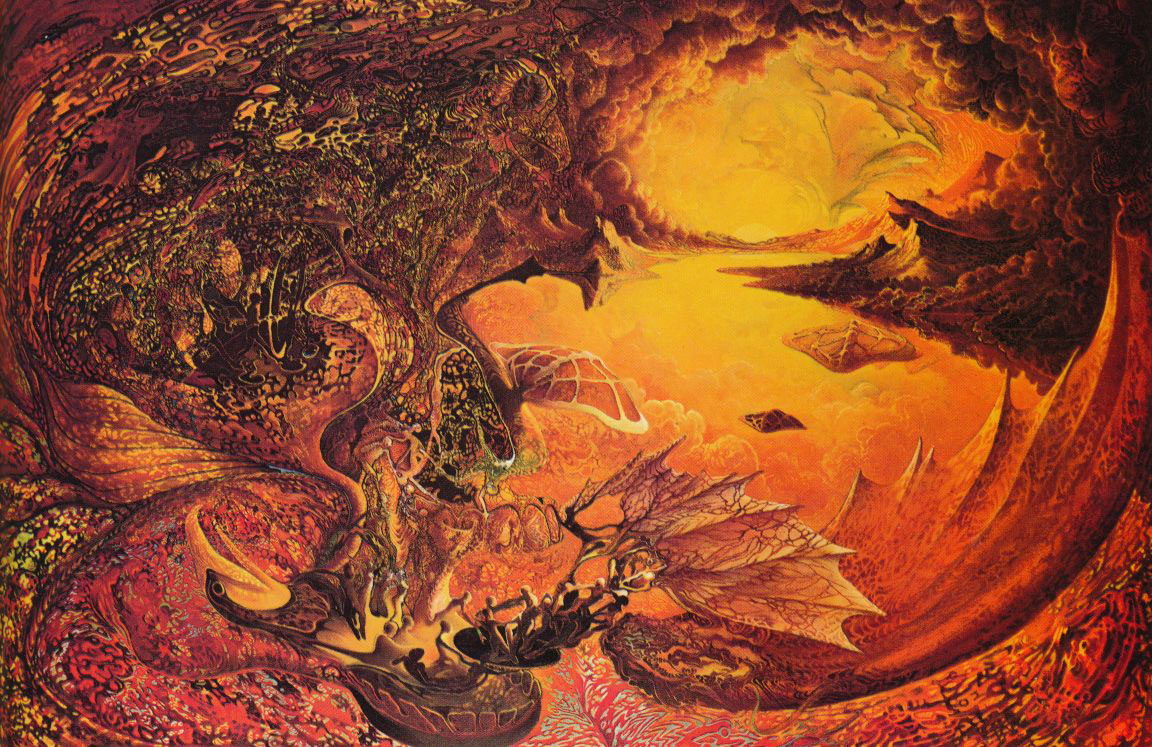
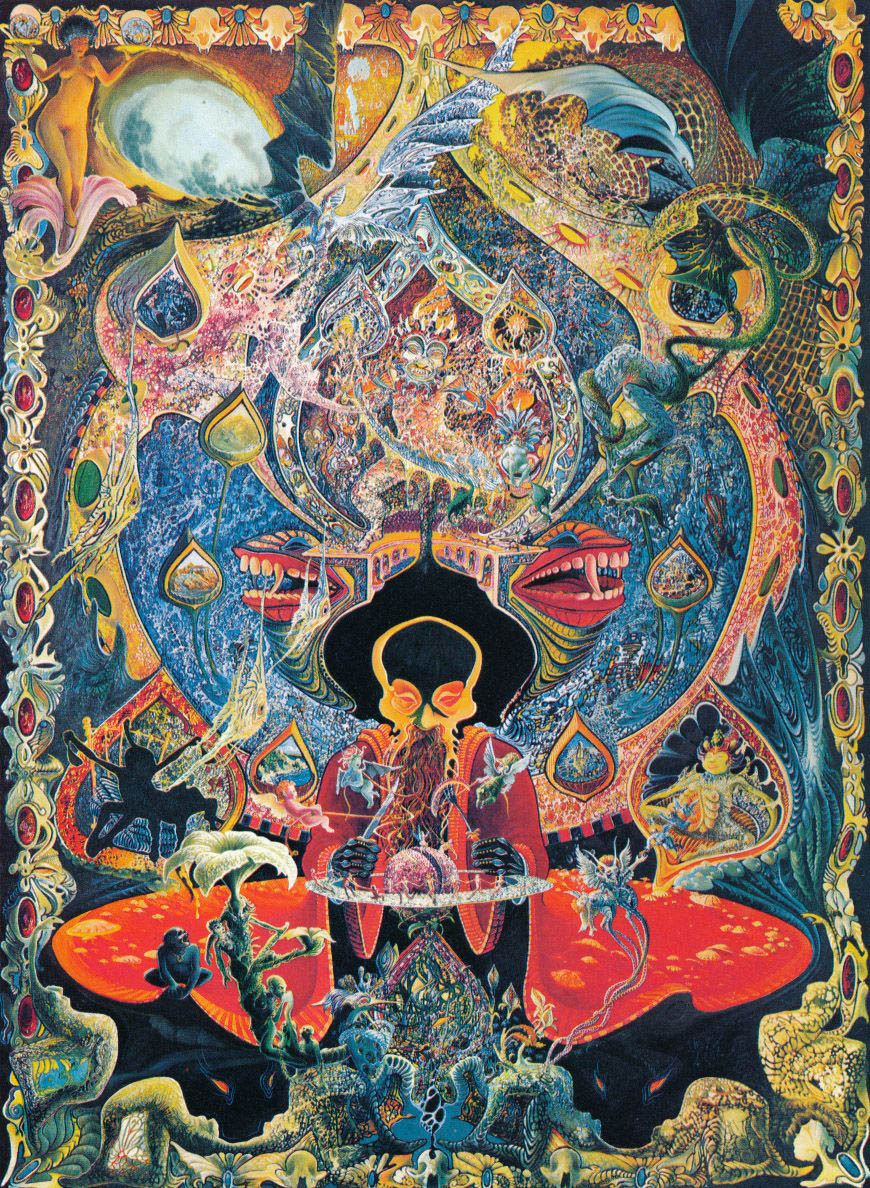
Estate of Man (1967).

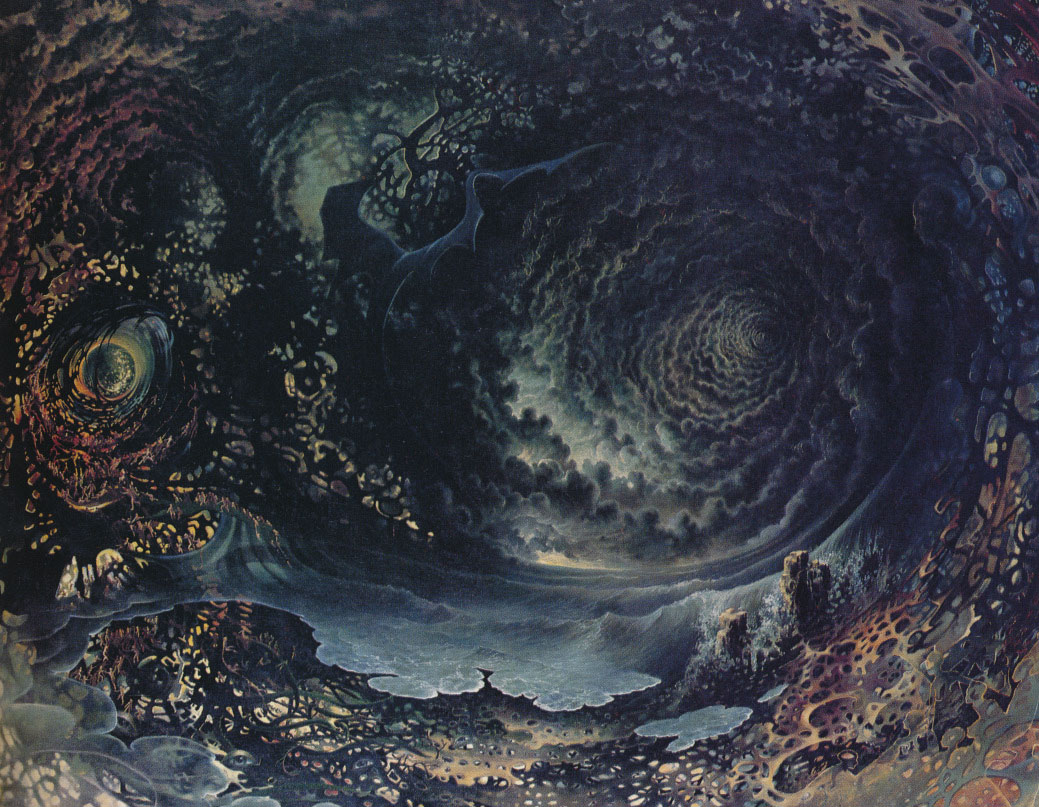
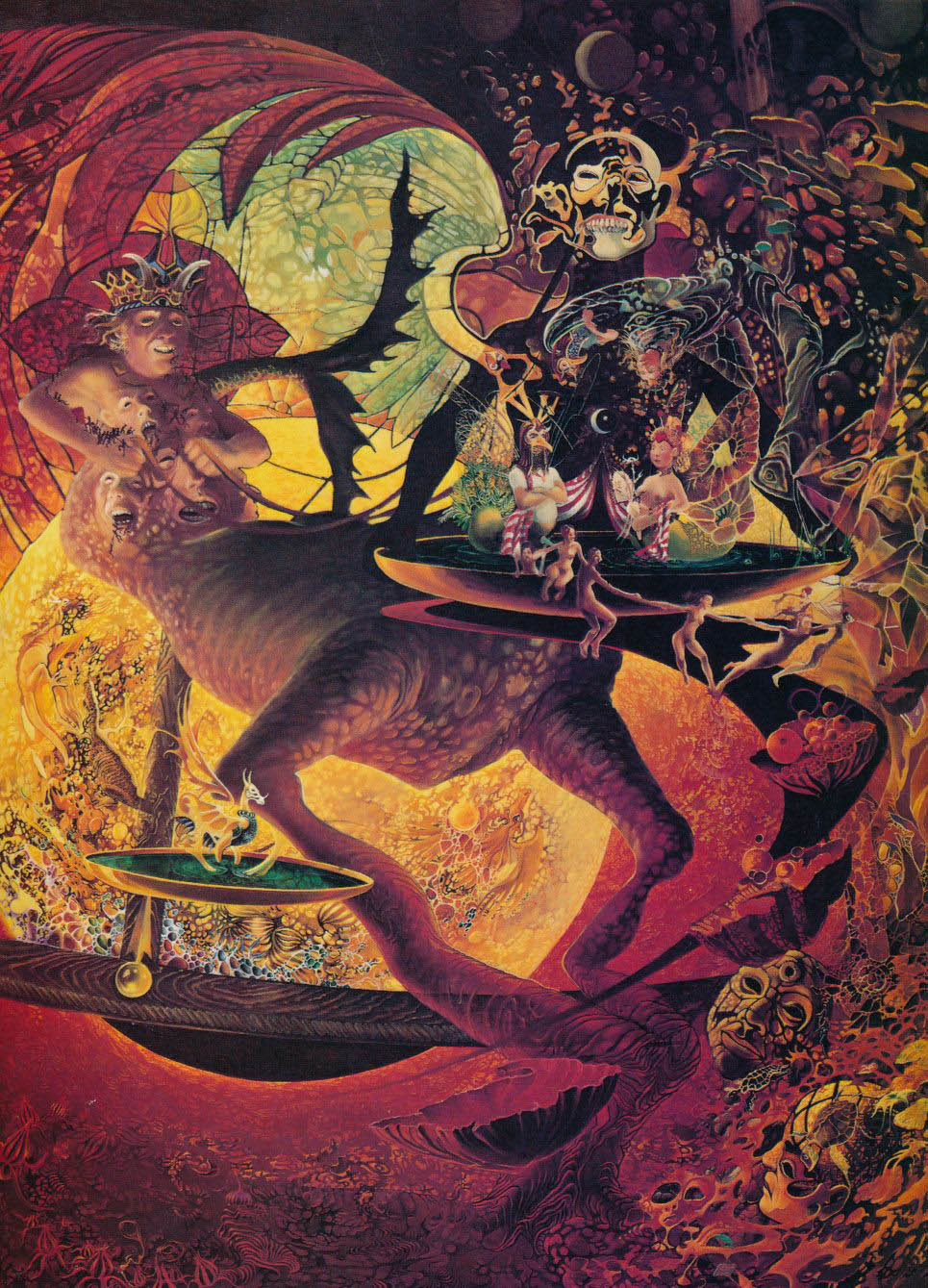
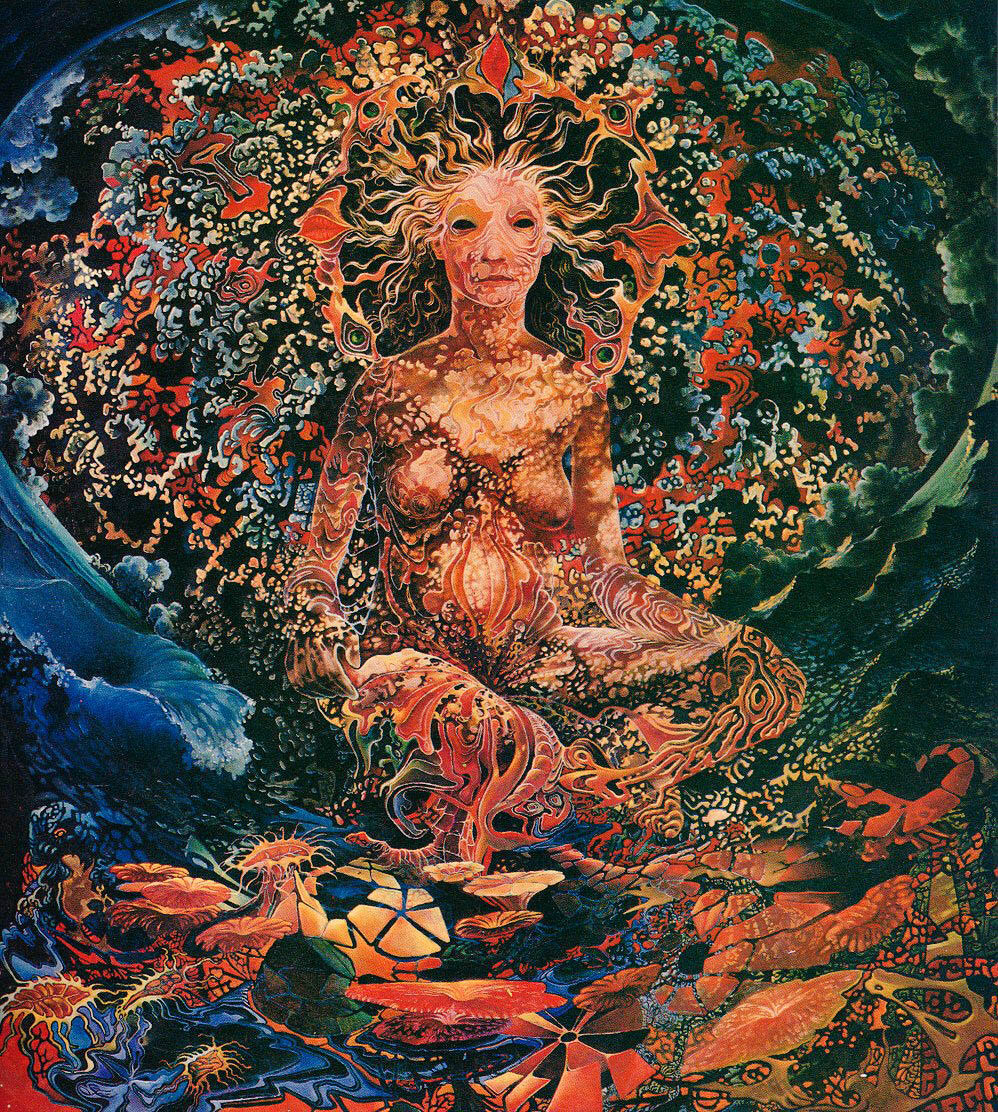
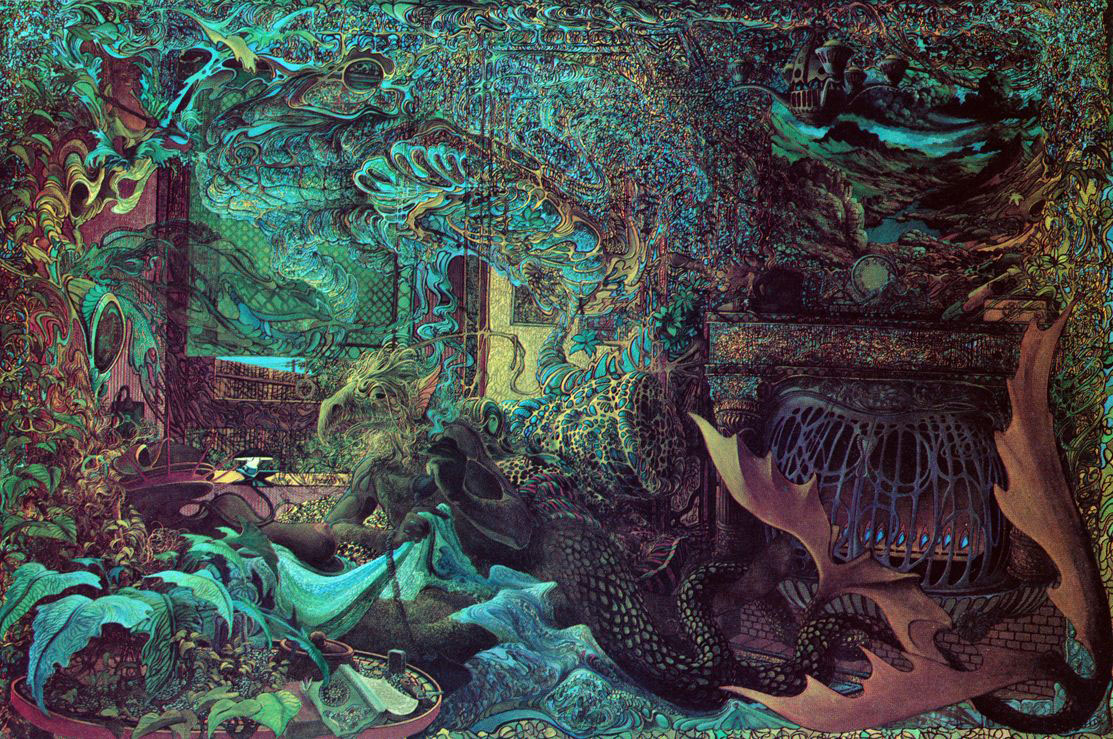
A short tribute to American artist Nick Hyde who I’ve been informed died last month. Hyde’s extraordinary paintings were featured here a few years ago after I found a copy of Visions (1977), an art book devoted to artists of the loosely-affiliated California Visionary school. Most of the paintings in the book are a type of fantastic art (not to be confused with fantasy art) that owes much to the hippy mysticism that later became codified as “New Age”, a vague term which covers a lot of territory. Several of the paintings were featured in the early issues of OMNI magazine but I don’t recall Nick Hyde’s art being among them. Hyde’s early paintings are darker and stranger than those of his Visions contemporaries, and they were ones I inevitably preferred to the rest, hence my earlier post highlighting his work. There isn’t much else I can say about him other than pointing to the official website and posting the following appraisal by Walter Hopps from Visions. All the paintings here are from Visions, and several of them (Abraxas in particular) look like they need to be seen at a much larger size.

hyde06.jpg

Cryptyde (1967).

I am not trying to clean myself of impurities, but to venture into a very real situation. I consider myself a true visionary—it comes to me and I flow with it. My imagery is always a dance.” Nick Hyde, 1976

The powerful nature of Nick Hyde’s art stands in certain important ways vividly apart from that presented here by his visionary colleagues. Rather than scenes of cosmic calm, serene process, or peaceful resolution, Hyde pours forth effulgent compositions of both hallucinatory intensity and tumultuous activity. The myriad visual events and details brought forth in an all-at-once total vision in Hyde’s paintings give rise to a unique tension between what seems the most violent of struggles and the most delicate of dances. In maintaining qualities of such polarity Hyde reveals a mastery of a sinuous, insinuating line structure that both divulges and dissolves images.

hyde03.jpg

Inside Out Breaking Free (1968).

In his extraordinary allegorical painting Estate of Man, human figures are disgorged from a Gothic tracery of lines that suggests the network of nerves of a livid inner eye. Closer inspection reveals the jaws of a hell-mouth that swallows these figures and assimilates them as functioning fibers in a self-conceiving infernal machine. At upper right, however, in a zone of apparent transcendence, Hyde paints a luminist landscape at the moment of sunrise. It is perhaps where one is to find redemption in the Eye of God: or is it merely the burning earth that bears man to offer him to hell?

hyde01.jpg

BethAnn (1969).

Hyde’s painting Abraxas touches on a note of subtle, mordant humor: the mythoid monster and his serpent-headed mate entwined in an infernal lair is, at the same time, a gentleman with his lady, reclining at ease, casually smoking. and telephone in hand. A clock—on the fire-place mantle at the right of the composition—is without hands, and ornamented by two barely perceptible figures. They repeat in reverse the pose of the two polymorphic companions. Abraxas, a god of good and evil, exists in a world abandoned of time, of rhythmic mimesis, of smoldering mockery. —Walter Hopps

hyde02.jpg

Urp (1970).

hyde04.jpg

Abraxas (1971).

Elsewhere on { feuilleton }
The fantastic art archive

Previously on { feuilleton }
Visions and the art of Nick Hyde

Weekend links 445

fukuda.jpg

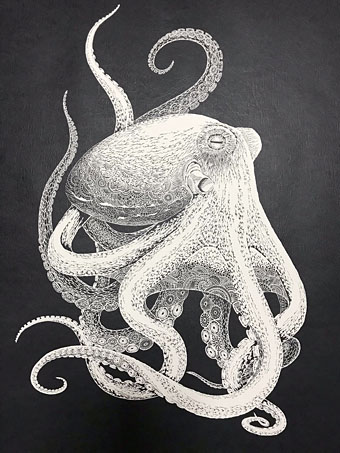
Masayo Fukuda‘s octopus is cut from a single sheet of paper.

• “But in the title track, Homosapien contains a truly great song; four and a half minutes of bubbling synth and clever wordplay, atop which Shelley puts to one side the knowing coyness he’d frequently inserted into his contributions to the Buzzcocks catalogue, loosens his tie, and, as much as he ever committed to tape, is explicit in telling the listen exactly what he desires.” James McMahon on Pete Shelley’s first proper solo album.

Kosmischer Läufer, the reissue project for East German kosmische music of the 1970s which may not be entirely authentic, has now reached its fourth volume. Authentic or not, the attention to detail is impressive.

• One of my favourite browsing places this month: NASA Image and Video Library.

• At Dangerous Minds: Eric Stanton and the History of the Bizarre Underground.

• Public domain artworks in high resolution at the Art Institute of Chicago.

• Mix of the week: FACT Mix 686 by the The Radiophonic Workshop.

• At Dennis Cooper’s: Les Blank Day.

Art of the Poster 1880–1918.

cakeordeathsite

Interstellar Rock: Kosmische Musik (1974) by Cosmic Jokers | Sehr Kosmisch (1974) by Harmonia | Meine Kosmische Musik (1974) by Sternenmädchen

Weekend links 443

gorey.jpg

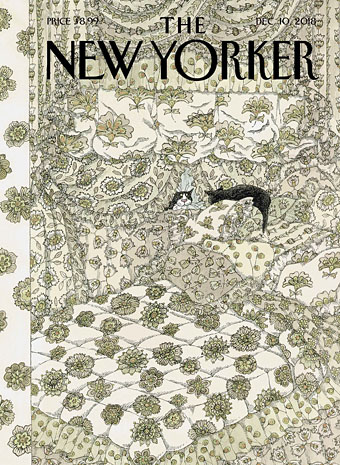
• Yet more Gorey: Mark Dery’s biography of the artist prompted The New Yorker to unearth a piece of cover art that Edward Gorey submitted 25 years ago. In the same magazine Joan Acocella reviews Dery’s book and examines Gorey’s life and art. At Expanding Mind, Erik Davis talks with Mark Dery about Surrealism, the gay voice, Penny Dreadfuls, and the occult and Taoist influences in Gorey’s work.

Moving Through Old Daylight: Mark Fisher, Jim Jupp & Julian House of Ghost Box Recordings, and Iain Sinclair in conversation at the Roundhouse, Camden, London, 5 June 2010. Topics under discussion included Nigel Kneale, TC Lethbridge, John Foxx, BBC Radiophonic Workshop, alchemies of sound, the homogenisation of culture, imagining space and the impersistence of memory.

• “A radical retelling of our relationship with the cosmos, reinventing the history of astronomy as a new form of astrological calendar.” The Space Oracle by Ken Hollings.

There was a deliberate, almost prickly quality to Fisher’s writing and thinking that is rare nowadays, when criticism is more likely to involve open-minded rationalizing than steadfast refusal. He was not one to frolic in ambiguity or irony. “Just because something is current doesn’t mean it is new,” he writes in K-Punk, as he wonders if a time traveller from the nineties would find any contemporary music as radical as post-punk or jungle had once seemed to him. When everything is cheerfully “retro,” Fisher argued, we lose our grasp on history—and, without a sense of why the past happened the way it did, our anything-goes embrace of “happy hybridities” is an empty gesture. “What pop lacks now is the capacity for nihilation, for producing new potentials through the negation of what already exists,” he writes.

Hua Hsu on Mark Fisher’s K-Punk

• At Wormwoodiana: Mark Valentine on The Wind Protect You (1946), a novel by Pat Murphy which Mark describes as a forgotten precursor of Watership Down.

• “At once tiny and huge: what is this feeling we call ‘sublime’?” Sandra Shapshay explores the Romantic aesthetic.

Dennis Cooper‘s favourite fiction, poetry, non-fiction, film, art, and internet of 2018. Thanks again for the link here!

• Mixes of the week: XLR8R Podcast 572 by Nastia, and FACT Mix 683 by Casino Versus Japan.

A Child’s Voice (1978) by David Thomson, an overlooked ghost story starring TP McKenna.

• Jean Cocteau’s Orphée returns from the underworld via BFI blu-ray next month.

Rated SAVX: The Savage Pencil Scratchbook

Orpheus (1967) by The Walker Brothers | Orpheus (1987) by David Sylvian | Overture To Orpheus (2003) by Colin Booth