Covering Maldoror

roy.jpg

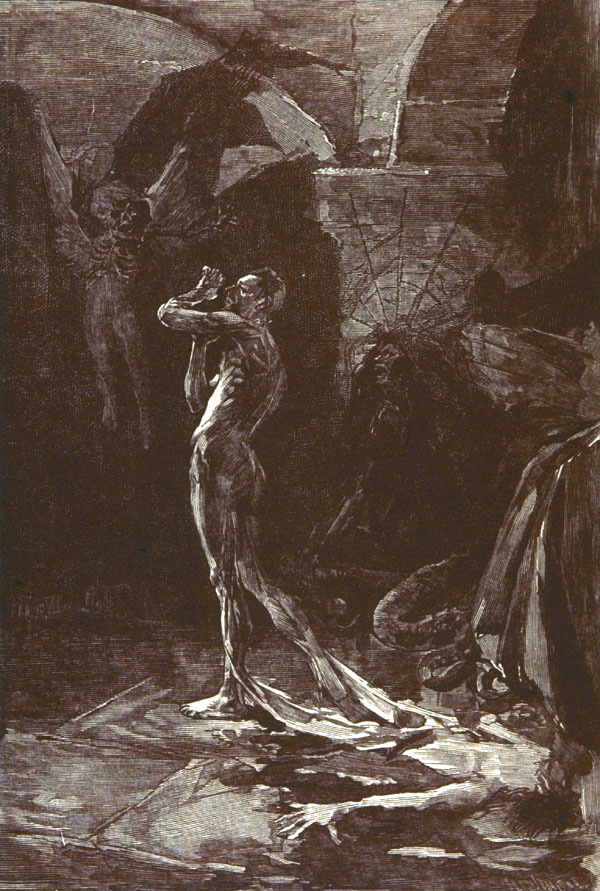
This illustration by José Roy is a frontispiece created for a rare edition of Les Chants de Maldoror published by Genonceaux in 1890. Roy (1860–1924) was a French artist whose work receives little attention today but his Maldoror illustration happens to be the first of its kind, and a picture that serves the text better than some of those being produced a few years later. The detail of a flayed man stepping out of his skin prefigures Clive Barker by almost a century, a further example of the ways in which Lautréamont’s baleful masterpiece was ahead of his time.
maldoror01.jpg

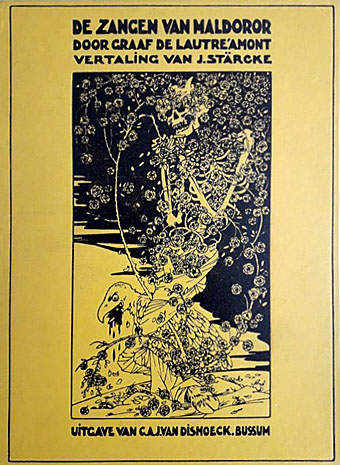
Netherlands, 1917. Cover art by WF Gouwe.

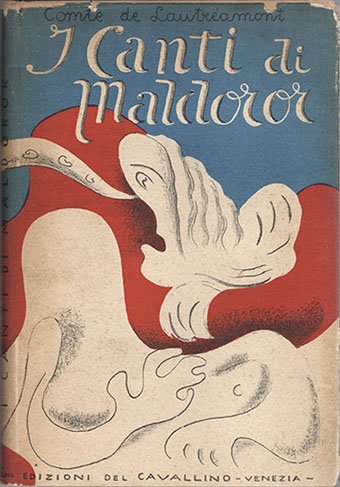
Previous posts here have concerned illustrated editions of Maldoror but this one is all about the covers. Literary classics aren’t always very rewarding in this respect but Maldoror’s textual and imaginative wildness has prompted an assortment of illustrative choices that range from the appropriate to the bewilderingly arbitrary. The following covers are a selection of the more notable examples, avoiding those without pictures or ones that use photographs of the book’s enigmatic author, Isidore Ducasse.
maldoror02.jpg

Italy, 1944. Cover art by Mario De Luigi.
maldoror26.jpg

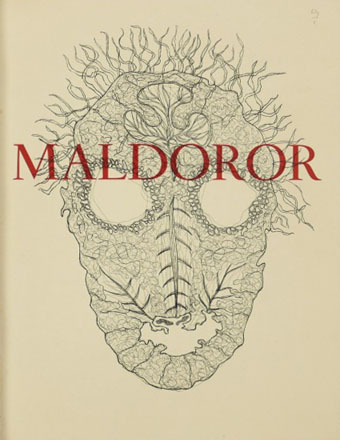
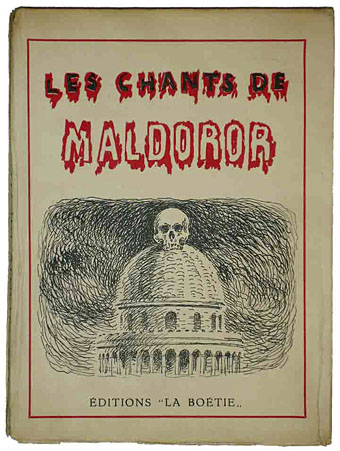
France, 1947. Cover and interior illustrations by Jacques Houplain.

Salvador Dalí was the first well-known artist to illustrate Maldoror but his 1934 edition was published with plain black boards. Houplain’s illustrations follow the text more closely than do those by Dalí, Magritte or Bellmer, all of whom remain preoccupied with their own obsessions.
maldoror03.jpg

Belgium, 1948. Cover and interior illustrations by René Magritte.
maldoror04.jpg

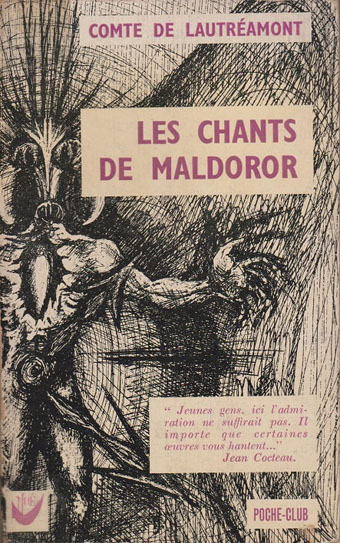
France, 1963. Cover art by Paul Jamotte.
Continue reading “Covering Maldoror”

Weekend links 676

binnie.jpg

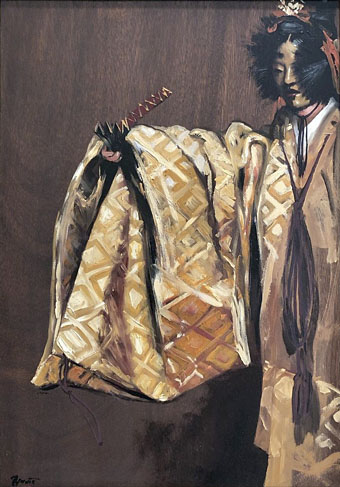
Sleeve Study, from Kakitsubata (1998) by Paul Binnie.

• “London was not a project for me. It was the curse that never stops giving.” Iain Sinclair talking to Matthew Stocker about his new book for Swan River Press, Agents of Oblivion.

The Ultimate DMT Breakthrough Replication Compilation, a video guide to the DMT experience by Josie Sims. Related: Kristen French on what hallucinogens will make you see.

• At Spoon & Tamago: A return to Tokyo Genso’s depictions of an urban Japan transformed by vegetation and neglect.

• New music: The Shell That Speaks The Sea by David Toop & Lawrence English.

• At Bajo el Signo de Libra: San Sebastián de Mártir a Icono Homosexual.

• Cosmic views from the Milky Way Photographer of the Year, 2023.

Nakamura Mitsue makes a Noh mask from a single block of wood.

• Mix of the week: A mix for The Wire by Eleni Poulou.

• At Dennis Cooper’s: Delphine Seyrig Day.

Of Ancient Memory (The Oblivion Seekers) (1994) by Jarboe | Oblivion (2001) by Lustmord | Oblivion (2004) by Redshift

Chirico by Tanaami and Aihara

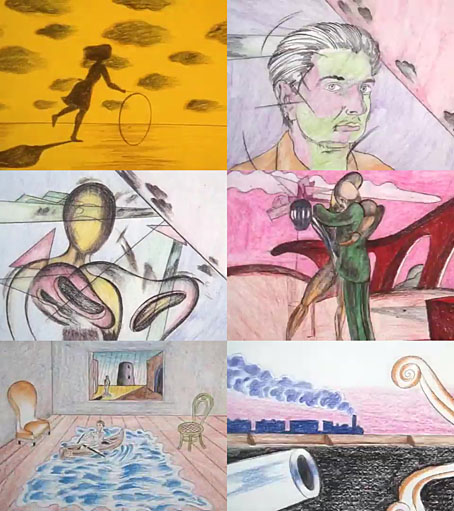
chirico.jpg

If I’d have seen it earlier I would have included this animated film in my Echoes of de Chirico post. Chirico (2008) is a wordless 4-minute homage to the maestro of pittura metafisica directed by Keiichi Tanaami with Nobuhiro Aihama. In addition to being a celebrated artist and designer, Keiichi Tanaami has been making short animations since the 1960s, usually with the assistance of other artists. This one puts familiar de Chirico motifs through a metamorphic Surrealist wringer in a manner that could easily have been extended into a much longer film. De Chirico has evidently been a preoccupation for Tanaami in recent years, providing a landscape he can appropriate for his bad-trip take on psychedelic art.

Elsewhere on { feuilleton }
The Surrealism archive

Previously on { feuilleton }
Echoes of de Chirico
Sweet Friday, a film by Keiichi Tanaami
Keiichi Tanaami record covers

Weekend links 675

stuck.jpg

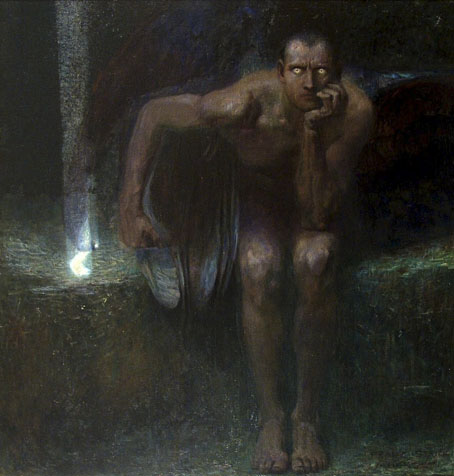
Lucifer (1890) by Franz Stuck.

• “I wanted to reclaim the word ‘psychonauts’ and take it back into the 19th century, where it describes not only renegades and rebels, but also establishment scientists, doctors, and pillars of the literary establishment. The word that was used at the time was “self-experimenter.” Mike Jay (again) talking to Steve Paulson about psychoactive research and the scientists who taste their own medicine.

• “How did countercultures commune before the internet?” asks J. Hoberman, reviewing Heads Together: Weed and the Underground Press Syndicate, 1965–1973 by David Jacob Kramer.

• At Public Domain Review: Medieval advice concerning the mythical Bonnacon: “the protection which its forehead denies this monster is furnished by its bowels”.

• DJ Food unearths posters and badges for The Kaleidoscope, a short-lived Los Angeles music venue of the late 60s.

• At Spoon & Tamago: Gaku Yamazaki has documented thousands of unusual road signs across Japan.

• New music: Psalm013: Unland by Pram of Dogs, and Intimaa by Bana Haffar.

• At Unquiet Things: A sneak peek from the forthcoming The Art of Fantasy.

• The Strange World of…Shirley Collins.

• At Dennis Cooper’s: Bruce Posner Day.

Kenneth Anger: a life in pictures.

• RIP Tina Turner.

Kaleidoscope (1967) by Kaleidoscope (UK) | Kaleidoscope (1984) by Rain Parade | Collideascope (1987) by The Dukes Of Stratosphear

Weekend links 673

ay-o.jpg

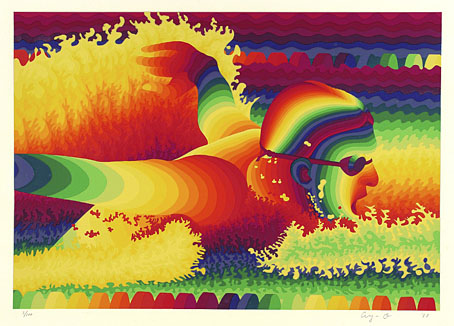
Butterfly (1988) by Ay-O.

• “[Mike] Jay says there are notional lessons to be learned about what happens next from the characters who populate Psychonauts but says they would have been of greatest benefit to ‘the legislators, the bureaucrats, the statisticians and social scientists of the early 20th century who created the idea of “good drugs” and “bad drugs”.’ It is the framework of ‘drugs’ itself which needs to be dismantled.” John Doran discussing Psychonauts: Drugs and the Making of the Modern Mind with the book’s author, Mike Jay. The piece ends with an extract from the book itself. There’s another extract at Nautilus.

• “From the eerie electronics of Earth Calling through to the warp speed crescendo of Master Of The Universe, Space Ritual is like no other live record released at the time or since.” Joe Banks explores the events that led to the recording of the definitive Hawkwind album, Space Ritual, which was released 50 years ago this week.

• “You know, it’s actually all about life, and love, and death, and it’s sexy, and it’s funny and it’s not depressing.” Simon Fisher Turner talking to Emily Bick about Blue Now, a new live staging of Derek Jarman’s final film.

mm.jpg

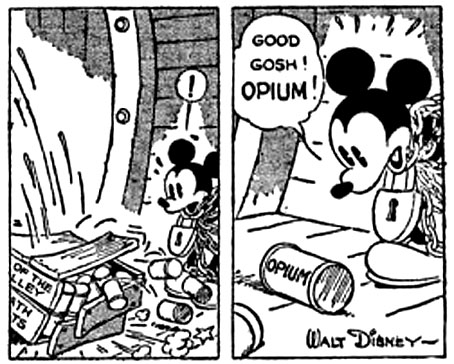
From The Castaway Captives (1934): Mickey Mouse in a deep fix.  Ignore the signature, this one was written and illustrated by Floyd Gottfredson.

• New music: Kinder Der Sonne (From Komplizen) by Alva Noto, and S.W.I.M. by Gunnar Jónsson Collider.

• Mixes of the week: Isolatedmix 120 by Lord Of The Isles, and XLR8R Podcast 799 by KMRU.

• Take a radiating, immersive trip into Ay-O’s Happy Rainbow Hell.

• At Dennis Cooper’s: New Queer Cinema 1985–1998 Day.

• Steven Heller’s font of the month is Hopeless Diamond.

Rainbow Chaser (1968) by Nirvana | Rainbows (1969) by Rainbows | Rainbow (2006) by Boris With Michio Kurihara