Murmur Become Ceaseless and Myriad

spare.jpg

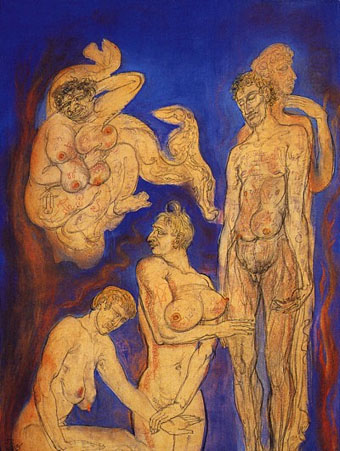
Efflaration (1952) by Austin Osman Spare.

The Austin Spare revival continues with another exhibition, Murmur Become Ceaseless and Myriad at Flat Time House, London, curated by Mark Titchner. Unless I’ve missed something this is a significant moment since it’s the first time Spare’s work has been paired with that of a more contemporary artist, the late John Latham (1921–2006) whose former home provides the exhibition space.

Biographically, the artists have a lot in common: a reticence to engage with the art establishment or the commercial art market; superficial correspondences with the work of their contemporaries but isolation by force of their ideas. The artistic genius of both these artists was, in the main, recognised by their peers, even if the subject of their work was not entirely understood.

In spite of this, discussion of Spare’s practice has largely related to arcana and magic, despite his training in fine art and early mainstream successes. Conversely, Latham’s work has been understood primarily in relation to the conceptual art practices of the 1960s and 70s. This exhibition broadens these perspectives, presenting their work in the context of two parallel experimental practices. (more)

There’s also a somewhat tenuous connection between the pair in the figure of Alan Moore, a Spare enthusiast who in 1992 appeared with John Latham and a number of other literary and artistic types in The Cardinal and the Corpse, a TV film by Iain Sinclair and Chris Petit which really ought to be on YouTube but isn’t. It’s worth a watch if you can find a copy. Murmur Become Ceaseless and Myriad runs until 30th October.

Previously on { feuilleton }
Kenneth Grant, 1924–2011
New Austin Spare grimoires
Austin Spare absinthe
Austin Spare’s Behind the Veil
Austin Osman Spare

Weekend links 77

farmer.jpg

Art by Tessa Farmer.

• An exhibition of Tessa Farmer’s art is running at Viktor Wynd Fine Art, London, until October 30th. On Saturday, October 1st, Strange Attractor hosts Good Neighbours: Faeries, Folklore and the Art of Tessa Farmer also at Viktor Wynd.

Unearthing The Psychedelic Harp: “David Moats talks to harpist and songwriter Serafina Steer about her work with John Foxx and Patrick Wolf, being classically trained, the difficulties of doing live soundtracks and psychedelia.”

• And speaking of psychedelia, Arkhonia is still blogging up a storm here, here and here about the lost Beach Boys album, Smile, the farthest Brian and co. ventured into the tripped-out weirdness of 1967. The complete original recordings will finally be released in November.

• “‘We’ve arrived at a level of commodification that may have negated the concept of counterculture,’ Gibson says in the Paris Review.” William Gibson profiled by Thomas Jones.

One of the qualities I always stress when talking about this design work influenced by Surrealism is its enormous boldness and creative freedom, which is something of a paradox in many cases, since the Czech and Polish designs were created under communist regimes. So, while Uncanny documents a significant current in the history of 20th-century visual culture, the show also has a polemical intention aimed, quite deliberately, at our circumstances now. Students who encounter these images in lectures sometimes feel constrained by their conception of what they — or their teachers — regard as acceptable in today’s marketplace. At times, this has struck me as being a form of insidious self-censorship. (more)

Rick Poynor: Jan Švankmajer and the Graphic Uncanny.

• The exhibition curated by Mr Poynor last year, Uncanny: Surrealism and Graphic Design, is now showing at the Kunsthal in Rotterdam until early December. Related: MizEnScen’s somber, surrealist collages.

Howard Pyle’s Book of Pirates (1921) at Golden Age Comic Book Stories, the Urtext of buccaneer imagery.

bonnat.jpg

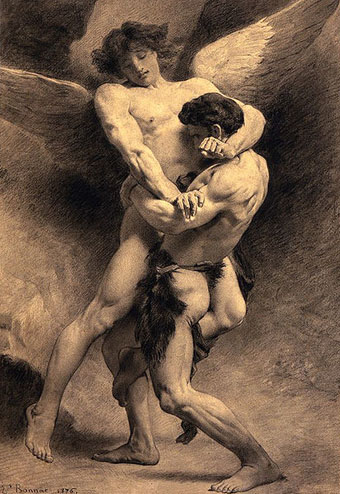
Another of those homoerotic religious pictures: Jacob Wrestling with the Angel (1876) by Léon Bonnat. Via Babylon Baroque.

• Celebrating the 250th anniversary of Laurence Sterne’s marbled page: Emblem of My Work.

John Martin’s Pompeii painting finally restored after 1928 Tate flood damage.

The Spectral Dimension: “where the paranormal and popular culture collide”.

The Writing of Stones (1970) by Roger Caillois at 50 Watts.

Mercury Arc Rectifiers.

• When silliness was an avant garde strategy: video from 1974 of Brian Eno performing China My China and (in better quality) The Seven Deadly Finns. (Go here for lyrics of the latter.)

Weekend links 73

sun2.jpg

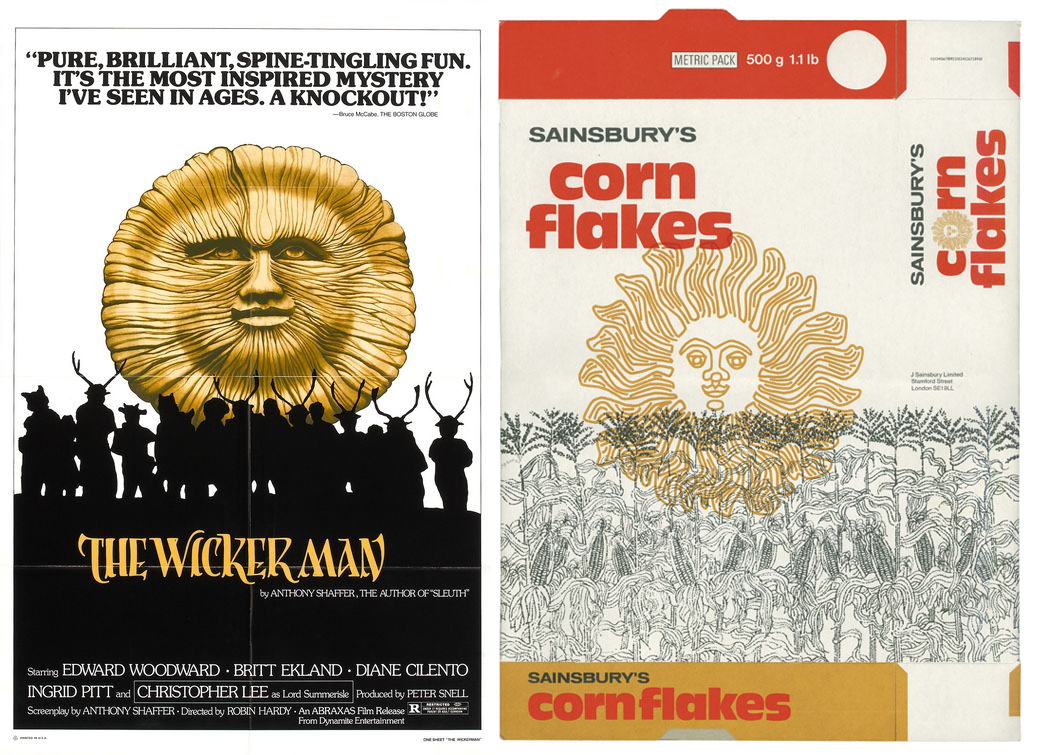
Johnny Trunk of Trunk Records reissued the soundtrack to The Wicker Man in 1997. Mr Trunk’s latest delve into the cultural past is Own Label: Sainsbury’s Design Studio, a book from Fuel examining the supermarket chain’s packaging design of the 1960s and 1970s. Creative Review shows some examples while I have to note the uncanny similarity between one of the posters for The Wicker Man and an old Sainsbury’s corn flakes box. Now we see that the Old Weird Britain wasn’t only hiding in the fields and the folk songs but was also lurking on the supermarket shelves.

Related: a new DVD set from the BFI, Here’s a Health to the Barley Mow: A Century of Folk Customs and Ancient Rural Games. And let’s not forget the ley lines of Milton Keynes, and a new edition of Ritual by David Pinner, said to be the novel which inspired The Wicker Man.

• “He wrote me…” Sans Soleil (1983), Chris Marker’s beguiling accumulation of memories, dreams and reflections, is recalled in a Quietus piece entitled Things that Quicken the Heart. Not the first time on DVD as it says there (Nouveaux Pictures released it with La Jetée in 2003) but it’s good to know it’s being reissued.

• Marker’s film references Tarkovsky’s Stalker a couple of times, most notably in the comment, “On that day there will be emus in the Zone.” Geoff Dyer has what he describes as “a very detailed study” of Stalker out next year.

I don’t like those commentators who keep on saying that London will never be the same again. London is always the same again. I remember those comments were made very loudly after the [July 2005] terrorist attacks – “London will never be the same again, London has lost its innocence” – it was all nonsense. London was exactly the same again the following day. Rioting has always been a London tradition. It has been since the early Middle Ages. There’s hardly a spate of years that goes by without violent rioting of one kind or another. They happen so frequently that they are almost part of London’s texture. The difference is that in the past the violence was more ferocious, and the penalties were more ferocious – in most cases, death.

Peter Ackroyd, reminding us that the Four Horsemen of the Apocalypse don’t wear hoodies and ride bikes.

Wolf Fifth: “rare vinyl records from the golden era of avant garde and experimental music”. And in FLAC as well, not crappy mp3; I want to hear all those scratches uncompressed, dammit!

Another great mix at FACT, this time compiled by snd who throw together Morton Feldman, Siberian shamen, Einstürzende Neubauten, Dome, Oval and many others.

• Colin Marshall asks “how weird is Australia?” in an appraisal of Nicolas Roeg’s Walkabout.

A Comprehensive Solution to the Tokyo Umbrella Problem.

• More poster art from Hapshash and the Coloured Coat.

Morbid Excess, a series of drawings by May Lim.

Conrad Schnitzler (1937–2011) by Geeta Dayal.

Neopolitan cephalopods.

Willow’s Song (1973) by Paul Giovanni & Magnet | The Willow Song (1989) by The Mock Turtles | Wicker Man Song (1994) by Nature and Organisation.

The Mysteries of Myra

crowley.jpg

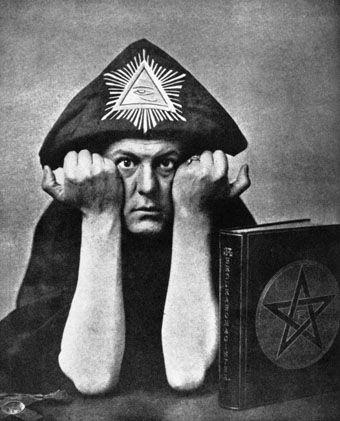
Aleister Crowley in 1912.

Back in 1999 I found myself making notes for a short essay on the subtle and often tenuous presence of Aleister Crowley in cinema. Despite Crowley’s reputation in the early years of the 20th century—famously labelled by tabloid hyperbole as “The Wickedest Man in the World”—he doesn’t seem to have ever been filmed. He does have a succession of cinematic avatars, however, in a variety of thrillers and horror films, usually manifesting in the guise of a fictional magus whose exploits will be based on the more lurid public perceptions of the Crowley persona.
myra1.jpg

After some research my short essay bloomed into a longer essay then began developing into a book-length project which I had the good sense to abandon. The idea still interests me but I didn’t have the time or resources to devote to all the detailed research such a project would require if it was going to be done thoroughly. It was also difficult at that time to see the some of the more obscure films, a crucial early example being Rex Ingram’s 1926 adaptation of The Magician, Somerset Maugham’s first novel whose central character, Oliver Haddo, is based on Crowley. The Magician has now been restored and reissued but at that time it was out of circulation entirely.
myra3.jpg

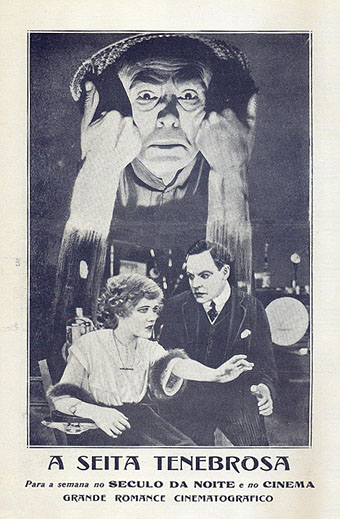
A Portuguese magazine ad.

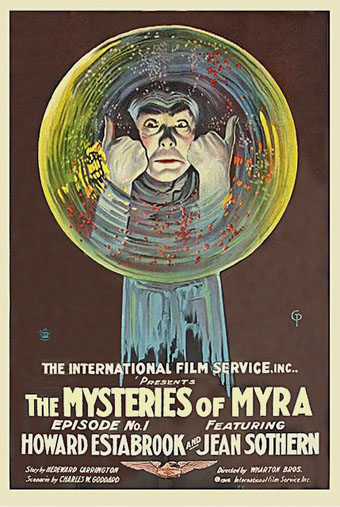
It’s also the case that there always seems to be more to find on this subject, a prime example being The Mysteries of Myra, a lost serial directed by Leopold & Theodore Wharton which has only now come to my attention. If the title seems vaguely familiar it’s because the screenwriter was one Charles W Goddard whose earlier The Perils of Pauline survives as a touchstone for silent melodrama if nothing else. The Mysteries of Myra dates from 1916, and is distinguished by being one of a number of films which received effects advice (and publicity, of course) from Harry Houdini. The Pulp Reader has a précis which includes this toothsome blurb:

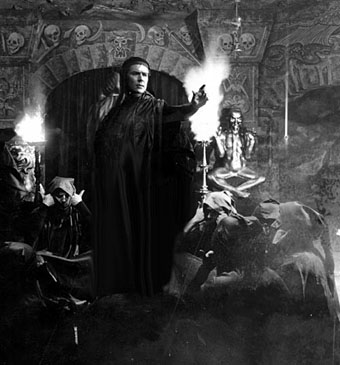
BEWARE THE BLACK ORDER! So comes the warning from the spirit of Myra Maynard’s father, who reaches out to her from beyond the grave to warn her of danger from the masters of the occult arts that lurk in the shadows and mark her for murder on her eighteenth birthday. Only the world’s first psychic detective, Dr. Payson Alden, and his friend Haji the Brahman mystic, can save clairvoyant Myra from the terrors of The Grand Master of the Order, who tries to claim not only her fortune but her life by means of suicide-inducing spells, invasion of her chamber by spirit assassins, and even reanimation of the dead by a fire elemental.

A list of the episode titles reads like a track list for a metal album or a collection of Algernon Blackwood stories: ‘The Dagger of Dreams’, ‘The Poisoned Flower’, ‘The Mystic Mirrors’, ‘The Wheel of Spirit’, ‘The Fumes of Fear’, ‘The Hypnotic Clue’, ‘The Mystery Mind’, ‘The Nether World’, ‘Invisible Destroyer’, ‘Levitation’, ‘The Fire-Elemental’, ‘Elixir of Youth’, ‘Witchcraft’, ‘Suspended Animation’, ‘The Thought Monster’. The Black Order menacing the imperilled Myra (there’s always an imperilled woman in these things) is almost certainly based on Crowley and his acolytes. John Symonds’ biography The Great Beast contains an account of Crowley’s rituals published for appalled American readers in The World Magazine in 1914. That article, and the famous 1912 photo of The Master Therion gesturing in his ceremonial robes, was all the filmmakers would have required to create their villainous cabal.
myra2.jpg

The Black Order at work.

The trouble with this kind of drama is that the description is often a lot more stimulating than the stodgy reality, so it may be for the best if Myra’s exploits have perished. Anyone eager to know more should avail themselves of the photonovel put together by the Serial Squadron using stills (some of which may be viewed here) and a novelisation of the serial story. The book is reviewed at Lovecraft is Missing. Unless anyone knows better, I’d say Aleister Crowley’s curious film career began with Myra’s mysteries.

Previously on { feuilleton }
The Mask of Fu Manchu
Aleister Crowley on vinyl

Art is magic. Magic is art.

millidge.jpg

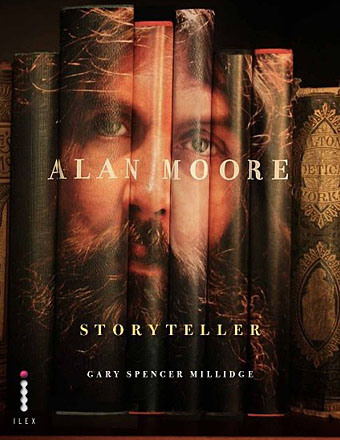
Cover concept by Chip Kidd.

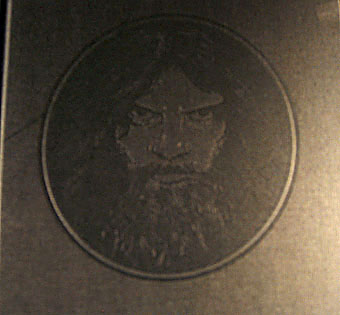
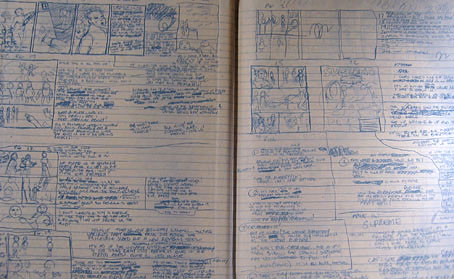
I noted the imminent arrival of Gary Spencer Millidge’s labour of love last month and the volume itself turned up this week, and what a book it is, a heavyweight hardback that’s far more lavish than I anticipated. The first surprise comes when removing the dust jacket to find Alan’s scowling visage embossed on the boards. Inside there’s a wealth of Moore ephemera from biographical material (lots of family photos) to insights into the scripting process behind the comics. I already knew Alan made little thumbnail sketches of his comic layouts before writing his scripts, having been fortunate enough to see one of the work-in-progress books for From Hell one time when I was chez Moore. Now everyone can have that opportunity. In addition there’s a thorough overview of Alan’s career, from the earliest juvenilia through to recent issues of Dodgem Logic. The comics career often overshadows his other work but in a later part of the book there’s considerable attention given to his collaborations with musicians, dancers and others for the Moon and Serpent performances. For my part it’s a pleasure to see some of the designs I created for the Moon and Serpent CDs printed large-size and in better quality than pressing plants manage with compact discs. None of those releases sold in great quantities and all are now out-of-print so the artwork often feels lost.

moore01.jpg

The front board.

What else? How about two sections of the book with fold-out pages? How about the first ever public appearance of Alan’s huge chart mapping the progress of every character through the unfinished Big Numbers? How about an introduction by Michael Moorcock where he calls Alan “a Robert Johnson of the Age of Doubt; questioning, confronting, mourning and yearning, representing his readers in profound ways, an intellectual autodidact, one of my few true peers for whom I have limitless respect.”? How about a compact disc featuring extracts from the Moon and Serpent CDs plus many other previously unreleased songs including pieces by the Emperors of Ice Cream? This is a gorgeous production designed by Simon Goggin and art directed by Julie Weir, and I haven’t even begun to read it yet. Is it necessary to state that it’s an essential purchase for anyone with more than a passing interest in Mr Moore and his many talented collaborators? Yours for twenty-five quid from Ilex Press. Some page samples follow.

moore02.jpg

Front endpapers showing Alan’s working notes and sketches.

Continue reading “Art is magic. Magic is art.”