Le Baiser de Narcisse

brisset1.jpg

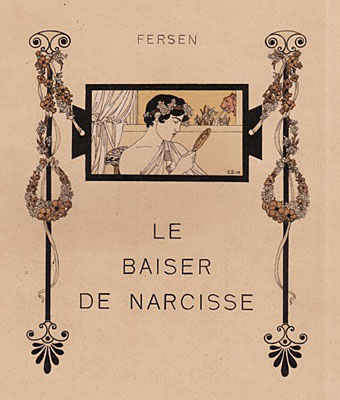
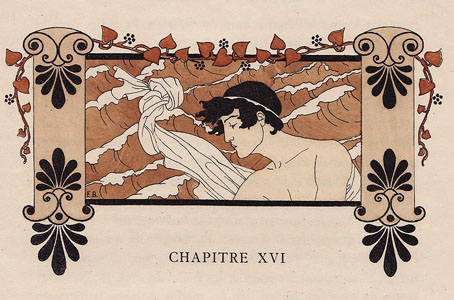
We have the French gay culture site Bibliothèque Gay to thank for posting illustrations by Ernest Brisset from Jacques d’Adelswärd-Fersen’s rare volume of homoerotic fiction, Le baiser de Narcisse (The Kiss of Narcissus). The book was originally published in 1907 but it was a new edition in 1912 which came embellished with Brisset’s Classical drawings and decorations. If these lack a degree of eros it should be noted that the text would have been condemned as outright pornography in the Britain of 1912, a paean to youthful male beauty which lingers over details of a boy’s “polished hips” and his “round and firm sex like a fruit”. As is usual with homoerotics of this period, the Classical setting and allusion to Greek myth provides the vaguest excuse for the subtext even though prudes of the time weren’t remotely fooled by this, as Oscar Wilde discovered.
brisset2.jpg

Among other works by Fersen there’s a decadent roman à clef, Lord Lyllian: Black Masses (1905), which I’ve been intent on reading since it was translated into English a couple of years ago. Here Fersen provides us with yet another fictional extrapolation of Oscar Wilde who the author gifts with some of his own scandalous history. Fersen had been driven from France following a public outrage involving the “Black Masses” of the novel’s title, and the alleged debauching of Parisian schoolboys.

hocker.jpg

Nino Cesarini by Paul Höcker (1904).

Fersen settled in Capri with his partner Nino Cesarini where they spent some years reinforcing the reputation of that island (not for nothing is Noël Coward’s camp and catty character in Boom! named “the Witch of Capri”), and proselytising for the Uranian cause with a literary journal, Akademos, modelled on Adolf Brand’s Der Eigene. Fersen’s later life is reminiscent of that of Elisar von Kupffer, a wealthy contemporary who created a secluded homoerotic paradise of his own, the Sanctuarium Artis Elisarion. Unlike Kupffer, however, Fersen ended his days prematurely in a haze of opium and cocaine. As for Ernest Brisset, if anyone finds other work of his online, please leave a comment.

Elsewhere on { feuilleton }
• The gay artists archive

Previously on { feuilleton }
• Reflections of Narcissus
• Narcissus
Weekend links 39

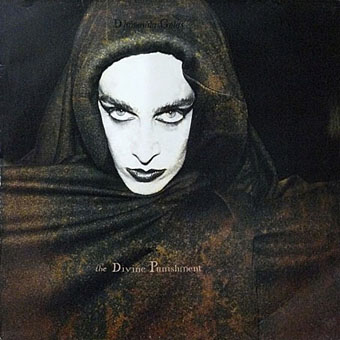
galas.jpg

The Divine Punishment (1986) by Diamanda Galás. Design by Paul White/Me Company.

What the Catholic League and certain members of the House presumably wish to remove from their consciousness is thirty years of death sentences handed down to their parishioners and citizenry, who were told not to wear condoms, and the mistreatment of those stigmatized as miscreants and sinners by their viral status and/or homosexuality and/or status as drug addicts.

• Diamanda Galás responds in her usual forthright manner to the censoring of David Wojnarowicz’s film (and her music which accompanied it) by the Catholic League and members of the House of Representatives earlier this week. Related: Demonstrators gather to protest removal of Wojnarowicz art from NPG | Is the censored David Wojnarowicz video really ‘anti-Christian’? | Vengeance is hers: a conversation with Diamanda Galás.

• Update: Hide/Seek: Too shocking for America. One of the exhibition curators speaks out against the censorship.

“Their attitude is: ‘Next time you think of writing about sex, don’t,'” said Susie Bright, who was the editor of the Best American Erotica anthology series for 15 years. “I can’t think of any other fundamental human experience that writers would be encouraged to keep to themselves.” Melissa Katsoulis, a literary reviewer for the Times of London, certainly seemed to conform to Bright’s impression when asked to comment on the award by the BBC: “Sex is a subject best avoided altogether,” she said. “If I was writing a novel, I wouldn’t attempt to write it except in the most Victorian and prim way, because it’s awful. It’s a cliché, but the moments of genuine frisson in books are when hardly anything happens.” Speak for yourself, missy.

• Laura Miller dissing the Literary Review‘s annual Bad Sex Award. Good to find more voices being raised against this drivel and the admission of failure which it implies.

• The latest offbeat experiment from filmmaker David Lynch: pop singles. He gets crazy with the vocoder here. Related: David Lynch talks new music projects.

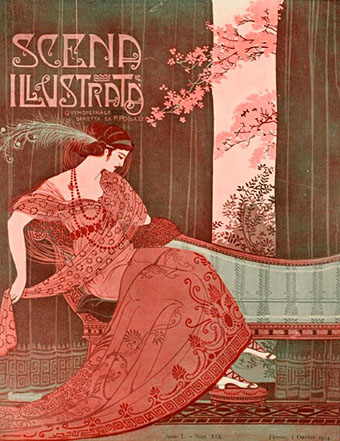
scenaillustrata.jpg

Scena Illustrata (1914). Cover by Ezio Anichini (?). Via this set of magazine covers from 1880–1920.

• Tumblrs of the week: Heart Killer and Pretty Pictures from the Paleo-Future Blog.

• The Big Picture’s 2010 Hubble Space Telescope Advent Calendar.

• National Geographic‘s Best Underwater Views of 2010.

• A seasonal gift from a famous Northampton resident.

• Paris versus New York: A Tally of Two Cities.

• This is your browser on drugs.

• Double-Barrel Prayer (1988) by Diamanda Galás, with a video directed by the late Peter Christopherson.

Weekend links 36

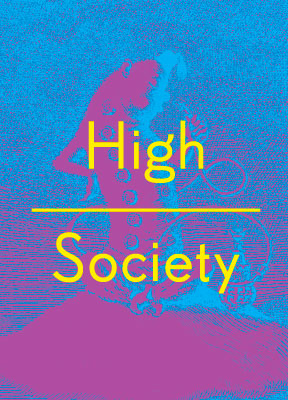
high_society.jpg

Mervyn Peake’s Caterpillar from Alice’s Adventures in Wonderland finds itself used to promote High Society, an exhibition at the Wellcome Collection devoted to the long history of human drug-taking. There’s more about the exhibition here and also an accompanying book by Mike Jay from Thames & Hudson. Related: The Most Dangerous Drug:

A group of British drug experts gathered by the Independent Scientific Committee on Drugs (ISCD) rated alcohol higher than most or all of the other drugs for health damage, mortality, impairment of mental functioning, accidental injury, economic cost, loss of relationships, and negative impact on community.

• Unless the magazine Man, Myth & Magic was advertised on TV in 1970 (and I suspect it would have been) Austin Osman Spare’s work has never been seen on British television, certainly not in any detail or with a credit to the artist. This week the BBC finally paid him some attention with a brief spot on The Culture Show as a result of the Fallen Visionary exhibition which is still running (until November 14) in London. Alan Moore, Fulgur‘s Robert Ansell and others attempt to summarise Spare’s career in seven minutes.

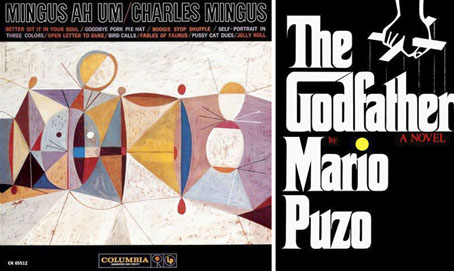
fujita.jpg

Neil Fujita designs: Mingus Ah Um (1959) and The Godfather (1969).

• RIP graphic designer Neil Fujita. Related:

“By taking the “G” and extending it to the “D,” I created a house for “God.” The way the word was designed was part of the logo and so was the type design. So when Paramount Pictures does a film version or Random House, which bought out the book from Putnam, does another Godfather book, I still get a design credit. In fact, before the first Godfather film opened in New York I saw a huge billboard going up in Times Square with my design on it. I actually got them to stop work on it until we were able to come to an agreement.” Waxing Chromatic: An Interview with S. Neil Fujita

• French SF illustration. Related: Where did science fiction come from? A primer on the pulps, a feature by Jess Nevins with some of the craziest covers you’ll see this month.

• Gay-bashers in 1970s San Francisco had to beware the wrath of the Lavender Panthers.

• More Marian Bantjes as she discusses her work in an audio interview.

• Music from Saharan cellphones.

• Origami Beauty Shots.

• Krautrock.com

• Better Git It In Your Soul (1959) by Charles Mingus.

Illustrating Poe #1: Aubrey Beardsley

beardsley_poe1.jpg

The Black Cat.

Halloween approaches, as if you needed reminding. In honour of that event it’s Poe Week here at {feuilleton}, and we’ll be skating through some favourite depictions of stories and poems by the Boston genius.

Aubrey Beardsley’s four Poe illustrations were commissioned by Herbert S. Stone and Company, Chicago, in 1894 as embellishment for a multi-volume collection of the author’s works. The Black Cat is justifiably the most reproduced of these. The other drawings are fine in themselves but not very successful illustrations of Poe’s tales. Aubrey wasn’t really suited to this kind of horror atmosphere; looking at his ear-ringed orangutan and the spotless furnishings surrounding it you’d never guess the scene of murderous simian frenzy which lies at the heart of the story.

beardsley_poe2.jpg

The Murders in the Rue Morgue.

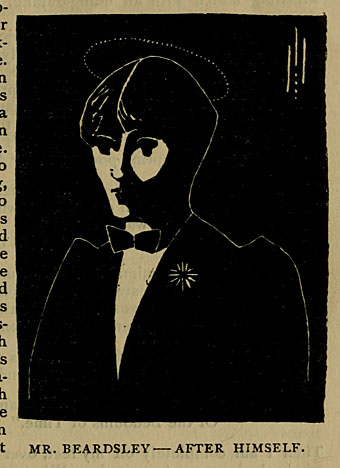
Herbert Stone’s company had begun publishing The Chap-Book in the same year, a witty American equivalent of British periodicals like The Yellow Book, and Beardsley’s work was featured in the early issues. Looking through some of these at the Internet Archive I was surprised to see the following illustration in a short appraisal of Beardsley’s art. If this is by the artist, as the credit implies, it’s a drawing I haven’t seen in any books of his work. If anyone can confirm this is a genuine Aubrey then please leave a comment. The other Poe illustrations follow.

beardsley_portrait.jpg

From The Chap-Book, May 15th, 1894.
Continue reading “Illustrating Poe #1: Aubrey Beardsley”

Weekend links 35

cr.jpg

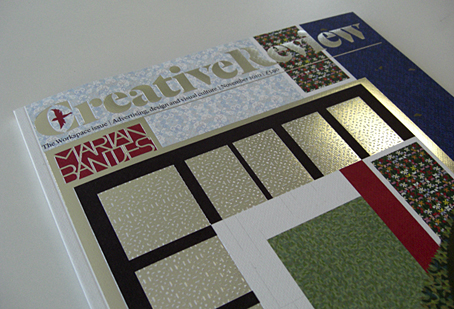
Marian Bantjes designs the cover of the latest Creative Review and there’s a feature about her work inside.

• “…the question: ‘was Shakespeare gay?’ strikes me as so daft as to be barely worth answering. Of course he was. Arguably he was bisexual, of sorts, but his heart was never on his straight side.” Don Paterson throws the cat among the pigeons in an examination of the Shakespeare’s sonnets. Related (sort of): Shakespeare and Company: The bookshop that thinks it’s a hotel. Also related: Jeanette Winterson revisits Shakespeare and Company.

• 100 orbs of light float in the Schuylkill River. Also in Philadelphia: Animators Amok in a Curiosity Cabinet: the Brothers Quay are making a film in the Mütter Museum. Can’t wait to see it.

• More Alan Moore: Fossil Angels, a lengthy essay about magic and the occult, was written in 2002 but hasn’t been given a public airing until now.

• Alberto Manguel is always worth reading:

As Borges was well aware even then, the history of literature is the history of this paradox. On the one hand, the deeply rooted intuition writers have that the world exists, in Mallarmé’s much-abused phrase, to result in a beautiful book (or, as Borges would have it, even a mediocre book), and, on the other hand, to know that the muse governing the enterprise is, as Mallarmé called her, the Muse of Impotence (or, to use a freer translation, the Muse of Impossibility). Mallarmé added later that all who have ever written anything, even those we call geniuses, have attempted this ultimate Book, the Book with a capital B. And all have failed.

• Here Comes Everybody: Wake In Progress is a self-described “foolhardy attempt to illustrate Finnegans Wake”. Easier to illustrate than make a film of the book, I’d have thought, and Mary Ellen Bute already attempted the latter.

hoffmeister.jpg

Psychic Explosion: Adolf Hoffmeister’s illustrations for a 1967 edition of Lautréamont’s Poesies at A Journey Round My Skull.

• Craig Colorusso’s Sun Boxes can be seen at Turner Falls, Massachusetts, during November.

• Clive Hicks-Jenkins has a book and retrospective exhibition of his art due next year.

• A sneak peek into The Steampunk Bible to which I’m a contributor. And also here.

• “Human or other; depends who comes”: the Ballardian films of Paul Williams.

• Transmission (1979) by Joy Division; Transmission (1995) by Low; Monkey (2010) by Robert Plant.