Weekend links 760

varo.jpg

Ermitaño Meditando (1955) by Remedios Varo.

• Public Domain Review announces the Public Domain Image Archive. I’ve added it to the list. Meanwhile, the PDR regular postings include Francis Picabia’s 391 magazine (1917–1924).

• Among the new titles at Standard Ebooks, the home of free, high-quality, public-domain texts: The Well at the World’s End by William Morris.

• At Smithsonian Magazine: “See 25 incredible images from the Wildlife Photographer of the Year Contest”.

The ideas are more complex than the presentation suggests, but not vastly. Neither is it exactly breaking new ground. Art is everywhere, they say, from fingernails to fine dining; art is not a message to be decoded, but takes on new meanings in the mind of each viewer; art allows us to experience emotions in a “safe” context, like a form of affective practice; art helps us to imagine new worlds, thereby expanding the boundaries of what’s possible in the real world. The point isn’t to be original, though, but to distil a lifetime’s worth of practical wisdom and reflection. The result is a kind of joyous manifesto: just the thing to inspire a teenager (or adult) into a new creative phase. Eno and Adriaanse conclude with a “Wish”: that the book helps us understand that “what we need is already inside us”, and that “art – playing and feeling – is a way of discovering it”.

Brian Eno and Bette Adriaanse talking to David Shariatmadari about their new book, What Art Does: An Unfinished Theory

• “Crunchie: The Taste Bomb!” DJ Food unearths four psychedelic posters promoting Fry’s Crunchie bars.

• New music: Music For Alien Temples by Various Artists, and Awakening The Ancestors by Nomad Tree.

• At Wormwoodiana: Mark Valentine lays out a history of the Tarot in England.

Sun Ra & His Intergalactic Research Arkestra live on German TV, 1970.

• At Dennis Cooper’s: Chris Marker Day (restored/expanded).

• At the BFI: Anton Bitel on 10 great Mexican horror films.

Matt Berry’s favourite albums.

Tarot (Ace of Wands Theme) (1970) by Andrew Bown | Tarotplane (1971) by Captain Beefheart And His Magic Band | Tarot One (2012) by Tarot Twilight

Weekend links 759

martin.jpg

Chance and Order, Change 6 (Monastral Blue) (1972) by Kenneth Martin.

• At Public Domain Review: Some of the media which will be entering the public domain (in the USA) in 2025, including links to Standard Ebooks for the book titles.

• At Wormwoodiana: Mark Valentine’s regular report on the state of secondhand bookshops in Britain.

• At Colossal: Beams of light lance monumental architecture in Jun Ong’s astral installations.

• At Popular Mechanics: “A scientist proved paradox-free time travel is possible”.

• An interview with Alice Coltrane from 1981 for Piano Jazz Radio (NPR).

• Read 19 issues of Arthur magazine in PDF format. More coming soon!

• At Spoon & Tamago: Japanese Designer New Year’s cards of 2025.

• At the BFI: Pamela Hutchinson on 10 great films of 1925.

Astral Traveling (1973) by Lonnie Liston Smith & The Cosmic Echoes | Astral Altar (The Gateway Of Legba) (1994) by Dub Terror Exhaust | Astral Melancholy Suite (2022) by Ghost Power

Weekend links 757

froebekapteyn.jpg

The Breath of Creation (c. 1926–34) by Olga Fröbe-Kapteyn.

• At Wormwoodiana: “…Gresham was well-read enough to know that while magic can be more than a MacGuffin in a fantasy story, neither fantasy nor thriller fiction lets magic unsettle readers much. […] Even when it is good, the supernatural is never safe in a Williams story. Not conventional fantasy by half.” G. Connor Salter on William Lindsay Gresham’s enthusiasm for Charles Williams’ novels.

• At Harper’s Magazine: Christopher Tayler reviews Lawrence Venuti’s translations of Dino Buzzati’s Il deserto dei Tartari (now titled The Stronghold) which was published last year, and The Bewitched Bourgeois: Fifty Stories which will be out in January.

Dennis Cooper’s favourite fiction, poetry, non-fiction, film, art, and internet of 2024. Thanks again for the link here!

• The Approach to J.L. Borges: A Borgesian pastiche in homage to the creator of Ficciones by Ed Simon.

• “HP Lovecraft meets Fafhrd and The Grey Mouser”: an essay from 1992 by Fritz Leiber.

Can performing live on The Old Grey Whistle Test in January, 1974.

• DJ Food says “Let’s have some psychedelia”.

• RIP Zakir Hussain.

Creation Dub 1 (1977) by Lee Perry & The Upsetters | Threat To Creation (1981) by Creation Rebel/New Age Steppers | Theme from ‘Creation’ (1992) by Brian Eno

The Golden Hind: A Quarterly Magazine of Art and Literature

golden01.jpg

Well, here we are at last… After years of waiting for scanned copies of The Golden Hind to turn up, now that they have done I’m still frustrated. The magazine was one of the many small arts periodicals being published in Britain during the 1920s. It had an erratic, eight-issue run from 1922 to 1924, and remains notable for being the second (and last) magazine to be co-edited by Austin Osman Spare. The artist’s first magazine venture, Form, had been edited by Spare and “Francis Marsden” (Frederick Carter), with the pair publishing two issues before the outbreak of the First World War, followed by a final issue in 1921. Spare co-edited The Golden Hind with writer Clifford Bax, creating a publication whose contents were less mystical than Form had been, while also providing more of a showcase for artists other than Spare himself.

golden02.jpg

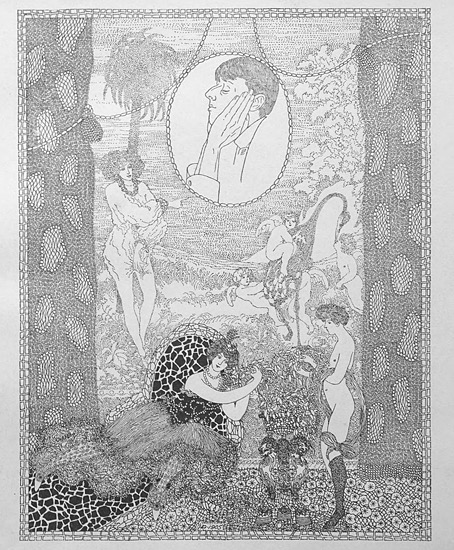
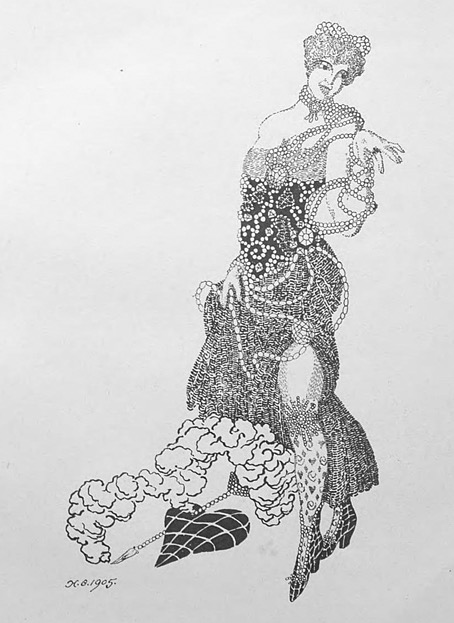
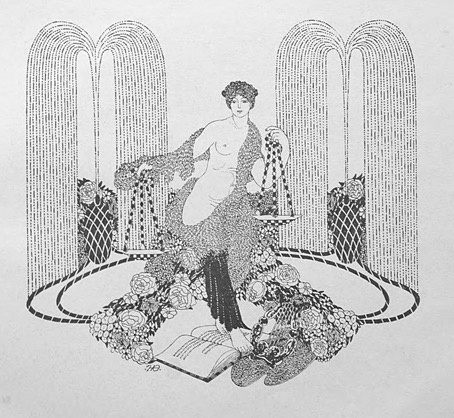
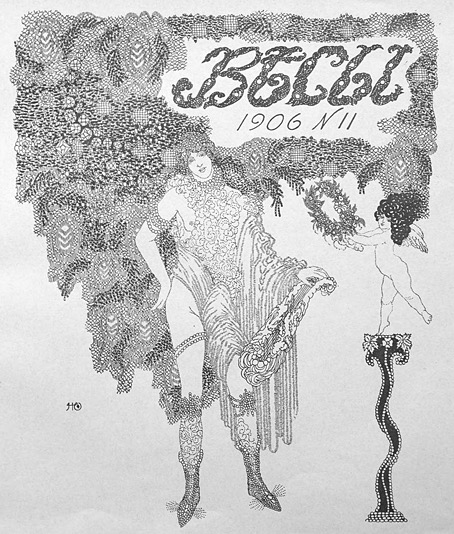
Inevitably, it’s the artists that interest me the most in The Golden Hind, even though the magazine was running pieces by writers like Aldous Huxley and Edith Sitwell. Many of the artists have been featured here before, some of them on many occasions: Alastair (Hans Henning Voigt), John Austen, Harry Clarke, Garth Jones, Henry Keen, and Allan Odle. Spare’s own drawings have since been recycled in various books but most of the other drawings, woodcuts, linocuts and prints remain exclusive to the magazine. The John Austen contributions are especially fine, further examples of his decorated style which borrows heavily from Aubrey Beardsley and Harry Clarke, and which he used so well in his illustrated Hamlet. The spirit of Beardsley’s 1890s is very much in evidence in The Golden Hind, a demonstration, perhaps, that Spare was once again looking back to The Savoy magazine as an example to be followed; one of the essays concerns the poety of The Savoy‘s literary editor, Arthur Symons.

golden03.jpg

In addition to artists whose popular works are still reprinted today there are less well-known figures like Sidney Hunt whose drawings owed more to contemporary trends than many of the other contributors. Hunt later edited an avant-garde magazine of his own, Ray, while producing his own brand of homoerotic prints like the Ganymede with Zeus which may be seen in The Golden Hind’s final issue.

golden04.jpg

The frustration I referred to above is my usual complaint about image quality. All the copies of the magazine have been taken from microfilm archives which means the pages aren’t grey enough to be illegible but their general murkiness is enough to destroy a lot of the artwork, especially the lithographs and other prints. The samples you see here have been brightened a little which does improve some of the line art but can do nothing for the rest. But I’m not going to complain too much. It’s taken a long time to be able to browse a complete run of this magazine, and I feel fortunate to do so even in this compromised manner. Better copies may still surface eventually. Fingers crossed.

golden05.jpg

Continue reading “The Golden Hind: A Quarterly Magazine of Art and Literature”

Weekend links 752

nemo.jpg

Captain Nemo by Alphonse de Neuville, from Twenty Thousand Leagues Under the Seas (1875) by Jules Verne.

• “…physical remoteness is a category of its own. It is an enhancer: It can make the glorious better and the terrible worse. The oceanic pole of inaccessibility distills physical remoteness on our planet into a pure and absolute form. […] Point Nemo is nearly impossible to get to and offers nothing when you arrive, not even a place to stand. It is the anti-Everest: It beckons because nothing is there.” Cullen Murphy explores the remotest place on Earth. A long and fascinating read, but no mention of Point Nemo’s dreaming tenant.

• More Bumper Book business: Smoky Man has posted the second part of his analysis of the book for (Quasi) (in Italian) which includes some comments from myself about the origin of the Moon and Serpent Magical Alphabet, and why the letter Q in the alphabet is assigned to Cthulhu. Elsewhere, Panini have announced an Italian edition of the Bumper Book for May next year, while at The Beat Steve Baxi reviewed the book from a philosophical perspective.

• At the BFI: David Parkinson on where to begin with Louis Feuillade. I’d suggest starting with Fantômas rather than Les Vampires but then I’m biased.

The combination of magic(k)al, ceremonial action, vivid colour and paradoxically serious camp in Jarman’s Super 8 films of the ’70s bears the influence of Kenneth Anger, but the differences between Jarman’s sensibility and Anger’s are more striking than the resemblances. Jarman’s vision is more materialist, austere and hermetic, and less sociological; where Anger identifies the glamour of American popular culture with the Will of the Crowleyan magician, Jarman situates the discovery of the cinematographic mechanism imaginatively within the history of alchemy. Anger cast rock stars as gods and adepts with the intention of harnessing the energy of their recognition; Jarman casts Fire Island, then in its heyday as a gay resort, as a desert defined by sculptural details and occupied by a single masked figure, in scenes that both recall his landscape paintings of the ’60s and ’70s and anticipate the design of his garden at Dungeness.

Luke Aspell on Derek Jarman’s hermetic film/painting, In the Shadow of the Sun

• At Smithsonian Magazine: “Visions of nuclear-powered cars captivated Cold War America, but the technology never really worked”.

• At The Spectator podcast: host Sam Leith talks to Michael Moorcock about 60 years of New Worlds magazine.

• At Public Domain Review: “Light from the Darkness” — Paul Nash’s Genesis (1924).

• At Bandcamp: “Disco godfather Cerrone’s enduring influence on dance music”.

• At Unquiet Things: The Art of Survival: Eyeball Fodder in Dark Times.

• Mix of the week: DreamScenes – November 2024 at Ambientblog.

• New music: The Laugh Is In The Eyes by Julia Holter.

• At The Daily Heller: The College of Collage.

• RIP jazz drummer Roy Haynes.

Thermonuclear Sweat (1980) by Defunkt | Nuclear Drive (1982) by Hawkwind | Nuclear Substation (2005) by The Advisory Circle