Paul Laffoley, 1940–2015

laffoley1.jpg

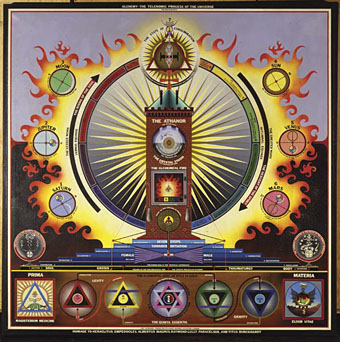
Alchemy: The Telnomic Process of the Universe (1973).

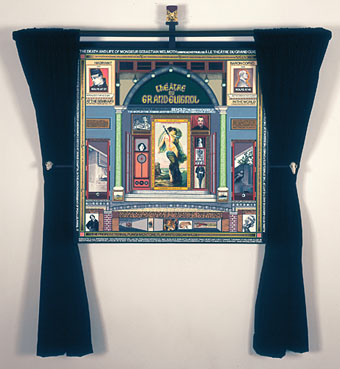
Another week, another incomparable artist gone. This small selection of Laffoley’s unique art and sculpture manages to combine references to (among other things) alchemy, William Blake, Charles Baudelaire, Oscar Wilde, HP Lovecraft, Mark of the Vampire, and Night of the Demon. And this is only a fraction of his work. Richard Metzger has a memorial post at Dangerous Minds together with more paintings and some video links. There’s more at the official website and Kent Fine Art. It’s good to read that the University of Chicago Press will be publishing The Essential Paul Laffoley in March, 2016.

laffoley2.jpg

The Death and Life of Monsieur Sebastian Melmoth: Au Théâtre du Grand Guignol (2001–2003).

laffoley3.jpg

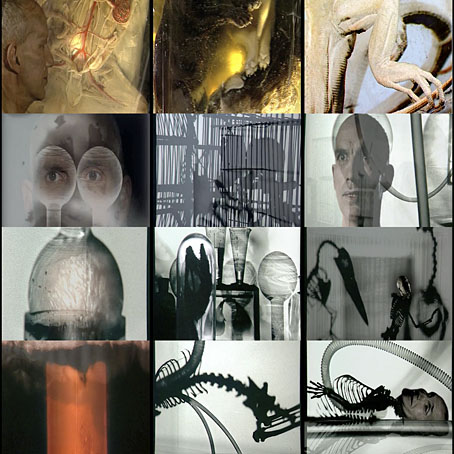
The Solitron (1997).

Continue reading “Paul Laffoley, 1940–2015”

Weekend links 283

wassmann.jpg

Behind by Lisa Wassmann.

• “Without space art, nobody would know what Mars would look like.” Artist David A. Hardy talking to Nadja Sayej about a life spent painting the cosmos and—briefly—working for Hawkwind. Visions of Space, an exhibition of astronomical art, is at the Wells & Mendip Museum throughout November.

• Mixes of the week: Something Beautiful Happened by Cafe Kaput; Autumn Vybes: Mist, Mystery and Motion by Abigail Ward; and Secret Thirteen Mix 166 by Ron Morelli.

• More Ghost Box: Two new singles in the Other Voices series will be released next month. And the label is profiled in the latest issue of Electronic Sound magazine.

It breaks my heart when one writer tells another what she can or cannot do. I once knew a woman, a professor of literature, who said that Flaubert had no right to write Madame Bovary because he was a man. Such dangerous foolishness! This is just another form that dogmatic thinking takes. And it seems to me that the imagining mind—which is also a profoundly human mind—must be unfettered, boundless. To write from the perspective of another’s world demands a generous and a rigorous leap of the spirit; it demands empathy and mindfulness. Writing is so much about subverting dogmatisms of all kinds, above all the ones that insist you cannot go there! You must not say that! Writers need to go anywhere, to take anything on. And the only rule is to do it well.

Rikki Ducornet in a retrospective feature at Dennis Cooper’s blog

• “Horror at its best has always existed outside the mainstream,” says Brian Ennis in another celebratory piece about Thomas Ligotti.

• Alan Clarke & David Rudkin’s Penda’s Fen receives another cinema screening next week at the Sallis Benney Theatre, Brighton.

• “[David] Lynch’s films abound with gnomic pronouncements and incantations,” says Dennis Lim.

Stars of the Lid play a tremendous hour-long set at St. Agnes Church in Brooklyn.

Drawn in Stereo: a book of music-related art and illustration by Michael Gillette.

• At Dangerous Minds: Only the coolest people get to sit in the wicker peacock chair.

Everything Is Erotic Therefore Everything Is Exhausting by Johanna Hedva.

Moon Mist (1961) by The Out-Islanders | River Mist (1989) by Brian Eno | Black Mist (Long Version) (2013) by Pye Corner Audio

Butcher’s Hook, a film by Simon Pummell

butcher.jpg

“Butcher’s hook” is Cockney rhyming slang for “look”, something alluded to in this short and wordless blend of live action and animation. But it also has a more sinister connotation when the fate of the taxidermist becomes apparent. As with Pummell’s earlier Secret Joy of Falling Angels, animal skeletons and silhouettes predominate. The film was co-written by novelist Simon Ings while the sound is by regular Quay Brothers collaborator Larry Sider.

Previously on { feuilleton }
Secret Joy of Falling Angels, a film by Simon Pummell

Suspiria details

suspiria01.jpg

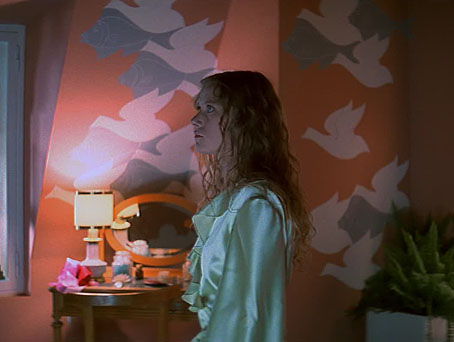
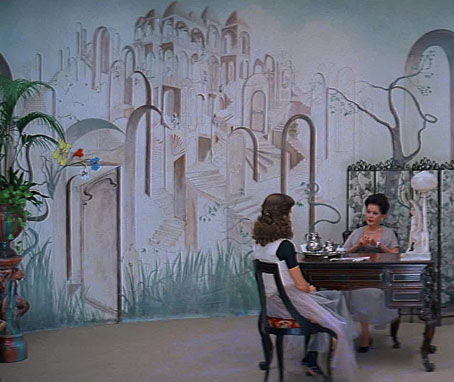
Wall decor based on MC Escher’s Study of Regular Division of the Plane with Fish and Birds (1938).

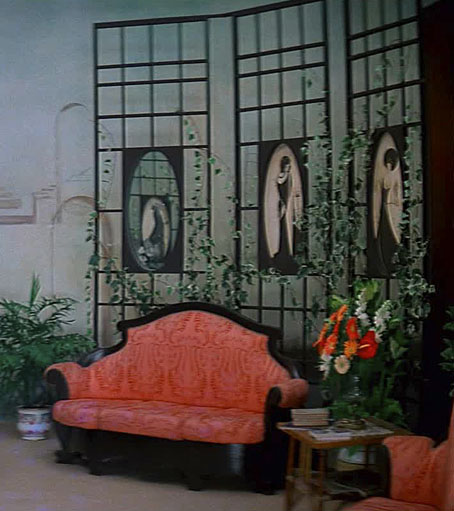
A few screen grabs from the weekend’s viewing of a German Blu-ray disc of Suspiria (1977). My old DVD didn’t look too bad but this is one film where high-definition is required to do justice to the vivid lighting and to Giuseppe Bassan’s marvellous production design. The Art Nouveau splendour of the cursed ballet school contains some notable art references but elsewhere there’s the Escher decoration on the walls of the apartment at the beginning, not the kind of decor you expect to find in a horror film. All these images are details cropped from widescreen frames.

suspiria02.jpg

Suzy (Jessica Harper) and Madame Blanc (Joan Bennett) in the madame’s office. The mural always fascinated me for being a strange confection of Escher motifs, all winding staircases and architecture borrowed from Belvedere (1958).

suspiria03.jpg

The far right of the same shot showing some of the Beardsley figures that fill the panels of Madame Blanc’s screens.

Continue reading “Suspiria details”

Weekend links 282

ligotti.jpg

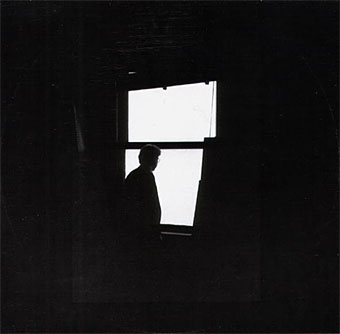
Thomas Ligotti photographed by Jennifer Gariepy.

• More Thomas Ligotti (he’s been marginalised for decades, the attention is overdue): “Songs of a Dead Dreamer and Grimscribe are fugues of the creeping unknown,” says Peter Bebergal who profiles Ligotti for The New Yorker, and gets him to talk about the impulses that produce his fiction; at the Lovecraft eZine eleven writers and editors ask Ligotti a question related to his work.

• As usual, Halloween brings out the mixes. This year there’s a choice of The Ivy-Strangled Path Vol. XII by David Colohan, Samhain Séance 4 : The Masks of Ashor by The_Ephemeral_Man, The Voluptuous Doom of Bava Yaga by SeraphicManta, Spool’s Out Radio #27 with Joseph Curwen, and The Edge Of The Holloween Oven – 10/26/15 by The Edge Of The Ape Oven.

Broadcast’s James Cargill has provided a soundtrack for Peter Strickland’s radio adaptation of The Stone Tape by Nigel Kneale. John Doran and Richard Augood review the new and old versions for The Quietus. Related: Peter Strickland’s favourite horror soundtracks.

My mission was to make sounds that didn’t exist in reality, whether it’s a star ship or a laser or a monster or an exploding planet. You started with basic sounds that were acoustic and then you manipulated them. There’s a scene in Raiders of the Lost Ark, when he falls into the well of souls and pushes over that statue and there are all those snakes? The sound of the snakes was made by pulling masking tape off glass. When the statue falls over and breaks the wall there’s the noise of lots of big rocks breaking. We just took some bricks and smashed them up and then slowed the tape recording down. I remember doing a lot of great scary effects using dry ice and a bunch of pots and pans out of the kitchen. You heat them up really hot and then you drop a load of dry ice into the hot pan so the rapid thermal change would make it scream.

Composer and sound designer Alan Howarth talks to Mat Colegate about working for films

Jordan Hoffman reviews Jacques Rivette’s legendary 13-hour feature film Out 1: Noli Me Tangere (1971). The film will be in cinemas next month, and available on DVD/BR in January.

The Stone Tape was originally a one-off TV drama shown at Christmas in 1972. Michael Newton looks at the BBC’s habit in the 1970s of screening ghost stories at Christmas.

Steven Arnold’s Epiphanies: A look back at some of the artist’s surrealist photographs.

Greydogtales just concluded a month of posts dedicated to William Hope Hodgson.

• At Dirge Magazine: Tenebrous Kate on seven songs based on dark literary classics.

Phil Legard opens some grimoires for a short history of signs and seals.

Micah Nathan on Tuesday’s Child, “LA’s best Satanist magazine”.

• “The Occult was a kind of awakening,” says Colin Wilson.

Shagfoal: witchcraft and horror-blues by Dante.

Jenny Hval‘s favourite albums.

The Attic Tapes (1975) by Cabaret Voltaire | Those Tapes Are Dangerous (1997) by The Bug | The Black Mill Video Tape (2012) by Pye Corner Audio