Tom Adams book covers

adams01.jpg

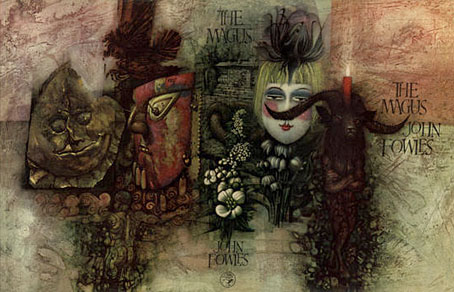
Dust jacket for The Magus (1966) by John Fowles.

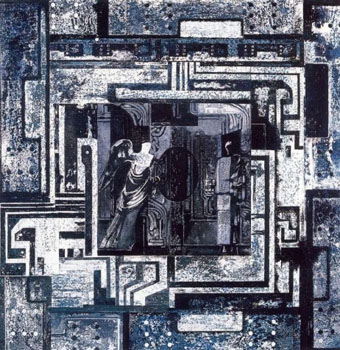
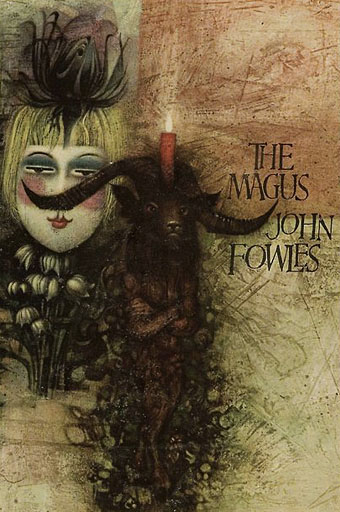
I pulled my 1982 paperback of John Fowles’ The Magus from the bookshelf recently. After flicking through the pages I decided to start re-reading it, having realised that in the thirty years which have elapsed since I first read it I couldn’t remember much at all about it. One thing I did remember, however, was the cover of the first edition, a painting and design I’d admired in the past without knowing the name of the artist responsible.
adams02.jpg

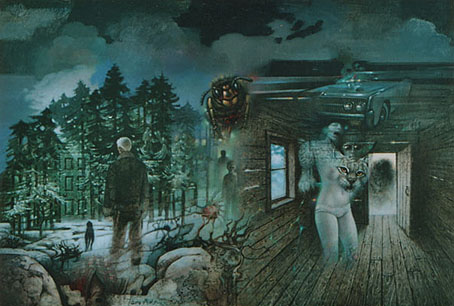
American illustrator Tom Adams is the artist in question, and looking at his painting again it further occurred to me that his cover deployed an evocative but not wholly specific assemblage of figures and objects that I’d often seen elsewhere, notably on the first edition cover of Peter Straub’s Ghost Story. So it was no great surprise to discover that Tom Adams was also responsible for that cover painting. The Fowles and Straub novels are big books which slowly reveal their layered mysteries. Adams’ approach to illustrating them strikes me as an ideal solution when neither of the novels can be easily reduced to a single image. (This hasn’t prevented subsequent designers from trying.) Fowles approved wholeheartedly of the painting but this isn’t a particularly fashionable technique at the moment, the trend being to try and condense complex narratives into a single motif.
adams03.jpg

Cover painting for Ghost Story (1979) by Peter Straub.

Looking for more of Adams’ art tipped me into an entire world of Agatha Christie book covers which were the artist’s main body of work for many years. Adams is understandably celebrated by Christie-philes (Paper Tiger published a book of his Christie covers in 1981) but outside Sherlock Holmes and Father Brown I’ve never had much of a taste for the classic detective story so this was a previously undiscovered niche. Here Adams sidesteps the chore of painting Christie’s meddlesome sleuths in favour of a remarkable display of grotesque Surrealism which—for a sceptic such as myself—makes the books seem potentially interesting. As with The Magus and Ghost Story there’s the same assemblage of evocative figures or objects but with an additional macabre twist. Many of these covers are so grotesque they could easily function as horror illustrations so it’s no wonder he was asked to illustrate the Straub. This Flickr page has many more examples (warning: wretched user-unfriendly Flickr layout in operation) as does this site. The artist has a website where prints of The Magus painting may be purchased.
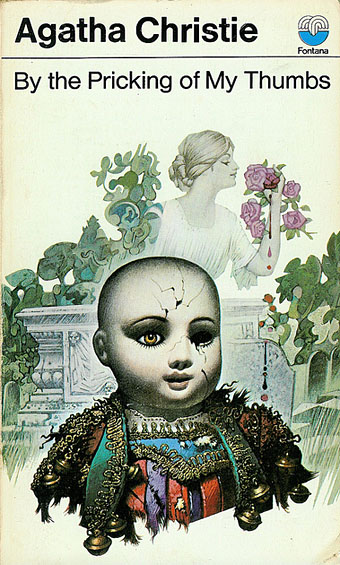
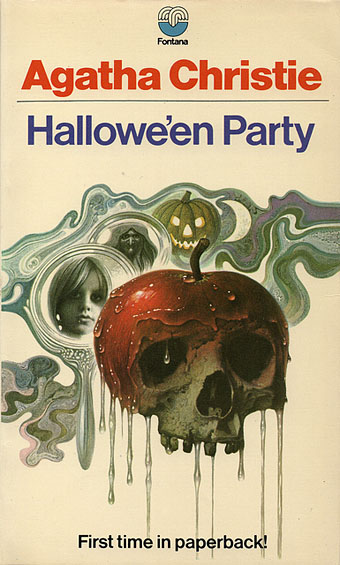
adams04.jpg

adams05.jpg

Continue reading “Tom Adams book covers”

The Cremator by Juraj Herz

cremator1.jpg

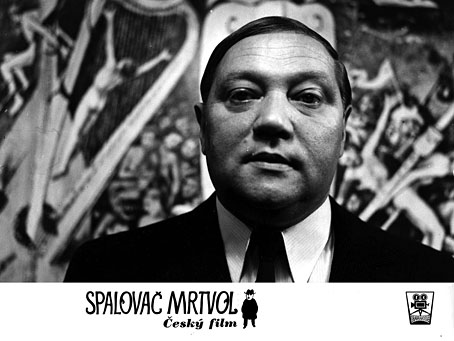
The Cremator, a film directed by Juraj Herz, missed out on the attention given to other Czech films in the late 1960s, something the Brothers Quay note in their enthusiastic introduction to the Second Run DVD. Unlike other films made during the Czech New Wave, Herz’s film premiered in 1969 then was promptly banned, and didn’t receive a wider distribution until 1989.

cremator2.jpg

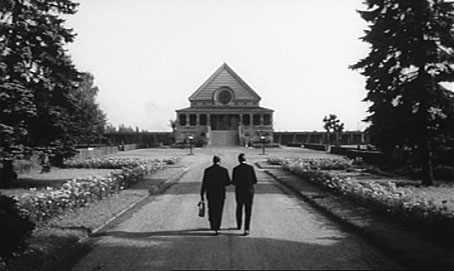
It’s easy to see why the Communist authorities would have a problem with a film about a Prague crematorium director in the 1930s, a man who not only delights in his ability to efficiently turn human beings into ash in 75 minutes, but also has no problem siding with the invading Nazi regime when it becomes apparent that this will further his obsession with incineration. Rudolf Hrušínský dominates the proceedings as cremator Kopfrkingl, a stout and ebullient presence who Herz directs without resorting to any clichés of macabre or morbid characterisation. We’re with Kopfrkingl in every scene, and for the most part he remains cheerful and reasonable, whether showing new workers around the crematorium, dealing with his family (or the prostitutes he visits), or happily shopping all the Jews he knows to his collaborationist associates. A Holocaust subtext becomes overt when Kopfrkingl is asked to lend his incineration skills to a “secret project” the new authorities have in mind, an offer which sends the cremator into a fantasising rant (filmed against Hieronymus Bosch’s painting of Hell) in which he realises he might be allowed to turn many thousands of bodies into ash.

cremator3.jpg

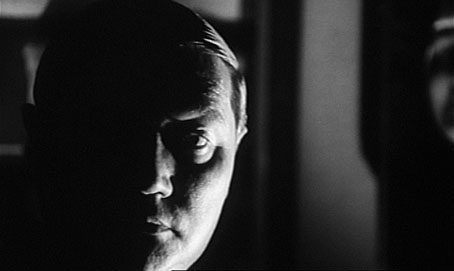
Described like this the film is a blackly comic satire at the expense of all those Czechs who collaborated with the Nazis during the war. What attracts the praise of viewers such as the Brothers Quay, and puts the film in the essential category, is the additional details of Herz’s direction. Anyone familiar with the early films of Jan Švankmajer will feel quite at home with the sequences of rapid editing, with the scenes introduced by unexpected close-ups, and with the grotesquery of a visit to a chamber of horrors which includes a special area showing bottled foetuses and the consequences of disease. The Švankmajer atmosphere is reinforced by a marvellous score from Zdeněk Liška whose music can be heard in many of Švankmajer’s early films. One of these, The Flat (1968), features Juraj Herz in an acting role, while The Ossuary (1970) would be ideal for a screening with The Cremator even if Kopfrkingl would disapprove of all those unburnt bones. Liška’s score is as idiosyncratic as in the Švankmajer films, and helps augment a sense of disquiet that shades to outright horror.

cremator4.jpg

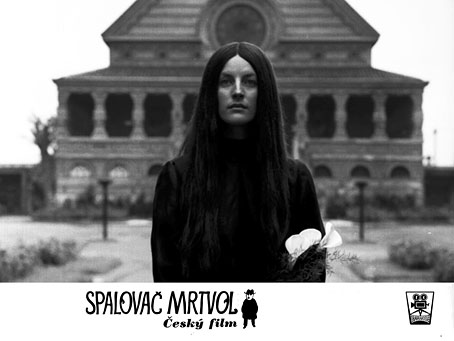
There’s more: the skilful way that Herz and screenwriter Ladislav Fuks (whose novel provides the basis of the story) link otherwise disconnected scenes; Kopfrkingl’s obsession with Tibet which gradually descends into mania; and the mysterious and silent dark-haired woman whose presence in so many scenes is never explained. Given all this, and the successful way that Herz blends his outré material, I’m surprised this film isn’t better known. Herz’s later Morgiana (1972) has more of an audience, and is also worth seeking out. It’s also very different to The Cremator, to such a degree that it might be the work of a different director altogether. Both films can be found on Region 2 DVD at Second Run.

Previously on { feuilleton }
Sedlec Ossuary panoramas
The Hourglass Sanatorium by Wojciech Has
Jan Svankmajer: The Complete Short Films

Weekend links 173

orszag.jpg

Icarus (1974–75) by Lili Ország.

• The Cabaret Voltaire albums released on the Virgin label in the 1980s have suffered the same shoddy treatment on CD as other Virgin reissues, a situation to be rectified in November with an extensive revisiting of the CV back catalogue. The long-overdue reappraisal will also include the release of Earthshaker, a collection of previously unavailable recordings from the Virgin period.

• It’s that book again: Design Observer has the preface from Lolita — The Story of a Cover Girl: Vladimir Nabokov’s novel in art and design, a book by John Bertram and Yuri Leving. At The Millions John Bertram talks to designer John Gall about the problems Lolita poses for cover designers.

• Jerry Lewis’s The Day the Clown Cried (1972) has acquired legendary status over the years for the apparent tastelessness of its subject matter—a clown in Auschwitz—and the fact that its director/star has never allowed the film to be seen in public. This week some footage arrived on YouTube.

Candy Bullets And Moon (1967), a one-off psychedelic collaboration between Don Preston and Meredith Monk.

• What’s the collective term for many bookshops? Whatever it is, there’s a lot of them in this Pinterest collection.

• At Dangerous Minds: Artist Gail Potocki’s exploration of Alice in Wonderland and the passing of time.

Anne Billson on the late Karen Black and why horror movies deserve our respect.

Tobias Carroll on the Surreal life and fiction of Leonora Carrington.

More details emerge about The Wicker Man – The Final Cut.

• Issue 35 of Arthur Magazine is now available for order.

• Graphics, drawings and collages by Jan Švankmajer.

• Every film poster designed by Saul Bass.

• Cabaret Voltaire: Just Fascination (1983) | Sensoria (1984) | I Want You (1985)

Weekend links 172

thielker.jpg

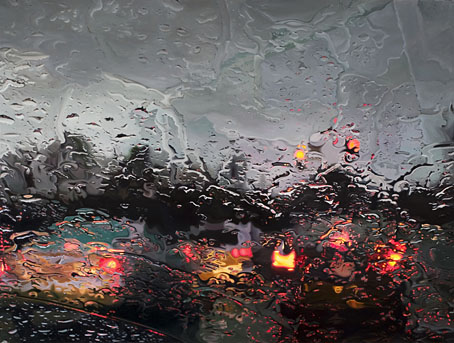
Complete Stop (2008), an oil painting by Gregory Thielker from his Under the Unminding Sky series.

• For Halloween last year I watched a very poor copy of a BBC Play For Today production, Robin Redbreast, a piece of rural horror by John Bowen which received a single screening in 1970. That poor copy—black-and-white, timecoded, multi-generation video—has been circulating for years, so it’s good to know that the BFI will be releasing Robin Redbreast on DVD in time for this year’s Halloween. This might be news enough but the following month the BFI also releases Leslie Megahey’s stunning adaptation of Schalcken the Painter in a dual DVD/Blu-ray edition. I wrote a short review of the latter film last October.

• Mixes of the week: August Sun High from The Advisory Circle, and John Wizards’ Quietus Mix “African music, R&B and chamber pop, filtered through gentle electronic arrangements that cross-pollinate with South African house, Shangaan electro and dub”.

• A trailer has surfaced for The Counselor, a film by Ridley Scott from an original screenplay by Cormac McCarthy. Trailers are too spoilerish so I’m refusing to watch it but for those interested Slate has the details.

Luckhurst makes an admirable attempt to link Lovecraft’s most frustrating writing tic to this theme of the unknown when he claims that Lovecraft’s “catachresis”—deliberate muddling of language through the use of mixed metaphors and the like—is a tool he uses to bolster the atmosphere of futility in the face of “absolute otherness.” The trauma of encountering something so far outside the realms of imagination triggers a collapse of logic in the language itself.

Cate Fricke reviews The Classic Horror Stories of HP Lovecraft, a collection from Oxford University Press edited by Roger Luckhurst.

• “Contemporary audiences found it too weird, too wonky and even borderline distasteful…” Xan Brooks goes looking for the locations from Powell & Pressburger’s 1943 film, A Canterbury Tale.

• Two songs from Julia Holter’s forthcoming album, Loud City Song: World and Maxim’s I. Also unveiled this week: Evangeline, a new track by John Foxx & Jori Hulkkonen.

• Have Ghost, Will Find: Colin Fleming on William Hope Hodgson’s Carnacki, The Ghost Finder.

• At PingMag: Urban Calligraphy: Turning the Streets into Big, Loud Canvases.

• Sex, Spirit, and Porn: Conner Habib talks to Erik Davis.

Serendip-o-matic: Let Your Sources Surprise You

The Pronunciation of European Typefaces

Twilight (2004) by Robin Guthrie & Harold Budd | Luminous (2009) by John Foxx & Robin Guthrie | Cling (2011) by Robin The Fog

The Outer Church

outer1.jpg

Compilation albums: on the one hand they’re in the lowest echelon of the musical world, all those cheap pop collections you see in any supermarket; on the other they provide an introduction to zones of activity which might seem too rich or too obscure to easily investigate; Soul Jazz Records is a master at this kind of collection.

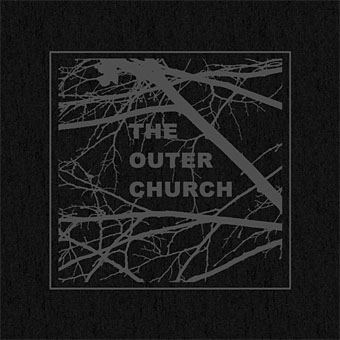
There’s also another level of compilation album where the collection becomes an opus in its own right, and which can also help to define a new movement or moment. In this category I’d think of favourites such as Kevin Martin’s Isolationism set from 1994 which first identified the emergence of what we now think of as Dark Ambient music; and Devendra Banhart’s The Golden Apples of the Sun (2004) which showcased a new generation of American folk artists. To these I’d add Joseph Stannard’s The Outer Church, a 2-CD set compiled for Front & Follow which is released this month. My hand-crafted, letterpressed edition just arrived so I’ve been relishing the new music after forcing myself to avoid the preview tracks which have been available for the past couple of weeks. Regular readers won’t be surprised to learn that the emphasis is very much on the Hauntological end of things; this blog nurses a Ghost Box fetish, and there are Ghost Box connections in the presence of Pye Corner Audio, Hong Kong In The 60s, and Baron Mordant. The latter pair and another artist, Robin The Fog, all provided tracks for the recent Restligeists, the cassette compilation that came with The Twilight Language of Nigel Kneale. Of the new collection, Joseph Stannard says in his notes:

Wind the tape all the way back to Brighton in 2009. The uncanny influence seeping into contemporary music from ‘elsewhere’ had become impossible to ignore. Magazine pieces I had written in my capacity as a music critic were revealed to contain subliminal memos for my own attention. Unusually vivid dreams and unsettling anonymous telephone calls imparted curious instructions. I was to establish a space in which various forms of unheimlich audio would converge with moving images of a similarly anomalous nature. Equipped only with a well-thumbed copy of The Beginner’s Guide To Psychic Architecture, I resolved to build a Church.

This compilation presents a selection of the artists who have performed at The Outer Church, with the exception of illustrious filmmaker and composer Graham Reznick, who lives in faraway Brooklyn and kindly permitted us to screen his tremendous psychedelic campfire tale, I Can See You, in Brighton and Dublin. All of the recordings here are previously unreleased. Together they advance the argument that something weird is stirring in modern music which resists categorisation, manifesting itself in unsettling cadences and temporal distortions across a wide variety of occult strategies.

outer2.jpg

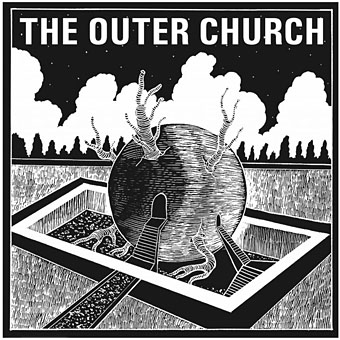
Illustration by Alexander Tucker.

And they aren’t the only ones exploring this territory: Demdike Stare and the very excellent Haxan Cloak might also have been included here. I am, of course, especially partial to any kind of doom-laden timbres, whether electronic, orchestral or guitar-oriented, so I can’t be an unbiased reviewer. But it has been a relief to see contemporary electronica (in the UK at least) find a way out of the rut of abstraction into which it had fallen in the late 1990s. That’s it’s done this by delving into our nation’s long history of ghost and folk mythology is no bad thing. Not all the artists on The Outer Church are attempting to spook their audience; there are songs as well as drones. Hong Kong In The 60s produce the kind of uptempo pop you’d expect from a band with that name. It’s to Stannard’s credit that he manages to sequence things without the mix of styles being too disjunctive.

outer3.jpg

One of the mini-postcards inside the limited edition. Photo by Joseph Stannard.

The first edition of The Outer Church has been selling well so anyone looking for a copy is advised to make haste and use the links on this page. There’s a related event in Brighton this (Friday) evening, and another in Manchester on Saturday. I’m now looking forward to following some of the paths revealed by this opening of the portals.

Previously on { feuilleton }
The Ghost Box Study Series
A playlist for Halloween: Hauntology
The Séance at Hobs Lane
Ghost Box