Weekend links 38

lovecraftbaw.jpg

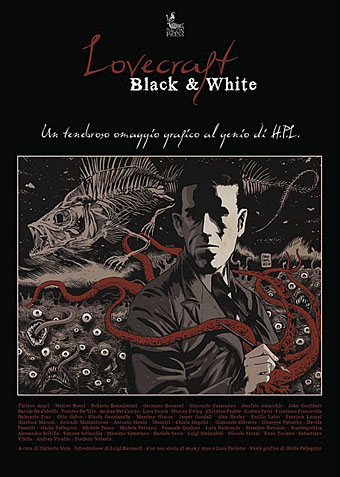
Arriving in the post this week was Lovecraft Black & White, an Italian book whose contents are spelled out in the title, black-and-white illustrations based on the work of the Providence master. Among the featured works is my 1999 rendering of Azathoth. There’s more about the book here and here.

Also on the work front, one of the books I designed interiors for a couple of months back was The Search for Philip K. Dick, a sombre biography and memoir by Anne R. Dick, the author’s third wife. Ms Dick discussed the book with the NYT a few days ago. The design was mostly straightforward layout but I did make a quick ASCII portrait of PKD from one of Anne Dick’s photos.

Farewell, the documentary film about Lady Grace Drummond-Hay’s flight around the world in the Graf Zeppelin, can be viewed here.

• “I personally think that the pages look better on the iPad than they do in real life.” Artist Tom Phillips again on the Humument iPad app.

The Birds Are Flying Elsewhere: singer/songwriter Linda Perhacs. Related: Parallelograms – A Short Film About Linda Perhacs.

St Eia, guitar improvisations by Zali Krishna, “Keywords: jazzgazing; entropy circus; st ives; cornwall; psychogeography”.

Moon Wiring Club and DD Denham: music for children, by children. Related: Moon Wiring Club’s Jayston Mix.
kirkland.jpg

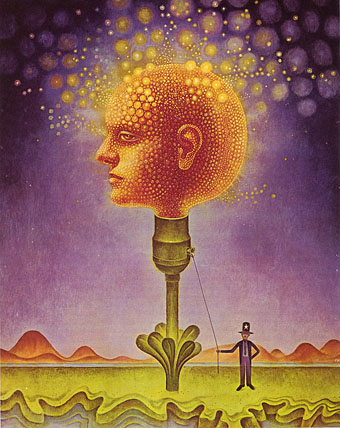
The 1970s was another country, they did things differently there. One of a number of illustrations for science textbooks by Phil Kirkland at A Journey Round My Skull.

• “Fellatio has become a recurrent theme in your work hasn’t it, I say.” Alan Bennett sheds some inhibitions.

Talking To The Sci-Fi Lord: Regenerations & Ruminations With Michael Moorcock.

Time and the Gods (1906) by Lord Dunsany, illustrated by Sidney Sime.

City of Silence, a calendar for 2011 by Thom Ayres.

Scientists glimpse universe before the Big Bang.

• Photography by Josef Sudek (1896–1976).

Aurora photo gallery, November 2010.

The Last Tuesday Society.

Parallelograms (1970) by Linda Perhacs | Six AM (1979) by Thomas Leer & Robert Rental | Rockin’ Back Inside My Heart (1989) by Julee Cruise.

The recurrent pose 39

egermeier.jpg

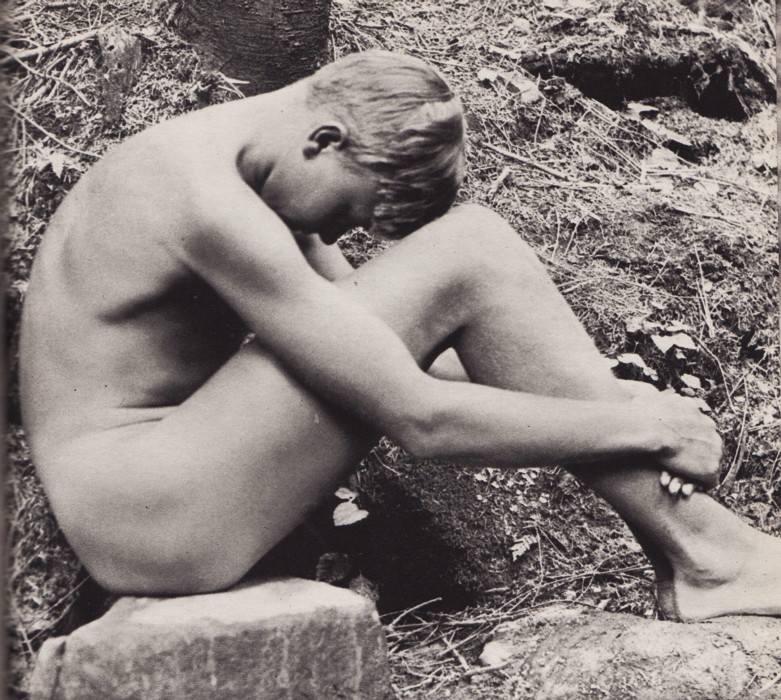
Here we go again, this example of the Flandrin pose being from 1924. The photograph is by Karel Egermeier and features in Paysage des Olympiques, a book devoted to studies of athletic youths with text by Henry de Montherlant. The author’s Uranian interests are well-documented so for once we can abandon any pretense that the publication had an entirely chaste intent. Thanks to Bibliothèque Gay for the tip, a great site for posts about French gay history and culture.

Elsewhere on { feuilleton }
The recurrent pose archive

Peter Christopherson, 1955–2010

coil.jpg

Coil, circa 1984. John Balance (left) & Peter Christopherson (right). Photo by Lawrence Watson.

The depths of the night sky
Reflects in his eye
He says “Everything changes
And everyone dies.”

Coil, Blood From The Air (1986)

Yes, everyone dies but you don’t always expect it this soon, six years after the sudden loss of John Balance. Coil and Throbbing Gristle were refreshingly direct about the transience of existence so we should no doubt regard these moments with the necessary degree of philosophy. And yet… I’ve said for years that we lack an adequate complement of innovators, genuine creators, rare minds, and what Robert Anton Wilson used to call Intelligence Agents; such people always seem too few, especially in a world where hatred and ignorance are encouraged by those eager to keep us unfulfilled, the easier to manipulate and control. There’s a natural desire each time you discover a like-minded soul to want them to stay around for as long as possible, to help shine a thousand lights in a darkened room.

I never met Peter Christopherson but I saw him on stage with Psychic TV in Manchester in 1983, and as part of Coil for their thrilling performance at the Royal Festival Hall, London, in 2000. We corresponded sporadically via letter and email throughout the 1990s, and spoke on the phone a couple of times. Coil wanted me to create a cover for one of their releases and we talked about this on and off for several years but nothing ever came of the plans, something I regret to this day. Peter bought a drawing off me ten years ago (this one), and he remains one of the few people I’ve sold any artwork to. I broke my usual rule on that occasion out of respect for his work. That work is mostly acknowledged as being musical, and it’s the music—as a member of Throbbing Gristle, Psychic TV, Coil, and TG again—that other obituaries will rightly celebrate. But he was also a talented photographer and graphic designer whose earliest public works were for the design group Hipgnosis in the 1970s. He joined Storm Thorgerson and Aubrey Powell as an assistant in the mid-70s and became a full partner in 1980. As a freelance photographer he shot the first promo pictures of the Sex Pistols in 1976, photos which (if I remember correctly) Malcolm McLaren decided not to use because they looked too heavy. Or maybe too queer…see this appraisal by John Gill from his book Queer Noises. It was Peter Christopherson’s design authority that gave the Throbbing Gristle releases a quality many other independent productions lacked in the post-punk era. He brought the same visual finesse to Psychic TV in 1982 and it was painfully obvious when that finesse was withdrawn after he and John Balance left PTV in 1983 to form Coil. I owe Coil more than I can easily articulate. I’ve spent hours and hours listening to their music whilst working; the full range of their interests probably matched mine more completely than any other group I’ve encountered. It was a real shock when everything crashed to an end in 2004. It’s good to know that the Coil site at Brainwashed has a wealth of interviews and articles going back through the years. And there’s still the music, of course.

Fellow TG members Cosey Fanni Tutti and Chris Carter issued some words of remembrance a few hours ago which they end by saying: “Peter was a kind and beautiful soul. No words can express how much he will be missed.” A few examples of his photography and design work follow.

Update: Full Guardian obituary by Alexis Petridis | Genesis P-Orridge Pays Tribute To Sleazy.

Continue reading “Peter Christopherson, 1955–2010”

Weekend links 37

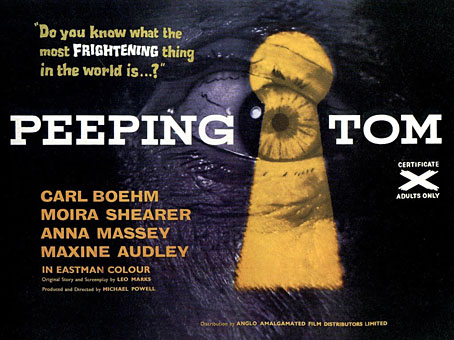
peeping.jpg

Michael Powell’s Peeping Tom is fifty-years old this year, an occasion celebrated with a limited UK cinema run and a reissue on Blu-ray and regular DVD. This was the film which famously ended Powell’s career as a director in Britain for reasons which have never been quite clear. Was the film’s critical vilification the culmination of an impatience with the director’s alleged excesses over the years? Was it an unarticulated discomfort at the way Powell and screenwriter Leo Marks implicated themselves and the audience in the sordid murders they (we) were watching in the dark? Or was the film withdrawn simply because producer Nat Cohen wanted a knighthood and was worried over his reputation as a peddler of “filth”? The bitterest blow for Powell would have been seeing his long-time rival Alfred Hitchcock have another success a few months later with Psycho, a film which allows its audience similar female-slaughtering thrills without questioning the role of the viewer in sustaining the drama. Hitchcock spent much of his career “punishing” women in a manner that verges on outright misogyny yet was indulged all along by audience and critics; Powell made a single film about a murderer and was himself punished for it. His other films often featured strong female characters, and I’ve long regarded him as the superior artist.

The Guardian this week celebrated Powell’s film with a number of articles: Peeping Tom may have been nasty but it didn’t deserve critics’ cold shoulder, Peeping Tom, pornography and the press, The Peeping Tom timebomb.

A Wizard of Earthsea: an unfilmed screenplay from 1983 by Michael Powell and Ursula K Le Guin based on Le Guin’s first two Earthsea novels.

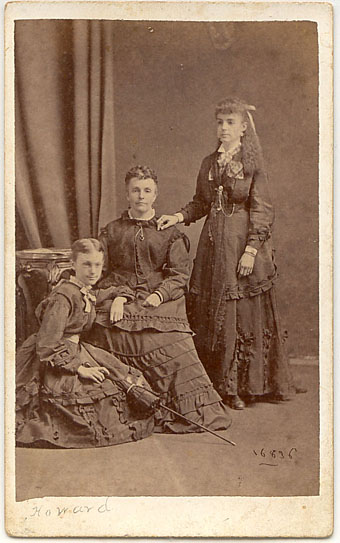
1860.jpg

A boy in a dress with mother and sister, 1860. Yesterday was the 12th Annual Transgender Day of Remembrance.

Quaintance by Reed Massengill and Dian Hanson, in which the pioneer of 20th century beefcake art gets the heavyweight Taschen treatment. Expensive but they’re making these volumes for obsessives. Related: Hide/Seek: Difference and Desire in American Portraiture, an exhibition of gay and lesbian art at the Smithsonian’s National Portrait Gallery. The gallery has a preview of the exhibition here. On a more humble level, BUTT magazine has a recreation of Quentin Crisp’s inevitably messy New York City apartment.

• From gay art to gay song and dance: Queer To The Core!: Queer Rock From The Vaults! Super-rare novelty singles with titles like Queer Police by Billy Devroe and The Devilaires. Meanwhile Cleveland Street: The Musical is a forthcoming stage celebration of Victorian London’s notorious male brothel. By Glenn Chandler, creator of the popular TV detective series Taggart (!) whose earlier musicals have titles like Boys of the Empire and Scouts in Bondage.

pejic.jpg

Strikingly androgynous male model Andrej Pejic photographed by Armin Morbach. There’s a lot more Andrej Pejic at Homotography.

Thrilling Wonder Stories II, “eight hours of architectural futurism featuring an unbelievable line-up of novelists, game designers, animators, scientists, comic book artists, architects, and more”. At the Architectural Association, London, November 26.

• “The iPad is one of the oldest things in the world…a pad or a slate.” Artist Tom Phillips reworks A Humument for a new medium. Related: Creating new books from old, in which Jonathan Safran Foer follows Phillips’ lead by cutting words from Bruno Schulz’s Street of Crocodiles to create a new work, Tree of Codes.

• “Technology is turning us into switchboard operators in the communication networks of our own lives.” I know the feeling. Rick Poynor on the seductive tyranny of design technology.

• Comic artist Moebius gets the Tumblr treatment. And speaking of Tumblr, my thanks to everyone who’s been reblogging the Cephalopod Bride.

Skull Comics, 1970–72, at Golden Age Comic Book Stories. Underground artists excavate Lovecraftian horrors, among other things.

The lost town of Dunwich.

The Bells of Dunwich (1975) by Stone Angel | Dunwich Beach, Autumn, 1960 (1982) by Brian Eno.

Weekend links: Hodgson edition

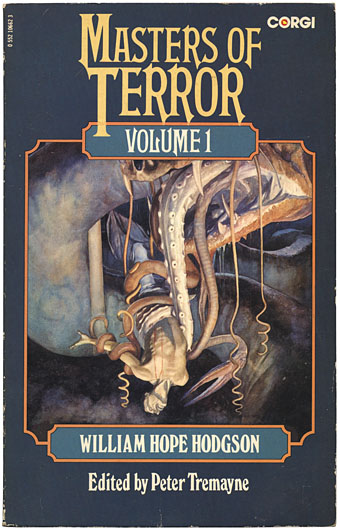
hodgson.jpg

Masters of Terror, Vol 1, Corgi Books, 1977. No illustrator credited.

It was all happening this week so there’s a lot to get through. Are you ready? Deep breath…

For ye Hogge doth be of ye outer Monstrous Ones, nor shall any human come nigh him nor continue meddling when ye hear his voice, for in ye earlier life upon the world did the Hogge have power, and shall again in ye end.

The Hog (c. 1910) by William Hope Hodgson.

• “The Hog is Hodgson’s most nakedly Jungian setpiece; fetid waves of archetypes sweep repeatedly against the thin walls of quotidian reality.” Thus Iain Sinclair, writing in a 1991 afterword to Carnaki the Ghost-Finder which I highly recommend to both Hodgson and Sinclair enthusiasts. China Miéville dissected Hodgson’s Hog on Wednesday and a few hours later a student protest in London turned into an assault on the Tory HQ. Coincidence? Here at {feuilleton} we only offer the facts, it’s up to you to join the dots. M John Harrison approved. Of the protest, that is, not the raising of Porcine Malevolence from the Gulfs Beyond, although he might approve of that as well.

• Further Hodgsonia: Science of The Night Land: Dying Suns and Earth Energy while for real devotees there’s Andy Robertson’s Night Land site.

• “Amplifying the vibrations of the ether” for a view “beyond the limits of ordinary life”: The Fugitive Futurist (1924), a remarkable short film at the BFI’s YouTube channel in which Trafalgar Square is flooded, a monorail crosses Tower Bridge and a dirigible takes to the air over the Houses of Parliament. Also Trafalgar Square Riot (1913), a newsreel with suffragettes at the centre of a civil disturbance. Some of the critics of Wednesday’s events seem to have forgotten that women gained the vote in this country only after repeatedly smashing windows and causing trouble.

• Related to the above: How to Hex a Corporation at Arthur magazine. And let’s not forget Hakim Bey’s Occult Assault on Institutions.

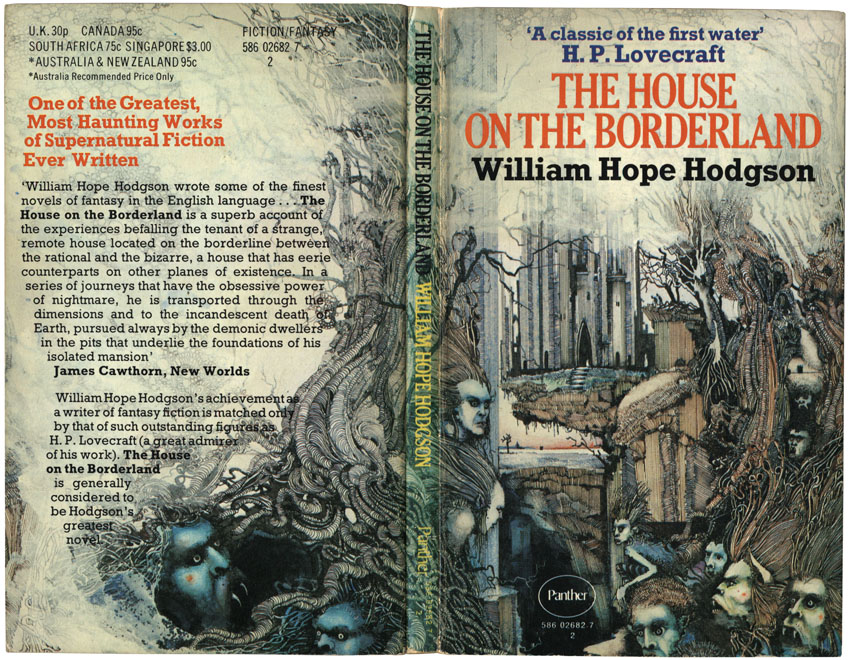
ian_miller4

Cover illustration by Ian Miller (1972). The other great cover for THOTB was by Ed Emshwiller in 1962.

The wanderings of the Narrator’s spirit through limitless light-years of cosmic space and Kalpas of eternity, and its witnessing of the solar system’s final destruction, constitute something almost unique in standard literature.

HP Lovecraft reviewing Hodgson’s The House on the Borderland in Supernatural Horror in Literature.

• Lovecraft has long cast a shadow over Hodgson’s fevered visions even though words of praise like those above have done much to keep the earlier writer’s work in print. I’ve been talking for years about doing a series of illustrations for The House on the Borderland and may yet make good on that threat; never say never. Meanwhile, Rick Poyner returned to Design Observer this week pondering the challenge of non-Euclidean architecture in What does HP Lovecraft look like?

hodgson2.jpg

Druillet illustrates Hodgson (1971).

• In his latest piece of Barney Bubbles detective work, Paul Gorman discovered the identity of BB’s first design employer, the alluded to but never named Michael Tucker. More surprising for me than the Robert Brownjohn connection is that there’s now a tenuous link between Barney Bubbles and William Gerhardi.

777 classical music album covers from the collection of Dr Horst Scherg. Related: The Golden Age of Wacky Classical LP Covers — Westminster Gold and the Westminster Gold discography.

Chez Fini: Little Augury looks at the work and workplaces (and cats!) of the marvellous Leonor Fini.

• There’s yet more Lovecraft (and much else besides) in Nomad Codes, a new book from Erik Davis.

• The Irrepressibles: “They’re scared of what we’re going to do next”.

• New Scientist asks Is this evidence that we can see the future?

Of Electricity And Water: A Thomas Dolby Interview.

Jarvis Cocker talks to Brian Eno.

Fuck Yeah, Gay Vintage

Hog Callin’ Blues (1962) by Charles Mingus. Play loud and often.