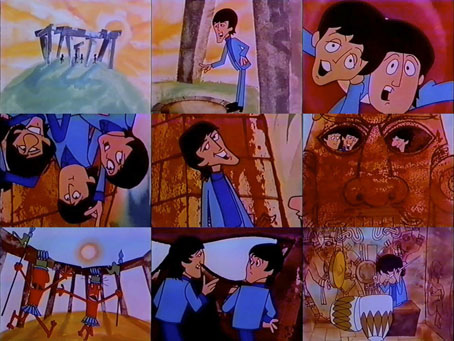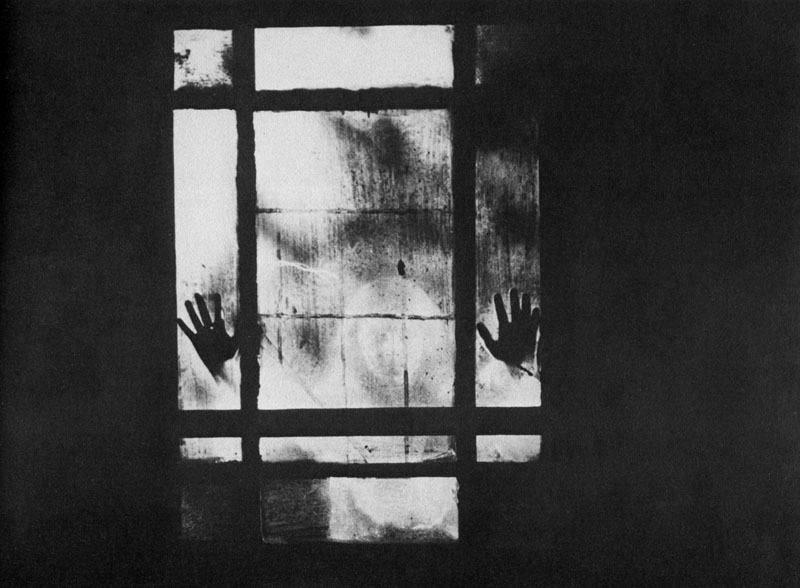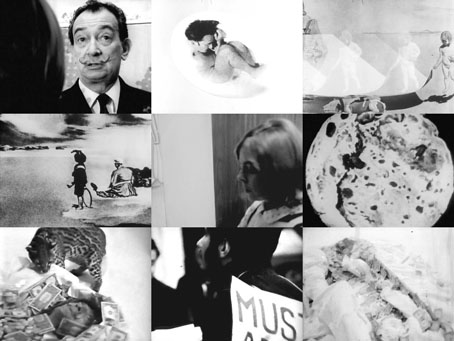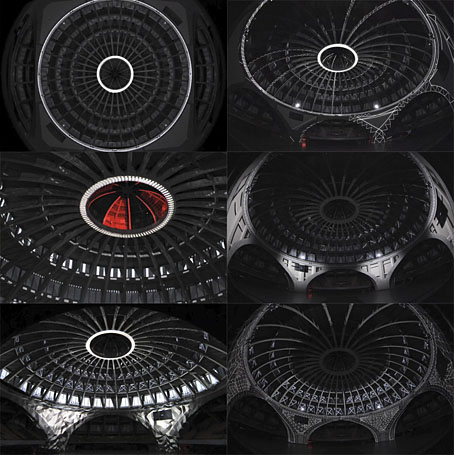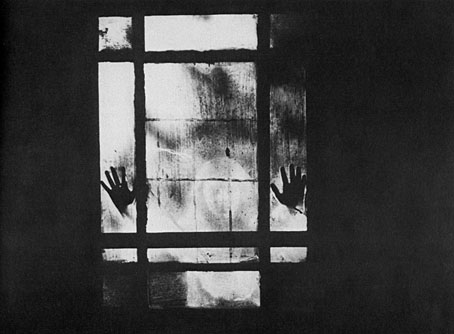
Further film formalism. Tango (1980) by Polish filmmaker Zbigniew Rybczynski is a static shot of an empty room. A boy throws a ball in through the window, retrieves it, exits then throws the ball in through the window. His repeated action is the first of an interwoven series of looped actions by thirty-six different people who eventually form an impossible crowd passing through the room. All human life is here: eating, drinking, sex, death, exercise, breastfeeding, theft, an accident—there’s even a man carrying a toilet bowl. Rybczynski spent seven months doing this the hard way with optical printing which is why the quality fluctuates as the room becomes more crowded. The whole thing lasts eight minutes and you can watch it here.
Category: {film}
Film
La Région Centrale
I would have posted this yesterday if it hadn’t been for the news about Ray Bradbury, Michael Snow’s La Région Centrale (1971) and Tony Hill’s Downside Up being related in my head if nowhere else. For anyone interested in experimental cinema Michael Snow occupies a key position with a pair of films that aspire to a kind of epic formality: Wavelength (1967), his 45-minute zoom into a photograph at the opposite end of a room, and La Région Centrale which is shots of the Canadian landscape (and the sky above it) filmed by a continuously moving camera attached to a robotic arm. Since the the latter runs for three whole hours it’s not the kind of thing you’ll find on TV or even at at most arts cinemas. Consequently all I’ve ever seen are extracts like this but it fascinates all the same. The electronic noises are the sound of the camera arm in operation. Snow apparently said that he wanted the effect to be that of an alien probe exploring a new planet; given this you could probably class La Région Centrale as a piece of science fiction formalism along with Chris Marker’s La Jetée.
YouTube is the worst venue for films intended to absorb the viewer’s intention but for the curious there’s a rough copy of Wavelength here.
Previously on { feuilleton }
• Downside Up
• Expanded Cinema by Gene Youngblood
Downside Up
Downside Up (1984)
For a long time I didn’t know which came first, Downside Up, a 16-minute short by experimental filmmaker Tony Hill, or Sensoria, the Cabaret Voltaire music video directed by Peter Care. Both were made in 1984 and both employ the same technique of a camera fixed to a special rig that allows shots to begin at ground level, rise parabolically into the air then descend to the ground again showing a reverse angle. Thanks to this Quietus interview with Peter Care last year we now know that Tony Hill’s film came first and that Care borrowed the rig for his video. Both are memorable pieces of work. Hill starts out with a series of slow shots accompanied by sounds that imply the camera is passing through the earth. This is contradicted later (and with gathering speed) when some of the shots are rotated through ninety degrees so they materialise out of building walls. Care stripped the technique down using faster shots that he cut with stop-motion footage of Richard Kirk and Stephen Mallinder. It’s the best of the promo videos made for the group.
Previously on { feuilleton }
• The Crackdown by Cabaret Voltaire
Weekend links 111
The Fox (1968). Design by Bill Gold, art by Leo & Diane Dillon.
Mark Rydell’s The Fox may be regarded unfavourably now for its retrograde idea of a lesbian relationship but that’s still a great poster by the Dillons. Equally retrograde (well it was 1957) is Anders als du und ich, a film about wayward German youth directed by ex-Nazi propagandist Veit Harlan:
Klaus is a young man in post-war Berlin. He is drawn to his friend Manfred and, under the encouragement of their acquaintance, Dr. Winkler, explores the underground world of gay clubs and electronic music. His family begins to learn of his other life and do everything they can to set him straight.
A saving grace is the conspicuous deployment of Oskar Sala’s Trautonium. They’re deviants—of course they like weird electronic music! Sala’s instrument was his own invention which means it has a unique pre-Moog sound, famously used by Alfred Hitchcock in the score for The Birds. YouTube has a collection of the electronica moments from Anders als du und ich. Wait for the wrestling scene…
• Netherwood: Last Resort of Aleister Crowley by A Gentleman of Hastings. Related: Jimmy Page’s Lucifer Rising sessions part 1 and part 2.
• “This coming 16 June, [BBC] Radio 4 will be a wall-to-wall Joycefest, kicking off at 9am and running until midnight.”
• A World Where Architecture is the Driving Force Behind Society, Core77 on the Cités Obscures of François Schuiten.
• At The Hooded Utilitarian an examination of the thorny problem of adapting Lovecraft for the comics medium.
• Plates from La Plante et ses Applications Ornementales (1897–1900) by Eugene Grasset.
• Coilhouse found a rough copy of Todd Haynes’ Superstar: The Karen Carpenter Story.
• Three Quick Ways to Introduce Yourself to the Work of Harlan Ellison.
• Daniel Buren’s Monumenta 2012 at the Grand Palais, Paris.
• Our Sorrows, a new video from Julia Holter.
• I, Cyclops: Monocularity in a 3-D World.
• JG Ballard: The Concordance.
• RIP Pete Cosey.
• Pete Cosey with Miles Davis et al, November 1973: Ife | Turnaroundphrase
Weekend links 110
Til Eulenspiegel by Urban Janke. From Twenty Postcards of the Wiener Werkstätte at 50 Watts.
• Rorschach Audio by Joe Banks is “essential reading for everyone interested in air-traffic control, anechoic chambers, artificial oxygen carriers, audio art, bell-ringing, cocktail parties, cognitive science, communications interference, compost, the death penalty, Electronic Voice Phenomena, evangelism, evolutionary biology, experimental music, ghosts, the historiography of art, illusions of sound and illusions of language, lip-reading jokes, nuclear blast craters, predictive texting, singing hair, sonic archives, sound design, steam trains, tinnitus, the Turing Test, Victorian blood painting, visual depth and space perception, ultrasonic visual music, ventriloquism, voices and warehouse fires and robberies.”
• “Freud did not understand female sexuality. Klimt did. Klimt’s women please themselves. The realization that women have an independent sexual life was an insight in art.” Eric Kandel discusses his new study The Age of Insight: The Quest to Understand the Unconscious in Art, Mind, and Brain, from Vienna 1900 to the Present.
• Three new books already mentioned here receive further attention: Stan Persky on Christopher Bram’s Eminent Outlaws : The Gay Writers Who Changed America. | Matthew Aquilone on Paul Russell’s The Unreal Life of Sergey Nabokov. | Karin L. Kross on the new translation of the Strugatsky’s Roadside Picnic.
The creative writing moment/movement baffles me and it intrigues me. What does it signify, all this creative longing? And why through language? Specifically fiction, poetry, memoir? […] The crazy part of it is that we are breeding professional, competent, homogenised writers who will go on to teach writing that is professional, competent and homogenised. The intriguing part of it is whether this movement towards creativity and self-expression is really the start of a kind of Occupy – that it could be dangerous and confrontational, not homogenised at all.
Dangerous? But then they won’t get published and win awards and get film deals and… Jeanette Winterson prepares to teach creative writing at Manchester University.
• The Underground New York Public Library is a visual library featuring the Reading-Riders of the NYC subways.
• Hob by No Man: “Constructed from soundtrack noises from both version of Quatermass and the Pit.”
• Stephen Thrower talks about his soundtrack music for The Erotic Films of Peter De Rome.
• John Waters surprises everyone by hitchhiking across the US.
• Sounds & the City: An interview with Julia Holter.
• The Dead Dream of the Dirigible.
• Meditation (1979) by Edward Artemyev.