Weekend links 400

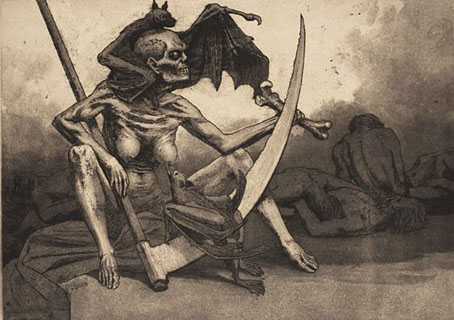
bernard.jpg

Le Répit (La Mort allaitant une chauve-souris) (1895) by Valère Bernard.

Playhouse 90 presents Heart of Darkness by Joseph Conrad. An American TV production from 1957 starring Boris Karloff, Roddy McDowall, Eartha Kitt and others; introduced by Sterling Hayden. It’s bizarre. Acidemic goes into the detail.

• Erik Davis talks to occult writer and drug geek Julian Vayne about Baphomet, the (sur)reality of spirits, evolution, ritualizing entheogens, and his new book Getting Higher: The Manual of Psychedelic Ceremony.

• “Unsurprisingly, 1. Outside was the record that the #BowieBookClub readers most readily associated with Hawksmoor.” Anna Aslanyan revisits Peter Ackroyd’s architectural mystery.

The Flowers of Dorian Gray: part one of a series of posts examining one of Oscar Wilde’s favourite symbols.

• At Haute Macabre, an interview with Michael Locascio & Heather Jean Skawold of Dellamorte & Co.

One Minute Art History, an animated film by Cao Shu.

Film posters at the Harry Ransom Center, UT-Austin.

• Mix of the week: FACT mix 639 by Black Milk.

Susanna‘s favourite albums.

• Welcome to The Spoodoir.

• Flowers Of Evil (1983) by Cortex | Baphomet (1989) by Foetus Inc. | Heart Of Darkness (1989) by Syd Straw

Weekend links 399

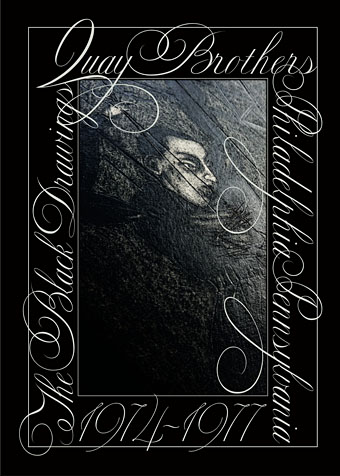
quays.jpg

• “In the mid-Seventies the influential stop-motion animators, Stephen and Timothy Quay, embarked on a series of dark graphite drawings, conceived as imaginary film posters. They kept their first autonomous art project hidden for decades, allowing only a few glimpses to transpire in some of their animation classics such as Noctura Artificialia and Street of Crocodiles. In hindsight, the Black Drawings can be considered as a blueprint for their future work. This book offers a first in-depth exploration of this important graphic series that reveals many of the themes and techniques that would come to life in their celebrated animation films.” Quay Brothers: The Black Drawings 1974—1977 is a book by Edwin Carels and Tommy Simoens.

• The first of the BFI’s forthcoming blu-ray boxes of Derek Jarman films is now available for preorder. In addition to what I presume will be an uncensored presentation of Sebastiane (1976) the set also includes the digital premiere of In the Shadow of the Sun (1980) an “alchemical” blending/transmutation of Jarman’s early Super-8 films with a score by Throbbing Gristle. Related: Adam Scovell on another of the films in the set, Jubilee (1978), and one that Jarman disliked even though it incorporates many of his obsessions, especially in the punk-baiting sequences derived from Shakespeare and Elizabethan metaphysics.

• Mixes of the week: FACT mix 638: Circuit des Yeux, XLR8R Podcast 528 by Huxley Anne, Secret Thirteen Mix 246 by Hiro Kone, and drone works from Abby Drohne. And since the untimely death of composer Jóhann Jóhannsson was announced a few hours ago, a return to his sombre mix for FACT from 2015.

Nabokov’s ambitions weren’t interpretive. He “held nothing but contempt for Freud’s crude oneirology,” Barabtarlo explains, and in tracking his dreams he wasn’t turning his gaze inward. For him, the mystery was outside—far outside. Nabokov had been reading deeply into serialism, a philosophy positing that time is reversible. The theory came from JW Dunne, a British engineer and armchair philosopher who, in 1927, published An Experiment with Time, arguing, in part, that our dreams afforded us rare access to a higher order of time. Was it possible that we were glimpsing snatches of the future in our dreams—that what we wrote off as déjà vu was actually a leap into the metaphysical ether? Dunne himself claimed to have had no fewer than eight precognitive dreams, including one in which he foresaw a headline about a volcanic eruption.

Daniel Piepenbring reviewing Insomniac Dreams by Gennady Barabtarlo

• Gavin Stamp 1948—2017: a eulogy to the late architectural writer by Jonathan Meades. One of Stamp’s more offbeat assignments was providing illustrations for the George Hay Necronomicon in 1978.

Embassy of the Free Mind is the name of the new online library whose digitisation of rare occult volumes was financed by author Dan Brown.

• At Dangerous Minds: Meet Princess Tinymeat, the obscure genderbending trashglam post-punk goth offshoot of Virgin Prunes.

• “Why are film-makers obsessed with the story of doomed British sailor Donald Crowhurst?” asks Jonathan Coe.

• “Asian music influenced Debussy who influenced me—it’s all a huge circle,” says Ryuichi Sakamoto.

• At Spoon & Tamago: The birds of Tokyo beautifully illustrated by Ryo Takemasa.

Mark Pilkington is In Wild Air

Professor Yaffle

The Sun’s Gone Dim And The Sky’s Turned Black (2006) by Jóhann Jóhannsson | The Great God Pan is Dead (2008) by Jóhann Jóhannsson | A Pile of Dust (2016) by Jóhann Jóhannsson

Weekend links 396

laswell.jpg

Cover art for Outer Dark (1994) by Bill Laswell. Photography by Thi-Linh Le.

• “In an era where music, among other creative endeavors, has been devalued as mere ‘content,’ freely accessed through the new digital medium, the very survival of those who create music and art and culture has been threatened. Bassist, iconic producer, and sonic visionary Bill Laswell becomes the latest legendary talent to fall victim to the vagaries of these crazy times. Beset by health problems while trying to navigate this harsh and uncertain economic landscape, Laswell is struggling to maintain Orange Music, the legendary New Jersey studio that he as helmed for the last 20 years. He is putting the call out to all fans, friends, and fellow artists alike: If you can help, please do so now. No contribution is too small.”

A Perspex Town is a video by Ian Hodgson (aka Moon Wiring Club) for Applied Music Vol.2: Plastics Today, a new album by Jon Brooks (aka The Advisory Circle).

• The strangeness in the land: Adam Scovell on the BBC’s Play for Today adaptation of Red Shift by Alan Garner. I’d recommend reading the novel as well.

• “My last album was pretty perfect,” says Scott Walker. Sundog, a book of his lyrics, is out now from Faber.

Popular Graphic Arts at the Library of Congress, a new resource of free-to-use, high-resolution scans.

• At The Quietus: LoneLady & Stephen Mallinder offer playlists of music they’ve enjoyed recently.

• Another Green World: Lewis Gordon on how Japanese ambient music found a new audience.

• The discography of Drew Mullholland (aka Mount Vernon Arts Lab) is now at Bandcamp.

• Mixes of the week: FACT mix 635 by Riobamba, XLR8R Podcast 526 by DJ Sports.

The occult roots of higher dimensional research in physics.

• Animated Britain: a YouTube playlist from the BFI.

Pye Corner Audio remixes Knightstown.

• At Dennis Cooper’s: John Waters Day.

• A World Of Different Dimensions (1979) by Tomita | Into The Fourth Dimension (Essenes In Starlight) (1991) by The Orb | New Dimensions In (2010) by The Advisory Circle

Weekend links 392

images.jpg

Art by Twins of Evil for the forthcoming blu-ray from Arrow Academy.

Images (1972), the film that Robert Altman made between McCabe and Mrs Miller and The Long Goodbye, is the closest the director came to outright horror. A disturbing portrait of mental breakdown, with Susannah York in the lead role, and photography by Vilmos Zsigmond, the film has for years been so difficult to see as to be almost invisible. Arrow Academy will remedy this situation in March next year with a new blu-ray restoration. Related: Geoff Andrew on where to begin with Robert Altman.

• “[Johnson] is a paltry, utterly conventional, upwardly mobile, morally squalid parvenu who yearns to be taken for what he isn’t.” Jonathan Meades‘ vitriol is in a class of its own, here being deployed in a review of Nincompoopolis: The Follies of Boris Johnson by Douglas Murphy.

• “These films, all preserved in the BFI National Archive, are known as Orphan Works. When the rights-holder for a film cannot be found, that film is classified as an Orphan Work.” 170 orphaned films have been added to the BFI’s YouTube channel.

Don’t romanticize science fiction. One of the questions I have been asked so many times I’ve forgotten what my stock answer to it is, ‘Since science fiction is a marginal form of writing, do you think it makes it easier to deal with marginal people?’ Which—no! Why should it be any easier? Dealing with the marginal is always a matter of dealing with the marginal. If anything, science fiction as a marginal genre is more rigid, far more rigid than literature. There are more examples of gay writing in literature than there are in science fiction.

Samuel Delany in a lengthy two-part interview with Adam Fitzgerald

• One of the books I was illustrating this year was The Demons of King Solomon, a horror anthology edited by Aaron French. The collection is out now; I’ll post the illustrations here in the next month or so.

• Mixes of the week: Routledge Dexter Satellite Systems by Moon Wiring Club, No Way Through The Woods: A Conjurer’s Hexmas by SeraphicManta, and FACT mix 632 by Priests.

• Also at the BFI: Adam Scovell on a film adaptation of MR James that predates Jonathan Miller’s Whistle and I’ll Come To You (1968) by 12 years.

• At Weird Fiction Review: Jon Padgett on absurd degenerations and totalitarian decrepitude in The Town Manager by Thomas Ligotti.

• At Larkfall: Electricity & Imagination: Karl von Eckartshausen and Romantic Synaesthesia.

• It’s the end of December so the London Review of Books has Alan Bennett’s diary for the past year.

Aquarium Drunkard‘s review of the year’s best music.

• At Dennis Cooper’s: Lotte Reiniger Day.

Robin Rimbaud is In Wild Air.

• Dream Sequence (Images II) (1976) by George Crumb | Images (1977) by Sun Ra | Mirror Images (1978) by Van Der Graaf

Richter’s “Anchor Blocks”

richters01.jpg

It’s safe to say that I wouldn’t have paid much attention to illustrations from a toy catalogue from 1880 if I hadn’t recognised the pictures from their fleeting appearance in Jan Švankmajer’s Jabberwocky (1971). One sequence in Švankmajer’s animated film has a battalion of toy soldiers emerging from the sleeves of a boy’s sailor suit. While the soldiers march around a table, a drawer opens and the wooden blocks within build themselves into a variety of architectural forms. Cut into this sequence are the pictures from Richter’s toy catalogues.

richters02.jpg

The latter have intrigued me ever since I spotted them in the film (the edits are typically brief) for their inadvertent Surrealism, a quality that may also have appealed to Švankmajer. Most catalogues devoted to toy blocks would display their potential constructions in a neutral space; Richter’s catalogue shows the block constructions as life-size architectural creations in otherwise realistic settings. The engraved renderings are rather fine as well, which adds to their strange atmosphere. There’s a definite Escher quality to some of the plates, in the shapes of the buildings—some of which resemble Escher’s famous fantasy constructions—and in the disparities of scale, a factor explored in this print.

richters03.jpg

The Internet Archive has two Richter catalogues here and here, both of which contain illustrations seen in Švankmajer’s film. Wikipedia has a short history of the blocks which notes that they also appear in Švankmajer’s Alice (1988).

Continue reading “Richter’s “Anchor Blocks””