Weekend links 543

cliffhouse.jpg

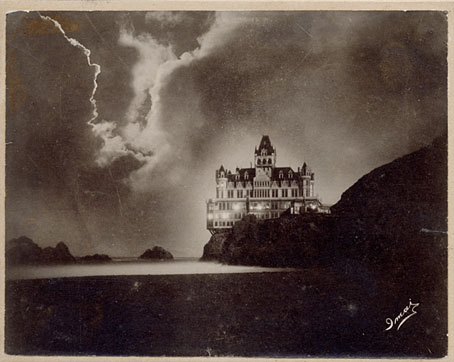
Adolph Sutro’s Cliff House in a Storm (c. 1900) by Tsunekichi Imai.

• Good to see a profile of Wendy Carlos, and to hear that she’s still working even though all her albums (to which she owns the rights) have been unavailable for the past two decades. I’d be wary of praising Switched-On Bach too much to avoid giving new listeners a wrong impression. The album was a breakthrough in 1968 but was quickly improved upon by The Well-Tempered Synthesizer (1969) and Switched-On Bach II (1973). And my two favourites, A Clockwork Orange – The Complete Original Score (1972) and the double-disc ambient album, Sonic Seasonings (1972), are superior to both.

• “[Sandy Pearlman] told me that one of the main inspirations was HP Lovecraft. I said, ‘Oh, which of his books?’ He said, ‘You know, the Cthulhu Mythos stories or At The Mountains Of Madness, any of those.'” Albert Bouchard, formerly of Blue Öyster Cult, talks to Edwin Pouncey about BÖC’s occult-themed concept album, Imaginos (1988), and his affiliated opus, Re Imaginos.

• More electronica: Jo Hutton talks to Caroline Catz, director of the “experimental documentary” Delia Derbyshire: The Myths and Legendary Tapes.

• At the V&A blog Clive Hicks-Jenkins talks to Rebecca Law about his award-winning illustrations for Hansel and Gretel: A Nightmare in Eight Scenes.

• New music: Archaeopteryx is a new album by Monolake; What’s Goin’ On is a further preview of the forthcoming Cabaret Voltaire album, Shadow Of Fear.

Celebrating A Voyage to Arcturus: details of two online events to mark the centenary year of David Lindsay’s novel.

• “Streaming platforms aren’t helping musicians – and things are only getting worse,” says Evet Jean.

• At Spoon & Tamago: the cyberpunk, Showa retro aesthetic of anime Akudama Drive.

• At A Year In The Country: a deep dive into the world of Bagpuss.

Sinister Sounds of the Solar System by NASA on SoundCloud.

• At Dennis Cooper’s: Shirley Clarke Day.

Mary Lattimore‘s favourite albums.

• Solaris, Part I: Bach (1972) by Edward Artemiev | Bach Is Dead (1978) by The Residents | Switch On Bach (1981) by Moderne

Weekend links 542

gysbrechts.jpg

The Reverse of a Framed Painting (between 1668 and 1672) by Cornelis Norbertus Gysbrechts.

• New music with a cinematic flavour: Disciples Of The Scorpion (Main Theme) Heavy Mix by The Rowan Amber Mill is a taster for the group’s forthcoming imaginary soundtrack, Disciples Of The Scorpion (also a sequel of sorts to The Book Of The Lost); The Quietened Dream Palace is this year’s final themed compilation from A Year In The Country. The subject this time is abandoned cinemas, past and present.

San Francisco Moog: 1968–72 by Doug McKechnie, a collection of early synthesizer music using a modular instrument that was later bought by Tangerine Dream. “The quiescent, meditative pulse of the music has much more in common with what would come to be known as the Berlin school of German electronic music than anything coming out of the US at the time,” says Geeta Dayal.

• Sarah Davachi released a new album recently, Cantus, Descant, so The Quietus asked her to discuss her favourite albums. Related: XLR8R has a mix of the music that Davachi regards as influences. Kudos for the choice of Why Do I Still Sleep by Popol Vuh, an overlooked piece from the end of the group’s career.

When I use relevance as a filter for determining what books to read, I’m failing to make myself available for an authentic encounter with otherness, something genuine art always offers. I’m presuming that I can guess, from the barest plot summary, whether a book will be useful in my life. But how can I know what I will find relevant about a work before I have submitted myself to the experience? I don’t think we are likely to be transformed by art if we try to determine that encounter in advance. Part of the vulnerability necessary for transformation is the recognition that I am, to a great extent, a mystery to myself. How could I know what I need?

Garth Greenwell on the idea that a novel is only worthwhile if it is somehow “relevant”

• “For a long time I had been encouraged by the world of fine art to remove references to the spiritual from my work,” says Penny Slinger in a piece by Hettie Judah exploring the resurgence of interest in occult art. Good to see S. Elizabeth and her book on the subject receiving a mention.

• Arriving on Region B blu-ray later this month is Spring (2014) by Justin Benson & Aaron Moorhead, which 101 Films describes as Richard Linklater channeling HP Lovecraft. I enjoyed Benson & Moorhead’s Resolution (2012) and The Endless (2017) so this one is on pre-order.

• Topical books dept: The Man in the High Chair and Other Tyrannies by Kurt Fawver, a benefit publication for the California Coalition for Women Prisoners.

• We never know exactly where we’re going in outer space: Caleb Scharf on the difficulties of aiming for distant objects in an ever-changing universe.

• Submissions open soon for the contemporary Dada journal Maintenant 15, with a theme of “Humanity: The Reboot”. Details here.

• At Dennis Cooper’s: Harry Smith, Filmmaker Day.

Pandemonium – Spring (1985) by Peter Principle | Silent Spring (2006) by Massive Attack feat. Elizabeth Fraser | Spring Stars (2009) by Simon Scott

Raoul Servais: Courts-Métrages

servais.jpg

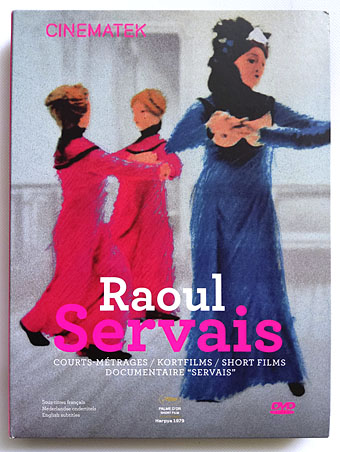
“Courts-métrages”, the French term for short films, is one of those phrases like “bande dessinée” that I prefer to its English equivalent. Among the weekend’s viewing was this double-disc DVD release devoted to the animated films of the Belgian director Raoul Servais. Some of the films are very familiar and have been the subject of previous posts, but the set comprises 14 films in total, and includes many I’d not seen before. Like Jan Švankmajer, Servais is generally the writer/director of his films rather than the animator which accounts for the great variety of graphic styles, although both directors helped animate their early works. The Servais art styles range from the flat UPA-derived idiom of the 1950s, through a variety of drawing techniques, to the later films which deploy “Servaisgraphy”, a process that combines live action and animation with drawn or photographed backgrounds. The last two films in the collection use digital technology.

harpya.jpg

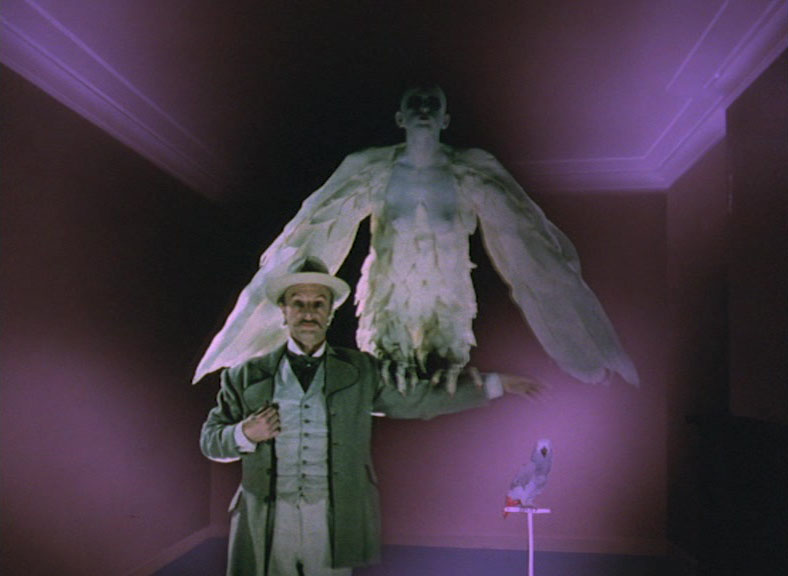
Harpya.

If there’s a common thread to this oeuvre it would be the Belgian brand of Surrealism, which might seem like a lazy comparison when so much animation can be described as superficially “surreal”. In the case of Servais, however, the connection is made explicit in Nocturnal Butterflies, a film dedicated to the Surrealist painter Paul Delvaux, whose paintings also inspired the director’s flawed feature film, Taxandria (1994). The Servais masterwork, Harpya, which won a Cannes Palme d’Or for best short film, is Surrealist to the tips of its feathers, a dark and absurd dream that’s a world away from his moralistic early works. One of the films I’d not seen before, November Diversion, resembles a Švankmajer live-action short, a wordless piece about a man trying to escape from an automobile cemetery. All the shorts have been restored by Cinematek, the Belgian film archive. I ordered my DVDs from Potemkine, Paris.

Contents
Disc 1: Harbour Lights (1960) / November Diversion (1962) / The False Note (1963) / Chromophobia (1965) / Sirene (1968) / Goldframe (1969) / To Speak or Not To Speak (1970) / Operation X-70 (1971) / Pegasus (1973) / Halewyn’s Song (1976) / Harpya (1979) / Nocturnal Butterflies (1998) / Atraksion (2001) / Tank (2015)
Disc 2: Servais (2018), a 60-minute documentary by Rudy Pinceel

Previously on { feuilleton }
Papillons de Nuit, a film by Raoul Servais
Sirene by Raoul Servais
Harpya by Raoul Servais
Taxandria, or Raoul Servais meets Paul Delvaux

Weekend links 532

ashmole.jpg

An alchemical illustration from Theatrum Chemicum Britannicum (1652) by Elias Ashmole.

• “Originally the idea was to do four parallel feuilleton stories, linked at the beginning of each episode by still shots connecting with the other episodes, rather like the old serials.” Jacques Rivette mentions a familiar word during a 1974 discussion with Carlos Clarens and Edgardo Cozarinsky about Out 1 and Céline and Julie Go Boating. I watched all 775 minutes of Out 1 last year, followed by a re-viewing of Céline and Julie, so this was good to read. Elsewhere: “The dizzying Céline and Julie Go Boating is apt viewing for a chaotic present,” says Phillipa Snow.

Away is a wordless feature-length animated film in which a boy is pursued by a lumbering monster after parachuting from a crashing aircraft. It was directed, written, edited, animated and scored by Gints Zilbalodis. Christopher Machell reviewed the film here. Watch the trailer.

• Jean Lorrain’s novel of Decadent dandyism, Monsieur Bougrelon, receives a new English translation by Brian Stableford for Side Real Press. (The Spurl translation by Eva Richter was reviewed here a few years ago.) The new edition includes illustrations by Etienne Drian (1885–1961).

El Topo again, among other things: Mike Soto on the anti-Western genre set in America’s surreal borderlands. Cormac McCarthy is a surprising absence from Soto’s lists despite almost all of his later work being concerned with the border region.

• “Whatever their pursuits, they were extremists who created literature that wasn’t so much great as it was relentless. Even now they make passive reading impossible.” Chris R. Morgan on Swift, Sade and the art of upsetting people.

• The best batch yet? Sean Kitching talks to Gary Lucas and Eric Drew Feldman about the recording of Captain Beefheart’s Doc At The Radar Station.

• Malkovich, Malkovich, Malkovich… Photographer Sandro Miller persuaded John Malkovich to recreate 41 famous photographic portraits.

• An extract from Rated SavX in which Edwin Pouncey/Savage Pencil talks with Timothy d’Arch Smith about his artistic evolution.

• At Dennis Cooper’s: Pat O’Neill Day.

Siavash Amini‘s favourite music.

Get Away (1970) by Ry Cooder | Running Away (2002) by Radar | Fly Me Away (2005) by Goldfrapp

Weekend links 531

miller.jpg

Cover art by Ian Miller, 1979.

• Ray Bradbury was born 100 years ago today. Emily Temple expresses surprise that Truman Capote encouraged the publication of a Bradbury short story at Mademoiselle in 1946. I’m more surprised that Bradbury was paid $400 for his work; no wonder he was so eager to write for the non-genre magazines. Elsewhere: Ray Bradbury—The Illustrated Man: the BBC’s Omnibus arts strand profiled Bradbury in 1980 with enthusiastic assistance (narrating/reading/performing) from the man himself; Ray Bradbury book and magazine covers at Flickr.

Anna Smith asks whether Linda Fiorentino was the greatest femme fatale ever in The Last Seduction (1994). A substantial claim, especially for a neo-noir playing so self-consciously with the theme, but it’s a very good film, and one I’d like to see again.

• “Bad as a work of art, and morally bad…” Vladimir Nabokov’s Lolita being reviewed by Kingsley Amis, a writer who preferred the peerless prose and stainless morals of Ian Fleming. Dan Sheehan looks at other contemporary reactions to Nabokov’s novel.

• At Dennis Cooper’s: Mary Ellen Bute Day, and (how could I avoid it?) ClicketyClack presents…Brothers Quay Day.

• More from The Art of the Occult: S. Elizabeth offers a glimpse of the contents of her forthcoming book.

• Make the letter bigger: John Boardley on the development of the illuminated capital.

• In 1987 Anne Billson talked to Nicolas Roeg about his latest film, Castaway.

• Five controversial arthouse features from Japanese filmmaker Sion Sono.

• It’s that group again: Joe Banks on the strange world of Hawkwind.

C82: Works of Nicholas Rougeux.

Fahrenheit 451 (1982) by Hawkwind | Something Wicked This Way Comes (1996) by Barry Adamson | The Martian Chronicles (2007) by Dimension X