Steampunk overloaded!

infernal.jpg

Yes, it’s the “S” word again, and if there was any doubt that this has been the Year of Steampunk here at Coulthart Towers, look at these recent works. And this is by no means everything I’ve been doing in this area, there’ll be further announcements later on.

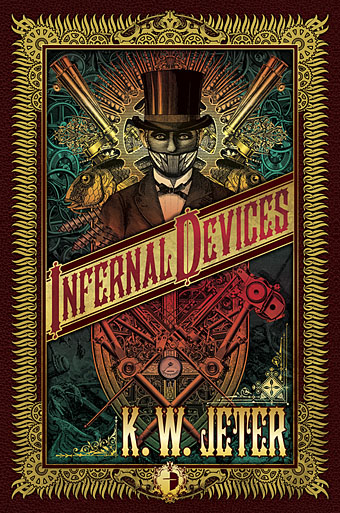
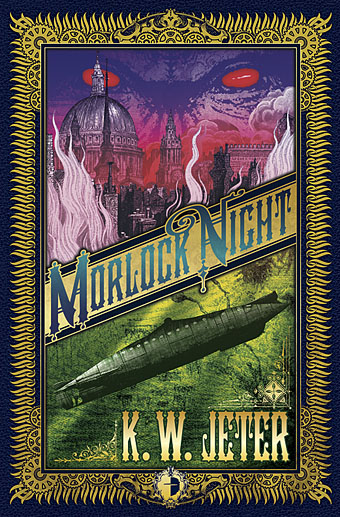
The covers for KW Jeter’s novels are a pair of reprintings from UK publisher Angry Robot whose books will shortly be available in the US and Canada. Jeter is now famous—infamous, perhaps—for having given the word “steampunk” to the world in the early 1980s. This was intended as a jest after he and a couple of other writers (including a favourite of mine, Tim Powers) had written a number of science fiction novels set in the 19th century; like many light-hearted neologisms, it gained a life of its own. Angry Robot are reissuing two of these early works as a result of the ongoing steampunk explosion.
morlock.jpg

Morlock Night (1979) is a pulpy affair which sees the Morlocks from HG Wells’ The Time Machine using the Time Traveller’s vehicle to return to Victorian London and wreak no end of havoc. Infernal Devices (1987) is a rather more substantial confection involving a great deal of clockwork mechanisms (for once the clock parts are justified!), automata, fish people, and a device capable of destroying the earth. I’ve been producing a lot of engraving collage à la Ernst and Sätty recently but the technique seemed especially appropriate here as a means of illustrating works which themselves are collages of Victorian motifs.
zeppelins.jpg

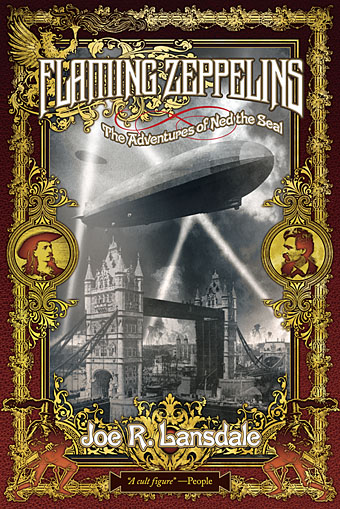
Meanwhile, over at Tachyon Publications, there’s this cover for another Victorian adventure, two in fact, from master beserker Joe R Lansdale. Flaming Zeppelins combines a pair of comic adventures, Zeppelins West (2001) and Flaming London (2006), which feature a host of notable figures including Mark Twain, Annie Oakley, Buffalo Bill Cody…and a talking seal. Publication date is November 1st.
steampunk.jpg

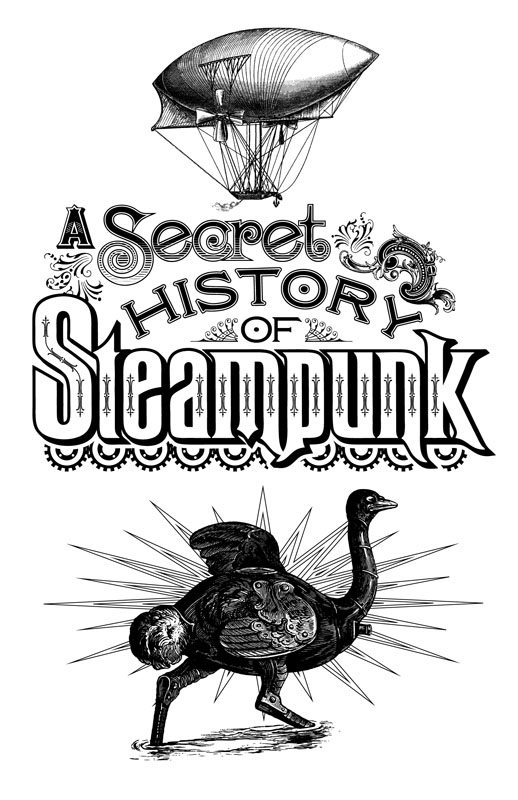
Then from Tachyon in mid-November there’ll be Steampunk II: Steampunk Reloaded, a 430-page anthology edited by Ann & Jeff VanderMeer which includes fiction and non-fiction from William Gibson, Caitlín R Kiernan, Jeffrey Ford, Cherie Priest, and many others. Also a comic strip, copious illustrations and a very full-on interior design from yours truly of which I’ll only show you the above page for the time being. Yes, that’s a mechanical ostrich but if you want to know what it’s doing there you’ll have to read the book. More about this later. And more later about The Steampunk Bible to which I’m also a contributor, a glossy, full-colour guide to the entire sub-culture which will be published next year by Abrams. By the time that appears I’ll probably be sick of the sight of clockwork parts, dirigibles, florid typefaces and Victorian decoration; I’ll be needing a good dose of Helvetica and Josef Müller-Brockmann minimalism to calm down.

Previously on { feuilleton }
Skeleton clocks
Vickers Airship Catalogue
The Air Ship
Dirigibles
More Steampunk and the Crawling Chaos
La route d’Armilia by Schuiten & Peeters
The art of François Schuiten
Steampunk Redux
Steampunk framed
Steampunk Horror Shortcuts
The Airship Destroyer
Zeppelin vs. Pterodactyls

Esquisses Décoratives by René Binet

exposition1.jpg

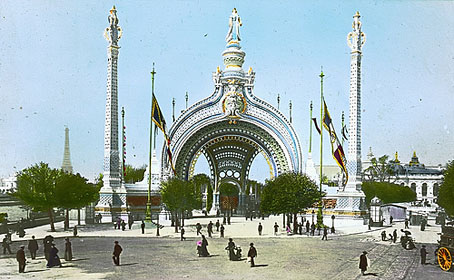
The work of French architect and designer René Binet (1866–1911) has been featured here before with one of his most famous creations, the monumental gate he designed for the Paris Exposition Universelle of 1900. Philippe Jullian in his 1974 book about the exposition, The Triumph of Art Nouveau, calls the gate the “Porte Binet” and also notes that it was referred to as “the Salamander” for its resemblance to the salamander stoves of the period.

binet1.jpg

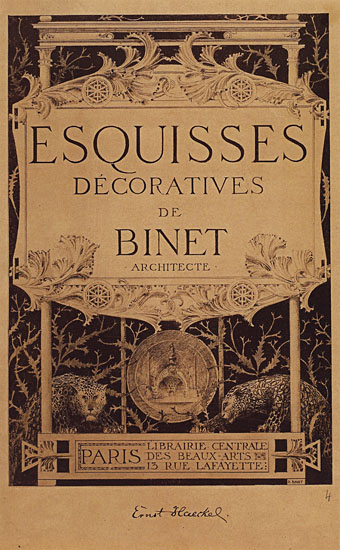
The reference to nature is apt, albeit for a different reason, since it was Ernst Haeckel’s Kunst-Formen der Natur which Binet used as inspiration for his designs, the encrustation on the gate being based on Haeckel’s studies of shell forms. This influence was developed four years later in Binet’s Esquisses Décoratives, a series of speculative designs which applied Haeckel’s work to architecture and interior design as a whole; the Porte Binet can be seen on the title plate above and the print there seems to have been either signed by or dedicated to Haeckel.

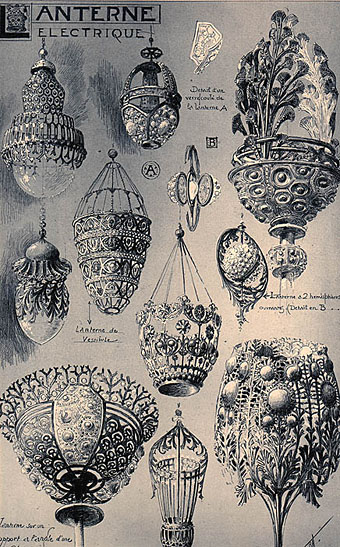
Art Nouveau design is usually thought of in terms of the curvaceous style derived from Alphonse Mucha and others, but there were several designers of the period looking to nature for inspiration in a way which went beyond William Morris’s application of plant forms to flat surfaces. Binet’s lamp designs below show how Haeckel’s sea-life could be transmuted into enclosures for electric lights. These designs hint at a direction which went unexplored in the 20th century; the Art Nouveau style was steadily vulgarised after the Exposition Universelle until it was replaced altogether by the development of Art Deco following the First World War. Binet went on to design the extension of the Paris department store, Printemps, but his huge Art Nouveau atrium was later destroyed by fire.

binet2.jpg

There aren’t many examples of Binet’s designs on web pages, the ones here are from this Flickr set and a vintage print seller. There is a recent study of Binet’s work available, however, René Binet: from Nature to Form by Olaf Breidbach. For an idea of how an entire city based on Haeckel might look, we have Schuiten and Peeters’ imaginary metropolis of Blossfeldtstad whose “Vegetalistic” architecture was featured in an earlier post.

Previously on { feuilleton }
Le Palais de l’Optique, 1900
Exposition Universelle films
Exposition jewellery
Exposition Universelle catalogue
Exposition Universelle publications
Exposition cornucopia
Return to the Exposition Universelle
The Palais Lumineux
Louis Bonnier’s exposition dreams
Exposition Universelle, 1900

Fascinating tentacula

squid.jpg

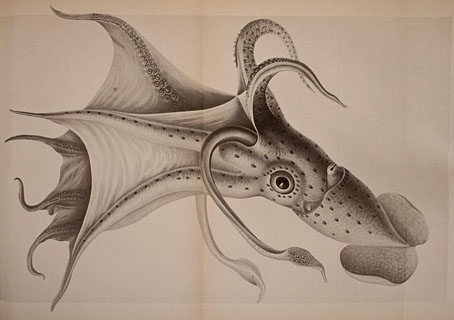
Histioteuthis ruppellii.

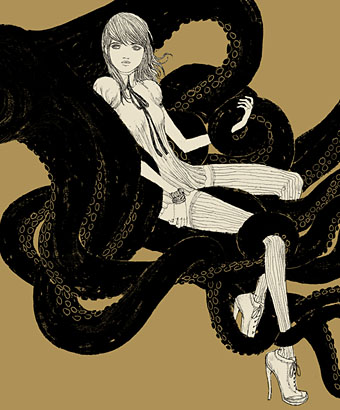
Suckered pseudopods flex and writhe again this week with simultaneous postings at BibliOdyssey and Sci-Fi-O-Rama. Coincidence or some cephalopodic zeitgeist thing? You decide. BibliOdyssey has a fine set of natural history plates showing various squid and octopuses while Sci-Fi-O-Rama presents a small collection of illustrations by Barnaby Ward. If it’s boys and tentacles you want (and who doesn’t?), then there’s always the art of NoBeast.

ward.jpg

Untitled drawing by Barnaby Ward.

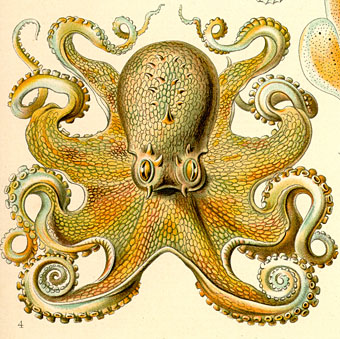
Ernst Haeckel remains my favourite tentacle illustrator, and the octopus below is one of his examples from Kunstformen der Natur (1899–1904). Somewhere (although Cthulhu knows where) I have a drawing by Hal Foster from one of his Prince Valiant strips showing a sinister octopus in a pit which is almost a match for Haeckel’s, and may even have been based on it. If I ever find it again I’ll post it here. Meanwhile, China Miéville’s Kraken is currently lurking on bookshelves, and let me remind you again that he discusses that novel and other works over at Salon Futura. While we’re on the subject, let’s not forget the Octopulps.

haeckel.jpg

Octopus by Ernst Haeckel.

Finally, a note to say that my webhost is moving this site to a new server which may cause some disruption to these pages for the next few days. As always, your patience is appreciated.

Previously on { feuilleton }
Jewelled butterflies and cephalopods
Haeckel fractals
Ernst Haeckel, Christmas card artist
The art of Rune Olsen
Octopulps
The art of NoBeast

Salon Futura #1

salon-futura.jpg

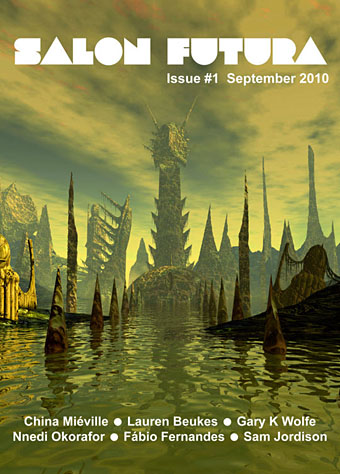
It’s been a pleasure this week seeing my 1999 portrait of Cthulhu’s rotting domicile, R’lyeh, used as the cover image for Salon Futura, a new online magazine edited by Cheryl Morgan. Cheryl describes SF as “a new and hopefully somewhat different magazine devoted to the discussion of science fiction, fantasy and other forms of speculative literature.” Among the contents there’s a podcast interview with Gary K Wolfe, Nnedi Okorafor and Fábio Fernandes (the latter is a contributor to the steampunk book I’m currently designing for Tachyon); there are video interviews with writers Lauren Beukes and China Miéville, and the Guardian‘s Sam Jordison writes an appraisal of EL Doctorow’s 1994 novel The Waterworks (about New York City’s minatory Croton Reservoir) which stimulated my interest enough to make me want to search out the book. And speaking of minatory architecture, {feuilleton} approves of the presence of Taschen’s fat volume of Piranesi works spied on China Miéville’s bookshelf. China always has interesting things to say; go and see for yourself.

Previously on { feuilleton }
Le horreur cosmique

Weekend links 27

wang.jpg

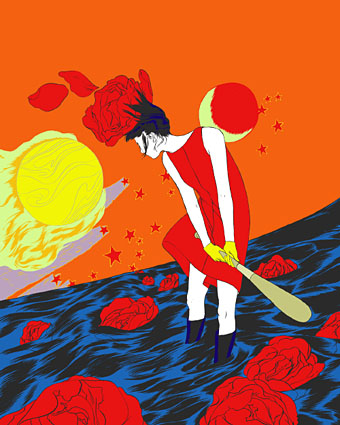
Annie Duels The Sun (2010) by Angie Wang.

I’m interviewed again, this time by James at Cardboard Cutout Sundown. Covering familiar subjects for {feuilleton} readers: art history, design, Lovecraft, the genre/mainstream seesaw, etc. Related: Jeff VanderMeer previewed my design for the forthcoming Steampunk Reloaded.

Battle over legacy of father of Art Nouveau. Prague authorities are demanding the paintings which comprise Alphonse Mucha’s Slav Epic be moved to the capital.

The films that time forgot. David Thomson on ten neglected works including a cult favourite of mine, Jerzy Skolimowski’s Deep End (1970).

The Viatorium Press: “Fine letterpress printing, digital typography, and hand painted illumination.” Among their recent productions is a poem by Clark Ashton Smith.

verne.jpg

À la conquête du pôle (1912); Georges Méliès vs. Jules Verne.

Taxandria, a feature-length collaboration between Raoul Servais, François Schuiten and, er, Alain Robbe-Grillet, is on YouTube. My earlier post about the film is here.

Salvagepunk, or (maybe) Post-post-modernism: “How a music micro-trend heralds an emerging, internet-enabled, aesthetic movement.” See also the latest issue of The Wire.

Drainspotting with Remo Camerota: documenting Japan’s creative manhole covers.

• Yo-ho-ho, and a bottle of squid: a book devoted to Kraken Black Spiced Rum.

After Stanley Kubrick. Christiane Kubrick on life without Stanley K.

• Pills and penises and kissing boys: Tara Sinn’s Kaleidoscopes.

Found Objects: a hauntological dumping ground.

• Sandow Birk’s American Qur’an.

• RIP Frank Kermode.

Feuerland (1968) by Theo Schumann Combo; Feuerland (1977) by Michael Rother; Feuerland (2007) by Justus Köhnke.