
Weekend links 476

kimura.jpg

Man’s body dish for Sashimi under the cherry blossom (2005) by Ryoko Kimura.

• Godley & Creme’s Consequences (1977) is reissued this month on CD and vinyl. Originally a three-disc concept album with a theme of climate disaster and the natural world’s revenge on humanity, Consequences was released at a time when punk and prog rock were fighting for the attention of music listeners. 1977 wasn’t the end of prog by any means (many of the vilified bands had some of their greatest successes at this time) but Godley & Creme’s transition from the smart pop songs of 10cc to extended instrumental suites was abrupt, and their concept, such as it was, lacked the drama and accessibility of Jeff Wayne’s The War of the Worlds, even with the addition of Peter Cook providing a multi-voice comic narrative between the musical pieces. (Kevin Godley ruefully referred to the album in later years as Con Sequences.) The album flopped, and has been a cult item ever since.

• “A word of caution, though. Once you do read it, it’s hard to let it go.” Philip Hoare on Herman Melville and Moby-Dick. Related: William T. Vollmann on how a voyage to French Polynesia set Herman Melville on the course to write Moby-Dick.

Samm Deighan on The “Faraway Forest” in Peter Strickland’s Katalin Varga, The Duke of Burgundy, and The Cobbler’s Lot.

Brian Eno, Roger Eno, and Daniel Lanois discuss the recording of Apollo: Atmospheres & Soundtracks.

John Boardley on the first fashion books, Renaissance pixel fonts and the invention of graph paper.

Melanie Xulu looks back at a time where major labels were releasing witchcraft rituals.

• “Tom Phillips’ A Humument is a completely novel project,” says Rachel Hawley.

John Foster on the evolution of Stereolab’s analogue-inspired record sleeves.

• At Dennis Cooper’s: a history of le Grand Guignol by Agnes Peirron.

Casey Rae on William S. Burroughs and the cult of rock’n’roll.

• An Austin Osman Spare image archive.

Consequences (1965) by John Coltrane | Moby Dick (1969) by Led Zeppelin | Consequence (1995) by Paul Schütze
Weekend links 474

moon.jpg

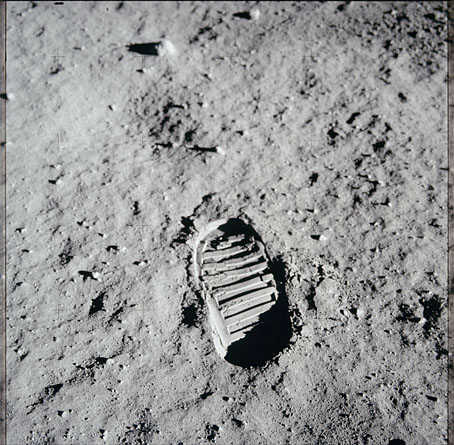
AS11-40-5877 (1969).

• A minimum of Moon-related links this week because this is a subject I always return to. Previous links to NASA’s photo archives are now redundant after they changed their website but the archive of photos from the Apollo missions are currently hosted on Flickr…while Flickr lasts, anyway. The Albums section features whole film rolls from each of the missions.

• Mixes of the week: Stephen O’Malley presents In Session: Richard Pinhas (a re-posting of a mix from last year), and The Ivy-Strangled Path Vol. XVII by David Colohan.

• Living With The Human Machines: experimental artist Sarah Angliss speaks to Matthew Neale about the cyborgs, dummies and ghosts that populate her work.

• On And On And On: A Guide to Generative Electronic Music. Related: Deconstructing Brian Eno’s Music for Airports.

• At Dennis Cooper’s: Jesse Bransford presents…A List of Grimoires for the Twilight of the Age of the Book.

A Dandy in Aspic exclusive: Paul Gallagher interviewed cult author Derek Marlowe in 1984.

• From Ted Hughes to HG Wells: Jeanette Winterson picks the best books about the Moon.

• Tate acquires vast archive of British surrealist Ithell Colquhoun.

• At Greydogtales: Ten supernatural stories which stay with you.

• Emptyset turn to machine learning on new album Blossoms.

• Paul Grimstad on the absolute originality of Georges Perec.

• Valerie Stivers on cooking with Bruno Schulz.

• Blown out ’77: in the studio with Suicide.

Astronauts on record covers.

Back Side Of The Moon (1991) by The Orb | Moonshot (1999) by Hallucinator | Under The Moon (2019) by Brian Eno with Daniel Lanois & Roger Eno

Weekend links 473

spectra.jpg

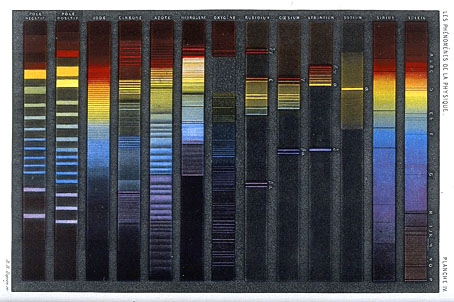
“Spectra of various light sources, solar, stellar, metallic, gaseous, electric”, print by René Henri Digeon; plate IV in Les phénomènes de la physique (1868).

• More polari: Thom Cuell this time with another review of Fabulosa!: The Story of Polari by Paul Baker. Good as it is to see these articles, one thing they all share is paying tribute to the polari-enriched radio series Round the Horne without crediting its writers, Barry Took and Marty Feldman.

• “…with its conspiracy theories, babbling demagogues and demonised minorities, Bahr’s investigation is sadly all too relevant today.” Antisemitism (1894) by Hermann Bahr, is the latest new translation from Rixdorf Editions.

Isao Tomita in 1978 showing a presenter from NHK around his tiny studio. Japanese-only but the discussion reveals that the words “synthesizer”, “tape recorder” and “mixer” sound the same as they do in English.

Ben Frost talks to Patrick Clarke about his music for German TV series, Dark.

• PYUR composes a guide through limbo with Oratorio For The Underworld.

• Steven Heller on Don Wall’s book design for a Paolo Soleri retrospective.

• Coming soon from Fulgur Press: Ira Cohen: Into the Mylar Chamber.

Will Harris compiles an oral history of Q: The Winged Serpent.

• Mix of the week: a mix for The Wire by Overlook.

• At Dennis Cooper’s: Magic Shop Internationale.

Shadow In Twilight by Pram.

The Feathered Serpent Of The Aztecs (1960) by Les Baxter | The Serpent (In Quicksilver) (1981) by Harold Budd | Black Jewelled Serpent Of Sound (1986) by The Dukes Of Stratosphear

Allerlei Gedanken in Vignettenform

czeschka01.jpg

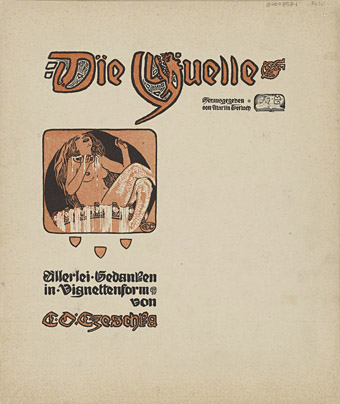
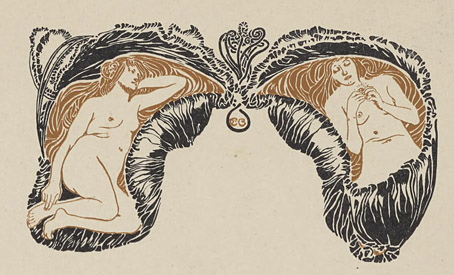
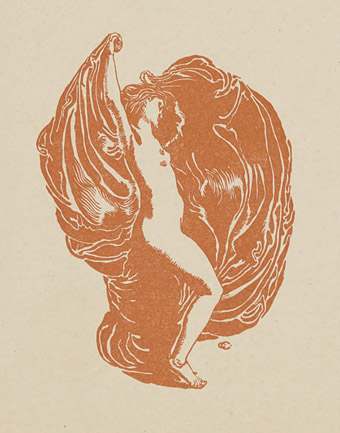
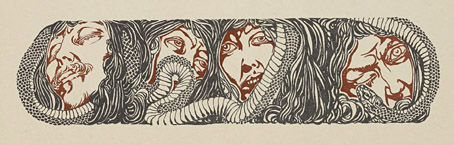
In a post from November last year I expressed a hope that the Internet Archive might add more of the design source books in the Quelle series to its collection. Fast forward a few months and here’s another of the books, this time showcasing the work of Carl Otto Czeschka (1878–1960). As with the Max Benirschke volume, the Czeschka book is a collection of graphics for use by artists, designers and printers. Where Benirschke presented pages of decorative motifs in the Art Nouveau style, Czeschka’s work is more illustrational, and more limited in its use, with some of the pieces intended to function as ex libris plates or menu headers. Considering that these designs were meant to have a general application there’s a surprising quantity of beetles and skeletons/skulls in Czeschka’s drawings; he even manages to put a skull into a drawing of that fin-de-siècle staple, the peacock feather. Browse or download the book here.

czeschka02.jpg

czeschka03.jpg

czeschka04.jpg

Continue reading “Allerlei Gedanken in Vignettenform”

Weekend links 471

maclean.jpg

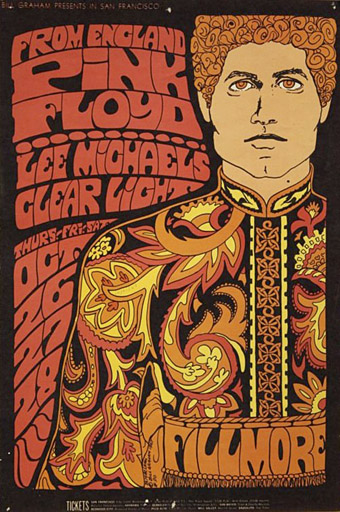
Pink Floyd, Lee Michaels, Clear Light (1967) by Bonnie MacLean.

• Electronic musician Mort Garson has been subject to a revival of interest recently, with reissues of his works as Ataraxia (The Unexplained), and Lucifer (Black Mass). The latest reissue is Mother Earth’s Plantasia (1976), an album released under Garson’s own name, and one of several works of plant mysticism from the 1970s (see Stevie Wonder’s Journey Through The Secret Life Of Plants, and Green by Steve Hillage).

• “It is striking how much of this work sounds like a missing link from the art world to the popular groups of the time, such as the Detroit techno pioneers Cybotron and the Japanese electro legends Yellow Magic Orchestra.” Geeta Dayal on the reconfigured Speak & Spell machinery of Paul DeMarinis.

The cost of free love and the designers who bore it: Madeleine Morley meets the women of psychedelic design.

For the transhumanist anarchist Wilson, the neurological relativism revealed by his own learning and personal deprogramming experiments called for a form of ‘guerrilla ontology’ that lampooned, rejected and transmitted much needed interference into the ‘reality tunnels’ that attempt to control much of contemporary society and individual behaviour. In the Schrödinger’s Cat Trilogy, characters are repeatedly placed in positions of cognitive dissonance, where they are forced to reevaluate their own belief systems due to experiences that they are unable to accommodate.

Sean Kitching on the 40th anniversary of Robert Anton Wilson’s Schrödinger’s Cat Trilogy

• They said books were dead, they were wrong: Adrian Shaughnessy on a decade of Unit Editions.

• Mixes of the week: Xianedelica by Jesús Bacalão, and Kosmische Mix By Tarotplane.

• Swinging 60s surrealist Penny Slinger: “Collectors thought I came with the art”.

• Cabaret Voltaire: Chance Versus Causality (Teaser).

Luc Sante on postcards of American violence.

• At Dennis Cooper’s: Peter Whitehead Day.

Computerwelt (1981) by Kraftwerk | Speak And Spell (1984) by Christina Kubisch | Time Space Transmat (1985) by Model 500