Weekend links 626

conformist.jpg

Czech poster for Bernardo Bertolucci’s The Conformist. Art and design by Miroslav Pechánek, 1972.

• “Acknowledgements are not part of the novel; in fact, they break the spell the author has spent 200 or more pages weaving. We should take a book on its merits, knowing as little about the author as possible. As one reader put it to me, ‘the end of a book is time for thinking about the book, not for an acceptance speech’.” John Self on dedications and acknowledgements.

• Mixes of the week: a Power Ambient mix by A Strangely Isolated Place, and a mix for The Wire by Nexcyia.

• At Spoon & Tamago: 3D-scanned stones create vessel for human-made interventions.

Weeks turned into months. Slowly it dawned on me that I was performing the role of Boswell for a man who might be: a) a put-on maestro or arcane troll; b) a fiction writer slash performance artist; or c) a lunatic. But by his own admission King had tagged me with a familiar spirit. Whether or not he was telling the truth was irrelevant at this point. I could feel something squatting on my soul. I needed to see what it was.

Kent Russell on looking for demons in a disenchanted world

• A trailer for Mad God, Phil Tippett’s 30-years-in-the-making animated feature.

• New music: Vesta by Azu Tiwaline, and Right, Right, Right by Nils Frahm.

• At Dennis Cooper’s: Max Hattler Day.

• “Marcel Duchamp was not a thief.”

• RIP Jean-Louis Trintignant.

Demons Of Rage (1972) by Nik Raicevic | Shall Come Forth The Demons (1991?) by Yuri Morozov | Angels Of Darkness, Demons Of Light (2011) by Earth

A Penrose pentagram

hofstadter.jpg

A classic text although that cover art always looks a little off. I’m sure MC Escher would have insisted on the triangle being equilateral.

Most people are familiar with the Penrose triangle by sight even if they don’t know who “Penrose” was. (Psychiatrist Lionel, together with his son, Roger, the celebrated mathematician and physicist.) I’ve been playing with these things for years, most notably on the cover art I created for Zones by Hawkwind, although the triangle also formed the basis for the robot pathways I created a couple of years ago when illustrating Bruce Sterling’s Robot Artists and Black Swans.

pentagram.jpg

Earlier this week it occurred to me that I hadn’t tried applying the Penrose effect to a pentagram. For a fleeting moment I thought the idea might be a novel one but a quick web search disabused me of this; plenty of similar examples exist already. Here it is anyway, after 20 minutes or so in Illustrator. I’m tempted to try a few more things like this when I have the time. Many possibilities present themselves.

Previously on { feuilleton }
More Swans and Robots

Weekend links 624

griffiths.jpg

An alphabet designed by Ben Griffiths. Via.

• “From the cellular to the galactic, via Paleolithic cave markings to the trace impressions left by drone photography on our mind’s eye, incorporating dancing plagues, communist psychedelic witches, hyper-sexual fungi, chthonic descents, and skyward ascents, The Neon Hieroglyph weaves together a series of painterly and poetic considerations on a feminized history of the rye fungus Ergot, the chemical basis of LSD.” Coming soon from Strange Attractor: The Neon Hieroglyph, a book, LP and folio of prints by Tai Shani.

• “3rd From The Sun was the last album of Chrome’s imperial phase, and it cemented their status as one of the most inhuman and superhuman rock bands that America ever produced. More people need to recognize.” Agreed. (previously)

• “People often say, ‘How can you be so disciplined?’ It’s easy. Otherwise, I would have to go work for somebody else!” John Waters (again). Also here.

I’ve always thought that literature should be entertaining as well as instructive—a very old-fashioned idea but one that I adhere to. When I set out to write in this way—particularly in this way, a political way, if you want to call it that—I intend to make a donation, to try to give something. There doesn’t seem to me to be any point in giving more misery or exacerbating unhappiness through some kind of hyper-intellectual, pyrotechnical writing about unhappiness and the shit that we all find ourselves in. That’s been done plenty. I think first of all that it doesn’t need to be done any more and second of all there’s a kind of reactionary aspect to it which is that the emphasizing of misery without any anti-pessimism, as you put it, would be simply seduction into inactivity and political despair. In other words, to do politics at all on any level, especially on a revolutionary or on an insurrectionary level, there has to be some anti-pessimism—I won’t say optimism because that sounds so fatuous, futile; but anti-pessimism is a nice phrase. And there’s a deliberate attempt at that in the writing. Then again it’s a matter of my personality, I guess, inclined towards the notion of the healing laugh to some extent. We have an anarchist thinker in America, John Zerzan, who wrote an essay against humour which maybe is one of the things I was reacting against. Even if irony is counter-revolutionary which I think it might be to a certain extent I don’t see any way in which you could say that laughter itself is counter-revolutionary. This doesn’t make any sense to me unless you mean to get rid of language and thought altogether, which is just another form of nihilism. So as long as you’re going to accept culture on some level you’re certainly going to have to accept humour. And as long as you’re going to have to accept humour you might as well see humour as potentially revolutionary.

Peter Lamborn Wilson aka Hakim Bey, who died last month. Many of Wilson’s writings are available at The Anarchist Library. From 2008: A poem for Leonora Carrington

• “It’s such a fundamental question,” says Midori Takada, “why do humans need to make rhythm, and the space that structure creates?”

• “14 Warning Signs That You Are Living in a Society Without a Counterculture” by Ted Gioia.

• A trailer for Earwig, the new film from Lucile Hadžihalilović, based on a story by Brian Catling.

• New music: Aura by Hatis Noit, and Warmth Of The Sun by Pye Corner Audio.

• At Dennis Cooper’s: Spotlight on…SE Hinton Rumble Fish (1975).

• “Hear tracks from the 1980s Peruvian electronic underground”.

Intermittent Eyeball Fodder at Unquiet Things.

West Tulsa Story (1983) by Stewart Copeland | Kála/Assassins Of Hakim Bey (1997) by Coil | Neon Lights (2000) by Señor Coconut Y Su Conjunto

Drone Mass

johannsson.jpg

Design by Florian Karg.

You’d think someone would have used the title Drone Mass prior to this new release but it seems not. The album is the premiere recording of a late composition by Jóhann Jóhannsson, performed by the composer’s regular collaborators in the American Contemporary Music Ensemble, together with Theatre of Voices and their conductor Paul Hillier. The album title and the presence of a choral group raises expectations of a religious Mass but John Schaefer’s notes draw attention to the title’s ambiguities, Jóhannsson having said that he was thinking as much about airborne drones as sustained sounds. (The Khephri scarab on the cover has a rather drone-like appearance.) Schaefer also notes that the word “mass” can refer to physical substance as well as religious ritual.

As to the substance of the music, there is a superficially religious quality to the first two pieces, a feature deceptive enough to make the album the kind of thing I’d like to play to the unsuspecting. Without knowing what to expect you could easily imagine the rest of the suite developing like an Arvo Pärt composition (and Theatre of Voices/Paul Hillier have performed Pärt on several occasions) until you reach the dissonant waves of the third piece, Triptych In Mass, after which various electronic rumbles and distortions arrive to take the album into a very different sphere. One of the pleasures of Jóhannsson’s compositions was this juxtaposition between the familiar structures and instruments of classical composition with sounds processed by computer software. The combination isn’t exactly new, Edgard Varèse was doing the same as far back as the 1930s (he also discussed his music in terms of “sound masses”), but in 20th-century examples the orchestral component is always striving to seem as fresh and as different as the electronics genuinely were. What you didn’t get then—because any such music would have been deemed old-fashioned or even reactionary—is this blending of traditional chords and harmonies with sounds that originate in the latest digital processes. After the release of Last And First Men I hadn’t been expecting any new Jóhannsson compositions (although previously unreleased soundtracks keep turning up) so this is all very welcome.

If you’ve looked at Florian Karg’s cover and are wondering what any of the above has to do with Ancient Egypt, an explanation may be found inside the album where a photo shows the 2015 premiere performance of Drone Mass taking place outside the Temple of Dendur at the Metropolitan Museum of Art, New York. That bright yellow Deutsche Grammophon logo has become something to watch for in recent years. The DG cartouche has always been a trademark of quality where classical recordings are concerned but the label has a somewhat broader remit today, releasing many more soundtrack albums than they would have done in the past, in addition to non-soundtrack works by Jóhann Jóhannsson, Max Richter and others. Oddly enough (considering the news last week), the new direction was begun by Vangelis in 1985 when his Invisible Connections album was released on DG instead of its pop sibling, Polydor. This was very surprising at the time even though the label had been releasing avant-garde compositions for many years; the first Stockhausen album I bought in 1981 was a secondhand DG release of Mikrophonie I & II. Some of the recent remixes of old Berlin Philharmonic recordings will have set Herbert von Karajan spinning in his sarcophagus but the label hasn’t pushed things too far in that direction, and if the poppier works pay for new recordings such as this one then I’m not complaining.

Previously on { feuilleton }
Jóhannssonia
Last and First Men

Weekend links 622

balbi.jpg

Testa Anatomica (1854) by Filippo Balbi.

The New School of the Anthropocene is “…an experiment. But it is also an act of repair. In partnership with October Gallery in London, we seek to reinstate the intellectual adventure and creative risk that formerly characterised arts education before the university system capitulated to market principles and managerial bureaucracy… (more)”

• “Every once in a while, you come across old music that generates a shock of new excitement.” Geeta Dayal on Oksana Linde whose electronic compositions are being released in a retrospective collection next month.

• More Walerian Borowczyk: Anatomy of the Devil, a collection of Borowczyk’s short stories, newly translated into English by Michael Levy, and with a cover design by the Quay Brothers.

• Washing machines, garden snails, and plastic surgery: A stroll through the Matmos catalogue. Related: “Why scientists are turning molecules into music.”

• Coming soon from Strange Attractor: Boogie Down Predictions, Hip Hop, Time and Afrofuturism, edited by Roy Christopher.

• At Spoon & Tamago: Exploring Japan’s historical landmarks and shrines in the middle of streets.

• New music: Adrian Sherwood Presents: Dub No Frontiers, music by female dub artists.

Winners of the 2022 Milky Way Photographer of the Year.

• A Vision In Many Voices: The art of Leo and Diane Dillon.

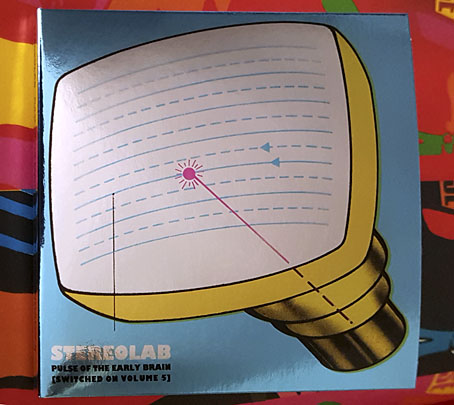
Molecular Delusion (1971) by Ramases | DNA Music (Molecular Meditation) (1985) by Riley McLaughlin | Pop Molecule (Molecular Pop 1) (2008) by Stereolab