Weekend links 99

moebius.jpg

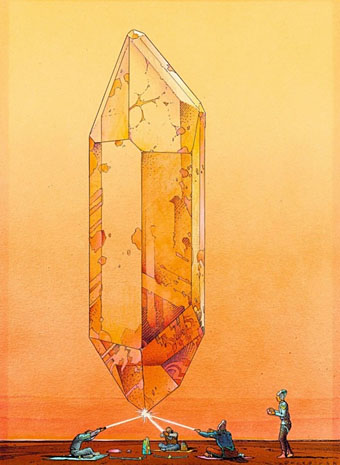
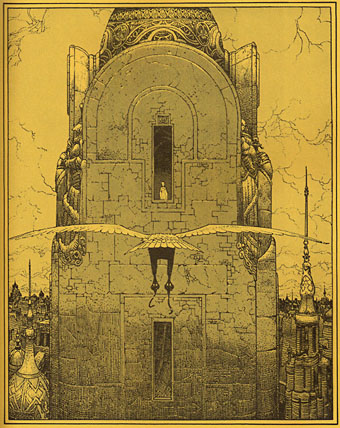
From the Crystal Saga portfolio (1986) by Moebius. Via Quenched Consciousness.

Moebius: A while ago, [science fiction] was filled with monstrous rocket ships and planets; it was a naive and materialistic vision, which confused external space with internal space, which saw the future as an extrapolation of the present. It was a victim of an illusion of a technological sort, of a progression without stopping towards a consummation of energy. But we’ve completely changed that vision. It’s been a sharp, radical change, and somewhat brutal.
HM: Why brutal?
Moebius: Because all those beautiful projects we believed in are gone. But the real sense of science fiction is the discovery that the voyage is interior, and the real energy, the rockets of the past, is what is contained in people’s spirits.
HM: One doesn’t have to read other people’s visions then, one can make the discovery oneself?
Moebius: Well, that, and also the fact that the “new planet” of old science fiction is right here: it’s the Earth.

The Moebius Interview by Diana K. Bletter, Heavy Metal, August 1980.

RIP Jean Giraud, aka Moebius, one of the great artists of the 20th century. My approach to drawing comics was almost wholly derived from the illustrational style of the French, Belgian and other artists being published in Heavy Metal magazine in the late 1970s/early 1980s. Many of the stories were appearing in English for the first time, and for me they revitalised a medium in which (undergrounds aside) I’d lost all interest. It wasn’t only the exceptional artwork that was attractive. The narratives of Moebius, Druillet, Bilal and co. presented a more sophisticated approach to science fiction and fantasy than the simple-minded fare filling the superhero titles or the pages of 2000 AD. Moebius’s work was wittier, sexier and far more imaginative than any American comics I’d seen up to that time. Some of the stories read like graphic equivalents of New Worlds-era science fiction so it came as no surprise to find Moebius drawing a strip called The Airtight Garage of Jerry Cornelius (the title was later amended at Moorcock’s request) while Druillet in his September 1980 Heavy Metal interview mentioned enjoying books by William Burroughs, Michael Moorcock and Thomas Disch, and singled-out Ballard’s Crash as a favourite novel. Without the examples of Druillet and Moebius (and the intoxicating inspiration of the October 1979 issue of Heavy Metal) I wouldn’t have spent 17 months adapting The Call of Cthulhu as a comic strip.

Hasko Baumann’s 2007 documentary, Moebius Redux: A Life in Pictures (some of which can be seen on YouTube) is a good place to start when trying to appraise Jean Giraud’s extensive career. The film is now available on DVD.

Update:
The hour-long cut of Moebius Redux has been posted to Vimeo
An obituary by Kim Thompson at The Comics Journal
The Moebius posts at But Does It Float
moebius2.jpg

From Les Yeux du Chat (1978) by Jodorowsky & Moebius. Via Quenched Consciousness.

• “Naked Lunch,” Ballard wrote later, “was a grenade tossed into the sherry party of English fiction.” The criss-crossing careers of JG Ballard and William Burroughs are examined in detail at RealityStudio. Related: The Discipline of D.E. (1982) by Gus Van Sant and The Unlimited Dream Company (1983) by Sam Scoggins.

• Dr John’s forthcoming album, Locked Down, has been produced by The Black Keys‘ Dan Auerbach. Those of us who favour the Doctor’s voodoo-inflected early albums are hoping this might mean he gets groove back after wandering for years in an MOR swamp. One of the new recordings, Revolution, sounds promising.

I don’t think sexuality is fixed anymore. I think more from the gay male side than the lesbian side, there is often a wish for things to be fixed. I heard Lady Gaga’s Born This Way and I don’t know why they like it. Maybe, they need more certainty than girls do. For me, it’s like why do you care anyway? Maybe you were, maybe you weren’t. What’s the big deal? I can’t connect to that emotionally, so it baffles me.

Jeanette Winterson talks to Sassafras Lowrey.

• “In [Jacob’s Room], [Virginia] Woolf makes the subject matter not Jacob himself but the ways in which we know and don’t know each other – the gaps in our knowledge.” Alexandra Harris on Modernism in art and literature.

• The Northwest Film Forum in Seattle hosts Magick in Cinema on 5th April, an evening of occult-themed short films which includes a rare screening of Curtis Harrington’s Wormwood Star.

• John Bertram’s Lolita cover competition from 2009 is due to appear in June as a book-length study entitled Recovering Lolita. Bertram previews the contents here.

• “Erotic fiction is having a steamy renaissance and its hottest authors are women.”

LSD helps to treat alcoholism.

• The other Moebius (Dieter): News (1980) by Moebius & Plank | Tollkühn (1981) by Moebius & Plank | Conditionierer (1981) by Moebius & Plank.

Maps of Midtown Manhattan

manhattan1.jpg

Midtown Manhattan by Constantine A. Anderson.

Yesterday’s link to a Domus article, The importance of being axonometric, features an interview with map and chart collector Michael Stoll whose Flickr account has some wonderful samples from his archives. Among the many city charts there are several maps of New York in various axonometric projections including this example designed by Constantine A. Anderson for the Manhattan Map Corporation in 1985. Anderson’s map is like a modern equivalent of Turgot’s map of Paris, and caught my attention for possibly being the one that comic artist Dave Gibbons used for reference when he was drawing Watchmen in 1986. Gibbons and Watchmen writer Alan Moore mentioned the map in the huge round table discussion I posted here in 2006 (the discussion at this point concerns the story’s recurrent street corner location):

Dave Gibbons: I didn’t actually make a model of it, although when we first conceived it I did draw a streetmap.
Alan Moore: Well, we checked it up on a map of New York.
Fiona Jerome: It’s really there?
DG: It’s a feasible corner—I’ve got a map at home.
Steve Whittaker: I noticed you put Forbidden Planet N.Y. in there at one stage—where they’re selling all the pirate comics.
AM & DG: No, that’s Treasure Island.
DG: Which would, if you had pirate comics, be FP. At home I’ve got this brilliant map they do which is an isometric projection of New York, so not only is it a street map but it’s all the buildings standing up and it’s got all the post boxes and the trees.
AM: It’s lovely, it’s a work of art you can wander round New York in your head.
DG: It’s about this big but… you know the joke about New York people look at it and say “When’s it going to be finished?” It’s the same with this map, it’s never actually finished because as fast as they put buildings in it, other ones are torn down. There are places in it where there’s just a site with a crane or something.
[…]
DG: But that corner, l’m sure that at some time I’ve been to New York I must have walked past that corner. In fact, what I’d really like to do, the next time I go, is actually walk to that junction and see what’s there. On the isometric map there is a fairly new high rise building which could be the Institute for Extra Terrestrials, another building which looks like a cinema to me because it’s got a curved front, and there are some other, lower buildings.
SW: And a fast food chain, perhaps?
DG: That intersection is feasible, right down to the way that the sun rises. This isn’t just down to me. Alan obviously made specific provision for this in his script. The sun actually does rise in the east end sets in the west, and if you look at the thing, if it’s afternoon the shadows are going this way and in the mornings the shadows are going the other way.

I could no doubt have confirmed this by asking DG on Twitter but didn’t want to pester him. Suffice to say there can’t have been many super-detailed axonometric maps of New York being produced at this time. As Gibbons notes, city maps date very quickly: to see a century of change at work compare this equally detailed map from 1879 with Anderson’s views. Stoll has a more recent axonometric map of New York by Tadashi Ishihara but that’s now twelve years old so it’ll also be out-of-date. If we want a close view of New York’s streets today we can simply fire up Google Earth but there’s still something graceless and clunky about the 3D boxes it imposes on the city’s streets. For the moment these views, especially Anderson’s meticulous line renderings, remain hard to beat.

manhattan2.jpg

Previously on { feuilleton }
The Turgot Map of Paris
Watchmen

Weekend links 96

nunez.jpg

Sin título (monstruas) (2008) by Marina Núñez.   

• Salon asks Christopher Bram “Is gay literature over?” Bram’s new book, Eminent Outlaws: The Gay Writers Who Changed America, is reviewed here.

Robert Montgomery is profiled at the Independent as “The artist vandalising advertising with poetry.”

In addition to aesthetics, McCarthy noted a deeper link between great science and great writing. “Both involve curiosity, taking risks, thinking in an adventurous manner, and being willing to say something 9/10ths of people will say is wrong.” Profound insights in both domains also tend arise from a source beyond the limits of analytic reason. “Major insights in science come from the subconscious, from staring at your shoes. They’re not just analytical.”

Nick Romeo meets Cormac McCarthy at the Santa Fe Institute.

• For FACT mix 316 Julia Holter mixes radio broadcasts, street recordings and music.

• This week in the Tumblr labyrinth: fin de siècle art and graphics from Nocnitsa.

“There’s a widespread cultural barrenness across art and political culture. But there are some pockets of resistance on the extreme margins, like the techno-savvy protest movements, small press, the creator-owned comics, that seem to be getting some signs of hope for the future,” he says. “All of the genuinely interesting work is being done on the margins, with independent companies, self-producing, and alternative distribution networks.”

Alan Moore on Watchmen’s “toxic cloud” and creativity v. big business.

Stone Tape Shuffle, a 12” LP of readings by Iain Sinclair. Limited to 400 copies.

Monolake on how we cope with death: mythologies, rituals, drugs and Ghosts.

Kraftwerk perform at New York’s Museum of Modern Art in April.

Kathy Acker (in 1988?) interviewing William Burroughs.

pogany.jpg

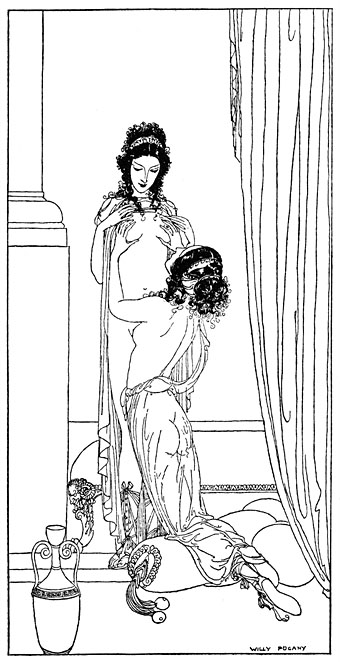
Willy Pogány’s erotica: illustrations for a 1926 edition of The Songs of Bilitis by Pierre Louÿs.

• Nicholas Lezard on David Lynch: director of dreams.

Did otherworldly music inspire Stonehenge?

Coilhouse has an Eyepatch Party.

Tanzmusik (1973) by Kraftwerk | The Model (1992) by the Balanescu Quartet | Trans Europe Express (2003) by the Wiener Sinfonie Orchestra & Arnold Schönberg Choir.

Weekend links 95

skidoo.jpg

Seven Songs (1982) by 23 Skidoo. Sleeve by Neville Brody.

The first volume of The Graphic Canon will be published in May by Seven Stories Press, a collection of comic strip adaptations and illustrations edited by Russ Kick. The anthology has already picked up some attention at the GuardianWestern canon to be rewritten as three-volume graphic novel—and Publishers’ WeeklyGraphic Canon: Comics Meet the Classics. I know someone who’ll bristle at the lazy use of “graphic novel”. The Graphic Canon isn’t anything of the sort, it’s a three-volume voyage through world literature presented in graphic form with a list of contributors including Robert Crumb, Will Eisner, Molly Crabapple, Rick Geary, and Roberta Gregory. My contribution is a very condensed adaptation of The Picture of Dorian Gray that will appear in volume 2. More about that closer to the publication date.

• LTM Records announces a vinyl reissue for Seven Songs (1982) by 23 Skidoo, an album produced by Ken Thomas, Genesis P Orridge & Peter Christopherson that still sounds like nothing else. Related: an extract from Tranquilizer (1984) by Richard Heslop, cut-up Super-8 film/video with audio collage by 23 Skidoo.

• New exhibitions: Another Air: The Czech–Slovak Surrealist Group, 1991–2011 at the Old Town City Hall, Prague (details in English here), and Ed Sanders – Fuck You / A Magazine of the Arts 1962–1965 at Boo-Hooray, NYC.

• “…we have a situation where the banks seem to be an untouchable monarchy beyond the reach of governmental restraint…” Alan Moore writes for the BBC about V for Vendetta and the rise of Anonymous.

Announcing Arc: “a new magazine about the future from the makers of New Scientist“. Digital-only for the time being, as they explain here. Their Tumblr has tasters of the contents.

• From another world: Acid Mothers Temple interviewed. Also at The Quietus: Jajouka or Joujouka? The conflicted legacy of the Master Musicians.

• More from Susan Cain on introverts versus extroverts. Related: Groupthink: The brainstorming myth by Jonah Lehrer.

Ten Thousand Waves, an installation by Isaac Julien.

Afterlife: mouldscapes photographed by Heikki Leis.

• The book covers of Ralph Steadman. And more.

• “James Joyce children’s book sparks feud

Arkitypo: the final alphabet.

Book Aesthete

Kundalini (1982) by 23 Skidoo | Vegas El Bandito (1982) by 23 Skidoo | IY (1982) by 23 Skidoo

Book talk

shevdon.jpg

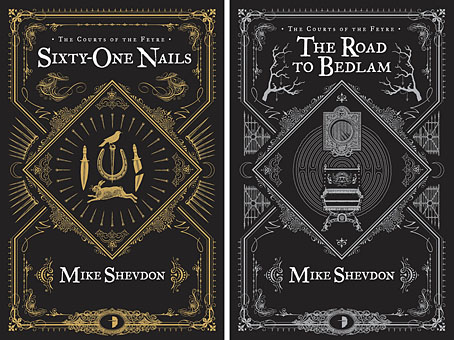
I posted my covers for the Angry Robot editions of Mike Shevdon’s Courts of the Feyre series last month. Last week Mike asked me to answer a few questions about the design process and related matters. The answers are now posted on his blog where I discuss art, book design, favourite reading and a couple of the things I plan to foist on the world in the near future.

Not mentioned there but due on the shelves later this year is The Graphic Canon, a collection of adaptations in comic strip and illustration form of literary works from the Epic of Gilgamesh on. Seven Stories Press is the publisher, Russ Kick is the editor, and my contribution is a condensation of The Picture of Dorian Gray. The first of the three volumes will be out in April. More about that later.

Previously on { feuilleton }
The Courts of the Feyre