Ah Pook Is Here

pook1.jpg

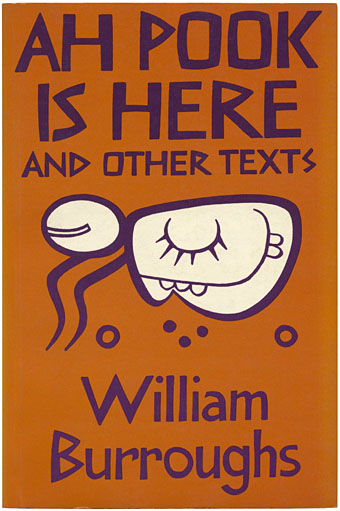
John Calder edition (1979). Design by Brian Paine incorporating a glyph of Ah Pook from the Dresden Codex.

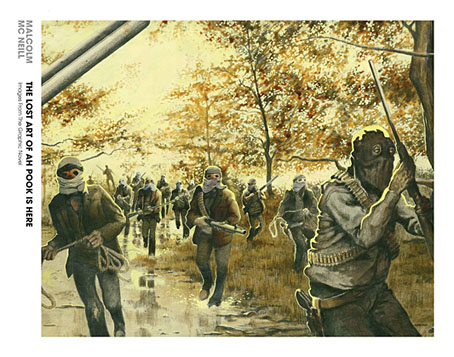
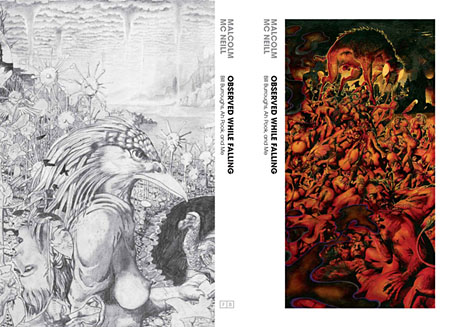
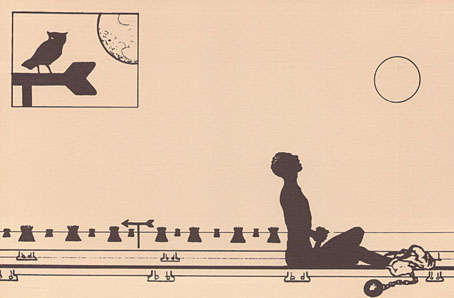
It would have been tempting to write “Ah Pook is finally here” but that’s not quite the case. Artist Malcolm McNeill sent Savoy Books the following preview images last week. What was originally going to be the long-awaited publication of McNeill’s collaboration with William Burroughs, Ah Pook Is Here, will now be two separate volumes published by Fantagraphics Books later this year: The Lost Art of Ah Pook Is Here which will comprise McNeill’s art without the accompanying text (apparently the Burroughs estate objected to its inclusion), and Observed While Falling—Burroughs, Ah Pook and Me, a memoir of the project’s creation. The loss of the text is an annoyance but not the end of the world, at least if you’re fortunate enough to own the scarce Calder book above which comprises a 40-page story that I imagine (and hope) may be read whilst viewing McNeill’s meticulous artwork. Amazon’s listing shows the two books scheduled for October 2012, and there’s now a website for the two books with further preview images.

pook2.jpg

pook3.jpg

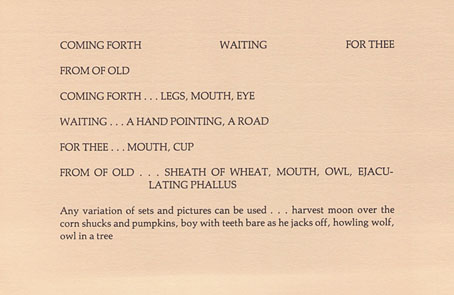
The 1979 Ah Pook Is Here is a fascinating collection, not least for the title piece which fits with the Wild Boys/Port of Saints narratives that Burroughs worked on during the 1970s. It’s also one of the better Burroughs anthologies so it’s always seemed odd that it’s remained resolutely out of print. Burroughs mentions McNeill’s artwork in a preface but doesn’t show any examples of his work. There is other artwork, however: in addition to some uncredited line drawings of figures like those in the Mayan codices there’s the whole of The Book of Breeething, a collaboration with artist Robert F. Gale from 1974. The latter concerns Burroughs’ interest in hieroglyphic communication, and attempts to show how one might convey short sentences through visual images alone, as in the pages below.

breeething1.jpg

The Book of Breeething (1974).

breeething2.jpg

The final piece in the book is The Electronic Revolution, an essay about using technology for guerilla purposes which was an inspiration for Cabaret Voltaire and others. All of this is choice and unusual material so it’s surprising that it’s been out of print for so long. In the case of Ah Pook Is Here it’s even more surprising to find it being prevented from republication despite Burroughs’ hope in his 1978 preface that the text would eventually be published along with the artwork. I’m sure the Burroughs estate have their own reasons for these manoeuvres but you can’t help but feel that this is another example of best intentions acting posthumously against the wishes of the artist they represent. A final irony can be found on the first page of Ah Pook Is Here where we see several mentions of a predatory agency that Burroughs warned against throughout his career, the thing he called CONTROL.

Elsewhere on { feuilleton }
The William Burroughs archive

A Reverbstorm jukebox

lordhorror.jpg

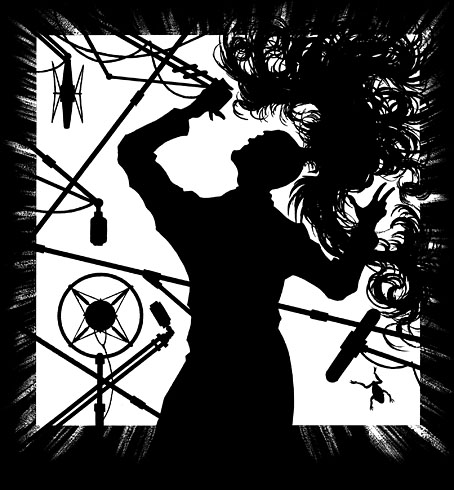
Another in a series of posts that supplement the forthcoming Reverbstorm book. Music, especially the rock’n’roll of the mid-50s to the mid-60s, was an important motor in Reverbstorm‘s creation: the title comes from the lyrics to Paul Temple’s song, and the song itself was included as a CD-single with the first issue. Each issue opened with a playlist of ten pieces of music offered as a complement to the narrative. We alternated the choices: David Britton chose the first ten, I chose ten for the second issue and so on. Dave’s choices were mainly the rock’n’roll he’s been listening to all his life while I tried to balance this with a more eclectic selection. But in Reverbstorm itself it’s the rock’n’roll that’s referenced the most, and it was this era of music we were both listening to a great deal during the composition of the series.

What follows is a guide to some of the songs and instrumentals referred to in the book, together with some of my favourite tracks from a compilation tape I used to play repeatedly while I was drawing. A few of these tracks are very obscure one-off singles so this list serves an additional function in saving people the trouble of hunting around.
bo.jpg

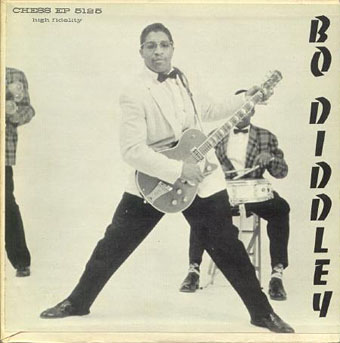
Bo Diddley (1955) by Bo Diddley
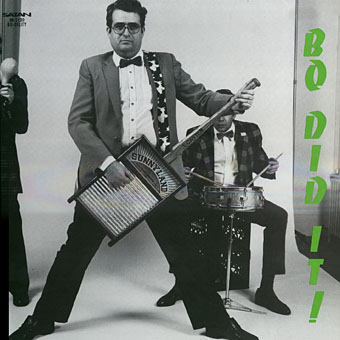
Part 3 of Reverbstorm, “The Big Beat of Apes”, is subtitled “Bo Diddley meets William Hope Hodgson”, and it’s to the Bo Diddley Beat that we’re referring. Diddley recycled his highly influential riff/rhythm many times, and inspired many cover versions, pastiches or outright thefts. A heady mix of these may be heard on one of the key albums for the creation of the series, a 1989 vinyl-only compilation entitled Bo Did It! which gathered seventeen obscure Diddley Beat singles. A couple of these are listed in Lord Horror’s radio playlist seen in part two, while others are present in this list. But this Bo Diddley song is where it all begins.

Bottle To The Baby (1956) by Charlie Feathers
Classic hiccoughing rockabilly and a favourite of Savoy cult band The Cramps who covered Feathers’ I Can’t Hardly Stand It. Bottle To The Baby gets a mention in part 3 while Charlie himself is quoted in part 8.

The Monkey (Speaks His Mind) (1957) by Dave Bartholomew
A moral tale from Mr Bartholomew, also quoted in part 3.

Esquerita And The Voola (1958) by Esquerita
Often cited as the guy that Little Richard stole all everything from, the very flamboyant Eskew Reeder Jr had an erratic career which yielded this berserk highlight, the B-side of his Rockin’ The Joint single. I first heard this when Dave played it in Savoy’s Peter Street shop one day and couldn’t believe how crazy it sounded. It’s also hard to believe it was on a major label. Play loud.

Hootchy-Koo (1958) by Larry Williams
Larry Williams was the prince of big bawdy numbers like this, and a favourite of The Beatles who covered three of his songs. The version I used to listen to was a slightly different demo recording (not on YT, unfortunately). Lucy Swan liked Hootchy-Koo so much she mentions it in her Lord Horror-related novel The Adventures of Little Lou.

Rumble (1958) by Link Wray
The ultimate swaggering riff and the moment where the guitar takes over from the saxophone as the locus of menace in popular music. Most people have probably heard this in the background of the Jack Rabbit Slim’s scene in Pulp Fiction but you’ll find it elsewhere, notably a Ry Cooder cover version in Streets of Fire, the highlight of an otherwise lacklustre film.

Alligator Wine (1958) by Screamin’ Jay Hawkins
The witches’ recipe from Macbeth gets reworked by Leiber & Stoller as a swampland love potion for Screamin’ Jay.

Storm Warning (1959) by Mac Rebennack
Before a bullet ruined one of his fingers, Dr John was guitarist Mac Rebennack whose early career produced some impressive singles such as this Diddley Beat instrumental. That title is now impossible to disassociate from the devastation wrought by Hurricane Katrina in 2005.

Tall Cool One (1959) by The Wailers
The Wailers, a Seattle group, are often listed now as The Fabulous Wailers to distinguish them from Bob Marley’s group. They had a knack for catchy instrumentals; in addition to this there was also Mau Mau.

Wang Dang Doodle (1960) by Howlin’ Wolf
Given a choice between this version of Willy Dixon’s song and the later Koko Taylor recording (which includes Dixon on vocals) I’d probably choose Koko’s but the Wolf came first, and this was the one Dave listed in the first issue of the series.

I Want Some of That (1961) by Kai Ray
One from the Lord’s playlist in part 2.

Let There Be Drums (1961) by Sandy Nelson
Sandy Nelson made a career out of recording drum instrumentals. This thundering opus is his finest moment.
bodidit.jpg

Bo Did It! (1989)

Boom Stix (1962) by Curley and The Jades
Who the hell were Curley and The Jades? Don’t ask me but this obscure single from the Bo Did It! collection manages to weld a Sandy Nelson drum break to the Diddley Beat.

Papa-Oom-Mow-Mow (1962) by The Rivingtons
One of the great nonsense hits, and endlessly imitated afterwards, the title gets a mention in part 2. Kim Fowley had something to do with the release so it’s fitting that he’s wound up with Savoy as well, having written the insert notes to the recent Fenella Fielding album.

Surfin’ Bird (1963) by The Trashmen
Of all the copyists and imitators that chased The Rivingtons’ success none can approach these two minutes and twenty seconds of demented genius.

The Fourth Dimension (1964) by The Ventures
I find a little of The Ventures’ twanging instrumentals usually goes a long way, like many of these groups they work best on compilations. But I do like The Ventures in Space which is where this spooky David Lynch-style number originates.

Strychnine (1965) by The Sonics
Psycho would have been the obvious choice here but I tried to avoid being predictable. Everything The Sonics recorded sounds cranked to the point of distortion, and this is no exception. Garage punk at its wildest.

Bop Diddlie In The Jungle (1966) by Tommy King and The Starlites
Another track from Lord Horror’s playlist found on the Bo Did It! collection, this is Bo’s Diddley Daddy relocated to a jungle setting.

Electricity (1967) by Captain Beefheart and his Magic Band
The whole of Reverbstorm is dedicated to Trout Mask Replica but this was a track from one of my playlists. A compelling argument for why there should be more theremins in pop music.

I Wanna Be Your Dog (1969) by The Stooges
Lust For Life was the album I was playing a lot whilst drawing but this song was another of Dave’s choices. One of the Savoy “Lord Horror” singles in the 1980s was a cover of Raw Power.

Garbageman (1980) by The Cramps
And another of the Savoy “Lord Horror” singles was a cover of this unstoppable beast from The Cramps. “Do you want the real thing, or are you just talkin’?”

Previously on { feuilleton }
Reverbstorm: Bauhaus Horror
Reverbstorm: an introduction and preview

Weekend links 109

magritte.jpg

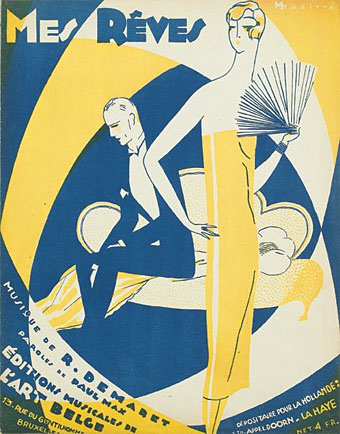
Dreams before Surrealism: a sheet music cover from 1926 by René Magritte.

• The week in music: Listen to compositions by Annea Lockwood. | At the Free Music Archive: Uncomfortable Music, a tribute to David Lynch’s Eraserhead (and, it should be said, to Alan Splet’s unique soundtrack). | Alan Licht plays a track from Trout Mask Replica then loops some Donna Summer and improvises guitar noise over it. | Music Experiments with Terror: The Spooky Isles presents Joseph Stannard‘s list of recent eldritch sounds from British musicians.

Great art, or, let’s just say, more modestly, original art is never created in the safe middle ground, but always at the edge. Originality is dangerous. It challenges, questions, overturns assumptions, unsettles moral codes, disrespects sacred cows or other such entities. It can be shocking, or ugly, or, to use the catch-all term so beloved of the tabloid press, controversial. And if we believe in liberty, if we want the air we breathe to remain plentiful and breathable, this is the art whose right to exist we must not only defend, but celebrate. Art is not entertainment. At its very best, it’s a revolution.

Salman Rushdie on the censorship of art

• All Diamond, No Rough” says the School Library Journal about the first volume of The Graphic Canon. Volume two should be out in August.

Scientific American asks: Do Psychedelics Expand the Mind by Reducing Brain Activity?

• From 2010: A Dandy in Aspic – A letter from Derek Marlowe.

Tom Phillips and A Humument: how a novel became an oracle.

Timeline Maps at the David Rumsey Map Collection.

• Happy 50th birthday, A Clockwork Orange.

Jim Dandy (1956) by LaVern Baker | Larks’ Tongues in Aspic, part one (1972) by King Crimson, live on Beat Club.

Reverbstorm: Bauhaus Horror

reverbstorm1.jpg

Lord Horror (after Klaus Barthelmess).

(No, not Pete Murphy and co.) Now that the Reverbstorm book is at the printers I have an excuse to discuss a few of the art and design appropriations that run through the narrative. I wanted to use some Bauhaus-style design back in the early 1990s when we were putting the first of the comic issues together but that idea got buried under conflicting demands and the need to actually finish all the drawing. It was only when I started designing the opening pages in 2008 that I was able to return to some of the original intentions. There were two reasons for this choice: one was that the minimalist graphics of the Bauhaus style worked well in black-and-white, and also provided an effective counterpoint to the very dense and detailed drawings that followed. The second was that the Bauhaus design school found itself in the early 1930s in opposition to the fascist forces which the figure of Lord Horror represents. (Many of the Bauhaus architects and designers eventually fled Germany for Britain and the United States.) This combination of antagonistic elements yielded another of Reverbstorm‘s collisions of counterposed philosophies and aesthetics.

reverbstorm2.jpg

Reverbstorm title page.

The title page is the most flagrant Bauhaus appropriation, a swipe worthy of Peter Saville at his plundering height. Joost Schmidt’s famous Bauhaus-Ausstellung poster is reworked with a Neville Brody typeface (Industria) and with Oskar Schlemmer’s face logo turned into a scowling profile.

On a typographic note, Industria was used right from the start with Reverbstorm since Brody designed it in the Thatcherite 1980s as a deliberate harking back to the authoritarian 1930s. It also has a very appropriate name. The other typefaces used in the book—Morris Fuller Benton’s Empire and Eric Gill’s Perpetua—date from 1937 and 1928 respectively.

reverbstorm3.jpg

Joost Schmidt (1923).

reverbstorm4.jpg

The reworked Oskar Schlemmer face/logo as it appears on the Appendix page. The lightning flash in Reverbstorm has multiple associations: adapted initially from the symbol used by Oswald Mosley’s British Union of Fascists (a symbol also appropriated at various times by David Bowie and Throbbing Gristle) it can also relate to storms, radio broadcasts and electricity in general. Here it becomes a minimal cipher representing Horror’s outrageous plume of hair.

reverbstorm5.jpg

Oskar Schlemmer (1923).

reverbstorm6.jpg

Reverbstorm, part 8.

In part 8 of Reverbstorm Horror ends up naked inside “a Soul” (don’t ask), and we see his figure juxtaposed against a series of backgrounds that recapitulate earlier aspects of the narrative. It was always the intention to end the series with a change of style so I did this by creating a kind of digital maquette figure using vector shapes that could be posed in a variety of ways. The origin of the figure was a sketch by Klaus Barthelmess, one of the students in Oskar Schlemmer’s drawing class. The sketch below appeared in a slightly altered form in issue 5 of the original publications but I always felt more could have been done with it: a posable figure turned out to be the perfect solution. By coincidence, while I was working on the final pages, Clive Hicks-Jenkins had been running a maquette exhibition on his blog. I was tempted to offer my example but a combination of too much work and a reluctance to throw Lord Horror’s obscene and reprehensible presence into the mix put paid to that. Besides which, my figure is a digital creation, not a bona fide paper cut-out.

reverbstorm7.jpg

Drawing by Klaus Barthelmess (1922).

For those who want more Bauhaus design, the Barbican in London is currently staging a major exhibition, Bauhaus: Art as Life, that will run throughout the summer.

Previously on { feuilleton }
Reverbstorm: an introduction and preview

Reverbstorm: an introduction and preview

reverbstorm-covers.jpg

Reverbstorm: 1994–2012.

Art, intellectual pursuits, the development of the natural sciences, many branches of scholarship flourished in close spacial, temporal proximity to massacre and the death camps. It is the structure and meaning of that proximity that must be looked at. […] But there is a […] danger. Not only is the relevant material vast and intractable: it exercises a subtle, corrupting fascination. Bending too fixedly over hideousness, one feels queerly drawn. In some strange way the horror flatters attention, it gives to one’s own limited means a spurious resonance. […] I am not sure whether anyone, however scrupulous, who spends time and imaginative resources on these dark places, can, or indeed, ought to leave them personally intact. Yet the dark places are at the centre. Pass them by and there can be no serious discussion of human potential.

George Steiner, In Bluebeard’s Castle: Some Notes Towards the Re-definition of Culture (1971)

Reverbstorm is an eight-part comic series which I began drawing in 1990. Last week I finished work on the final section, and also completed the layout and design for the collected edition, a 344-page volume which Savoy Books will be publishing later this year. All the artwork has been scanned afresh, re-lettered and, in a few places, improved to fix compromises and print errors present in the published issues. This unfinished project has been hanging over me for so long that I make this announcement with some relief. The book will be published without a foreword so this post can serve as an introduction for the uninitiated. But before I get to the details, some history.

rev1.jpg

David Britton was the writer and instigator of Reverbstorm, the series being a continued exploration in the comics medium of his Lord Horror character. Lord Horror is an alternate-history equivalent of the real-life William Joyce, a member of the British Union of Fascists in the 1930s whose propaganda broadcasts to Britain from Nazi Germany during the Second World War led the press to dub him Lord Haw-Haw. The first five-part Lord Horror comic series, Hard Core Horror, showed the evolution of Horace William Joyce, aka Lord Horror, from charismatic politician to Nazi collaborator; the final two issues of the series concerned Horror’s involvement in the Holocaust. In Britton’s mythos James Joyce is the brother of Horace Joyce while Jessie Matthews, a popular British musical star of the 1930s, is Lord Horror’s wife. (Britton’s Lord Horror novels are examined in detail by Keith Seward in his Horror Panegyric essay.) My fellow artist at Savoy, Kris Guidio, drew the first four issues of Hard Core Horror; I drew issue five which was less a comic story, more a portfolio of static scenes of death-camp architecture. The series was well-received by regular Savoy readers but mostly ignored by the British comics world, with some justification: the comics were a glossy production but the narrative was very erratic, even technically inept in places. At Savoy the series was regarded as a failed experiment, Kris’s drawing style and flair for cartooning being more suited to the broad humour of the Meng & Ecker strips. But Dave liked what I’d done with the final issue and felt we could try something new that was also more original than a fictional skate through recent history.

rev2.jpg

In addition to producing comics in the late 1980s, Savoy had been recording a number of eccentric cover versions, most of them sung by PJ Proby. A music journalist, Paul Temple, came to interview Proby about the songs and stayed in touch. He subsequently approached the company with a song of his own entitled Reverbstorm, a bombastic number best described as “Wagnerian Northern Soul” which Savoy recorded in 1993. (Temple recounts the origin of the song here.) This gave a title to the new comic series that Dave was planning, the story outline being expanded from a scenario that he and Savoy colleague Michael Butterworth had sketched out when a film company showed some fleeting interest in Lord Horror. Kris Guidio and I worked on the opening pages, the initial idea being that Kris would continue drawing the Lord while I would do everything else. Once I’d convinced Dave that I could draw his Lordship to his satisfaction I took over the series while Kris carried on with the Meng & Ecker comics. I spent most of 1991–1996 drawing the first seven parts of Reverbstorm which were published as separate comics during that period. The first issue came with a CD single of Paul Temple’s song which was sung by Sue Quinn but credited to Jessie Matthews. (It’s now available on iTunes.) The last part of the series was always going to be something that differed from the preceding sections but I didn’t know how this might manifest until 1997 when I painted a series of monochrome double-spreads intended to form backgrounds for Dave’s text. That’s where the series stalled after the paintings had improvised themselves to such a degree of abstraction and incoherence that I didn’t feel able to continue. The breakthrough came a couple of years ago when I started scanning all the artwork into the computer and thinking again about the series. I realised I could complete everything now that my computer graphics skills were adequate enough to complement the earlier issues whilst also adding something new.

Continue reading “Reverbstorm: an introduction and preview”