The eyes of Odilon Redon

redon1.jpg

L’Oeil, comme un ballon bizarre se dirige vers l’infini from A Edgar Poe (1882).

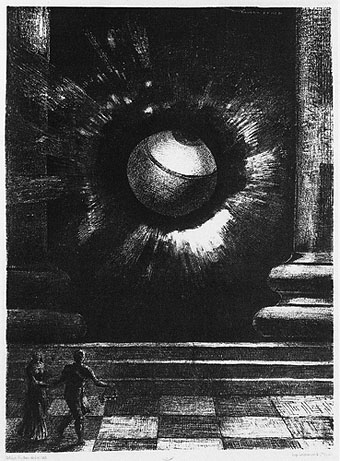
Another decently thorough Symbolist website covers the life and work of Odilon Redon (1840–1916), an artist whose pastels and prints were strange even by the standards of his contemporaries. His giant eyeballs and other floating figures are always startling and point the way inevitably to Surrealism, especially in dream lithographs like the one below.
redon2.jpg

Vision from Dans le Rêve (1879).

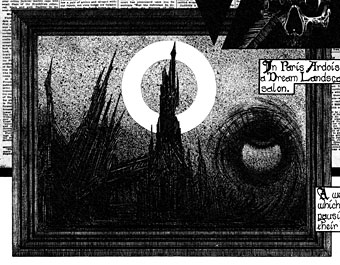
I compounded that Symbolist/Surrealist association when I was drawing The Call of Cthulhu in 1987 by showing Ardois-Boonot’s Dream Landscape (which Lovecraft doesn’t describe beyond the word “blasphemous”) as being a Max Ernst-style frottage canvas with a Redon eye rising from the murk. Cthulhu’s presence reduced to a single ocular motif like the eye of Sauron.
call.jpg

The Call of Cthulhu (1988).

And while we’re on the subject there’s Guy Maddin’s typically phantasmic short, Odilon Redon or The Eye Like a Strange Balloon Mounts Toward Infinity made for the BBC in 1995. Ostensibly based on the balloon picture above, this manages to reference a host of other Redon lithographs and charcoal drawings in the space of four-and-a-half minutes. Sublimely weird and weirdly sublime.

Elsewhere on { feuilleton }
The fantastic art archive

Previously on { feuilleton }
Arthur Zaidenberg’s À Rebours
The Heart of the World

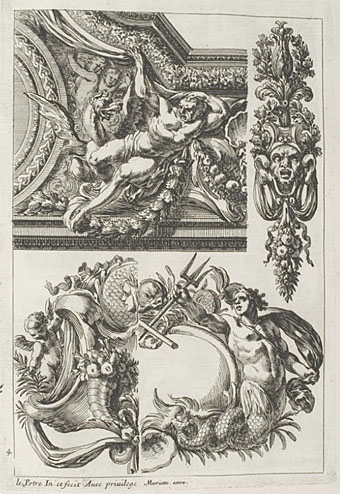
Oeuvres D’Architecture by Jean Le Pautre

lepautre.jpg

Following some print links led me once again to the University of Heidelberg and a collection of engravings by Jean Le Pautre (1618–1682), the grandly-titled Oeuvres D’Architecture De Jean Le Pautre, Architecte, Dessinateur & Graveur du Roi (Band 1): Contenant les Frises, Feuillages, Montans ou Pilastres, Grotesques, Moresques, Panneaux, Placarts, Trumeaux, Lambris, Amortissements, Plafonds, & généralement tout ce qui concerne l’Ornement. This was published in Paris in 1751 and is a splendid series of architectural details including some eye-popping friezes of Rococo turmoil with a profusion of dragons, putti, hippogriffs, mermen and many other hybrids rioting among whiplash foliage. As with other works at Heidelberg, you can either examine the prints one at a time or download the lot as a single PDF.

Elsewhere on { feuilleton }
The etching and engraving archive

Exposition Universelle publications

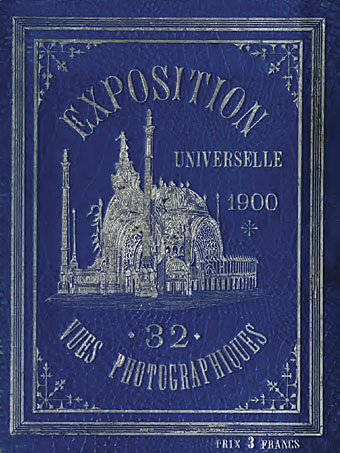
exposition1.jpg

More Exposition Universelle fetishism. The Internet Archive has a small collection of documents from the Paris exposition, not all of them of interest but these two are worth a look for their pictures at least. Exposition universelle, 1900; 32 vues photographiques (above) features various views of the exposition exhibits although they’re made somewhat redundant by the Brooklyn Museum’s Flickr set of tinted photos.

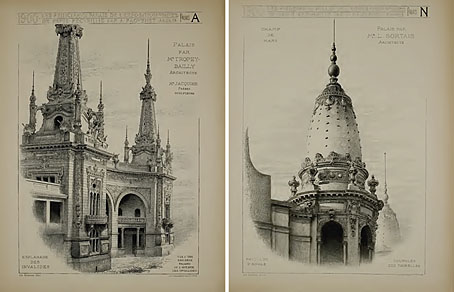
exposition2.jpg

Of more interest is Les principaux palais de l’Exposition universelle de Paris with its details of the extravagant architectural confections on display. And for a look at a visitors’ guide there’s Paris Exposition, 1900: guide pratique du visiteur de Paris et de l’exposition from Hachette & Cie, still going strong today and now the UK’s largest publisher.

Previously on { feuilleton }
Exposition cornucopia
Return to the Exposition Universelle
The Palais Lumineux
Louis Bonnier’s exposition dreams
Exposition Universelle, 1900
The Palais du Trocadéro
The Evanescent City

International Times archive

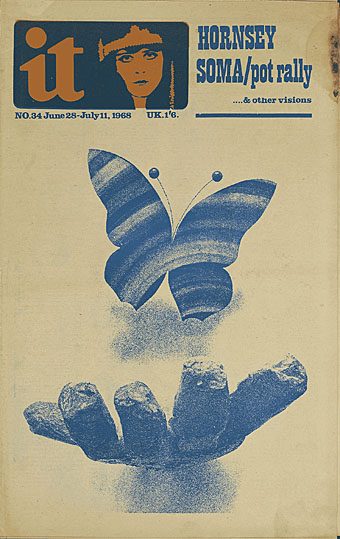
itcover.jpg

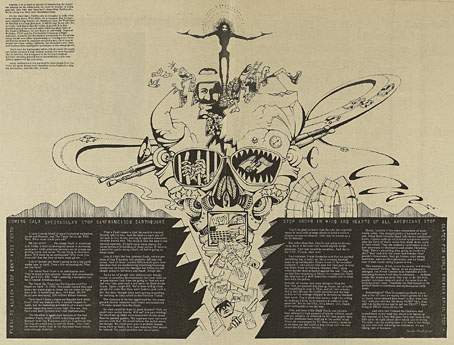
The entire run of Britain’s first underground/alternative newspaper. Incredible. IT was never as flashy as Oz but ran for longer and arguably had the better contributors, among them William Burroughs. One notable feature was an avant garde comic strip, The Adventures of Jerry Cornelius, written by Michael Moorcock and M John Harrison with artwork by Mal Dean and Richard Glyn Jones. Heavyweight contributions to magazines tend to get reprinted, however, what I enjoy seeing in archives such as this is the ephemera which can’t be found elsewhere: adverts, reviews and illustrations like the one below. The site is a bit slow and it would have been good to have individual issues as PDFs but it feels churlish to complain. More archives like this, please.

Via Jahsonic.

it.jpg

Illustration by Stanley Mouse (1969).

Previously on { feuilleton }
The Realist
Revenant volumes: Bob Haberfield, New Worlds and others
Oz magazine, 1967-73

The art of Elihu Vedder, 1836–1923

vedder1.jpg

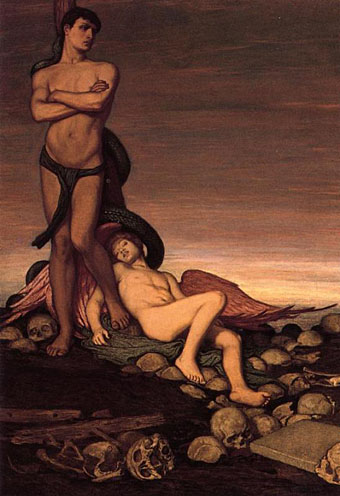
The Last Man (1886–1891).

Vedder was one of the principal American Symbolists, possibly the leading one although there wasn’t the same degree of competition in the United States as there was in Europe. Last time I was casting around the web for his work he wasn’t so visible but that’s changed recently with a dedicated website. Vedder’s 1884 edition of the The Rubáiyát of Omar Khayyám is highly-regarded and at least one of those drawings—The Cup of Death—was reworked as a painting. Compared to his Continental contemporaries he’s a particularly gloomy artist, with sombre subjects rendered in a sombre palette. The Last Man is typical as well as being curiously inexplicable; is the serpent there a Satanic presence? And why is there a dead (?) angel boy at the feet of the Last Man?

The Smithsonian American Art Museum has a set of the Rubáiyát illustrations.

vedder2.jpg

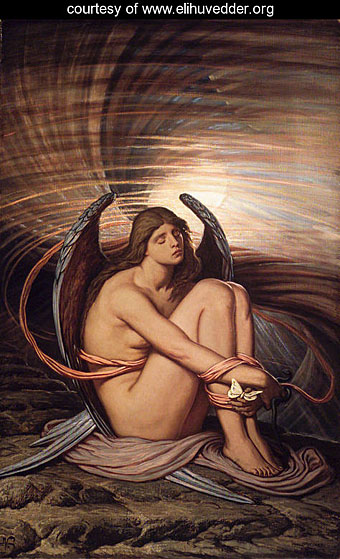
Soul in Bondage (1891–1892).

Previously on { feuilleton }
Angels 5: Angels of Death