Tranquillo Marangoni bookplates

marangoni1

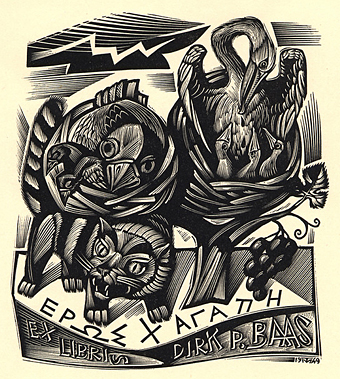
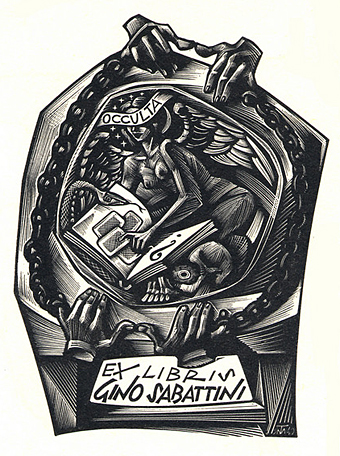
Occulta (1949).

Two of the many bookplates produced by Italian artist Tranquillo Marangoni (1912–1992). The official site (in Italian) has three pages of ex libris work as well as further pages devoted to his woodcut book illustrations, postage stamp designs and other graphic productions.

marangoni2

Eros x Agapi (1949).

Elsewhere on { feuilleton }
The illustrators archive

Previously on { feuilleton }
Book-plates of To-day
Louis Rhead bookplates
Pratt Libraries Ex Libris Collection
The Evil Orchid Bookplate Contest
David Becket’s bookplates

Weekend links 28

/shah1.jpg

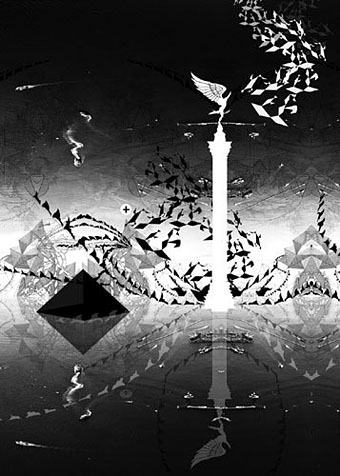
The Expansion of the First Great Ornamental Age: 3 Distances (2009) by Seher Shah.

Great Female Artists? Think Karachi. “One reason for the unusually high ratio of female artists in Pakistan has to do with the fact that the art industry has not traditionally been viewed as a lucrative business by men, says South Asian art historian Savita Apte, who administers the internationally renowned Abraaj Capital Art Prize. Until very recently, creatively inclined males tended to focus on fields such as advertising or illustration, leaving the art field wide open for some very talented women.” Related: artist Seher Shah (and also here).

• Hardformat looks at the luxury/collectors/whatever edition of the forthcoming Brian Eno album. “What’s the music like?” Colin asks. Indeed.

Strange Flowers is “a celebration of the most extraordinary, eccentric and unfairly forgotten figures of the past 200 years”.

Warsaw Warble: Illustration and design in Poland, 1917 to 1938. More marvels from A Journey Round My Skull.

• Strange Attractor hosts talks at London’s Little Shoppe of Horrors throughout the autumn.

• Barney Bubbles in Mojo and more details of the new edition of Paul Gorman’s BB book.

• A blog devoted to all things having to do with Howard Pyle (1853–1911).

Erik Davis on Dreaming, Writing, Philip K Dick and Lovecraft.

10 Reading Revolutions Before E-Books.

Secular Exorcisms by Evan J Peterson.

• RIP Jean Benoît.

Street haikus.

I Put A Spell On You (1965) by Screamin’ Jay Hawkins; I Put A Spell On You (1965) by Nina Simone; I Put A Spell On You (2001) by Natacha Atlas.

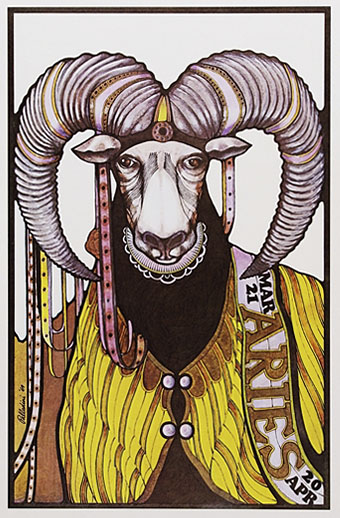
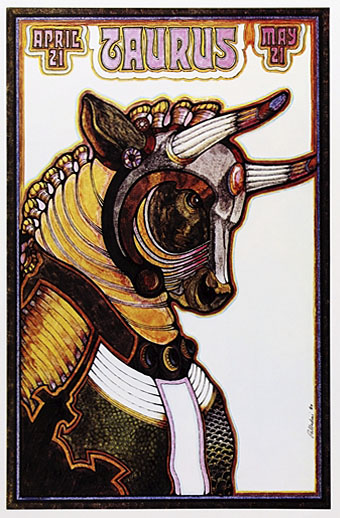
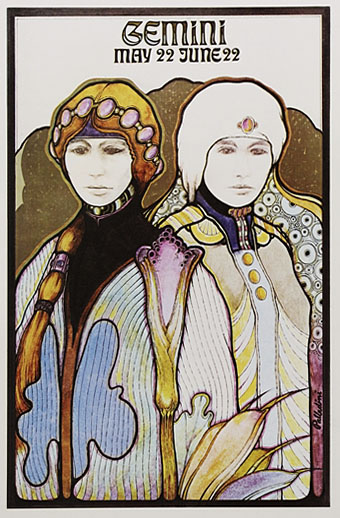
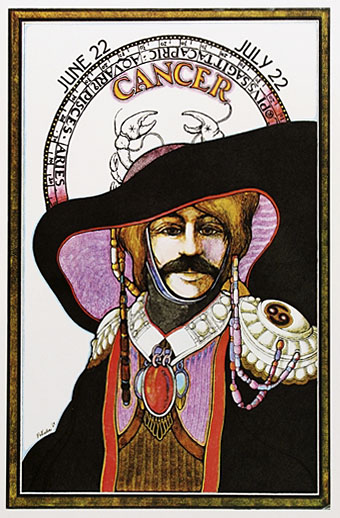
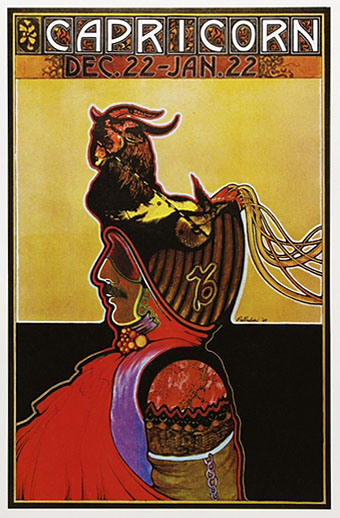
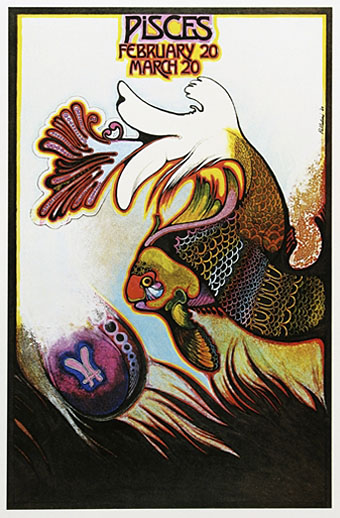
Palladini’s Zodiac

palladini06.jpg

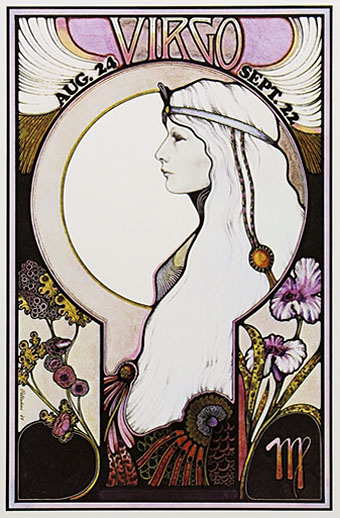
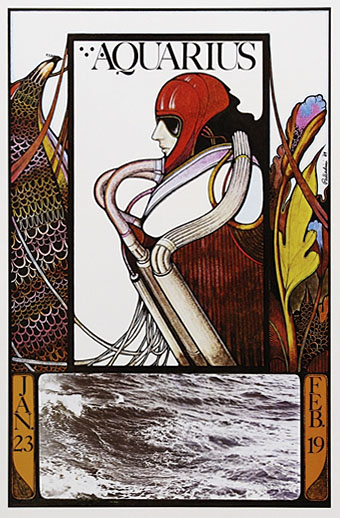
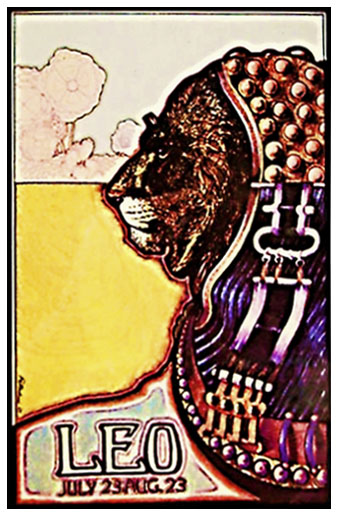
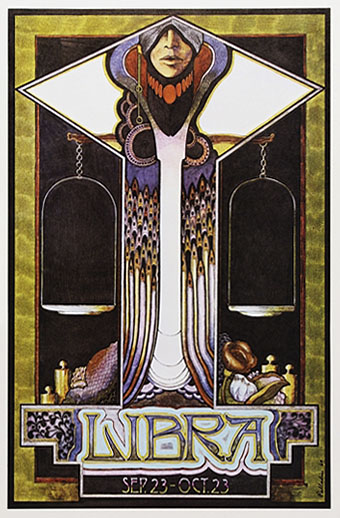
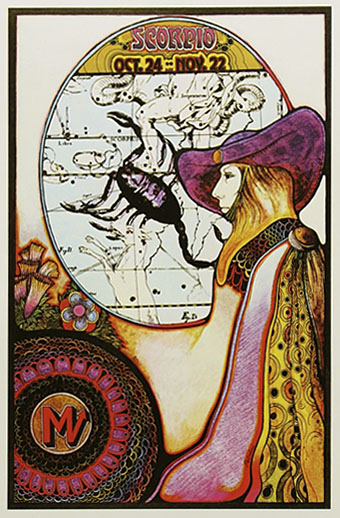
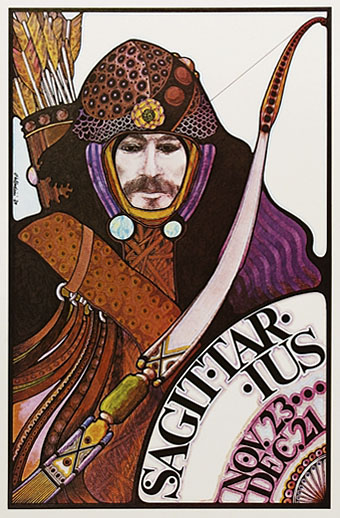
David Palladini’s poster for Werner Herzog’s Nosferatu the Vampyre has been mentioned here twice in the past week so it seemed only fair to see whether any of his other work matched that splendid piece. The artist has worked for years as a book illustrator but seems to receive most attention these days for his Aquarian Tarot deck, first produced in 1970 and still being sold today. Many of the card designs show something like the kind of stained-glass window approach he used for his film poster but with less decoration. Far closer to the Herzog piece is a series of posters he made in 1969 depicting his own interpretation of the signs of the zodiac. Every mention I’ve seen of these notes their scarcity which is a shame when many of them are such striking designs. Of particular interest to this Aubrey Beardsley obsessive is seeing that the scale shapes which Palladini put into the “N” of his Nosferatu lettering may, as I guessed, go back to the similar shapes which Aubrey borrowed from Whistler’s Peacock Room; see the peacock-like bird in Aquarius below.

This page has some examples of the Major Arcana designs from Palladini’s Tarot. More of his zodiac posters follow, all of which are courtesy Meibohm Fine Arts.

palladini11.jpg

palladini01.jpg

palladini02.jpg

palladini03.jpg

palladini04.jpg

palladini05.jpg

palladini07.jpg

palladini08.jpg

palladini09.jpg

palladini10.jpg

palladini12.jpg

Elsewhere on { feuilleton }
The illustrators archive

Previously on { feuilleton }
Druillet’s vampires
The Art Nouveau dance goes on forever
The Sapphire Museum of Magic and Occultism
The art of Pamela Colman Smith, 1878–1951
Layered Orders: Crowley’s Thoth Deck and the Tarot
Whistler’s Peacock Room
The Major Arcana

Weekend links 27

wang.jpg

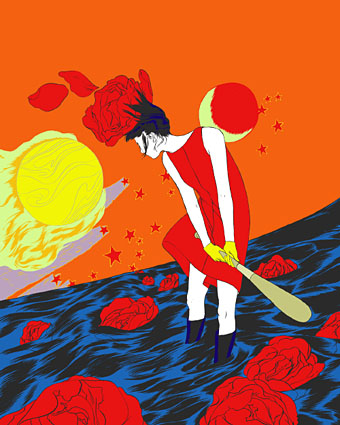
Annie Duels The Sun (2010) by Angie Wang.

I’m interviewed again, this time by James at Cardboard Cutout Sundown. Covering familiar subjects for {feuilleton} readers: art history, design, Lovecraft, the genre/mainstream seesaw, etc. Related: Jeff VanderMeer previewed my design for the forthcoming Steampunk Reloaded.

Battle over legacy of father of Art Nouveau. Prague authorities are demanding the paintings which comprise Alphonse Mucha’s Slav Epic be moved to the capital.

The films that time forgot. David Thomson on ten neglected works including a cult favourite of mine, Jerzy Skolimowski’s Deep End (1970).

The Viatorium Press: “Fine letterpress printing, digital typography, and hand painted illumination.” Among their recent productions is a poem by Clark Ashton Smith.
verne.jpg

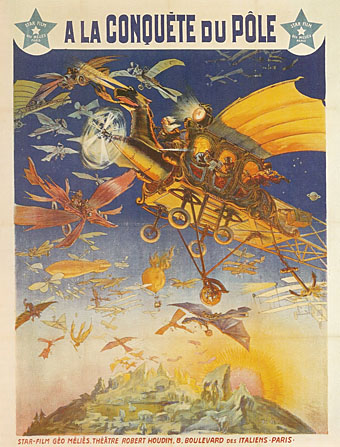
À la conquête du pôle (1912); Georges Méliès vs. Jules Verne.

Taxandria, a feature-length collaboration between Raoul Servais, François Schuiten and, er, Alain Robbe-Grillet, is on YouTube. My earlier post about the film is here.

Salvagepunk, or (maybe) Post-post-modernism: “How a music micro-trend heralds an emerging, internet-enabled, aesthetic movement.” See also the latest issue of The Wire.

Drainspotting with Remo Camerota: documenting Japan’s creative manhole covers.

• Yo-ho-ho, and a bottle of squid: a book devoted to Kraken Black Spiced Rum.

After Stanley Kubrick. Christiane Kubrick on life without Stanley K.

• Pills and penises and kissing boys: Tara Sinn’s Kaleidoscopes.

Found Objects: a hauntological dumping ground.

• Sandow Birk’s American Qur’an.

• RIP Frank Kermode.

Feuerland (1968) by Theo Schumann Combo; Feuerland (1977) by Michael Rother; Feuerland (2007) by Justus Köhnke.

Druillet’s vampires

vampire3.jpg

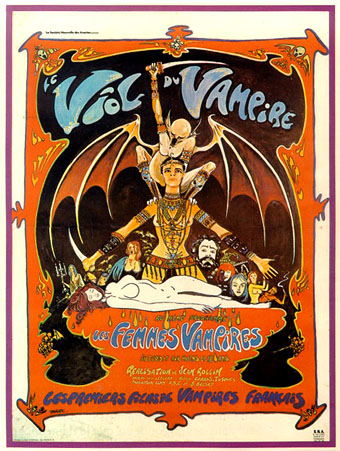
Le Viol du Vampire (1968) or Rape of the Vampire (stay classy, Jean!); re-titled Queen of the Vampires for the Anglophone world.

We’re so inundated these days with vampires and—worse—fucking zombies, that I’ll be perfectly happy if I never see another bloodsucker or shambling corpse again. But let’s overlook the degrading of horror staples for a moment to consider Philippe Druillet‘s excursions into the art of the cinema poster.

vampire1.jpg

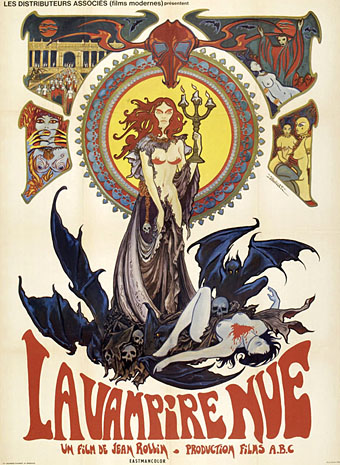
La Vampire Nue (1969).

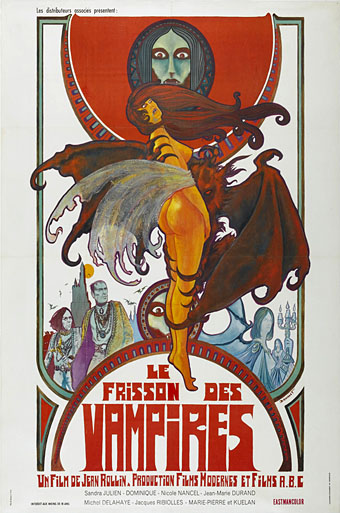
These pieces are for Jean Rollin‘s first three films, additions to the groovy-lesbian-vampire-with-false-eyelashes-and-bare-boobs sub-genre made at a time—the late 60s—when all the European film studios, Hammer included, were pushing the erotic content of their films more than had previously been dared. Rollin’s erotic comic strip from 1967, Saga de Xam, featured art contributions from Druillet, among others, which no doubt explains the choice of artist. As with David Palladini’s fantastic design for Werner Herzog’s Nosferatu the Vampyre (1979), these are further examples of how unique and distinctive film posters once were in a way they rarely are today. (Druillet, incidentally, produced his own adaptation of Nosferatu in 1989.)

vampire2.jpg

Le Frisson des Vampires (1970).

Pages from the fabulously rare Saga de Xam feature in the Art Nouveau catalogue that was the subject of yesterday’s post. So too does Druillet’s poster for Le Frisson des Vampires although any of these pieces would have made suitable inclusions. Even more than in his comic strips Druillet’s work here shows the overt influence of Alphonse Mucha.

Most of Rollin’s films seem to be available on DVD should you be desperate for some fangs and boobs. I’d much rather see Saga de Xam be reissued; it’s been out of print since 1967 and the copies available go for upwards of £200. This site has samples of the pages and there’s a post about the book (in French) here. For more about Jean Rollin, see Fascination: the Jean Rollin Experience.

Elsewhere on { feuilleton }
The illustrators archive

Previously on { feuilleton }
The Art Nouveau dance goes on forever
Salammbô illustrated
Druillet meets Hodgson
The music of Igor Wakhévitch
Nosferatu