Weekend links 33

andrews1.jpg

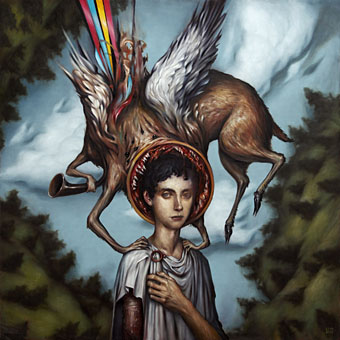
Blue Sky Noise (2010) by Esao Andrews.

Franz Xaver Messerschmidt is the first exhibition in the United States devoted exclusively to the 18th-century sculptor. Related: an earlier post about the artist’s work.

• How are the team behind War Horse planning to follow up their smash hit? With a gay love story performed by puppets. Related: Achilles (1995) by Barry JC Purves.

• More great posts at A Journey Round My Skull: Czechoslovakian Expose VI and Black Cradle of Bright Life, fifteen works by the Macedonian artist Vangel Naumovski (1924–2006).

Top 10 Anti-Gay Activists Caught Being Gay. Related: “Fuck your feelings,” in which columnist Dan Savage gets righteously impatient when a correspondent complains. As Savage says, people who use their faith as a stick to beat gay people contribute to an atmosphere of intolerance in which kids are bullied for being gay (or appearing to be), or transgender, or merely different, and kill themselves as a result. Over the past couple of weeks there’s been an upsurge of US media attention to the most recent suicides; Savage inaugurated the It Gets Better project in order to help. Also related: God Loves Poetry.
andrews2.jpg

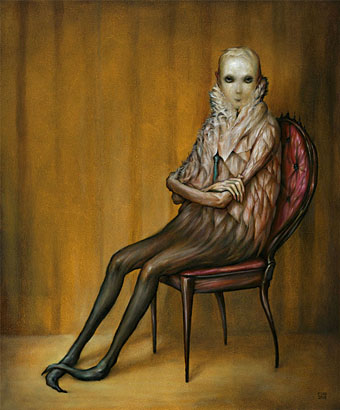
Meigh (2010) by Esao Andrews.

Antony Hegarty enthuses about Shoot Yer Load, one of the scurrilous 12″ singles released by my Savoy colleagues in the 1980s. Antony and the Johnsons have a new album out, Swanlights, on Secretly Canadian.

When the future of music was a rainbow hued parabola: book designer John Gall collects old synthesizer manuals.

Fantastic Memories (1944) by Maurice Sandoz, illustrated by Salvador Dalí.

Urban optometry: life as a London crane operator at BLDGBLOG.

• Today is 10/10/10 which means it’s Powers of Ten Day.

These New Puritans: a band like no other.

Art Nouveau: a virtual exhibition.

Diaghilev: Lord of the dance.

Flaming Telepaths (1974) by Blue Öyster Cult; Flaming Telepaths (2005) by Espers.
Carceri, thermae and candelabra

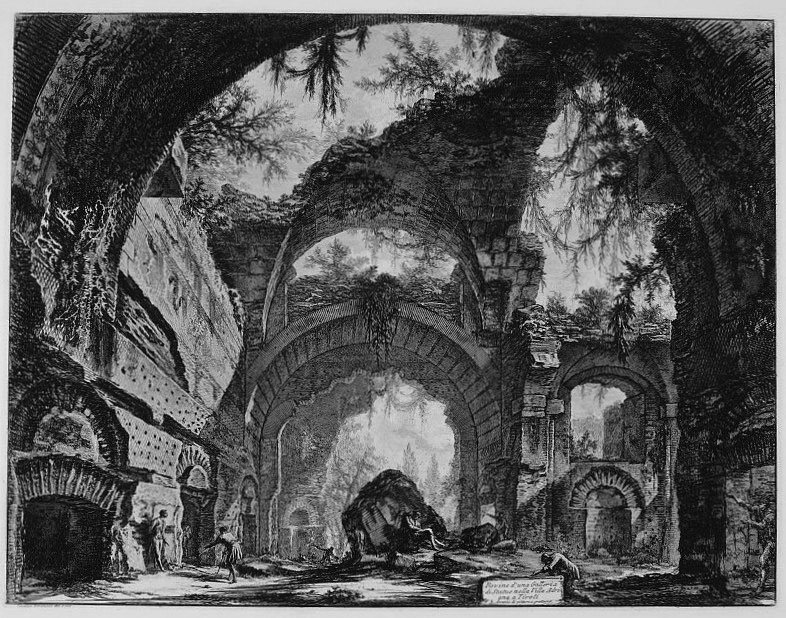
piranesi_tivoli.jpg

Piranesi’s etching which purports to show a statue gallery at Hadrian’s Villa was published in 1770 as part of the artist’s Vedute di Roma series, and conveniently provides a themed link for a pair of new exhibitions. The artist’s attribution of statue gallery was a mistaken one, the structure is actually the remains of Hadrian’s thermae, or baths, but archaeology was still in its infancy in the 18th century so mistakes were inevitable. If you’re fortunate enough to be in Venice during the next two months the Fondazione Cini has a major exhibition of Piranesi’s work, The Art of Piranesi: architect, engraver, antiquarian, vedutista, designer. On display are over three hundred prints which no doubt include many of the Vedute di Roma.

piranesi.jpg

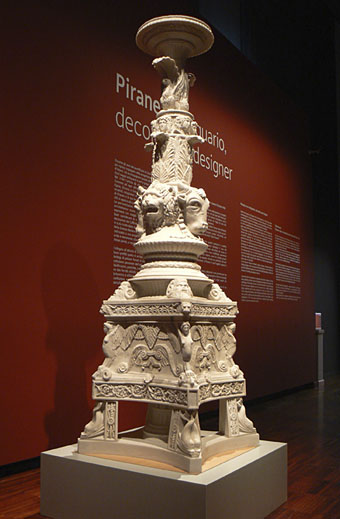
Ornamental candelabrum created by Factum Arte from a design by Piranesi.

Good as that sounds, what’s especially notable about this exhibition is a presentation of three-dimensional works specially created from Piranesi’s designs for candelabra, fireplaces, and other objects based on his studies of artefacts from the ancient world. These pieces have been produced by Factum Arte who have a great website showing the finished pieces and also a page detailing the production of the objects. Also on that page is one of the exhibition’s other features, a 10-minute video by Gregoire Dupond which cleverly joins together and animates a journey through several of Piranesi’s Carceri d’invenzione (Imaginary Prisons). The music accompaniment is Bach’s Cello Suite 2 which happens to be the piece played by Yo-Yo Ma in an earlier animation of the Carceri, so it’s a reasonable guess that the earlier film was an inspiration for this new work. The exhibition runs to November 21, 2010.

jauregui.jpg

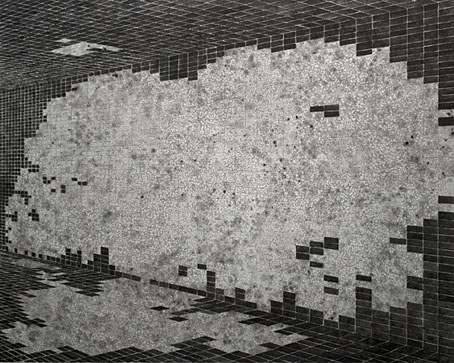
Jack’s Bath (2010) by Danny Jauregui. Gouache on canvas.

Hadrian’s obsession with his doomed lover Antinous makes the Emperor a gay icon which explains the connection between Piranesi’s view of the ruined baths and an exhibition of work by American artist Danny Jauregui. There Goes the Neighborhood is at the Leslie Tonkonow Gallery, New York, and features a selection of Jauregui’s paintings of tiles from the bathhouses which were a feature of gay life in the days before AIDS.

I make paintings of bathhouses in ruin. Moldy, disheveled and abandoned, the paintings are memorials to the absence of memorials – indexes of the traumatic erasure inflicted on the radical gay sexuality of the past. They are paintings of what I imagine those spaces to look like, had they not been disguised and hidden from sight. (More.)

The exhibition runs until October 30, 2010. By coincidence gay news blog Towleroad had a post yesterday about New York’s first anti-gay police raid on the Ariston Baths in 1903.

time-bandits.jpg

Time Bandits.

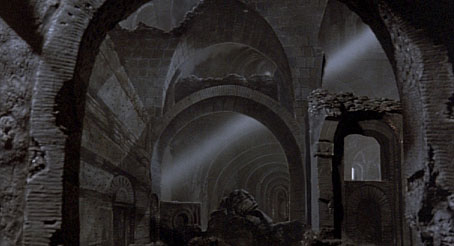
Seeing as I posted the picture of Hadrian’s baths I have to also post this shot from Terry Gilliam’s Time Bandits (1981) showing the interior of the Fortress of Ultimate Darkness. Here we see the Piranesi’s ruined baths incorporated into a vast and gloomy space which must surely be inspired by the Carceri, the views of Rome being absorbed by the artist’s darker imaginings. And for a final piece of trivia, writer Marguerite Yourcenar is not only the author of Memoirs of Hadrian (1951), a novel about the Emperor’s passion for Antinous, but also penned an essay about the Carceri. I haven’t read either of those works so I think it’s time to add them to the shopping list.

Update: For those in the UK, there’s also Piranesi’s Prisons, an exhibition at the Mead Gallery, Warwick, from now until December.

Elsewhere on { feuilleton }
The etching and engraving archive

Previously on { feuilleton }
La Tour by Schuiten & Peeters
Set in Stone
Hadrian and Greek love
Piranesi as designer
Vedute di Roma
Aldous Huxley on Piranesi’s Prisons
The Cult of Antinous

The Tempest illustrated

tempest.jpg

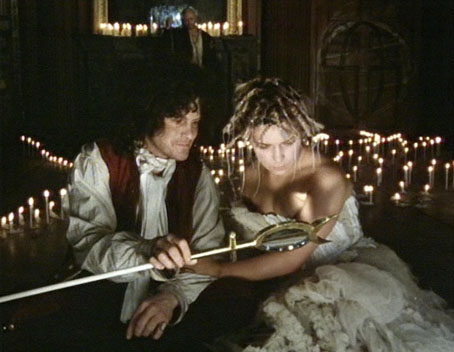
“Such stuff as dreams are made on”: Heathcote Williams and Toyah Willcox.

DVD viewing earlier this week was Derek Jarman’s wonderful adaptation of The Tempest which he directed in 1979. This is my favourite of Jarman’s films, partly because the play is my favourite Shakespeare (along with its polar opposite, Macbeth) and also because it’s a film infused with an occult sensibility which comes directly from the director’s own interests, rather than being the usual film or theatre conventions of what magic entails. An example of this is the grimoire which Prospero (Heathcote Williams) is seen leafing through which Jarman reveals in his autobiography, Dancing Ledge, to be his own 17th-century edition of Cornelius Agrippa’s Occult Philosophy. In his account of the filming he also describes his conception of Prospero as being based on Dr John Dee, the Elizabethan occultist who Shakespeare would certainly have known of, and may even have met since the pair both had business with Elizabeth I’s court. The most explicit reference to Dee comes in the shape of Prospero’s magical glass (above), based on Dee’s Monas Hieroglyphica, and a prop I’d dearly love to own. Dee was also a character in Jarman’s Jubilee (1978), and his Angelic Conversations gave a title to Jarman’s later filming of Shakespeare’s sonnets.

Seeing Jarman’s adaptation again had me thinking about the various representations of the characters. Ariel is generally depicted as a fairy type although he’s a lot more powerful than the fairies in A Midsummer Night’s Dream. As for Caliban, like Grendel in Beowulf, he’s an all-purpose monster whose predominant attributes seem to be whatever Ariel isn’t: ugly, earthbound, stupid, treacherous, and so on. I’d be tempted to propose the island’s quartet as representing the four elements—Prospero: water; Miranda: fire; Caliban: earth; Ariel: air—but I’m sure that’s not an original idea given the amount of academic trawling through the Bard’s corpus. Rather than dig for symbolism, what follows is a few pictures found during another trawl of my own through the Internet Archive, where the books aren’t drowned but patiently await their rediscovery.

Continue reading “The Tempest illustrated”

The art of Ephraim Moses Lilien, 1874–1925

lilien1.jpg

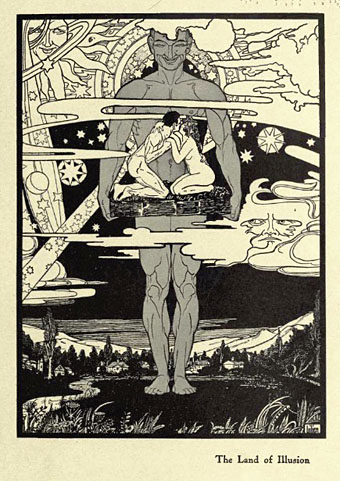
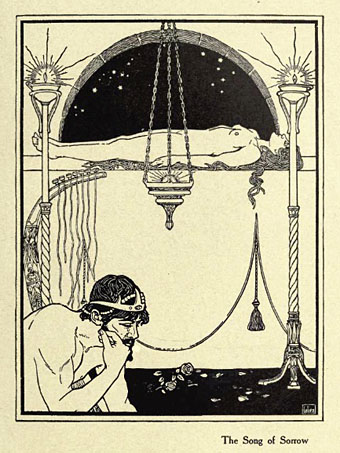
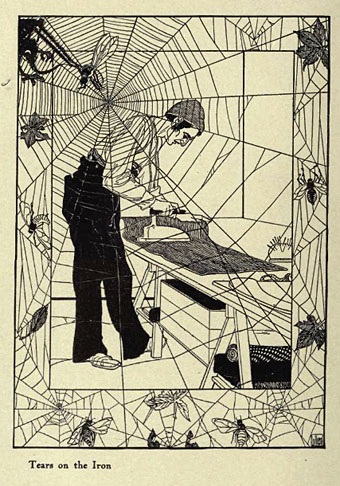
Marvellous black-and-white work from a Galician artist whose drawings were predominately concerned with Jewish and Zionist themes. These are from a small monograph about the artist, The New Art of an Ancient People; The Work of Ephraim Mose Lilien (1906) which can be downloaded at the Internet Archive. Elsewhere there’s a page here about the artist with further examples and links, a gallery site with a catalogue of his drawings of Palestine, and some of his illustrations can also be found in back issues of Jugend magazine.

lilien2.jpg

lilien3.jpg

Elsewhere on { feuilleton }
The illustrators archive

Previously on { feuilleton }
Jugend, 1900

Arthur Penn, 1922–2010

bandc.jpg

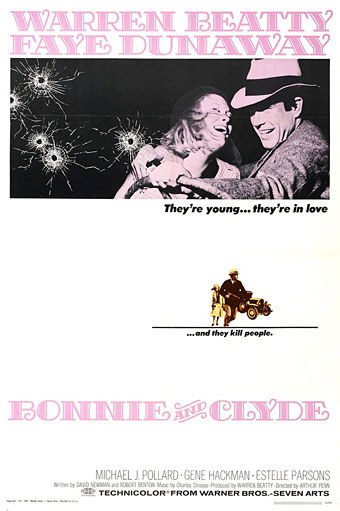
Design by Bill Gold.

With respect to Bonnie and Clyde and my other films, I would have to say that I think violence is a part of the American character. It began with the Western, the frontier. America is a country of people who act out their views in violent ways—there is not a strong tradition of persuasion, of ideation, and of law.

Let’s face it: Kennedy was shot. We’re in Vietnam, shooting people and getting shot. We have not been out of a war for any period of time in my lifetime. Gangsters were flourishing during my youth, I was in the war at age 18, then came Korea, now comes Vietnam. We have a violent society. It’s not Greece, it’s not Athens, it’s not the Renaissance—it is the American society, and I would have to personify it by saying it is a violent one. So why not make films about it.

From The Bonnie and Clyde Book (1972)

Thus film director Arthur Penn, whose death was announced earlier this week, speaking at a press conference in Montreal in 1967 following the first screenings of Bonnie and Clyde. Penn’s film shocked critics and audiences at the time ostensibly for its graphic violence although the disturbance went deeper than that. What I found shocking the first time I saw it—home alone one evening, watching TV with no idea what to expect—was the abrupt shifts of tone from near comedy (the speeding cars and bluegrass soundtrack, Gene Wilder’s role) to awful realism as the consequences of a life of bank-robbing became apparent. This was disturbing for audiences used to being spoon-fed their morality tales with easily identifiable heroes and villains; the sudden, savage conclusion was especially jolting. A “nightmare comedy” quality was a hallmark of Penn’s best work, and he followed Bonnie and Clyde with another nightmare comedy that’s also a further exploration of America’s troubled history, Little Big Man (1970). Here Dustin Hoffman’s character finds himself caught between the Native Americans who raised him and the warring Cavalry intent on massacring the native tribes. Like Robert Aldrich in Ulzana’s Raid (1972), Penn was using Western history to make a statement about America’s involvement in Vietnam; the soldiers in Little Big Man are murderous racists and General Custer is presented not as a doomed hero but as an unhinged psychopath. For me the film has always been distinguished by the character of Little Horse, the first (only?) gay Native American character in cinema. There’s plenty of documentary evidence for gay individuals in Native American tribes but these have seldom been seen in films. It’s Thomas Berger we have to thank for this detail, since it was Berger’s novel which Penn adapted, but the film’s writer and director are also to be congratulated for keeping a minor character who might easily have been excised.

It’s surprising when you see Bonnie and Clyde cited as one of the films that enabled directors to have more artistic freedom during the 1970s that Penn didn’t manage to do more during that golden decade. After Little Big Man there were two films which seem minor in comparison but would be major works from many lesser directors. Night Moves (1975) is one of the handful of attempts at updating film noir which appeared in the 1970s (for others see The Long Goodbye, Robert Aldrich’s Hustle and Taxi Driver), with a screenplay by Alan Sharp, the writer of Ulzana’s Raid. It’s a curio even by the standards of the decade, part detective story set in the Florida Keys, part symbolic drama with chess games and boats named “Point of View”; it’s also Penn’s last great film. The Missouri Breaks (1976), another Western, is fascinating for its pairing of Marlon Brando and Jack Nicholson but Brando’s eccentric performance is the start of his decline as an actor. It’s hard to believe that Penn only made five more films after this but he was one of a number of individual talents who flourished in the 1960s and 1970s then found themselves shut out in the 1980s as intellect was ousted by commerce. There’s even less room for him today than there was then. We’ve travelled from a time of intelligent and challenging films made by adults for adults to an era of shitty action movies and worthless adaptations of equally worthless costumed vigilantes. But I never counsel despair; celebrate what we have rather than bemoaning what we might have lost. Fuck Star Wars in 3D, watch Little Big Man instead.

Guardian obituary | NYT obituary
David Thomson on Penn