
Early British Trackways

watkins01.jpg

Continuing the Earth mysteries/megaliths theme, Early British Trackways: Moats, Mounds, Camps, and Sites (1922) by Alfred Watkins (1855–1935) was the first book in which the ley lines theory was proposed. Watkins was an amateur archaeologist (more a kind of early psychogeographer), photographer and writer who theorised that ancient Britons had marked the land with pathways connected by a variety of natural and man-made features: hills, mounds, trees, ponds, hillside notches and (of course) standing stones. Watkins coined the term “ley” after noticing that many of the lines connecting these features ran through villages or areas of land whose names ended in “-ley”, “-lay” or similar. The thesis was developed more fully in The Old Straight Track (1925), a book which became the ur-text for subsequent ley hunters. I’ve never seen any of Watkins’ books so it was interesting finding this short volume at the Internet Archive, not least because several of the photos appear in Mysterious Britain (1972) by Janet & Colin Bord, a classic guide to Britain’s sacred sites and folk rituals.

watkins02.jpg

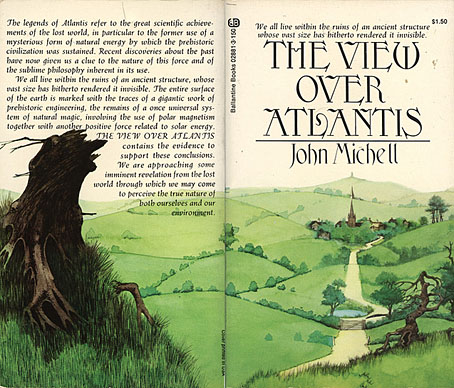
Watkins never regarded ley lines as having any mystic significance, he thought they were probably old trade routes. Archaeologists have never agreed with his suppositions, however, and Watkins himself might have disapproved of the conjectures added to his theories by John Michell in The View Over Atlantis (1969) which wedded ley line theory to feng shui to create the whole “lines of energy” idea. Whatever one thinks of Michell’s theories, that book and subsequent volumes put ley lines firmly into popular culture, and without them we wouldn’t have the references in Children of the Stones, Steve Hillage’s Green (1978) (pretty much a Michell-inspired concept album), Nigel Kneale’s Quatermass (1979) and so on. But this slim book is where it all begins.
tvoa.jpg

Illustration by Roger Dean (1972).

watkins03.jpg

Continue reading “Early British Trackways”

Weekend links 135

kuhlman.jpg

Two Grove Press covers by Roy Kuhlman. From Arden Kuhlman Riordan’s Pinterest page collecting her father’s cover designs.

• “When people asked me what boylesque was, I’d say I’m doing burlesque and I have a penis,” said Mr. Ferguson.

Sequence5: 42 tracks of new, atmospheric/ambient music. A free download in a variety of formats.

The trailer for Jimmy’s End, the forthcoming film by Alan Moore and Mitch Jenkins.

As a porn performer, I can say from experience and with confidence that I’ve never been objectified by other performers. Nor have I been objectified by viewers. At least not in a way that seemed to confuse them into thinking I was an object. What happens instead is that I shift in and out of object-hood. Athletes do this too—they engage with their bodies for a specific task. At the end of the game or the shoot, the context changes.

Conner Habib on The Virtues of Being an Object

Secret Weapons (1972), David Cronenberg’s lost TV movie resurfaces.

Joseph Burnett reviews Nude, the new album by The Irrepressibles.

Over a third of e-readers are used just once before being set aside.

The guarded, the cautious, the small-scale, the modest, the well-crafted—such books may be rewarded (in our own time, at the national level), but they are rarely preserved. They are not preserved because guardedness, caution, smallness, modesty, and craft can be replaced in any given generation. What is irreplaceable is excess: Of verbal kinesis, religious intensity, intellectual voracity.

Amit Majmudar on Entertainment and Excess: The Great Literary Audiences

Miniature Book Interviews with Louis Wain Bound by Hand.

A Tour Inside Salvador Dalí’s Labyrinthine Spanish Home.

• Horror fiction should be deep, not cheap, says Nina Allan.

• RIP Peter Kuhlmann aka Pete Namlook

More is More by Alex Trochut

The Useless Web

Lost In The Sea (1992) by Sequential (Pete Namlook & DJ Criss) | Angel Tech (1994) by Bill Laswell & Pete Namlook | Yenlik (Part II) (1996) by Burhan Öçal & Pete Namlook

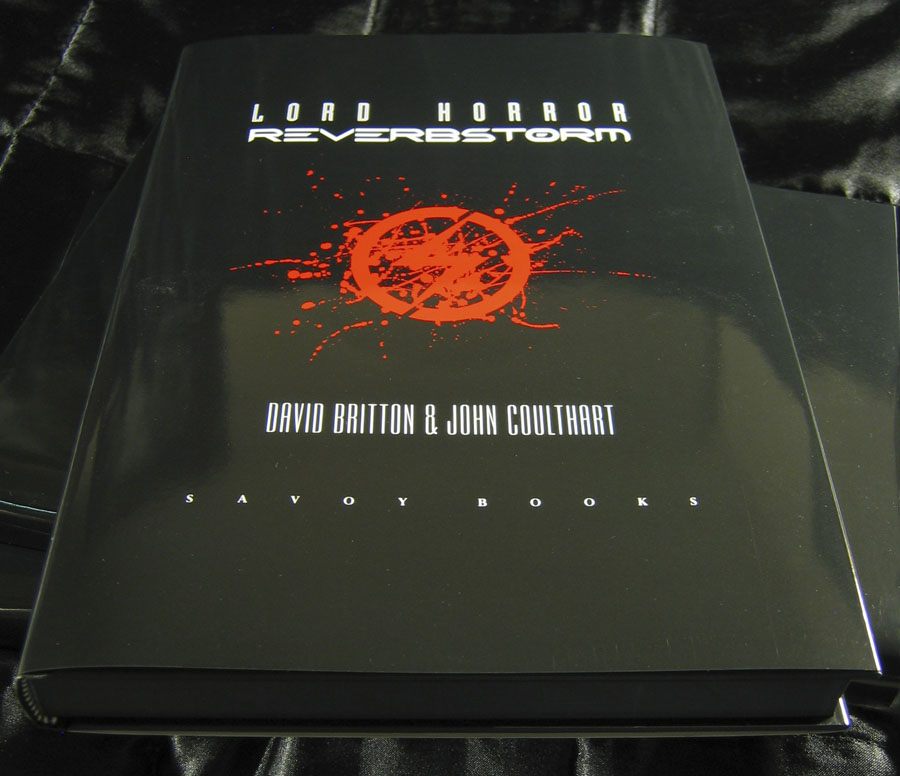
Reverbstorm in print

rev1.jpg

A couple of months ago I was starting to wonder whether I’d ever see this book printed, the production process became so tortuously drawn out. But Reverbstorm is finally in print and looking exactly the way I intended with black boards, black endpapers and black ink on the page edges. The latter proved to be a costly extra which explains why it’s an uncommon effect.

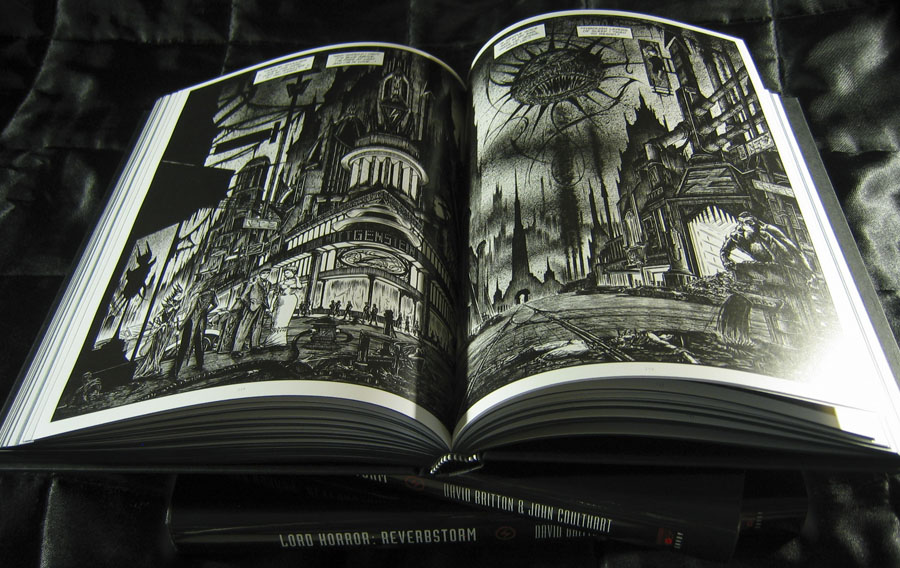
rev2.jpg

More important than the book design is that the printing of the artwork is excellent, with rich blacks and pin-sharp detail throughout. You’d think that printing black-and-white pages was a fairly straightforward business but the first set of proofs were pretty disastrous, the ink bleeding over the edges of many panels and detail elsewhere being blacked in. A combination of copious cross-hatching, spattered ink and—on later pages—brush shading and monochrome painting proved to be too much when the A3 artwork was reduced to half its size. This was particularly galling since these pages had never been properly printed since they were drawn: the original comics looked glossy enough but were all produced by back-street printers who didn’t bother too much about quality, and even made mistakes. They were a necessary evil at a time when other Savoy books had been refused by printers who objected to the material they contained. The relief at finally seeing the series completed and printed to this standard is considerable.

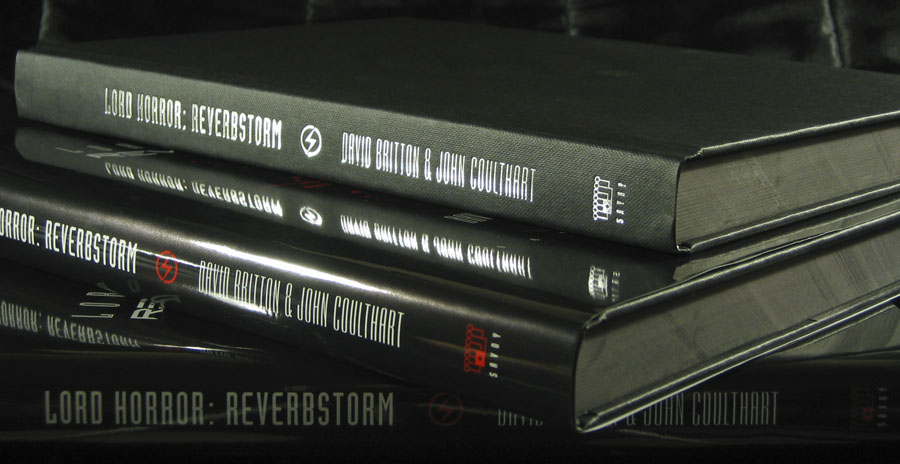
rev3.jpg

However, I’m afraid would-be purchasers still have a slight wait before they can buy a copy. The official publication date will now be early February but copies will be available to buy from the first week in January after distribution details have been finalised. I tried to persuade Savoy to relent on this and let a few copies go out prematurely but that won’t be happening. Sorry to anyone who’s been waiting since April (!) for the book but the decision is out of my hands. I believe it’ll be worth the wait. This is a better book than The Haunter of the Dark, and the best (and last) thing I’ll do in the comics medium. Next up is Axiom, a different world entirely. More about that later.

rev4.jpg

Previously on { feuilleton }
Reverbstorm update
James Joyce in Reverbstorm
A Reverbstorm jukebox
Reverbstorm: Bauhaus Horror
Reverbstorm: an introduction and preview

World Fantasy Awards

infernal.jpg

Presenting some of the cover art and interior illustration from 2011 which won me the World Fantasy Award for best artist in Toronto on Sunday. (The complete awards list is here.) It was a surprise to be nominated, and even more of a surprise to win since working in different areas—book, music, comics—is never a good way to get noticed for doing one particular thing. It’s also the case that sf/fantasy art awards tend to favour painters or virtuoso digital artists over people such as myself who I suppose are more illustrator-designers; that’s not a criticism, just an acknowledgement of the strength and popularity of highly-refined pictorial art in this area of the literary world. The recognition hazard works in the opposite direction: the design world often gives the most attention to graphic design alone, with the illustration quotient being regarded as secondary content.

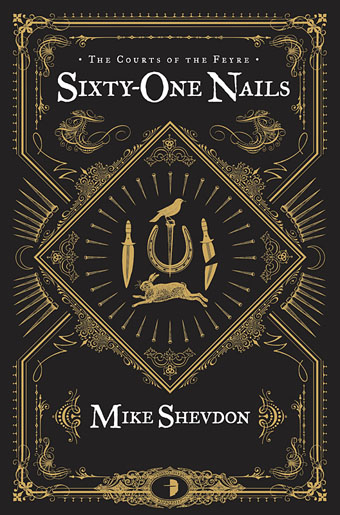
I’m not exactly sure what the judges were looking at of my work so these examples have been chosen for being published during the year under examination. They’re also covers that people seemed to like a lot, especially KW Jeter‘s Morlock Night (even though I still prefer Infernal Devices!), and those for Mike Shevdon‘s books. The Jeter and Shevdon volumes are all published by Angry Robot who will also be publishing Lavie Tidhar‘s The Bookman Histories early next year sporting another of my covers. Lavie’s novel Osama won best novel in Toronto while Ann and Jeff VanderMeer (editors of the Lambshead book below) picked up a best anthology award for their monumental The Weird. And to add to the good company, my regular publishers Tachyon saw one of their authors, Tim Powers, gaining best story collection. Congratulations to everyone, and a big thanks to Ann for collecting my award.

I’m always using these posts to point to other artists so it’s only right that I encourage everyone to go and look at the work of the other nominees. Here they are (although Jon Foster’s site appears down at the moment):

Julie Dillon
Jon Foster
Kathleen Jennings
John Picacio

John Picacio has a rather gorgeous calendar due out soon, details here.

morlock.jpg

lambshead.jpg

Title page for The Thackery T. Lambshead Cabinet of Curiosities edited by Ann & Jeff VanderMeer (Harper Voyager).

shevdon1.jpg

Continue reading “World Fantasy Awards”

More CthulhuPress

cthulhoid.jpg

Cthulhoid (2012).

I finally found time this weekend to add these recent works to my CafePress shops so they’re now available as prints. I’ll add a few more products later on although not everything at CafePress suits either square images or work with large amounts of detail. Click on the pictures for the links.I don’t think I’ve mentioned before that Cthulhoid will soon be appearing soon on the cover of a Lovecraftian fiction collection edited by ST Joshi. The book is A Mountain Walked: Great Tales of the Cthulhu Mythos from Centipede Press. I haven’t been given a publication date yet but it’ll probably be out early next year.

And do I need to say for the fifth or sixth time that these pictures are also a part of this year’s Cthulhu Calendar? They are. Thanks to everyone who’s bought a copy so far.

deprofundis.jpg

De Profundis (2012).

tentaclelatitudes.jpg

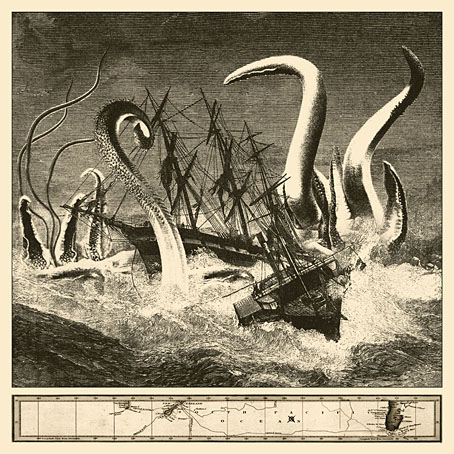
S. Latitude 47°9?, W. Longitude 126°43? (2012).

Previously on { feuilleton }
Cthulhu Calendar
S. Latitude 47°9′, W. Longitude 126°43′
Resurgam variations
De Profundis
Cthulhoid and Artflakes
Cthulhu for sale
Cthulhu God
Cthulhu under glass
CthulhuPress
Cubist Cthulhu