Nigel Kneale’s Nineteen Eighty-Four

1984-1.jpg

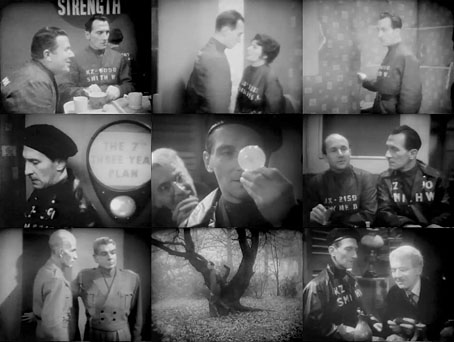
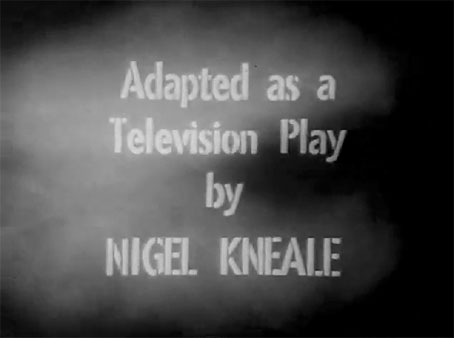
If I’d been more diligent I would have posted this yesterday which happened to be the UK’s first George Orwell Day. The Quatermass Experiment and this adaptation of Nineteen Eighty-Four are the two outstanding dramas from the very early days of British television. Both were written by Nigel Kneale and directed by Rudolph Cartier, an expatriate Austrian who brought to the small screen skills honed at the UFA studios before the war. The Quatermass Experiment was the first major collaboration between the pair after which they adapted Wuthering Heights. Nineteen Eighty-Four followed, a production that was screened twice in November 1954, and which caused considerable controversy at the time on account of its oppressive atmosphere and the scenes of Winston Smith’s torture.
1984-3.jpg

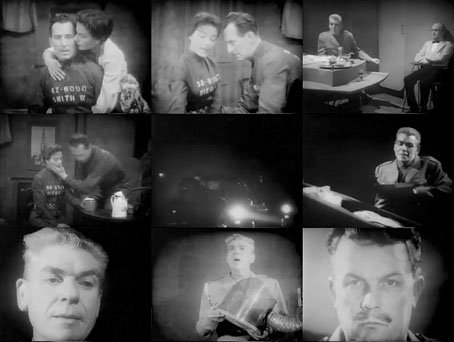
Kneale’s drama, which was performed live in the studio on both occasions, looks primitive compared to everything that’s followed but in many ways I prefer this adaptation to Michael Radford’s glossier feature film. For a start it has a great cast: Peter Cushing plays Winston Smith, Yvonne Mitchell is Julia, Donald Pleasence is Syme, and André Morell (who later played Professor Quatermass in the BBC’s Quatermass and the Pit) is O’Brien. Also among the cast there’s Wilfrid Brambell in two minor roles, one of them a precursor of the crusty old man he’d spend the rest of his life portraying. Neither Cushing nor Pleasence were known as film actors at this time; both would no doubt have been surprised to be told that their subsequent careers would involve a great deal of horror and science fiction.
1984-2.jpg

Cartier and Kneale didn’t have the budget to compete with feature films but for once the claustrophobic nature of a studio production works in the favour of a drama where there’s little intimacy or privacy. With the exception of a few filmed inserts almost everything is close shots. As the story grows more desperate so the shadows close in, until the final scenes are all spotlit faces in darkened rooms. The power of Cushing’s performance still resonates today, and gives an idea of how shocking this must have been to a home audience expecting little more than light entertainment on a Sunday evening. The YouTube copy is the entire 107-minute film, and is worth a watch if only to see Donald Pleasence when he had an almost complete head of hair.

• From 2009: Robert McCrum on The masterpiece that killed George Orwell.

Previously on { feuilleton }
The Stone Tape

Weekend links 143

empire.jpg

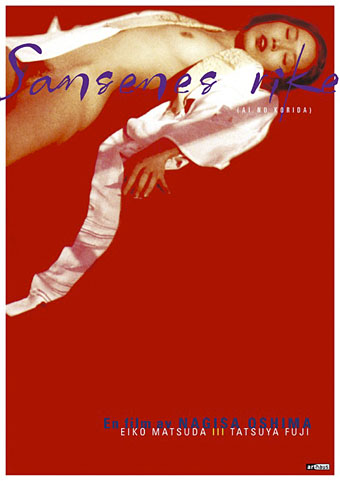
Ai No Corrida poster design by Egil Haraldsen (2001).

• “Back then, publishing an interview with Félix Guattari alongside little chats with rough trade and street walkers was unheard of — it still is for the most part.” BUTT on Kraximo, a gay Greek magazine of the 1980s.

13 books for 2013: A selection of forthcoming titles at Strange Flowers which so closely aligns with my preoccupations that I worry he’s reading my mind.

• “The Macaulay Library is the world’s largest and oldest scientific archive of biodiversity audio and video recordings.”

• A free BitTorrent Robert Anton Wilson audio and video pack. See also the RAW files at the Internet Archive.

beijing.jpg

The Pangu Building, Beijing, January 12th, 2013. Blade Runner arrives six years early.

Wired celebrates 100 years of Edward Johnston’s typeface for the London Underground.

Borges’ translation of Ulysses. Or of the last page of Ulysses as a translation of Ulysses.

0181, a new album by Four Tet, can be heard in full at SoundCloud.

• The Edge question for 2013: “What should we be worried about?

JG Ballard documentaries at Ubuweb.

Unlocking Dockstader.

• RIP Nagisa Oshima.

Ai No Corrida (1980) by Quincy Jones | Empire Of The Senses (1982) by Bill Nelson | Forbidden Colours (1983) by David Sylvian & Riuichi Sakamoto

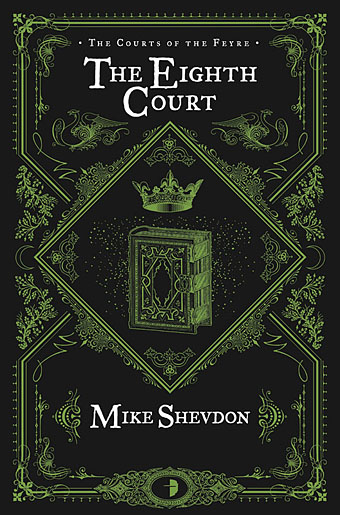
The Eighth Court

shevdon.jpg

Mid-January and here’s the first book cover design of the year, and another title for Angry Robot. This is the fourth book in Mike Shevdon‘s Courts of the Feyre series; since I’d already provided the three earlier books with a uniform design it didn’t take long to create this one. I’ve been very pleased with the reception of these covers, the positive response shows that it’s possible to design something for a fantasy series that isn’t the customary generic illustration plus florid typography. I wrote about the problems of designing fantasy covers last year with a lengthy examination of M. John Harrison’s Viriconium books.

angryrobot.jpg

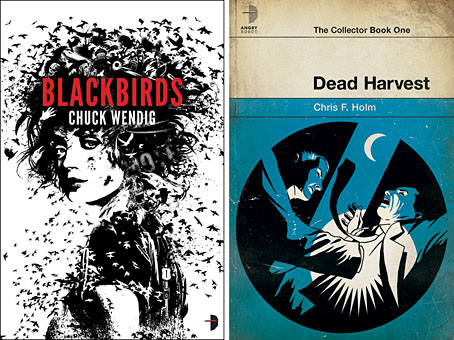
Two recent Angry Robot covers: Joey HiFi‘s cover for Chuck Wendig and Amazing15‘s Pelican-styled design for Chris F. Holm.

Credit should be given to Angry Robot’s Marc Gascoigne for encouraging this direction, the company has been producing a range of very smart covers which don’t pander to the clichés of the marketplace. There’s more of an incentive for smaller publishers to do this when small press imprints and self-publishers often have terrible cover designs (sad but true) while the multinationals play safe for fear of losing readers. If you want to stand out from the crowd then it helps to look good.

Elsewhere on { feuilleton }
The book covers archive

Previously on { feuilleton }
The Courts of the Feyre

Jean Genet, 1981

genet.jpg

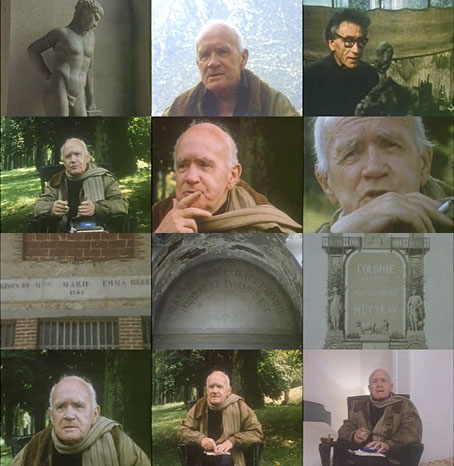
Until watching Antoine Bourseiller’s film, the only interview I’d seen with Jean Genet was the one filmed by the BBC in 1985 in which a tetchy and evidently irritated Genet made a fool of interviewer Nigel Williams, and compared the whole experience to a police interrogation. (Williams and his interview are memorialised in Iain Sinclair’s Downriver with the words “Is he the one who made a cunt of himself with Genet?”)

Bourseiller’s 52-minute film is very different, presenting a warm and effusive writer who talks at length about lovers, friends (including Alberto Giacometti), posterity (which he dismisses), and his prison experiences. Between the interview sections there are readings from some of his texts. That this is as good as BBC films used to be shows what a wasted opportunity the actual BBC interview was. At the time it was impossible to tell whether Genet was simply a prickly character or whether Williams and company had severely pissed him off. Judged against Bourseiller’s film I’d bet on the latter.

(Note: The YouTube copy is in French but includes optional subtitles.)

Previously on { feuilleton }
Un Chant d’Amour (nouveau)
Jean Genet… ‘The Courtesy of Objects’
Querelle again
Saint Genet
Emil Cadoo
Exterface
Penguin Labyrinths and the Thief’s Journal
Un Chant D’Amour by Jean Genet

The art of Henri Caruchet

caruchet1.jpg

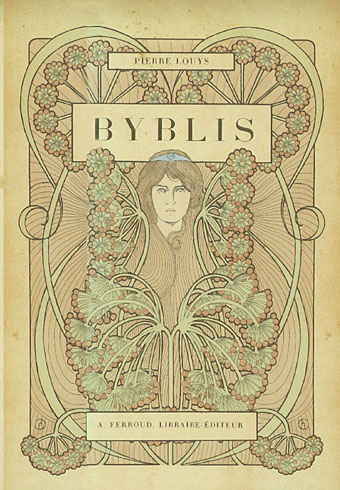
Byblis (1901) by Pierre Louÿs.

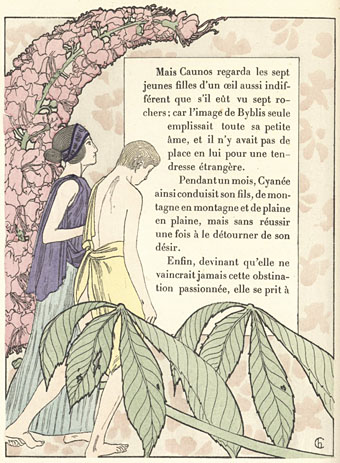
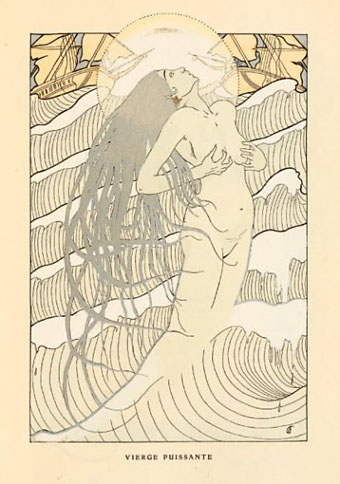
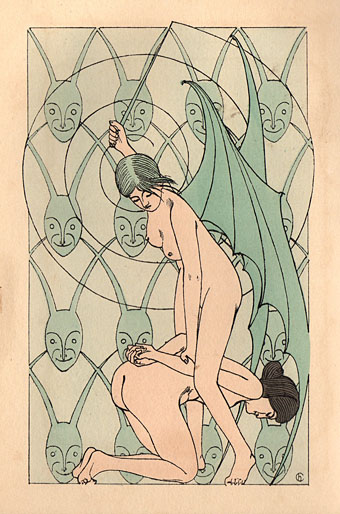
Henri Caruchet isn’t in George Barbier’s league, never mind that of Alphonse Mucha whose graphic style Caruchet appropriated. I’ve not been able to find details about his life either, all that turns up is examples of his book illustration on various websites. Author Pierre Louÿs is notable for his erotic works but it’s Caruchet’s illustrations for Jean de Villiot (via this site) which travel the furthest in that direction (see below), including another example of that deviant sub-genre, the woman being mauled by an octopus. If Caruchet had been a better draughtsman his illustrations might not have languished for so long.

There’s more decorative illustration by Caruchet at Gutenberg.org with an edition of Théophile Gautier’s Émaux et Camées. Two of Gautier’s poems from that volume are quoted by Oscar Wilde in The Picture of Dorian Gray.

caruchet2.jpg

Byblis (1901) by Pierre Louÿs.

caruchet3.jpg

Les Litanies de la Mer (1903) by Jean Richepin.

caruchet4.jpg

Parisienne et Peaux-Rouges (1904) by Jean de Villiot.

Continue reading “The art of Henri Caruchet”