
Weekend links 149

bowie.jpg

It’s not cheap but it’s rather tasty: The Changing Faces of Bowie, a limited print at the V&A shop produced for the forthcoming David Bowie exhibition. One hundred artists and designers were asked to choose or create a Bowie-related type design, the collection being printed on holographic paper. Creative Review looked at some details. Related: Bowie’s new album, The Next Day, is now streaming in full at iTunes.

• Marisa Siegel reviews The Moon & Other Inventions: Poems After Joseph Cornell by Kristina Marie Darling, “a fully enchanting if somewhat mysterious collection of poems, written entirely as footnotes”. BlazeVOX has an extract here.

• “[Clement] Greenberg came round to our house in Camden Square. He started telling Bill what he should do to improve a work. Dad lost patience and kicked him out.” Alex Turbull of 23 Skidoo on sculptor father William Turnbull.

“You get the impression that a lot of these young directors have never gained much experience of life outside their film schools or their video-rental stores.”

Anne Billson met Roman Polanski in 1995 to discuss Death and the Maiden.

• Max Beerbohm’s The Happy Hypocrite, and Ronald Firbank’s Vainglory are available in new print-on-demand and ebook editions from Michael Walmer.

• “Bring Back the Illustrated Book!” says Sam Sacks. Some of us would reply that it never went away but merely remains subject to much unexamined prejudice.

The Forest and The Trees: A blog by Genevieve Kaplan about altered texts and book art by herself and other artists.

The Homosexual Atom Bomb: Sophie Pinkham on gay rights, Soviet Russia and the Cold War.

Who’s Afraid Of The Art Of Zang Tumb Tuum? A blog devoted to the ZTT record label.

• Nigel Kneale’s TV ghost drama, The Stone Tape, is reissued on DVD later this month.

• The drawings of Victor Hugo.

David Bowie at Pinterest.

•  The Man Who Sold The World (1994) by Nirvana | V-2 Schneider (1996) by Philip Glass | ‘Heroes’ (2000) by King Crimson
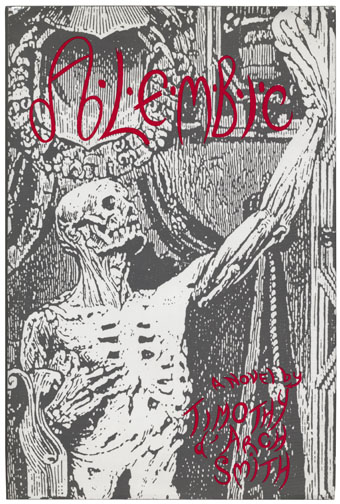
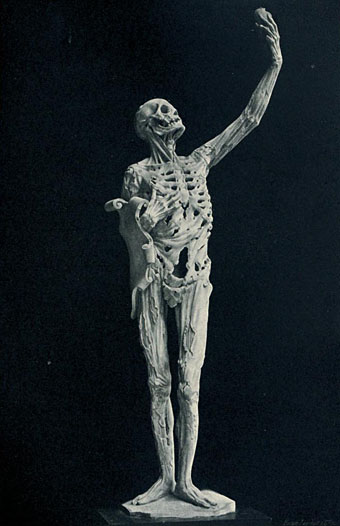
Alembic and Ligier Richier

alembic.jpg

Current reading is Alembic (1992), a curious novel by Timothy d’Arch Smith whose publishings prior to this were all non-fiction, among them a study of the Uranian poets, a bibliography of Montague Summers, and The Books of the Beast, one of the many books about Aleister Crowley. Alembic reflects some of these interests and blends them with others, notably alchemy and rock music, delivering the result in a digressive, comma-strewn prose style which I imagine many readers would find off-putting. From the jacket description:

Alembic is an unsettling novel about madness and alchemy, epistemology and rock and roll, magic and perversion. Thomas Graves, a young antiquarian, works for ALEMBIC, a British government office investigating the contemporary applications of the secrets of alchemy. The strange world of alchemy, however, is as eerie as the rock and roll world of Thomas’s friend Nicholas Spark, leader of a Led Zeppelin-like band called Celestial Praylin. Moving between these worlds, colourfully conveyed in d’Arch Smith’s sonorous prose – at times elegant, at times comic – Thomas Graves feels his grip on reality constantly imperilled; his attraction to the fourteen-year-old daughter of one of his colleagues complicates his existence further. A dramatic turn of events brings all of his fears and fancies out in the open, suggesting finally that the world is as mad as Thomas thought himself to be. Alembic is itself an alembic, a vessel that allows things to disintegrate and be transformed into new, refined substances. Set largely in the early 1980s, Alembic ends in the early years of the twenty-first century as alchemy engineers a new world order of darkness and perfection, destruction and eternal life, concluding a novel of great originality and ill-boding.

I don’t mind the style, it’s preferrable to the rudimentary bestsellerese that passes for much genre writing today. D’Arch Smith’s writing is witty, and there’s enough going on to sustain the interest. I thought at first the uncredited cover design would have had little to do with the contents but Ligier Richier’s celebrated sculpture of René de Chalon is referred to early on:

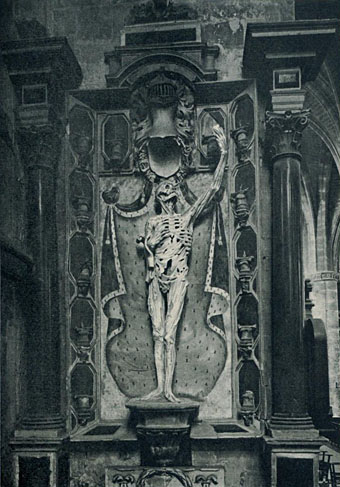
Nicholas had done himself to death. That was unequivocally stated in the garish red and black drawing depicted above the lyrics. In a grotesque parody of Ligier Richier’s funerary monument at Bar-le-Duc of the skeletal knight holding out his heart to God—possibly viewed by Ma during her historical tour of Alsace-Lorraine—Nicholas had been delineated in the same mortified yet exultant posture. The original figure was macabre enough, in the flaying of the naked body and the exposure of leg and arm muscles not yet rotted from the bones, to command attention, but the figure was imbued by Richier’s art with an enduring majesty that, though his design had been closely followed, was utterly overturned by the specious caricature of Nicholas Spark emblazoned down the waitress’s white cotton vest.

Given this, it’s a safe bet that the author would have asked for the capital “A” in the title to be given the same phallic connotations as it has in Aleister Crowley’s signature.

richier1.jpg

The web has plenty of photos of Le Transi de René de Chalon (c. 1545) but this view of Richier’s sculpture shows it to better effect than those where the background reduces the impact of the figure. The photos are from Ligier Richier, l’Artiste et Son Uvre (1911) by Paul Denis. As for Alembic, that’s currently out-of-print but copies are easy enough to find online.

richier2.jpg

Elsewhere on { feuilleton }
The book covers archive

Previously on { feuilleton }
Atalanta Fugiens
Splendor Solis revisited
Laurie Lipton’s Splendor Solis
The Arms of the Art
Splendor Solis
Amphitheatrum Sapientiae Aeternae
Cabala, Speculum Artis Et Naturae In Alchymia
Digital alchemy

Zone music

stalker1.jpg

Undulating terrain: Stalker (1979).

Marking the boundaries of an obsession, this post follows the discovery last week of the Sine Fiction soundtracks for science fiction novels, one of which was five tracks by Jos Smolders for Arkady and Boris Strugatsky’s Roadside Picnic. That album set me wondering what other recordings might have been inspired by that bounded region known as the Zone, whether derived from the Strugatskys’ novel, from Andrei Tarkovsky’s 1979 film Stalker (for whom the Strugatskys provided a screenplay) or even from the real-life Zone around the irradiated Chernobyl disaster site in Ukraine.

The cult status of the book and film can be measured by the following list which I’m sure will have many omissions, not least because searching music sites for “stalker”, “zone” and “roadside picnic” yields multiple results; all three of those terms happen to also be the names of musical artists or groups, as well as the names of labels, albums and individual recordings. (I’ll skip over the S.T.A.L.K.E.R. series of computer games. All have music but since I’ve not played any of them I can’t say much about them.)

stalker2.jpg

The stalker’s dream from Stalker.

The first release is of course the haunting film theme by Edward Artemyev, a mere five minutes of music which nonetheless adds a great deal to Tarkovsky’s unforgettable images. Artemyev also provided music for Tarkovsky’s Solaris (1972) and Mirror (1975) yet nothing else I’ve heard by the composer resembles this piece which wouldn’t be out-of-place on a compilation of German Kosmische music from the 1970s.

While that long camera shot over waterlogged objects is still in mind, there’s the following from Nova Swing (2006) by M. John Harrison, a science fiction novel which riffs on both Stalker and Roadside Picnic:

Upstairs, Emil Bonaventure was propped upright against the pillows like a corpse, his skin yellow in the streetlight from the window, his old ribs slatted with shadows. The energy had drained out of his smart tattoos and he was breathing ever so lightly. Edith watched the pulse in his neck. She could almost see the life through the skin, the thoughts in his head, and what were they but the dreams he couldn’t any longer have? Shallow water over cracked chequerboard tiles and cast-off domestic objects, books, plates, magazines, empty tunnels smelling of chemicals, a black dog trotting aimlessly round him in his sleep on some dirty waterlogged ground neither in nor out of anything you could think of as the world, while a woman’s voice mourned open-throat from a house not far enough in the distance.

Nova Swing will be available in a new edition later this year.

richlustmord.jpg

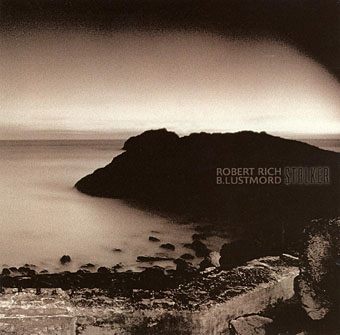
Stalker (1995) by Robert Rich & B. Lustmord.

The doomy atmospherics which have become the hallmark of Zone music begin with this album by Robert Rich and B. Lustmord. Seven tracks take Tarkovsky’s film as an inspiration with vaguely allusive titles—Undulating Terrain—and occasional snatches of dialogue buried in the mix. A superb piece of late-night listening even without the associations.

Continue reading “Zone music”

Weekend links 148

lanna.jpg

Quantum Entanglement by Duda Lanna.

An hour-long electronica mix (with the Düül rocking out at the end) by Chris Carter for Ninja Tune’s Solid Steel Radio Show.

• “…a clothes-optional Rosicrucian jamboree.”: Strange Flowers on the paintings of Elisàr von Kupffer.

• A Paste review of volume 2 of The Graphic Canon has some favourable words for my contribution.

It is an entertaining thought to remember that Orlando, all sex-change, cross-dressing and transgressive desire, appeared in the same year as Radclyffe Hall’s sapphic romance The Well of Loneliness. The two novels are different solar systems. The Well is gloomy, beaten, defensive, where women who love women have only suffering and misunderstanding in their lonely lives. The theme is as depressing as the writing, which is terrible. Orlando is a joyful and passionate declaration of love as life, regardless of gender. The Well was banned and declared obscene. Orlando became a bestseller.

Jeanette Winterson on Virginia Woolf’s androgynous fantasia.

Jim Jupp discovers the mystical novels of Charles Williams.

Michael Andre-Driussi on The Politics of Roadside Picnic.

Les Softs Machines: 25 August 1968, Ce Soir On Danse.

• At 50 Watts: Illustrations and comics by Pierre Ferrero.

Soviet posters: 1469 examples at Flickr.

Oliver Sacks on drugs (again).

• At Pinterest: Altered States.

• Farewell, Kevin Ayers.

Darkest London

Why Are We Sleeping? (1969) by The Soft Machine | Lady Rachel (1969) by Kevin Ayers | Decadence (1973) by Kevin Ayers

Interzone: A William Burroughs Mix

burroughs.jpg

Interzone is a selection of William Burroughs recordings mixed with electronic music and other pieces such as extracts from Howard Shore & Ornette Coleman’s Naked Lunch soundtrack:

A tribute to ‘El Hombre Invisible’. It features some of my favourite readings, to which I’ve added music by John Zorn (from his Burroughs-inspired work), Tod Dockstader, Arne Nordheim and others. Also in the mix are radio recordings and vocal cut-ups by the man himself.

The curator is Mixcloud user Timewriter, one of whose mixes I linked to last Halloween. I was surprised to find I’d already downloaded the Burroughs mix from the Timewriter blog, Include Me Out, but hadn’t managed to listen to it. Better late than never. This week seems a good time to draw attention to both the mix and that blog in general which features among its posts a quantity of Burroughs-related ephemera. Many of the mix readings are from the albums of Burroughs’ tape recordings from the 1960s, including Nothing Here Now But The Recordings, the collection of tape experiments released by Industrial Records in 1981. The latter is essential listening for anyone who appreciates Burroughs’ early novels; some of its pieces such as Last Words of Hassan Sabbah sound less like readings of the author’s work than actual artefacts from the books themselves.

Elsewhere on { feuilleton }
The William Burroughs archive