Rodler’s Fine, Useful Booklet

rodler01.jpg

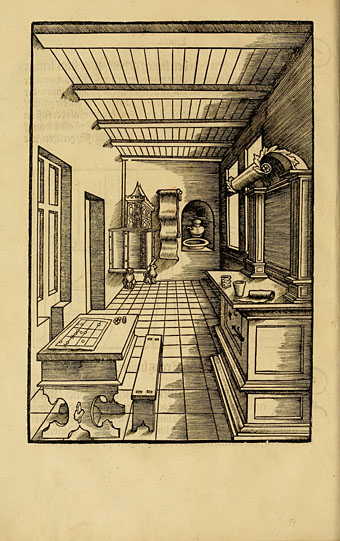
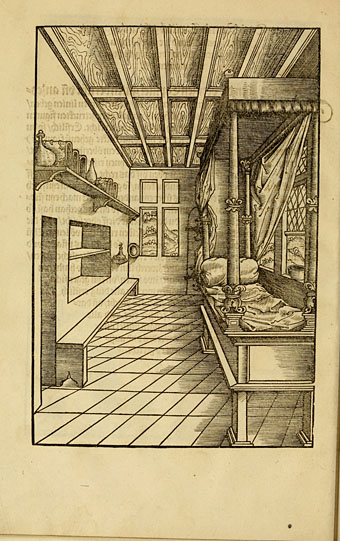
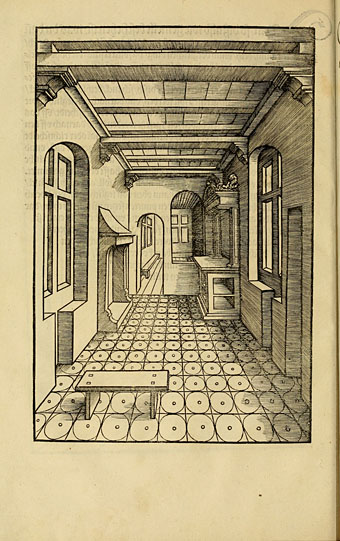
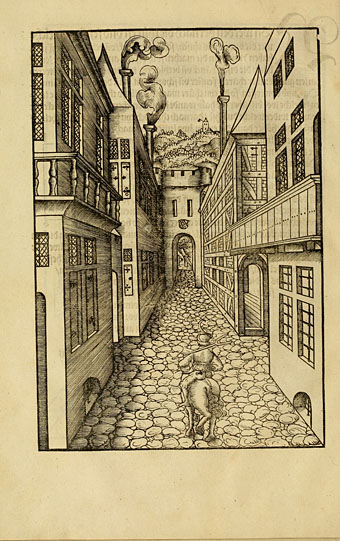
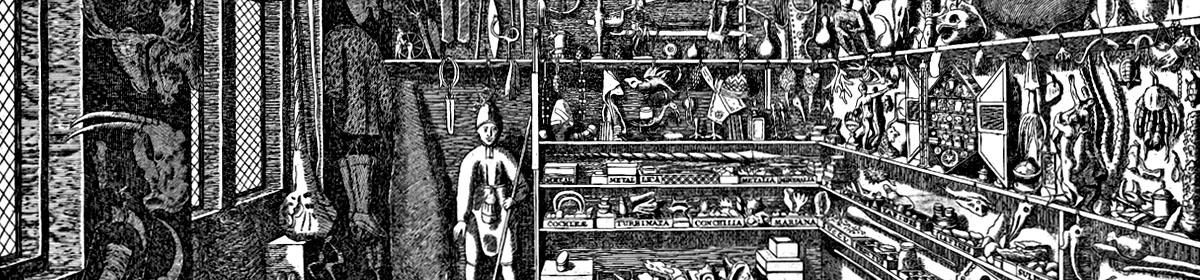
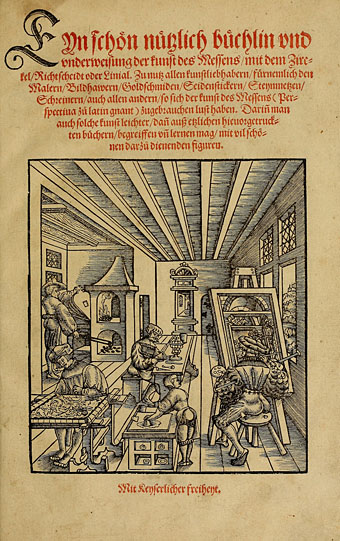
Another treatise on perspective, and an older one than Pozzo’s so the drawings are somewhat cruder. Eyn schön nützlich büchlin und underweisung der kunst des Messens (A Fine, Useful Booklet and Instruction in the Art of Measurement) by Hieronymus Rodler was published in 1531, and features a number of full-page views where the perspective is accurate but also alarmingly severe in places. The emptiness and unusual appearance of the scenes has an unintentional charm, they remind me of the illustrations from The Dumas Club (1993) by Arturo Pérez-Reverte where the mysterious drawings—based on old alchemical illustrations—contain subtle variations. Rodler’s book made an appearance at Giornale Nuovo in 2005 so I’ll point you there for further discussion of its technical qualities. The book itself may be browsed here or downloaded here.

rodler02.jpg

rodler03.jpg

rodler04.jpg

rodler05.jpg

Continue reading “Rodler’s Fine, Useful Booklet”

Rules and Examples of Perspective Proper, 1693

perspective01.jpg

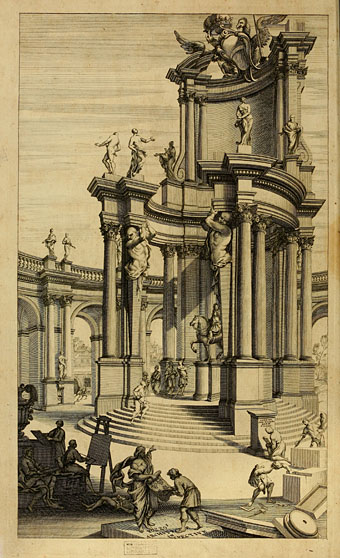
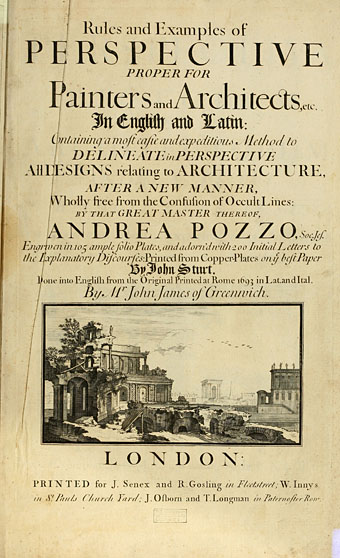
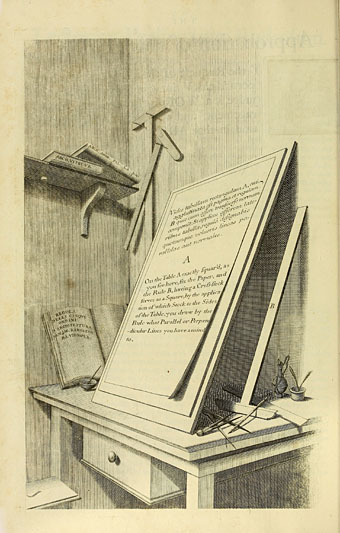
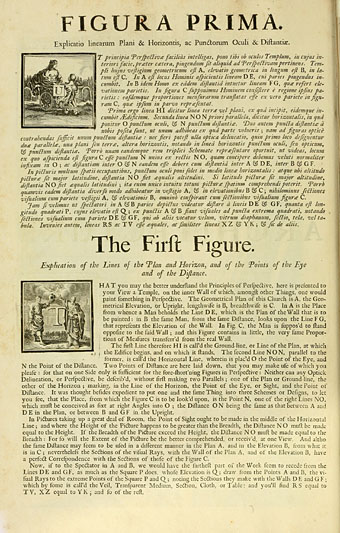
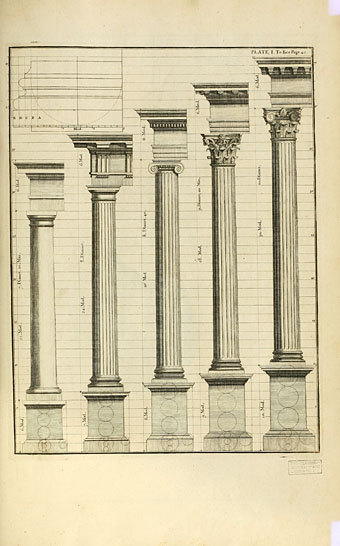
I’m working on more engraving collage at the moment so I’ve been delving into the scanned books at the Internet Archive once more in search of raw material. I still tend to use things scanned from paper volumes but the Internet Archive is useful for small details, and searches there also have the advantage of turning up things you might not otherwise see. This is one such book, an English guide to perspective for painters and architects adapted from the two-volume Perspectiva pictorum et architectorum by Andrea Pozzo (1642–1709). The title page declares the instruction to be “wholly free from the confusion of occult lines” which it certainly is, the plates would still serve as guides to the trickier aspects of perspective today. The engravings in this edition are by John Sturt.

Pozzo was a master of trompe l’oeil painting, and when you see ceilings such as this it’s no surprise that he might have a thing or two to say about perspective. The plates begin with simple shapes then graduate to the construction of the columns and capitals used in Classical architecture; at the end you have some intimidatingly complex pediments and porticoes. The University of Heidelberg has copies of Pozzo’s original books, including the second volume where things become even more elaborate.

perspective02.jpg

perspective03.jpg

perspective04.jpg

perspective05.jpg

Continue reading “Rules and Examples of Perspective Proper, 1693”

Antony Little’s echoes of Aubrey

little1.jpg

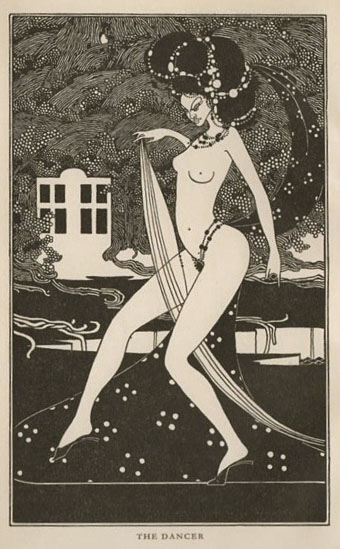
The Dancer (1967) by Antony Little.

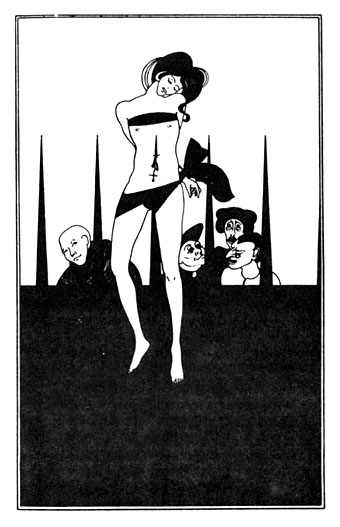
My thanks to Sweet Jane this time for alerting me to her post about a series of Beardsley-inspired illustrations from 1967 by Biba designer Antony Little. The Wandering Jew and Other Stories was the first translation in English of Apollinaire’s 1910 collection L’Hérèsiarque et Cie. I’ve known about this book for a while but few of the illustrations have been on view anywhere until this post. There are eight in all, each of them very adeptly capturing different phases of Beardsley’s drawing style, from the spare black-and-whites to the more detailed renderings seen in his later work. The drawing below is another in the series from a post of Callum’s which also includes a favourite of mine by Beresford Egan.

Little’s designs, and the prominence of the Biba stores, did much to make Art Nouveau in general, and Beardsley in particular, a crucial component of London fashion in the late 1960s. For more on that subject see this Sweet Jane post featuring yet more Beardsley borrowings and monochrome design, plus Osborne & Little’s fantastic Chinese Dragon wallpaper which made a memorable appearance last year in Only God Forgives.

little2.jpg

Elsewhere on { feuilleton }
The Aubrey Beardsley archive
The illustrators archive

Weekend links 204

somnium.jpg

RIP Steve Moore. We never met, unfortunately, but I was very pleased he asked me to create a cover for his unique occult novel, Somnium, in 2011. Prior to this we’d been connected by shared acquaintances, colleagues, and membership in the informal cabal that was (and maybe still is) The Moon & Serpent Grand Egyptian Theatre of Marvels. Steve’s long friendship with Alan Moore (no relation) is well-documented, not least by Alan himself who made Steve the subject of his Unearthing project. One surprising connection for me was that Steve also had a link to Savoy Books. In the late 1960s he was working for comics publisher Odhams where he was able to copy for David Britton some Ken Reid comic art which Odhams had refused to print. Dave published the forbidden pages in his first magazine, Weird Fantasy, in 1969. In 2011 Steve talked to Pádraig Ó Méalóid about Somnium, and also to Aug Stone at The Quietus. Aug Stone penned a few memorial words here.

• “People love using the word ‘porn’ as long as there’s a partner for it. Pair ‘porn’ with something else and it’s usually a good thing. A celebration of style and culture. But that word on its own? Well.” Porn star Conner Habib asks why people have such a problem with porn actors.

Dave Maier‘s Russian cinema recommendations. Several favourites there including the magical and remarkable Shadows of Our Forgotten Ancestors (1964) which, as Maier notes, isn’t really Russian but should be seen in any case.

Shakespeare uses verbal magic, cantrips and ditties, nonsense songs and verses throughout the plays, but in Othello he gives a glimpse of how powerful a spell becomes when it’s no longer oral, but fixed in material form. The fatal handkerchief is no ordinary hanky; it’s a love spell, and it was made with gruesome and potent ingredients (mummified “maiden’s hearts”) by a two-hundred-year-old sibyl in Egypt—Egypt being the birthplace and pinnacle of magic knowledge.

Marina Warner on magic.

• Mixes of the week: an hour of electro-acoustics and contemporary classical recordings sequenced by Laurel Halo, and (from 2010) 36-minutes of “umbral electronic hypnagogia” by The Wyrding Module.

• “This is the book that, 10 years later, inspired Richard Hollis’s landmark design for John Berger’s Ways of Seeing.” Rick Poynor on Chris Marker’s Commentaires.

• Is the Linweave Tarot the grooviest deck ever made? Dangerous Minds thinks so.

• Bobby Barry talks to Holger Czukay about his 1969 audio collage, Canaxis 5.

• “What Happened to Experimental Writing?” asks Susan Steinberg.

Aldous Huxley‘s lectures on visionary experience at MIT, 1962.

Laura Palmer will see Agent Cooper again in just a few hours.

Callum found a copy of The Gay Coloring Book (1964).

Metal Cats

Moonshake (1973) by Can | Lunar Musick Suite (1976) by Steve Hillage | Dark Moon (1993) by Holger Czukay | Boy In The Moon (2012) by Julia Holter
The art of Robert W. Richards

richards1.jpg

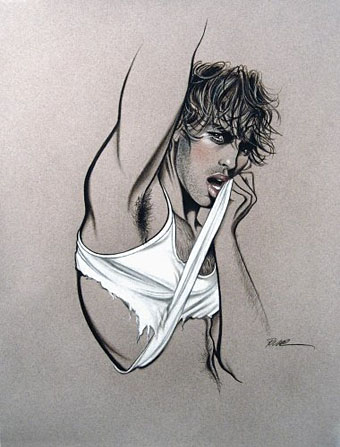
The latest interview at the essential BUTT magazine is Danny Calvi talking to ex-fashion illustrator and erotica artist Robert W. Richards about his life and work. I’d seen some of Richards’ drawings before but this is the first time I’ve seen him interviewed; one of the many commendable things about BUTT is the way they seek out people such as this to talk to, people who’ve been producing gay art for years but who the glossy, celebrity-obsessed mags will seldom mention. My only complaint is that some of their interviews aren’t longer.

richards2.jpg

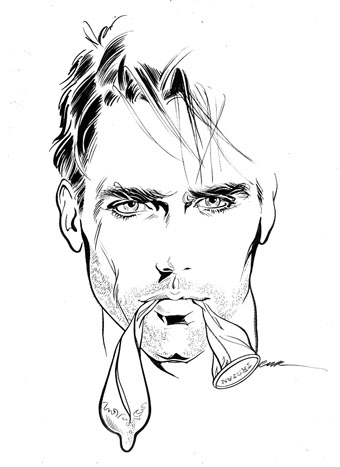
As can be seen from the examples here, Richards’ career in the fashion world helped hone a technique and a command of line that’s very accomplished. When you’re this good it’s easy to stick to doing strictly commercial work, and avoid anything overtly explicit, gay or straight. Richards doesn’t seem to have been too worried about maintaining a sex-free reputation. BUTT has more examples of his drawings, as does Juxtapoz. There’s also a book, Allure, published by Bruno Gmünder. Stroke: From Under the Mattress to the Museum Wall, an exhibition of Richards’ art at the Leslie + Lohman Museum, New York, runs from March 28 to May 25, 2014.

Elsewhere on { feuilleton }
The gay artists archive