Weekend links 209

soundcarriers.jpg

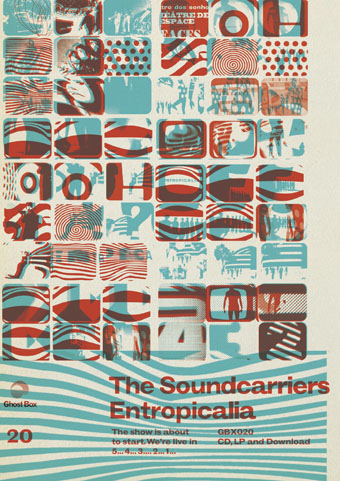
Soundcarriers poster by Julian House.

A new release on the Ghost Box label is always a welcome thing but Entropicalia by The Soundcarriers, out on May 20th, is one I’m especially looking forward to. Julian House has made a video for new song Boiling Point, and there’s also the poster above which can be downloaded at larger size here. The Ghost Box Guest Shop has a couple of new additions including the recent Man Woman Birth Death Infinity album by Raagnagrok.

• “It’s a funny time to be making music, because we’re a generation of people who make music with screens instead of with ears.” Ben Frost talking to Tristan Bath.

• At Dangerous Minds: You Gotta Say Yes to Another Excess, a rare glimpse of Yello live in concert, 1983.

Our movements about London are closely circumscribed, and while we may imagine ourselves to be free, the truth is that the vast majority of our journeys are undertaken for commercial imperatives: we travel either to work or to spend. All about us during our daily existence we are presented with buildings we cannot enter, fences we cannot climb and thoroughfares it would be foolhardy to cross. We are disbarred from some places because we don’t have the money — and from others because we don’t have the power. The city promises us everything, but it will deliver only a bit.

The place-hackers draw our attention to how physically and commercially circumscribed our urban existence really is. […] As more and more international capital flows into London, so public space is increasingly eroded — it’s just too valuable for us ordinary folk to paddle about in any more.

Give the freedom of the city to our urban explorers, says Will Self. Related: Robert Macfarlane accompanied urbexer Bradley Garrett on a night-time jaunt.

Black Sabbeth: Metal band Gonga covering a classic with Portishead’s Beth Gibbons on vocals.

• Pelican books take flight again; Paul Laity on the resurrection of the non-fiction imprint.

• Finland’s homoerotic stamps are an ocular feast for women, too, says Nell Frizzell.

• “I guess you could say I am a Pagan.” Kenneth Anger on the occult.

• “How much gay sex should a novel have?” asks Caleb Crain.

• Mix of the week: Secret Thirteen Mix 112 by Kyoka.

The Gibraltar Encyclopedia of Progressive Rock

Zombi’s Guide to Goblin

Decadence Comics

Zombie Warfare (1979) by Chrome | Escape From The Flesheaters (Zombie) (1979) by Fabio Frizzi | Zombie’ites (1993) by Transglobal Underground
Steampunk catalogued

steampunk1.jpg

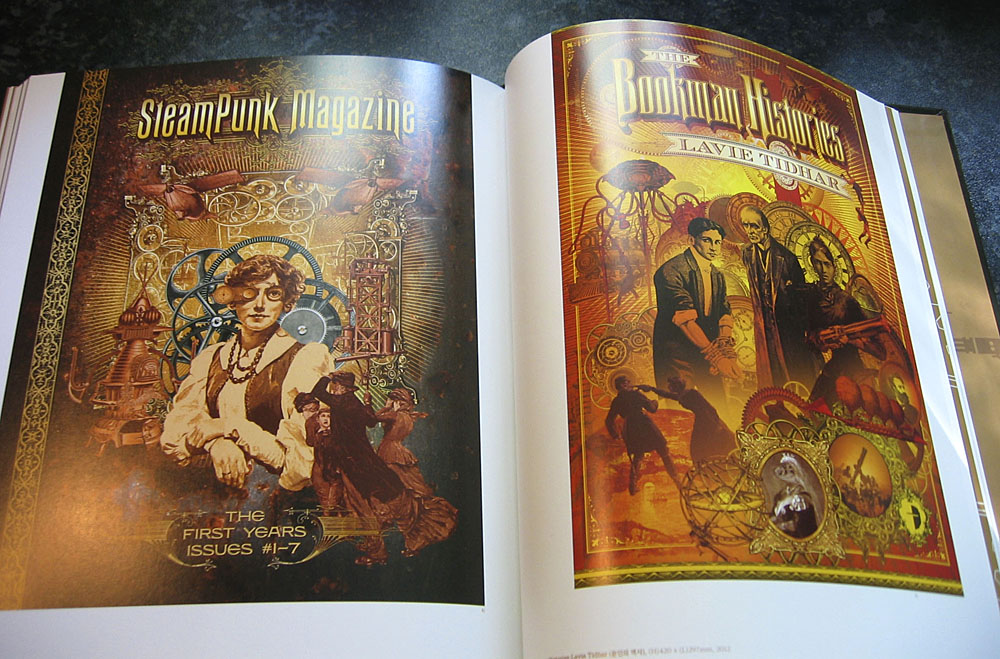
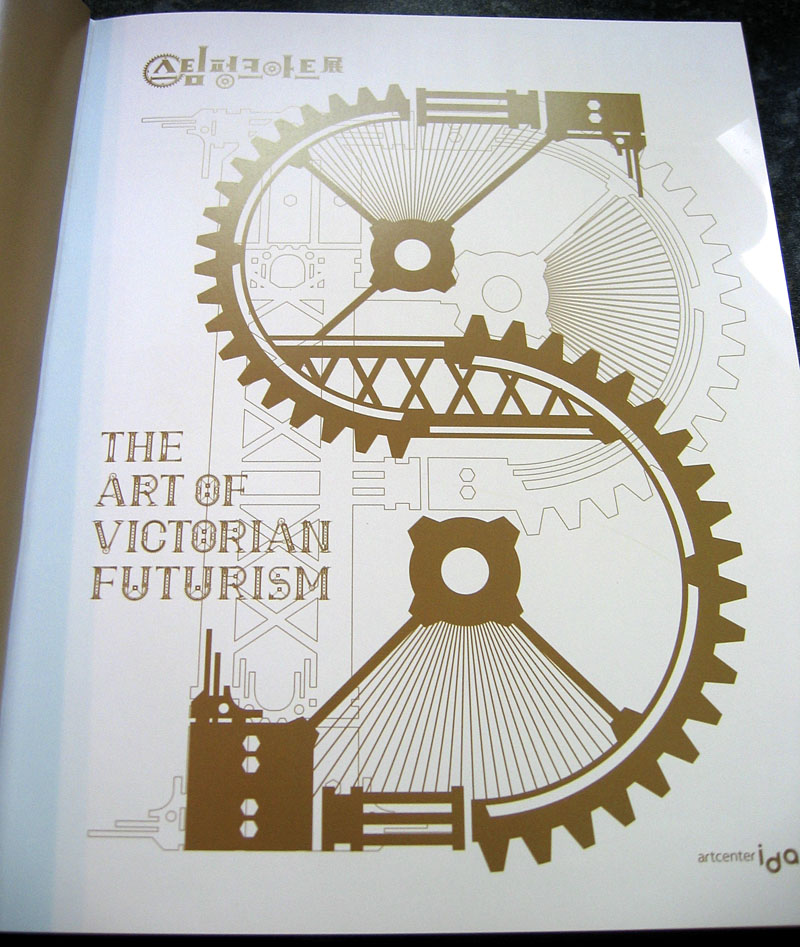
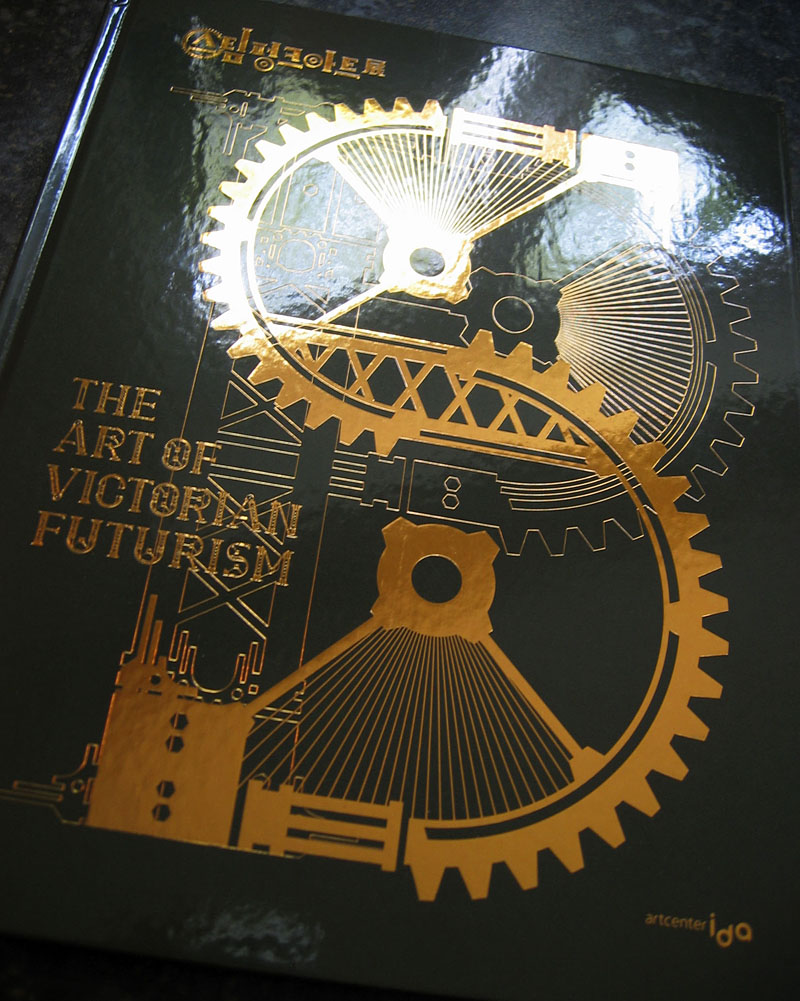
Another month, another exhibition catalogue. Steampunk: The Art of Victorian Futurism is still running at Artcenter IDA in Seoul with a selection of my book covers on display among a great variety of mechanical sculptures, costumes and other creations. The catalogue is a suitably lavish affair, so much so that it puts to shame many of the bandwagon-jumping coffee-table books that have been appearing recently. Excellent printing with lots of gold-ink embellishment, and all the exhibits are given substantial space. I especially like the mechanical type designs, and can now credit them to designers Se Byeol Moon and Han Woong Yoon. Korean TV news has run a couple of reports about the exhibition, the best of which may be seen here. The exhibition itself continues until May 18th.

steampunk2.jpg

steampunk3.jpg

steampunk4.jpg

Previously on { feuilleton }
Steampunk: The Art of Victorian Futurism
Steampunk Calendar
Words and pictures
Nathanial Krill at the Time Node
Fiendish Schemes
Ghosts in Gaslight, Monsters in Steam
Steampunk Revolution
The Bookman Histories
Aether Cola
Crafting steampunk illustrations
SteamPunk Magazine
Morlocks, airships and curious cabinets
The Steampunk Bible
Steampunk Reloaded
Steampunk overloaded!
More Steampunk and the Crawling Chaos
Steampunk Redux
Steampunk framed
Steampunk Horror Shortcuts

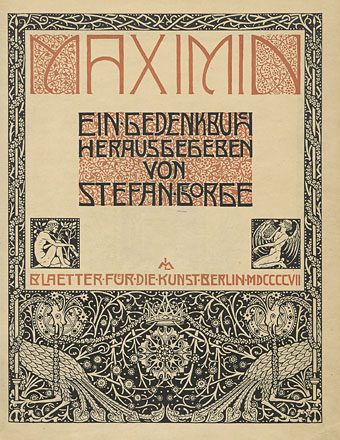
Maximin: ein Gedenkbuch by Stefan George

maximin01.jpg

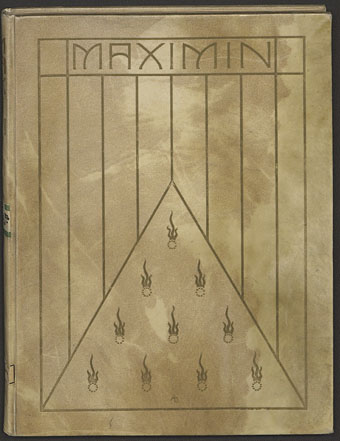
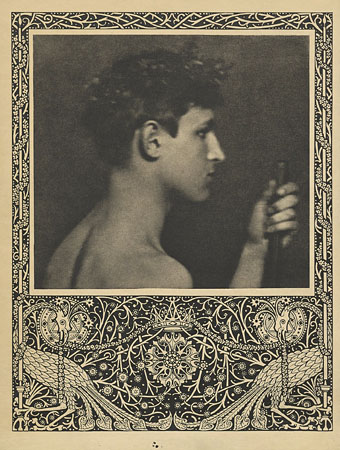
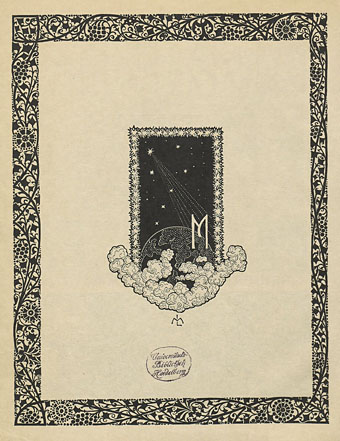
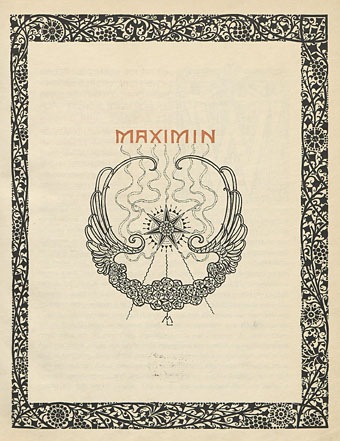
This is a strange and beautiful book, a loving paean to a dead boy-poet from another poet, Stefan George (1868–1933), published in 1907. The “Maximin” of the title was Maximilian Kronberger (1888–1904) who was around 14 when he met George; the older man was 34 at the time. George was apparently smitten by the boy, and devastated when he died from meningitis two years later. Maximin: ein Gedenkbuch (A Memorial Book) is the result, a collection of mournful poems, beautifully designed and illustrated by Melchior Lechter in that rectilinear Art Nouveau style which the artist made his own. The memory of the dead Maximin became for George a quasi-religious obsession which makes Maximin the bible of the homosocial cult that George subsequently encouraged.

maximin02.jpg

What’s most surprising about all this behaviour is that it did nothing at all to harm his reputation, even among the Nazis who later revered his poetry. George was a contemporary of Oscar Wilde but the pair were poles apart in character, George’s chilly, high-minded aestheticism preserving him from the brickbats aimed at Wilde and others. Nonetheless, the inherent camp that results from the combination of such a remote attitude combined with flagrant boy-worship secured for George a place alongside Wilde in Philip Core’s essential Camp: The Lie that Tells the Truth (1984):

Strangely enough his overtly (if classically) homosexual verses, his preference for beautiful youth, and his severe black-clad dignity, all became immensely popular in the land of brüderschaft (brothers’ love). The camp Classicism of his ‘academy’ of the spirit, in surroundings of neo-Classical kitsch, hit just the right middle ground between Edwardian sentimentality and Hitlerian Imperialism.

Maximin: ein Gedenkbuch may be browsed or downloaded at the University of Heidelberg. There’s a more academic examination of George’s homoerotics here. Further page samples follow.

maximin03.jpg

maximin04.jpg

maximin05.jpg

Continue reading “Maximin: ein Gedenkbuch by Stefan George”

Weekend links 208

sungwon.jpg

The Blue Girl (2013) by Sungwon.

• “Meanwhile, in her parents’ room [Max] Ernst painted aardvarks eating ants and big human hands around the windows. ‘Sexual connotations, I think,’ she says shyly.” Agnès Poirier talks to Cécile Eluard about her childhood among the Surrealists.

• “Thrilling and prophetic”: why film-maker Chris Marker‘s radical images influenced so many artists. Sukhdev Sandhu, William Gibson, Mark Romanek and Joanna Hogg on the elusive director.

• At Dangerous Minds: Throbbing Gristle live in Manchester in 1980, and Brian Butler talks about the rediscovered early print of Kenneth Anger’s Lucifer Rising. There’s a trailer!

• From 1981: The Art of Fiction No. 69 at The Paris Review, an interview with Gabriel García Márquez. Related: Thomas Pynchon reviewed Love in the Time of Cholera in 1988.

• “Seven years ago, a stolen first edition of Borges’s early poems was returned to Argentina’s National Library. But was it the right copy?” Graciela Mochkofsky investigates.

• “What was Walter Benjamin doing with his shirt off in Ibiza?” Peter E. Gordon reviews Walter Benjamin: A Critical Life by Howard Eiland & Michael W. Jennings.

• A video by Marcel Weber for Måtinden, a track from Eric Holm’s Andøya album. Another album on the Subtext label that I helped design.

• More Ian Miller: Boing Boing has pages from his new book, The Art of Ian Miller, and there’s an interview at Sci-Fi-O-Rama.

Outrun Europa, a free compilation of 80s-style electronic music. There’s a lot more along those lines here.

• Praise Be! Favourite religious and spiritual records chose by writers at The Quietus.

Ralph Steadman illustrated Alice’s Adventures in Wonderland in 1973.

British Pathé is uploading 85,000 of its newsreel films to YouTube.

• Drawings by Lebbeus Woods at The Drawing Center, New York.

• At Pinterest: Ian Miller and Kenneth Anger.

Lucifer Sam (1967) by Pink Floyd | The Surrealist Waltz (1967) by Pearls Before Swine | Which Dreamed It (1968) by Boeing Duveen And The Beautiful Soup

Robert Fludd’s Temples of Music

fludd1.jpg

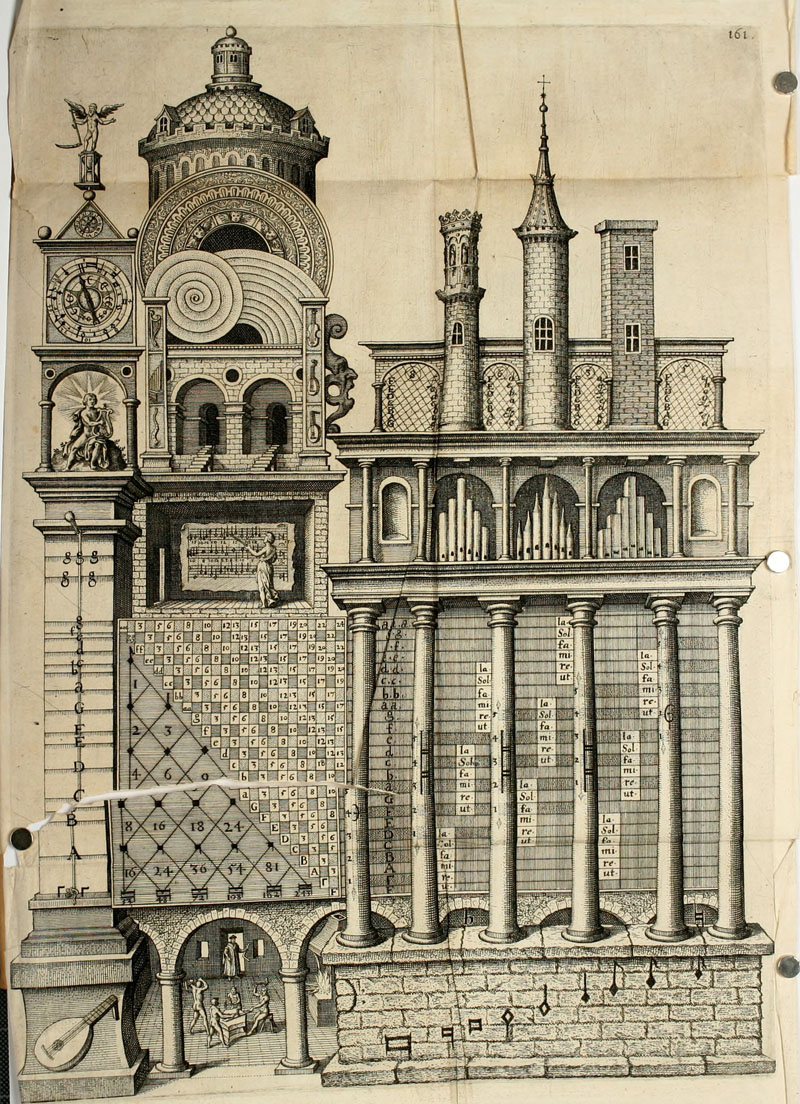
For the past week I’ve been downloading more of the books at the Internet Archive illustrated by Matthäus Merian. Among the hoard there’s a two-volume set of Robert Fludd’s Utriusque Cosmi, Maioris scilicet et Minoris, metaphysica, physica, atque technica Historia (1617–1626), a remarkable work which attempts to cover all the metaphysical, scientific and artistic knowledge of the time, opening modestly with a detailed description of the creation of the universe. The illustrations for these volumes by Merian and Johann de Bry are so good they’ve been plundered endlessly, not only in later books but in the general culture; I’ve swiped details myself on more than one occasion so—once again—it’s good to see an original printing with all the accompanying text, and also all the less familiar treatises and pictures.

fludd2.jpg

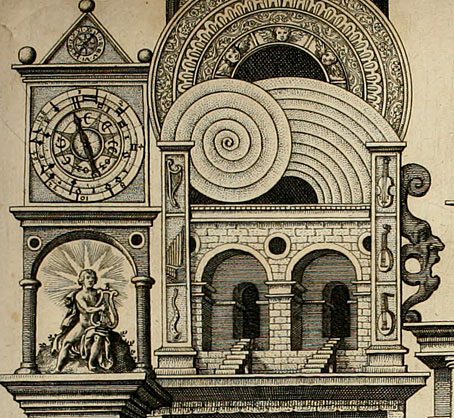
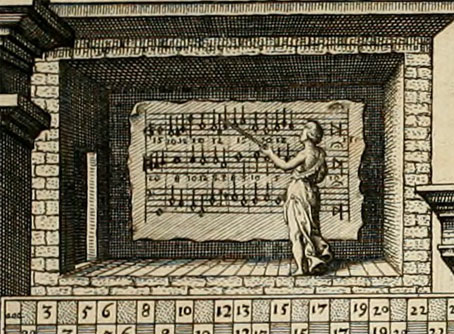
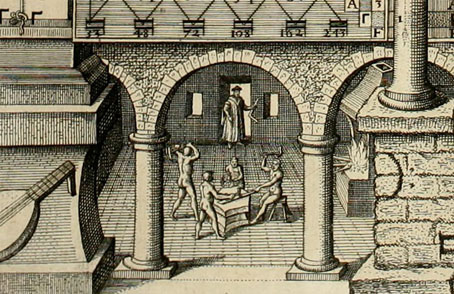
One area of Fludd’s study concerns music, a subject which Merian and De Bry illustrate using a variety of graphic devices, the most fanciful of which are the “Temples of Music” displaying the notes and divisions of the Pythagorean scale. The largest of the drawings was printed onto a fold-out sheet which explains the unfortunate tear in this copy. I love all the details on this one, some of which are rather unusual: who are the people underneath the temple in the room with the furnace? What are they doing, and why are they naked?

fludd3.jpg

fludd4.jpg

Continue reading “Robert Fludd’s Temples of Music”