Tresham’s Trinities

lodge.jpg

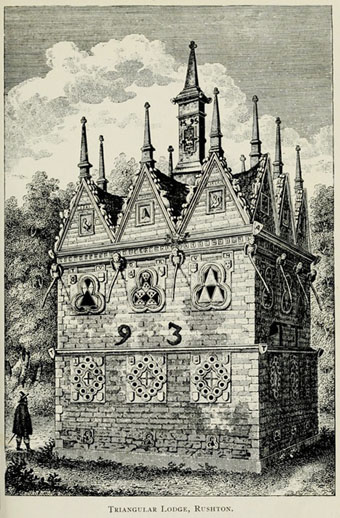
Memorials of Old Northamptonshire (1903), a book edited by Alice Dryden, includes an entire chapter by M. Jourdain about Thomas Tresham’s Triangular Lodge. Descriptions of the building usually skate over the Catholic symbolism encoded in its structure but Jourdain goes into some detail describing the many inscriptions and numerological details. The engraved illustration is rather good as well, although it makes the lodge appear a more squat than it should be. The chapter also contains a description of further symbolism at Tresham’s Lyveden manor. Read it here.

Previously on { feuilleton }
The Triangular Lodge again
The Triangular Lodge

The Winchester Mystery House

winchester1.jpg

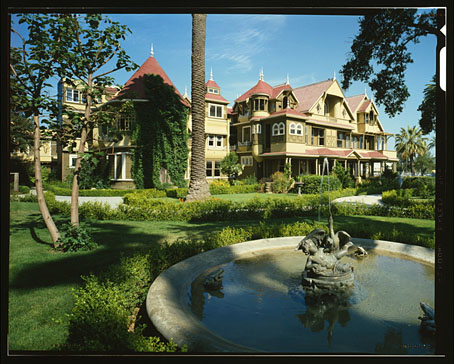
Winchester House, 525 South Winchester Boulevard, San Jose, Santa Clara County, CA.

“One of the peculiar traits of Hill House is its design—”

“Crazy house at the carnival.”

“Precisely. Have you not wondered at our extreme difficulty in finding our way around? An ordinary house would not have had the four of us in such confusion for so long, and yet time after time we choose the wrong doors, the room we want eludes us. Even I have had my troubles.” He sighed and nodded. “I daresay,” he went on, “that old Hugh Crain expected that someday Hill House might become a showplace, like the Winchester House in California or the many octagon houses; he designed Hill House himself, remember, and, I have told you before, he was a strange man. Every angle”—and the doctor gestured toward the doorway—”every angle is slightly wrong. Hugh Crain must have detested other people and their sensible squared-away houses, because he made his house to suit his mind. Angles which you assume are the right angles you are accustomed to, and have every right to expect are true, are actually a fraction of a degree off in one direction or another. I am sure, for instance, that you believe that the stairs you are sitting on are level, because you are not prepared for stairs which are not level—”

They moved uneasily, and Theodora put out a quick hand to take hold of the balustrade, as though she felt she might be falling.

“—are actually on a very slight slant toward the central shaft; the doorways are all a very little bit off centre—that may be, by the way, the reason the doors swing shut unless they are held…”

The Haunting of Hill House (1959) by Shirley Jackson.

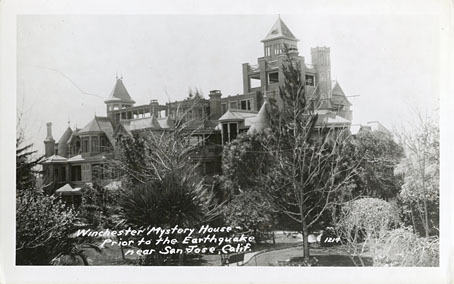
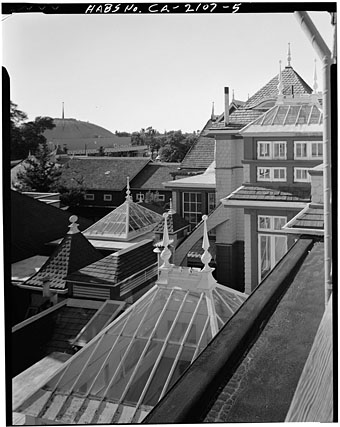
I re-read Shirley Jackson’s novel a few months ago but neglected at the time to follow-up the reference to the Winchester House. News this week that Sarah Winchester’s sprawling folly in San Jose is to finally allow overnight stays prompted some investigation. The most remarkable thing about the Winchester Mystery House is that it’s much more of an oddity than its fictional relation, if you overlook (so to speak) the fact that Shirley Jackson’s house is a home to malevolent spectres. Sarah Winchester was heir to the Winchester rifle fortune, and instituted a process of continual and completely uncoordinated house-building for thirty-seven years, believing that this would confound the ghosts of those killed by the weapons bearing her name. Among the house’s 160 rooms are extraneous chambers and closets, doors to nowhere, and stairways serving no purpose. The spirit-trapping decorations include repeated spider-web motifs, and a recurrence of the number 13; one room at least was originally a Séance Room. This blog post concerns a tour round the house as it is today, while the Library of Congress has a number of views of the place.
winchester2.jpg

View looking west from top floor.

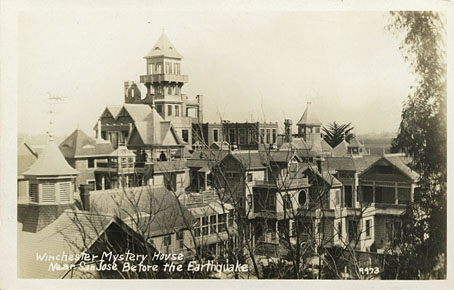
It’s unfortunate that the house was built in California’s earthquake zone, the structure had reached seven stories until the 1906 earthquake forced the removal of the three topmost floors. I had to go looking for views of the pre-quake building, and happily there are a few preserved on old postcards. When Blue Öyster Cult chose Adolph Sutro’s Cliff House for the cover of their Imaginos album they certainly picked the more immediately photogenic building, but the Winchester Mystery House a few miles to the south has it beat when it comes to metaphysical cachet.

The Winchester Mystery House at Pinterest.
winchester4.jpg

winchester3.jpg

Previously on { feuilleton }
The Cliff House revisited
Adolph Sutro’s Gingerbread Palace
Weekend links 203

budich.jpg

A Dune-inspired piece by Joshua Budich for In Dreams: an art show tribute to David Lynch at Spoke Art.

• “[Montague] Summers was a friend of Aleister Crowley and, like [Jacques d’Adelswärd] Fersen, conducted homoerotic black masses; whatever eldritch divinity received their entreaties was evidently propitiated by nude youths.” Strange Flowers goes in search of the Reverend Summers.

• More Jarmania: Veronica Horwell on the theatrical life of Derek Jarman, Paul Gallagher on When Derek Jarman met William Burroughs, and Scott Treleaven on Derek Jarman’s Advice to a Young Queer Artist.

Robert Henke of Monolake talks to Secret Thirteen about his electronic music. More electronica: analogue-synth group Node have recorded a new album, their first since their debut in 1995.

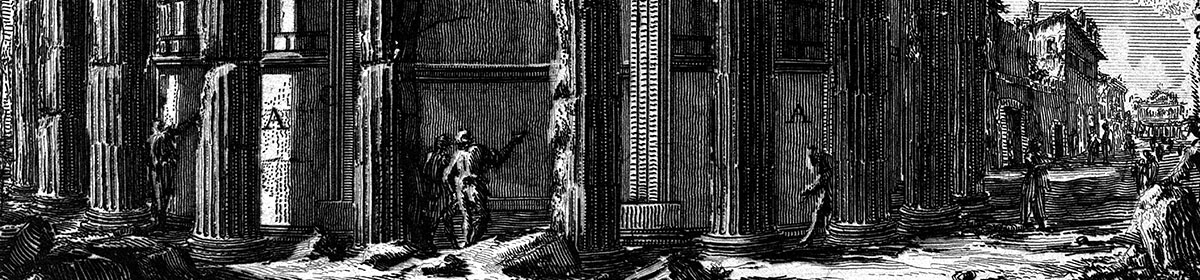
This hypertrophied response to decay and dilapidation is what drives the “ruin gaze”, a kind of steroidal sublime that enables us to enlarge the past because we cannot enlarge the present. When ruin-meister Giovanni Piranesi introduced human figures into his “Views of Rome”, they were always disproportionately small in relation to his colossal (and colossally inaccurate) wrecks of empire. It’s not that Piranesi, an architect, couldn’t do the maths: he wasn’t trying to document the remains so much as translate them into a grand melancholic view. As Marguerite Yourcenar put it, Piranesi was not only the interpreter but “virtually the inventor of Rome’s tragic beauty”. His “sublime dreams”, Horace Walpole said, had conjured “visions of Rome beyond what it boasted even in the meridian of its splendour”.

Frances Stonor Saunders on How ruins reveal our deepest fears and desires.

Gustave Doré. L’imaginaire au pouvoir: Four short films from the Musée d’Orsay to accompany their current exhibition, Gustave Doré (1832–1883): Master of Imagination.

• At Dangerous Minds: Remembering Cathy Berberian, the hippest—and funniest—lady of avant-garde classical music.

• “Merely a Man of Letters”: Jorge Luis Borges interviewed in 1977 by Denis Dutton & Michael Palencia-Roth.

Luke Epplin on Big as Life (1966), a science-fiction novel by EL Doctorow which the author has since disowned.

The Psychomagical Realism of Alejandro Jodorowsky: Eric Benson talks to the tireless polymath.

• A video essay by Matt Zoller Seitz for the 10th anniversary of David Milch’s Deadwood.

Eugene Brennan on Scott Walker’s The Climate of Hunter (1984).

Dune at Pinterest.

• Prophecy Theme from Dune (1984) by Brian Eno | Olivine (1995) by Node | Gobi 110 35′ south 45 58′ (1999) by Monolake

Title pages

title1.jpg

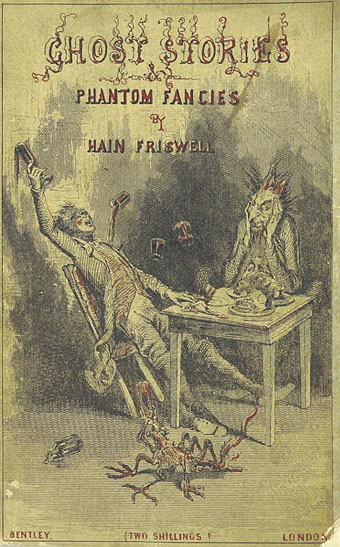
Ghost Stories and Phantom Fancies (1858) by James Hain Friswell.

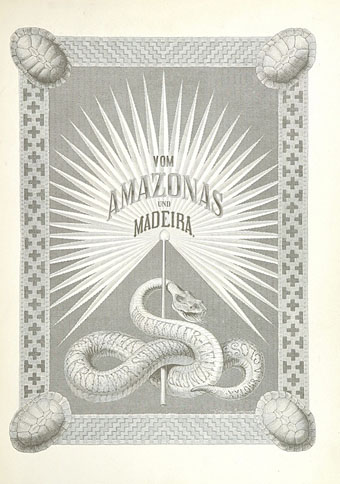
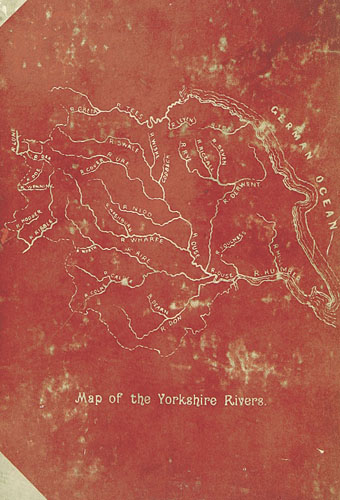
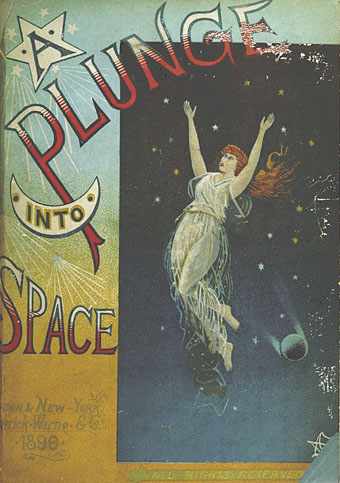
The vast repository of copyright-free images from the British Library is still being sifted into Flickr sets. These are a few examples from a set of 786 title pages which range from elegant book plates to Dime Westerns and Penny Dreadfuls. A Plunge into Space is a science-fiction novel about a journey to the planet Mars in a spaceship called The Steel Globe. Robert Cromie was also the author of A New Messiah (1901), and The Crack of Doom (1895). The latter—which has some great chapter titles: The Universe A Mistake!, The Murder Club, A Telepathic Telegram—may be read here.

title5.jpg

Vom Amazonas und Madeira (1874) by Franz Keller-Leuzinger.

title2.jpg

Yorkshire Rivers. Reproduced from The Yorkshire Weekly Post (1890) by Tom Bradley.

title3.jpg

A Plunge into Space (1890) by Robert Cromie.

title4.jpg

Idylls of the King (1898) by Alfred Tennyson. Illustrated by George and Louis Rhead.

Previously on { feuilleton }
A Trip to Mars

Steampunk: The Art of Victorian Futurism

steampunk.jpg

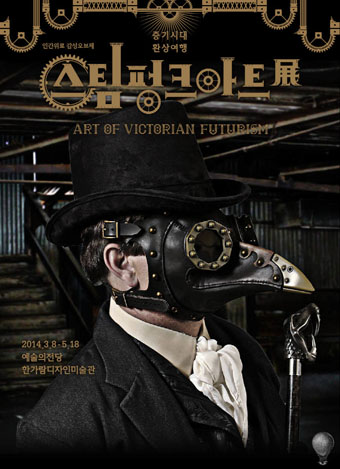
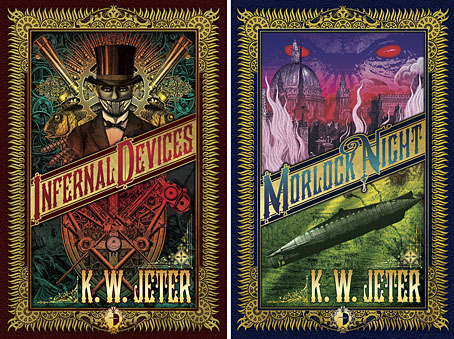
Those who were wishing a few years ago that steampunk would crawl into a hole and quietly die must be gnashing their teeth at the way the sub-genre continues to flourish. (See Pinterest for examples from the increasingly wild world of steampunk fashion.) If anyone reading this is visiting Seoul in the next couple of months—or even living there—then they’ll find some of my book covers on display at Artcenter IDA. Steampunk: The Art of Victorian Futurism is a look at the wide range of steampunk aesthetics, from graphic works to three-dimensional constructions, clothing, and so on. I’d like to credit the promotional design above but I’m not sure who’s responsible. Good type design whoever it was.

jeter.jpg

Five of my covers are on display, including the three I’ve done for KW Jeter’s novels. Mr Jeter, as mentioned before, is the man who first coined the term “steampunk” in the 1980s. This isn’t the first time my artwork has appeared in South Korea—when I was painting cards for Magic: The Gathering in the 1990s there were Korean editions printed—but it is the first time anything of mine has been exhibited there. The exhibition runs to mid-May.

Previously on { feuilleton }
Steampunk Calendar
Words and pictures
Nathanial Krill at the Time Node
Fiendish Schemes
Ghosts in Gaslight, Monsters in Steam
Steampunk Revolution
The Bookman Histories
Aether Cola
Crafting steampunk illustrations
SteamPunk Magazine
Morlocks, airships and curious cabinets
The Steampunk Bible
Steampunk Reloaded
Steampunk overloaded!
More Steampunk and the Crawling Chaos
Steampunk Redux
Steampunk framed
Steampunk Horror Shortcuts