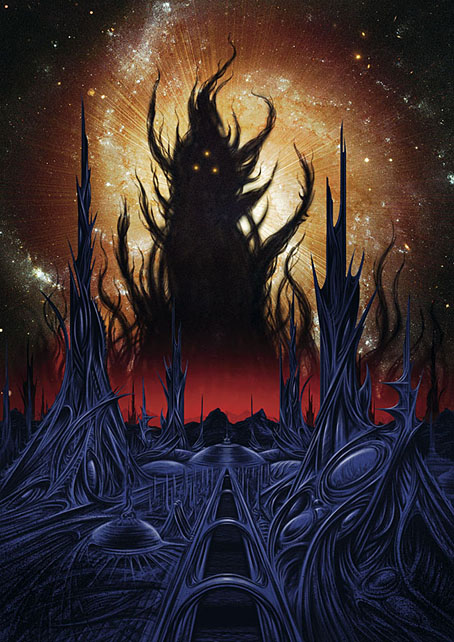
A view over Yuggoth

yuggoth2.jpg

I mentioned in the post about the Sherlock Holmes illustrations that the next book from Editorial Alma featuring my work would be another Lovecraft collection. One of the illustrations in the new volume was of the planet Yuggoth, a world known to human beings as Pluto. In Lovecraft’s mythos Yuggoth has long been an outpost of advanced alien civilisations, particularly the fungoid crustaceans of The Whisperer in Darkness and the splendidly-titled sonnet sequence Fungi from Yuggoth. I’d broached this subject a couple of times in the past, first with a panel in my Haunter of the Dark comic strip (the Shining Trapezohedron is described as being brought to Earth from Yuggoth) then with a photocopy collage of Haeckel organisms for the first Starry Wisdom collection.

Yuggoth is one of several alien outposts in Lovecraft’s fiction, allied in its remoteness from humans with the underwater city of R’lyeh and the Antarctic city in At the Mountains of Madness. All these locations suggest exotic architecture so they’ve long been some of my favourite features in Lovecraft’s work, hence this new piece which I couldn’t resist doing after completing work on the Alma book. Since I acquired a Wacom tablet four years ago I’ve become so used to using it for line drawing that working with it now feels as natural as working with pens and inks. But digital painting was something I still didn’t feel happy with. This is mainly because the brush options in Photoshop are limitless, and one thing I’ve never liked with art materials is too much choice. When I was working with physical media I used to use a minimum of pens and brushes so what I really wanted from Photoshop was a single brush that would do what I wanted without having to swap tools all the time when working. This view of Yuggoth is the result of having finally settled (by chance, as it happened) on a brush that does everything I want without getting in the way. The drawing was completely improvised so as a composition it has some flaws; it could also have been developed a lot more to bring out highlights and details. But as an experimental piece it worked out well and also didn’t take too very long to do. When I have the time I’ll be doing more with this new brush.

Elsewhere on { feuilleton }
The Lovecraft archive

Weekend links 423

howe.jpg

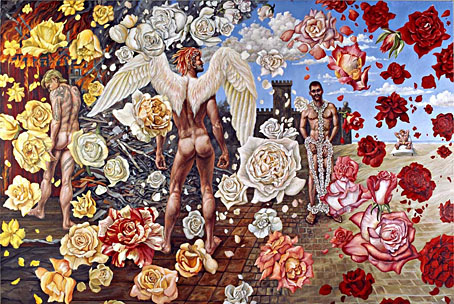
The Miracle (Genet’s Dream) (2001) by Delmas Howe.

• “Zachary Lipton, an assistant professor at the machine learning department at Carnegie Mellon University, watched with frustration as this story transformed from ‘interesting-ish research’ to ‘sensationalized crap’.” Oscar Schwartz on how the media gets AI alarmingly wrong.

• The Aesthetics of Science Fiction: what does SF look like after cyberpunk? Very Brutalist if you ask Rick Liebling, although the first example shown in his piece—the Brunel University Lecture Centre—appears briefly as future architecture in A Clockwork Orange.

• At Expanding Mind: Erik Davis talks with philosopher and religious studies professor Dustin Atlas about ancient skepticism, Madhyamaka Buddhism, the taste of honey, Montaigne, Robert Anton Wilson, and the path of doubt.

• At Muddy Colors: Part 1 of their choices for best fantasy book covers of the year so far, a list which includes my cover for Moonshine by Jasmine Gower. Thanks!

• Soundtracking with Edith Bowman, episode 84: director Todd Haynes on the music of Wonderstruck, I’m Not There, Carol and Far From Heaven.

• Mixes of the week: FACT mix 663 by Space Afrika, Secret Thirteen Mix 262 by Mieko Suzuki, and Black Minimalism, a playlist by David Toop.

• Two minutes, eight barrels: drone and GoPro footage of surfer Koa Smith riding the waves of the Namibia shoreline.

• David Lynch’s Sacred Clay: Shehryar Fazli reviews Room to Dream by David Lynch and Kristine McKenna.

Charlotte Higgins on myths, monsters and the maze: how writers fell in love with the labyrinth.

• Monstrous Geometries in the Fiction of HP Lovecraft by Moritz Ingwersen.

Listen to the mournful wails of planets and moons.

• A Peel Session by Laika

Surf Ride (1956) by Art Pepper | Surf (1976) by Tim Blake | Surfside Sex (1982) by Patrick Cowley

Weekend links 412

maroto.jpg

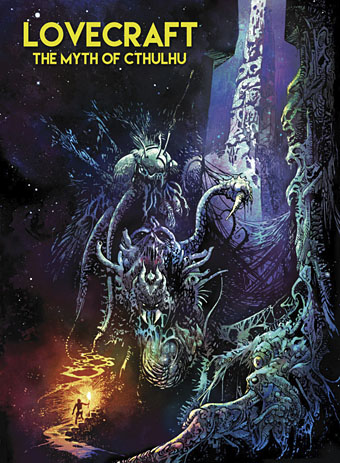
Lovecraft: The Myth of Cthulhu, an English-language edition of three comic-strip adaptations by Esteban Maroto, is now available from IDW.

The Coffin House, a short story by Robert Aickman that’s a taster for the new Aickman collection, Compulsory Games. Anwen Crawford wrote an introduction to Aickman’s world of “strange stories” for The New Yorker. Related: Victoria Nelson, editor of the new collection, chooses ten favourite horror stories.

• German music this week at The Quietus: Sean Kitching talks to Irmin Schmidt about his years with Can; and there’s an extract from Force Majeure, an autobiography by the late Edgar Froese, writing about the early days of Tangerine Dream.

• More German music at Carhartt WIP: a lengthy and revealing interview with guitarist Michael Rother about his time as one half of Neu!. There’s also a bonus Neu!-themed mix (and one of the mixes of the week) by Daniel Miller.

• From October last year, a Stereoklang interview with master synthesist Hideki Matsutake (Logic System, Yellow Magic Orchestra, et al).

• “When did you first get interested in esoteric studies?” Gary Lachman interviewed at The Astral Institute.

• At Sweet Jane: early illustrations by Wojtek Siudmak for Plexus magazine, 1969.

• 87 prints and drawings by MC Escher in zoomable high-resolution.

• Meet the Small Press: James Conway of Rixdorf Editions.

• Mix of the week: Goodbyes & Beginnings by Zach Cowie.

Derek Jarman on the trouble with shopping for clothes.

Person To Person (1981) by Logic System | Plan (1981) by Logic System | Prophet (1981) by Logic System

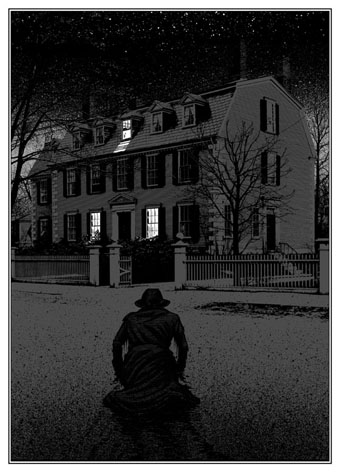
The Thing on the Doorstep

thing1.jpg

Workwise, this year has been a major one for interior illustration. So far I’ve completed about 80 illustrations for different titles, and I’m still not finished. The majority of the work has been for a Spanish publisher, Editorial Alma, based in Barcelona. Earlier this year they launched a line of reprints of classic works of fiction, each of which is illustrated. To date I’ve worked on three of the titles, the first of which, Narraciones extraordinarias by Edgar Allan Poe, will feature in a later post.

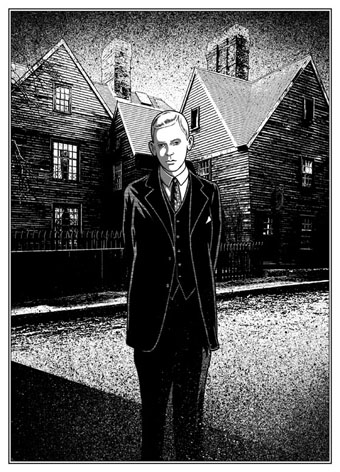
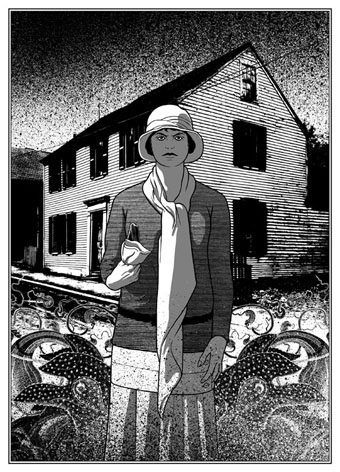
The second title, La llamada de Cthulhu by HP Lovecraft, is a small collection comprising the rather odd pairing of The Call of Cthulhu with The Thing on the Doorstep, two very different stories that you wouldn’t usually expect to see together. I provided six illustrations, three for Cthulhu which are slightly reworked pages from my comic-strip adaptation of the story, and three new ones for The Thing on the Doorstep. This is a story I’d never considered illustrating before when so much of its horror is psychological. It does, however, feature two characters who (by Lovecraft’s standards) are well-defined: the ineffectual Edward Pickman Derby and his sinister future wife, Asenath Waite. So that’s what you see here: portraits of the two main characters plus a view of the climactic scene that gives the story its title. Ideally, I would have liked to have done a fourth picture showing Derby’s surprise awakening at a nightmarish ritual but the deadlines on these books have been tight and there simply wasn’t time.

thing2.jpg

For those interested in this title, the only purchase link I have is an Amazon one. All the books are hardbacks (without dustjackets) complete with decorated endpapers—I provided a tentacle pattern for this one—and a bookmark ribbon. Deadlines aside, it’s been a very pleasant experience working for Alma. The next two books are the big ones so watch this space.

thing3.jpg

Elsewhere on { feuilleton }
The Lovecraft archive

Weekend links 387

liquidsky.jpg

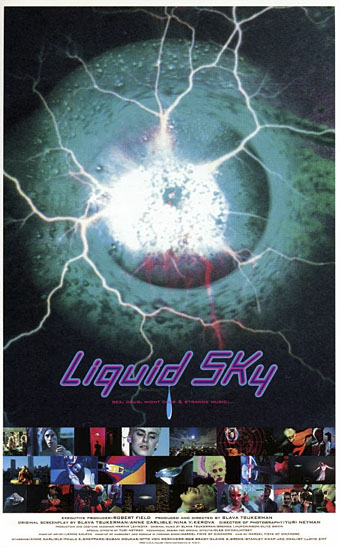
Japanese (?) poster for Liquid Sky (1982).

• The announcement this week of the death of Carl T. Ford, former editor of Dagon magazine, prompted a handful of memorial pieces. Dagon was notable for being a small British magazine devoted to Lovecraftian and other weird fiction (and the Call of Cthulhu games) at a time when the majority of such publications were American; it was also very well-produced, its later issues being typeset and filled with quality black-and-white illustration. Dagon interviewed many notable writers, including people such as Thomas Ligotti whose work at the time was still only known to a small group of enthusiasts. Mark Valentine posted a reminiscence at Wormwoodiana; Yog-Sothoth.com has an interview with Carl from 2010.

Michael “Dik Mik” Davies, manipulator of an audio generator and tape echo for Hawkwind, also died this week. Dik Mik’s primitive background electronics, augmented by Del Dettmar’s synthesizers, were an essential component of the early Hawkwind sound.

• Erik Davis talks to writer, photographer, and curator Joanna Ebenstein about Goth obsessions, memento mori, Santa Muerta, and her extraordinary new illustrated collection Death: A Graveside Companion.

• Slava Tsukerman’s cult film Liquid Sky (1982) finally gets a blu-ray release. From 2014: Punks, UFOs, and Heroin: Daniel Genis on how Liquid Sky became a cult movie.

Geeta Dayal explores the MOMA exhibition Thinking Machines: Art and Design in the Computer Age: 1959–1989.

You Should Come With Me Now is a collection of new fiction by M. John Harrison published this week.

VinylHub: “Our mission is to document every physical record shop and record event on the planet.”

Vladimir Nabokov‘s dream diary reveals experiments with “backwards timeflow”.

• Flawed Greatness: DB Jones on beauty and balance in John Ford’s The Searchers.

Irakli Kiziria on 9 synth artists who defined Eastern Europe’s post-Soviet sound.

• Edgar Allan Poe’s Hatchet Jobs: Mark Athitakis on Poe’s book reviews.

• Mix of the week: FACT mix 627 by Oneohtrix Point Never.

• At Creative Review: The design of Mute Records.

How generative music works.

Laraaji‘s favourite albums.

We Do It (1970) by Hawkwind | Adjust Me (1971) by Hawkwind | Electronic No. 1 (1973) by Hawkwind